


E-commerce SEO Audit Checklist 2026: Small Business Success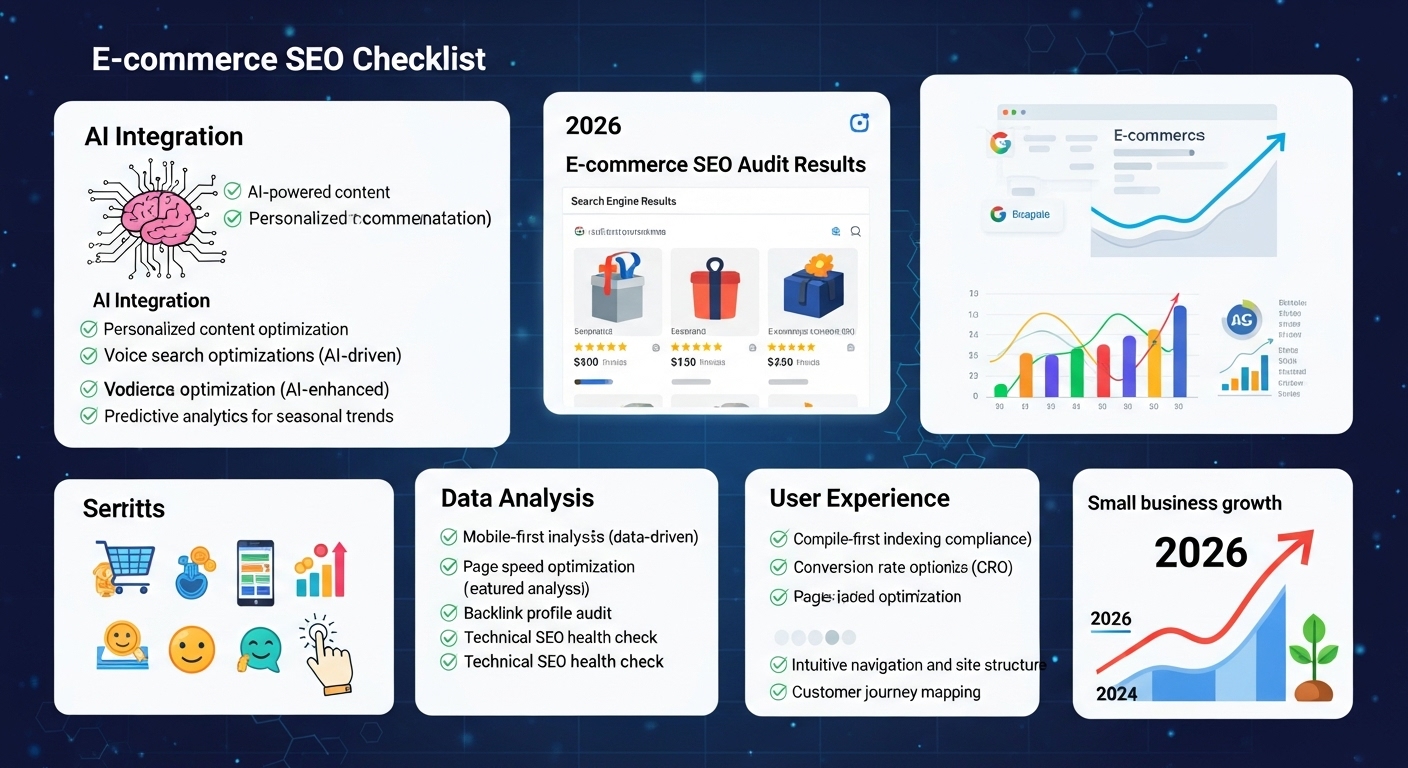
Introduction: Navigating the New Era of E-commerce Search
The landscape of Search Engine Optimization (SEO) for e-commerce is undergoing a fundamental transformation. As we advance into 2026, the legacy objective of simply “ranking #1” for a given keyword has become an insufficient and outdated goal. The digital marketplace is no longer a simple list of ten blue links. Instead, it is a dynamic, multifaceted ecosystem where visibility is achieved across a spectrum of platforms and formats, including AI-generated answers, voice search results, and visual discovery engines. For small e-commerce businesses, this evolution presents both a significant challenge and an unprecedented opportunity. SEO is no longer a siloed technical task; it has matured into a central pillar of sustainable business growth, brand authority, and customer trust.
Success in this new era of e-commerce search is predicated on three foundational pillars that will be explored throughout this audit:
- Unshakeable Authority: Building profound trust with both users and search engines through demonstrated Experience, Expertise, Authoritativeness, and Trustworthiness (E-E-A-T). In a world increasingly populated by AI-generated content, authentic, human-led expertise is the ultimate competitive advantage.
- Seamless User Experience (UX): Recognizing the convergence of user satisfaction and search engine preference. The most effective and sustainable way to please algorithms in 2026 is to first create an intuitive, fast, and helpful experience for human users.
- AI-Readiness: Structuring a website’s content and technical data not merely for human consumption but for clear, unambiguous machine interpretation. A well-prepared e-commerce store functions as a reliable data source for the AI models that now shape modern search results.
This document is designed to serve a dual purpose. It is, first, a comprehensive checklist for conducting a one-time, deep-dive audit of an e-commerce store’s current SEO health. Second, and more importantly, it is an ongoing strategic framework for continuous improvement, enabling small businesses to adapt, thrive, and win in the competitive digital marketplace of 2026 and beyond.
Section I: The Foundational Technical Health Audit
The technical integrity of an e-commerce website is the bedrock upon which all other SEO efforts are built. Without a technically sound foundation, even the most brilliant content and marketing strategies will fail to achieve their potential. This section provides a checklist for auditing and optimizing the critical technical elements of a small e-commerce store, ensuring it is fast, secure, accessible to all users, and perfectly legible to both traditional search engine crawlers and the emerging AI agents that define the 2026 search landscape.
1.1 Advanced Site Architecture & Navigation: The Blueprint for Success
A logical and intuitive site architecture is paramount. It directly impacts how easily users can find products and how efficiently search engines can crawl and understand the relative importance of pages.
-
Shallow and Logical Click Depth: The most critical product and category pages should be accessible to users within a maximum of three clicks from the homepage. A shallow site structure signals the importance of these pages to search engines and significantly improves the user experience by reducing the effort required to find key products. A site where a user must click through five or six levels to reach a product page creates friction and can lead to lower engagement and conversion rates.
-
Clean, Descriptive URL Structures: URLs are a fundamental, yet often overlooked, element of on-page SEO. For 2026, they must be human-readable, concise, and incorporate relevant keywords. For example, a URL like https://www.example.com/mens-shoes/running-shoes/blue-trainer-model-x is vastly superior to a dynamic, parameter-driven URL like https://www.example.com/cat?id=123&prod=987. The former provides clear contextual clues to both users and search engines about the page’s content. It is critical to follow Google’s recommendations, which include using a consistent case (lowercase is standard) and avoiding temporary parameters like session IDs or tracking codes in internal links, as these can create duplicate content issues.
-
Intuitive Navigation & Breadcrumbs: The site’s main navigation menu should be clear, logical, and reflect the primary product categories. A crucial component of this is breadcrumb navigation. Breadcrumbs are the trail of links, usually at the top of a page, that show users their current location within the site’s hierarchy (e.g., Home > Men’s Shoes > Running Shoes). They serve three vital functions: they improve the user experience by preventing disorientation, they strengthen the internal linking structure by linking back to higher-level category pages, and they are eligible to appear as rich snippets in search results, making a site’s listing more prominent and informative.
-
Faceted Navigation Management: Faceted navigation—the filters that allow users to refine product listings by attributes like size, color, brand, or price—is a double-edged sword. While essential for a good user experience on category pages, it can be devastating for SEO if implemented improperly. Each combination of filters can generate a unique URL, potentially creating thousands or even millions of low-value, duplicate, or near-duplicate pages. This wastes the “crawl budget” that search engines allocate to a site and severely dilutes ranking signals. A proper audit must check for a management strategy, which includes:
- Using rel=”canonical” tags to point filtered URLs back to the main category page.
- Applying the noindex meta tag to specific filter combinations that offer little unique value.
- Managing URL parameters within Google Search Console to instruct Google on how to handle them.
- Employing AJAX or JavaScript to load filtered results without changing the URL, which can be an effective but technically complex solution.
The ability to provide a rich, filterable user experience without compromising technical SEO health is a significant competitive advantage. Many small businesses either ignore the SEO problem, leading to poor performance, or disable useful filters, which harms the user experience. The business that solves this technical challenge wins on both fronts.
1.2 Performance Optimization & Core Web Vitals Mastery
In 2026, website speed is not a feature; it is a fundamental expectation. User patience has diminished to the point where the old “3-second rule” for loading is obsolete. Studies indicate that a load time delay of just one second can reduce conversions by up to 20%, and if a site takes more than two or three seconds to load, more than half of potential customers may leave before ever seeing a product. Site performance is a direct ranking factor for Google and a powerful signal of site quality and user experience.
-
Core Web Vitals (CWV) Audit: Core Web Vitals are a specific set of metrics Google uses to measure a page’s real-world user experience. A technical audit must measure the site against the following 2026 benchmarks using tools like Google PageSpeed Insights or Lighthouse:
- Largest Contentful Paint (LCP): Measures loading performance. The main content of the page should load within 2.5 seconds.
- Interaction to Next Paint (INP): Measures interactivity and responsiveness. This metric has replaced First Input Delay (FID) and should be under 100 milliseconds.
- Cumulative Layout Shift (CLS): Measures visual stability. The page layout should shift by a score of less than 0.1 to prevent users from accidentally clicking on the wrong elements.
-
Actionable Performance Checklist: Achieving these benchmarks requires a multi-pronged approach to optimization. The audit should verify the implementation of these key techniques:
- Advanced Image Compression: Images are often the largest files on an e-commerce page. They must be compressed and served in modern, efficient formats like WebP or AVIF, which offer superior quality at smaller file sizes compared to older formats like JPEG or PNG.
- Code Minification: This process involves removing all unnecessary characters (like spaces, comments, and line breaks) from CSS, JavaScript, and HTML files without affecting their functionality. This reduces file sizes and speeds up parsing by the browser.
- Lazy Loading: This technique defers the loading of non-critical resources (like images and videos that are “below the fold”) until the moment they are needed (i.e., when the user scrolls down to them). This dramatically improves initial page load time.
- Browser Caching: This instructs a returning visitor’s browser to store static assets (like logos, CSS files, and JavaScript) locally. When the user revisits the site, these assets are loaded from their local cache instead of being re-downloaded, making the experience much faster.
- Content Delivery Network (CDN): A CDN is a network of servers distributed globally. It stores copies of a site’s assets in multiple locations. When a user visits the site, the content is delivered from the server geographically closest to them, significantly reducing latency.
Introduction: Navigating the New Era of E-commerce Search
The landscape of Search Engine Optimization (SEO) for e-commerce is undergoing a fundamental transformation. As we advance into 2026, the legacy objective of simply “ranking #1” for a given keyword has become an insufficient and outdated goal. The digital marketplace is no longer a simple list of ten blue links. Instead, it is a dynamic, multifaceted ecosystem where visibility is achieved across a spectrum of platforms and formats, including AI-generated answers, voice search results, and visual discovery engines. For small e-commerce businesses, this evolution presents both a significant challenge and an unprecedented opportunity. SEO is no longer a siloed technical task; it has matured into a central pillar of sustainable business growth, brand authority, and customer trust.
Success in this new era of e-commerce search is predicated on three foundational pillars that will be explored throughout this audit:
- Unshakeable Authority: Building profound trust with both users and search engines through demonstrated Experience, Expertise, Authoritativeness, and Trustworthiness (E-E-A-T). In a world increasingly populated by AI-generated content, authentic, human-led expertise is the ultimate competitive advantage.
- Seamless User Experience (UX): Recognizing the convergence of user satisfaction and search engine preference. The most effective and sustainable way to please algorithms in 2026 is to first create an intuitive, fast, and helpful experience for human users.
- AI-Readiness: Structuring a website’s content and technical data not merely for human consumption but for clear, unambiguous machine interpretation. A well-prepared e-commerce store functions as a reliable data source for the AI models that now shape modern search results.
This document is designed to serve a dual purpose. It is, first, a comprehensive checklist for conducting a one-time, deep-dive audit of an e-commerce store’s current SEO health. Second, and more importantly, it is an ongoing strategic framework for continuous improvement, enabling small businesses to adapt, thrive, and win in the competitive digital marketplace of 2026 and beyond.
Section I: The Foundational Technical Health Audit
The technical integrity of an e-commerce website is the bedrock upon which all other SEO efforts are built. Without a technically sound foundation, even the most brilliant content and marketing strategies will fail to achieve their potential. This section provides a checklist for auditing and optimizing the critical technical elements of a small e-commerce store, ensuring it is fast, secure, accessible to all users, and perfectly legible to both traditional search engine crawlers and the emerging AI agents that define the 2026 search landscape.
1.1 Advanced Site Architecture & Navigation: The Blueprint for Success
A logical and intuitive site architecture is paramount. It directly impacts how easily users can find products and how efficiently search engines can crawl and understand the relative importance of pages.
-
Shallow and Logical Click Depth: The most critical product and category pages should be accessible to users within a maximum of three clicks from the homepage. A shallow site structure signals the importance of these pages to search engines and significantly improves the user experience by reducing the effort required to find key products. A site where a user must click through five or six levels to reach a product page creates friction and can lead to lower engagement and conversion rates.
-
Clean, Descriptive URL Structures: URLs are a fundamental, yet often overlooked, element of on-page SEO. For 2026, they must be human-readable, concise, and incorporate relevant keywords. For example, a URL like https://www.example.com/mens-shoes/running-shoes/blue-trainer-model-x is vastly superior to a dynamic, parameter-driven URL like https://www.example.com/cat?id=123&prod=987. The former provides clear contextual clues to both users and search engines about the page’s content. It is critical to follow Google’s recommendations, which include using a consistent case (lowercase is standard) and avoiding temporary parameters like session IDs or tracking codes in internal links, as these can create duplicate content issues.
-
Intuitive Navigation & Breadcrumbs: The site’s main navigation menu should be clear, logical, and reflect the primary product categories. A crucial component of this is breadcrumb navigation. Breadcrumbs are the trail of links, usually at the top of a page, that show users their current location within the site’s hierarchy (e.g., Home > Men’s Shoes > Running Shoes). They serve three vital functions: they improve the user experience by preventing disorientation, they strengthen the internal linking structure by linking back to higher-level category pages, and they are eligible to appear as rich snippets in search results, making a site’s listing more prominent and informative.
-
Faceted Navigation Management: Faceted navigation—the filters that allow users to refine product listings by attributes like size, color, brand, or price—is a double-edged sword. While essential for a good user experience on category pages, it can be devastating for SEO if implemented improperly. Each combination of filters can generate a unique URL, potentially creating thousands or even millions of low-value, duplicate, or near-duplicate pages. This wastes the “crawl budget” that search engines allocate to a site and severely dilutes ranking signals. A proper audit must check for a management strategy, which includes:
- Using rel=”canonical” tags to point filtered URLs back to the main category page.
- Applying the noindex meta tag to specific filter combinations that offer little unique value.
- Managing URL parameters within Google Search Console to instruct Google on how to handle them.
- Employing AJAX or JavaScript to load filtered results without changing the URL, which can be an effective but technically complex solution.
The ability to provide a rich, filterable user experience without compromising technical SEO health is a significant competitive advantage. Many small businesses either ignore the SEO problem, leading to poor performance, or disable useful filters, which harms the user experience. The business that solves this technical challenge wins on both fronts.
1.2 Performance Optimization & Core Web Vitals Mastery
In 2026, website speed is not a feature; it is a fundamental expectation. User patience has diminished to the point where the old “3-second rule” for loading is obsolete. Studies indicate that a load time delay of just one second can reduce conversions by up to 20%, and if a site takes more than two or three seconds to load, more than half of potential customers may leave before ever seeing a product. Site performance is a direct ranking factor for Google and a powerful signal of site quality and user experience.
-
Core Web Vitals (CWV) Audit: Core Web Vitals are a specific set of metrics Google uses to measure a page’s real-world user experience. A technical audit must measure the site against the following 2026 benchmarks using tools like Google PageSpeed Insights or Lighthouse:
- Largest Contentful Paint (LCP): Measures loading performance. The main content of the page should load within 2.5 seconds.
- Interaction to Next Paint (INP): Measures interactivity and responsiveness. This metric has replaced First Input Delay (FID) and should be under 100 milliseconds.
- Cumulative Layout Shift (CLS): Measures visual stability. The page layout should shift by a score of less than 0.1 to prevent users from accidentally clicking on the wrong elements.
-
Actionable Performance Checklist: Achieving these benchmarks requires a multi-pronged approach to optimization. The audit should verify the implementation of these key techniques:
- Advanced Image Compression: Images are often the largest files on an e-commerce page. They must be compressed and served in modern, efficient formats like WebP or AVIF, which offer superior quality at smaller file sizes compared to older formats like JPEG or PNG.
- Code Minification: This process involves removing all unnecessary characters (like spaces, comments, and line breaks) from CSS, JavaScript, and HTML files without affecting their functionality. This reduces file sizes and speeds up parsing by the browser.
- Lazy Loading: This technique defers the loading of non-critical resources (like images and videos that are “below the fold”) until the moment they are needed (i.e., when the user scrolls down to them). This dramatically improves initial page load time.
- Browser Caching: This instructs a returning visitor’s browser to store static assets (like logos, CSS files, and JavaScript) locally. When the user revisits the site, these assets are loaded from their local cache instead of being re-downloaded, making the experience much faster.
- Content Delivery Network (CDN): A CDN is a network of servers distributed globally. It stores copies of a site’s assets in multiple locations. When a user visits the site, the content is delivered from the server geographically closest to them, significantly reducing latency.
For any e-commerce store with customers outside its immediate geographic region, a CDN is essential.
1.3 Mobile-First by Design: Beyond Responsiveness
The paradigm has shifted definitively: the mobile version of an e-commerce site is no longer an adaptation of the desktop version; it is the primary storefront. The majority of online shopping now occurs on mobile devices, and Google uses the mobile version of a site for indexing and ranking (a practice known as mobile-first indexing). Therefore, the design and development process must prioritize the mobile experience from the outset.
- Mobile Usability Checklist: A “mobile-first” approach goes beyond a simple “responsive” design that just reflows content. It involves designing the experience specifically for the constraints and usage patterns of a smaller, touch-based screen. The audit must confirm:
- Thumb-Friendly Tap Targets: Buttons, links, and other interactive elements must be large enough and have sufficient spacing to be easily and accurately tapped with a thumb without zooming.
- Readable Fonts: Text should be legible on a small screen without requiring the user to pinch and zoom, which is a significant point of friction.
- Simplified Navigation: Complex, multi-level desktop menus do not translate well to mobile. The site should use mobile-friendly patterns like collapsible “hamburger” menus or streamlined navigation bars.
- Avoidance of Intrusive Interstitials: Full-screen pop-ups that block content and disrupt the user’s journey are particularly frustrating on mobile devices and can lead to penalties from Google.
1.4 Strategic Implementation of Structured Data (Schema)
Structured data, commonly implemented using Schema.org vocabulary, is a standardized format for providing explicit information about a page’s content to search engines. In the past, its primary benefit was enabling “rich snippets” (like star ratings or prices) in search results. By 2026, its role has become far more critical. With the rise of AI-driven search, structured data is the primary mechanism for a website to “speak the language” of search engines, feeding them the precise, well-organized information they need to generate rich results, knowledge panels, and AI Overviews. A site that masters structured data is essentially providing a clean, reliable API for Google’s AI, allowing it to become a citable source and gain visibility over competitors who are slower to adapt.
- E-commerce Schema Checklist: The audit must verify the correct implementation of the following essential schema types. Every implementation should be validated using Google’s Rich Results Test tool before and after deployment to ensure it is error-free.
- Product
-
- Primary Purpose: To describe a specific product, including its price, availability, and brand.
- Key Properties to Include: name, image, description, sku, brand, offers (with price, priceCurrency, availability), aggregateRating
- Best Used On: Product Pages
- SERP Benefit: Enables price, availability, and review stars to appear in search results, increasing CTR.
- Review
-
- Primary Purpose: To mark up individual or aggregate reviews for a product.
- Key Properties to Include: reviewRating (with ratingValue), author, reviewBody
- Best Used On: Product Pages
- SERP Benefit: Displays star ratings directly in the SERP, a powerful trust signal that boosts clicks.
- BreadcrumbList
-
- Primary Purpose: To indicate the page’s position in the site hierarchy.
- Key Properties to Include: itemListElement (with name, item, position)
- Best Used On: All pages except the homepage
- SERP Benefit: Displays the site’s navigation path in the search result, improving user orientation.
- FAQPage
-
- Primary Purpose: To mark up a list of questions and answers on a page.
- Key Properties to Include: mainEntity (with acceptedAnswer containing text)
- Best Used On: Product Pages, FAQ Pages
- SERP Benefit: Can generate an interactive dropdown of questions and answers in the SERP, capturing more real estate.
- Organization
-
- Primary Purpose: To provide key information about the business itself.
- Key Properties to Include: name, logo, url, sameAs (social profiles), contactPoint
- Best Used On: Homepage, About Us Page
- SERP Benefit: Helps establish the brand as a recognized entity in Google’s Knowledge Graph.
1.5 Indexation, Crawlability, and AI Crawler Management
For a site to rank, its pages must first be found (crawled) and understood (indexed) by search engines. A technical audit must ensure there are no barriers to this process.
- Robots.txt and Meta Robots: The robots.txt file, located at the root of a domain, gives crawlers instructions on which parts of the site they should or should not access. The audit must ensure that no important sections, such as product or category pages, are accidentally disallowed. Conversely, noindex meta tags should be used strategically on individual pages that offer no value in search results (e.g., internal user account pages, thank-you pages, or empty search result pages) to focus crawling efforts on valuable content.
- XML Sitemap Validation: An XML sitemap is a file that lists all the important, canonical URLs on a site. It acts as a roadmap for search engines. The audit must confirm that a clean, error-free, and up-to-date sitemap is generated and submitted to Google Search Console. It should include all canonical product, category, and content pages and be updated automatically as new products are added or removed.
- Future-Proofing with llms.txt: A forward-looking audit for 2026 should check for the emerging llms.txt standard. Similar to robots.txt, this file is designed to give site owners control over how their content is used by Large Language Models (LLMs). It can specify which AI agents are allowed to use site content for training purposes. Implementing this file is a proactive step to protect proprietary data, manage server load from increasingly aggressive AI crawlers, and maintain control over how a brand’s expertise is interpreted by AI tools.
- Crawl Budget Optimization: For e-commerce stores with thousands of products, “crawl budget”—the finite amount of resources a search engine will dedicate to crawling a site—becomes a concern. A clean site architecture, fast page load times, minimal redirect chains, and the strategic use of noindex tags all contribute to optimizing this budget, ensuring that the most important pages are crawled frequently and efficiently.
- HTTPS Security: It is a non-negotiable standard that the entire website must be served over HTTPS (secure connection). This is a baseline trust signal for users and a minor ranking factor for Google. The audit should confirm that a valid SSL certificate is in place and that all HTTP traffic is permanently redirected to HTTPS.
Section II: Optimizing the Digital Shelf: On-Page Excellence
Once the technical foundation is solid, the focus shifts to the “digital shelf”—the individual product and category pages where customers make purchasing decisions. On-page excellence in 2026 is about the meticulous alignment of every page element with user search intent. It involves creating a persuasive, trustworthy, and contextually rich experience that satisfies both the customer’s needs and the search engine’s hunger for high-quality information.
2.1 Search Intent Analysis: The New Keyword Research
The practice of SEO has evolved beyond a narrow focus on keywords. In 2026, the primary goal is to understand and satisfy the intent behind a user’s search query. A user’s intent can generally be categorized as Informational (seeking knowledge), Navigational (seeking a specific site), Commercial (researching before a purchase), or Transactional (ready to buy now).
- Long-Tail Keyword Prioritization: Small e-commerce businesses often find their greatest success not by competing for broad, high-volume keywords (e.g., “shoes”), but by targeting highly specific, long-tail keywords (e.g., “waterproof vegan leather hiking boots for women”). These longer queries have significantly lower competition, signal a much stronger purchase intent, and are more likely to lead to a conversion.
- Keyword Mapping: A critical strategic exercise is the creation of a keyword map. This process involves assigning a primary target keyword and a set of secondary, related keywords to each important page on the site. This deliberate mapping ensures that every page has a clear purpose and prevents “keyword cannibalization,” a situation where multiple pages on the same site compete for the same keyword, confusing search engines and diluting ranking potential.
- Tools for Intent Analysis: An effective audit should involve using a suite of tools to analyze the search landscape. Tools like the Google Keyword Planner, Semrush, and Ahrefs are invaluable for assessing keyword search volume, estimating competition levels, and, most importantly, analyzing the current search results page (SERP) to understand the type of content that Google deems relevant for a given query.
2.2 The Anatomy of a Perfectly Optimized Product Page
The product page is the most critical conversion point in an e-commerce journey. Historically, these pages were often treated as simple digital brochures. In the modern search environment, however, users frequently land directly on a product page from a specific search query. This means each product page must function as a comprehensive, self-contained landing page, equipped to answer all of the user’s questions and guide them to a purchase.
- Compelling Titles and H1s: The HTML page title (displayed in the browser tab and as the main headline in search results) and the on-page H1 tag are the most important on-page ranking signals. They should be closely aligned, unique for every product, and strategically crafted.
The title tag should be kept under 60 characters to avoid truncation in search results and should incorporate the primary keyword along with the brand name and a key benefit or differentiator. For large stores, creating templates for different product categories (e.g., “[Product Name] – |”) can ensure consistency and scalability.
- Unique, Persuasive Product Descriptions: This is a common failure point for many e-commerce stores. It is imperative to write original, compelling product descriptions and to never use the generic copy provided by the manufacturer. Using manufacturer descriptions creates a massive duplicate content problem, as dozens or hundreds of other retailers are using the exact same text. A high-quality description goes beyond listing features; it sells the benefits. It should be easily scannable (using bullet points and short paragraphs), answer key questions a customer might have, and naturally incorporate semantically related keywords.
- Strategic Meta Descriptions: While the meta description is not a direct ranking factor, it plays a crucial role in earning the click from the SERP. It is the short snippet of text (under 160 characters) that appears below the title in search results. It should be treated as ad copy: unique for each page, persuasive, and include a clear call-to-action (e.g., “Shop now and get free shipping.”).
- Prominent SKU Placement: For users who are cross-shopping or have specific product numbers, placing the Stock Keeping Unit (SKU) prominently near the product title provides immediate clarity and can be a valuable identifier for both users and search engines.
- Trust Signals: To overcome purchase hesitation, product pages must be saturated with trust signals. This includes displaying customer reviews and star ratings prominently, featuring trust badges (e.g., secure payment logos, money-back guarantees), and providing clear, easily accessible information about shipping and return policies.
2.3 Transforming Category Pages into Discovery Hubs
Category pages are more than just a grid of products; they are powerful SEO assets that can rank for broader, higher-volume, and often commercially-focused keywords (e.g., “women’s running shoes”). They serve as crucial hubs in the site’s architecture, helping users discover products and distributing ranking authority down to individual product pages.
- Optimized Category Content: To be effective, category pages should contain a block of unique, helpful introductory content. This text, typically placed above the product grid, provides context for the products listed, establishes the page’s relevance for its target keywords, and offers a better user experience than a simple, unadorned product listing.
- Optimized Category Titles and Descriptions: The same principles that apply to product pages are relevant here. Category pages must have unique, keyword-rich title tags and compelling meta descriptions that are tailored to capture comparison and navigational search intent. For example, a title like “Shop the Best Women’s Running Shoes | Free Shipping | ExampleBrand” is effective and informative.
- Logical Internal Linking: It is essential that category pages link to all of the products they contain. If pagination is used, it must be implemented correctly with unique URLs for each page (e.g., using ?page=2) to ensure that search engine crawlers can discover and index all products in the catalog.
2.4 Advanced Image, Video, and Multimedia Optimization
In a visually driven medium like e-commerce, media optimization is critical for both user experience and SEO.
- Descriptive Filenames and Alt Text: Every image uploaded to the site must have a descriptive, keyword-relevant filename before it is uploaded (e.g., blue-suede-running-shoe.webp, not IMG_54321.jpg). Additionally, every image must have descriptive alt text. Alt text is the text that is displayed if an image fails to load, is read aloud by screen readers for visually impaired users, and provides crucial context to search engines for image search. This is a fundamental aspect of both accessibility and SEO.
- Visual Search Readiness: The increasing use of visual search tools like Google Lens means that high-quality, original product photography is more important than ever. Using unique photos of products in various settings, rather than relying on generic stock photos from the manufacturer, sends stronger trust signals to users and provides more unique data for visual search algorithms.
- Video Content: Incorporating video on product pages is a powerful way to increase user engagement and dwell time, both of which are positive signals to search engines. Effective video content can include product demonstrations, 360-degree views, how-to guides, or customer testimonials. This multimedia approach creates a richer, more persuasive page experience.
The optimization of on-page elements has moved far beyond the simplistic tactic of repeating keywords. Modern search engines utilize sophisticated knowledge graphs to understand the relationships between ‘entities’—which are well-defined concepts like people, brands, or products. An optimized product page for a “GoPro HERO12” camera, for instance, should not just repeat that phrase. It should be semantically enriched with related entities such as “action camera,” “4K video,” “underwater housing,” “vlogging,” and even competitor entities like “DJI Osmo Action.” This is achieved by naturally weaving these terms into product descriptions, technical specifications, FAQs, and comparison content. By building this rich semantic context, a small e-commerce store can establish its topical relevance and rank for a much broader array of related queries, capturing customers at various stages of their research and buying journey.
Section III: Building Unshakeable Authority Through Content
For a small e-commerce business, competing with industry giants on advertising budgets or inventory size is often impossible. The most potent competitive advantage lies in building authority and trust. Content marketing is the primary vehicle for achieving this. In an era increasingly defined by AI, high-quality, human-centric, and genuinely helpful content is the most defensible moat a business can build. It allows a store to provide value beyond the transaction, establishing itself as an expert resource in its niche.
3.1 Developing Topical Authority with Content Hubs & Buying Guides
To signal comprehensive expertise to search engines, content should be organized strategically rather than published haphazardly.
- The Hub-and-Spoke Model: This is a powerful content architecture designed to build topical authority. The model involves creating a central, comprehensive “hub” or “pillar” page on a core topic relevant to the business (e.g., “The Ultimate Guide to Sustainable Home Coffee Brewing”). This hub page provides a broad overview of the topic. Then, multiple “spoke” articles are created, each diving deep into a specific sub-topic (e.g., “Choosing the Best Fair-Trade Coffee Beans,” “A Comparison of Pour-Over vs. French Press,” “How to Clean Your Grinder”). Crucially, each spoke article links back to the central hub page. This interconnected structure signals to Google that the site has a deep and well-organized body of knowledge on the subject, boosting the rankings for all related pages.
- Creating High-Conversion Buying Guides: Buying guides are quintessential mid-funnel content assets. They attract users who have moved past initial research and are actively considering a purchase. A buying guide that converts in 2026 must do more than just list products. It must:
- Address Customer Problems: The guide should be framed around solving a customer’s problem or answering their key questions, not just pushing products.
- Incorporate Originality and Insight: To stand out, a guide should include original data (e.g., from a customer survey), insights from in-house experts, or real-world examples and case studies. This provides “information gain”—value that cannot be found elsewhere.
- Guide the Decision-Making Process: Use helpful tools like comparison tables, interactive quizzes (“Find Your Perfect…”), or product finders to actively guide the user toward the best choice for their specific needs.
- Integrate Products Naturally: Product links should be woven into the guide in a contextually relevant and helpful manner, rather than feeling like a hard sell.
3.2 Mastering E-E-A-T: Your Defense Against AI Commoditization
E-E-A-T is the acronym for Experience, Expertise, Authoritativeness, and Trustworthiness. It is the core framework Google’s quality raters use to assess the quality of content, and its importance has skyrocketed in the age of AI. Content that demonstrates strong E-E-A-T is seen as more reliable and is more likely to be ranked highly and featured in AI-generated answers.
- Demonstrating Experience: The “E” for Experience is the most recent and arguably most critical addition to the framework. It signals a shift toward valuing content created by individuals with genuine, first-hand experience with the topic or product. For an e-commerce store, this means content should be infused with real-world usage. This can be achieved by sharing authentic stories, detailed case studies of how a product solved a problem, or using original photos and videos of the product in action, rather than just manufacturer-supplied images.
- Showcasing Expertise and Authority: Expertise is about demonstrating deep knowledge, while authority is about being recognized as a leader in the field.
-
These can be cultivated by:
- Featuring Author Bios: All blog posts and guides should have clear author bylines with short bios that highlight the author’s credentials and relevant experience.
- Publishing Thought Leadership: Create content that offers a unique perspective or deep analysis of industry trends.
- Securing External Validation: Earn guest post opportunities on reputable industry websites and seek mentions in the press.
- Building Trust: Trustworthiness is the foundation of E-E-A-T. It is built through transparency and reliability. Key elements include having a secure (HTTPS) website, providing clear contact information, being transparent about shipping and return policies, and prominently featuring genuine customer reviews.
Crucially, E-E-A-T should not be viewed as a simple content checklist but as an operational business strategy. To create content that truly demonstrates “Experience,” a business can no longer rely on generic freelance writers who have never used the products. Instead, it must operationalize content creation by involving its true experts: the founder with the origin story, the product designers who can explain the technical details, the customer support team who knows the most common user questions, and even loyal customers who can provide authentic testimonials. A small, passionate business has a natural advantage here over a large, siloed corporation, as its experts are inherently closer to both the product and the customer.
3.3 Harnessing the Power of User-Generated Content (UGC) & Reviews
User-generated content is one of the most powerful assets for an e-commerce store. It serves as powerful social proof, provides a steady stream of fresh and unique content for product pages, and is a direct and scalable way to demonstrate the “Experience” and “Trustworthiness” components of E-E-A-T.
- UGC Strategy Checklist: A proactive strategy for generating and leveraging UGC should be in place:
- Actively Solicit Reviews: Implement an automated post-purchase email sequence that politely asks customers for a review a week or two after their product has arrived.
- Encourage Social Sharing: Run campaigns that encourage customers to share photos or videos of their purchases on social media platforms like Instagram or TikTok, using a unique branded hashtag.
- Feature UGC on Product Pages: Obtain permission to feature the best customer photos and testimonials directly on the relevant product pages. Seeing a product used by a real person is far more persuasive than a sterile studio shot.
- Implement a Q&A Section: Add a question-and-answer section to product pages. Populate it initially with common questions received by customer service, and allow prospective customers to ask new questions. This creates highly relevant, long-tail content.
3.4 Advanced Concepts: Optimizing for Information Gain & Entities
To truly excel in the 2026 search landscape, content must be created with a deeper understanding of how modern search engines evaluate information.
- Information Gain: This concept refers to providing unique value or information within a piece of content that a user cannot find in the other top-ranking results for the same query. It’s about answering the initial question and then providing the answer to the next question the user didn’t even know they had. For an e-commerce store, this could manifest as a proprietary sizing calculator that is more accurate than competitors’, a unique comparison chart of material durability based on in-house testing, or a detailed video demonstrating a product assembly process that others gloss over. Content with high information gain is more likely to satisfy users and be prioritized by Google’s algorithms.
- Entity-Based SEO: As discussed previously, search engines are increasingly entity-based. From a content perspective, this means creating a rich, interconnected web of information around the core topics (entities) of the business. If a store sells high-end cameras, its content strategy should not only cover the cameras themselves but also related entities like “landscape photography,” “portrait lighting techniques,” “DSLR lenses,” and renowned photographers. By creating comprehensive content on these related topics and interlinking them logically, the store builds its authority as a central entity in the “photography” space within Google’s Knowledge Graph.
The strategic goal of content marketing is undergoing a significant shift. Traditionally, its purpose was to attract top-of-funnel traffic. However, with AI Overviews now intercepting many of these informational queries and providing direct answers, the value of simply ranking for these terms is diminishing due to “zero-click searches”. The new primary objective is to create content so authoritative, well-structured, and uniquely insightful that it becomes a citable source for the AI itself. This is the new form of top-of-SERP visibility. This re-engineering for “Generative Engine Optimization” (GEO) requires a focus on creating definitive, data-rich content that AI models will view as a trustworthy source to include in their generated summaries.
Section IV: Expanding Your Digital Footprint: Off-Page Strategy
Off-page SEO encompasses all activities performed outside of a business’s own website to enhance its authority, relevance, and trust in the eyes of search engines. It is about building a strong digital reputation and demonstrating that the brand is a valued and respected participant in the broader online ecosystem. In 2026, these off-page signals are more critical than ever, serving as third-party validation of a site’s E-E-A-T.
4.1 Building a Resilient, High-Quality Backlink Portfolio
Backlinks—links from other websites to a business’s site—remain a cornerstone of SEO. They function as votes of confidence or endorsements from one site to another. However, the nature of what constitutes a valuable backlink has evolved dramatically.
- Quality over Quantity: The guiding principle of modern link building is an unwavering focus on quality over sheer quantity. A single, contextually relevant backlink from a highly authoritative website in the same niche is exponentially more valuable than hundreds of low-quality, irrelevant links from spammy directories or forums. Low-quality link building practices can lead to penalties from Google.
- Evaluating Backlink Quality (The 2026 Litmus Test): An audit of the existing backlink profile and any future link acquisition efforts should be based on the following criteria:
- Topical Relevance: The linking website, and ideally the specific page containing the link, must be topically relevant to the e-commerce store’s niche. A link from a popular fashion blog to a clothing store is highly relevant; a link from a construction blog is not.
- E-E-A-T of the Linking Domain: The linking site itself must demonstrate strong Expertise, Authoritativeness, and Trustworthiness. A link from a well-respected industry publication or an educational institution carries immense weight.
- Editorial Placement: The most valuable links are placed “editorially,” meaning they are naturally included within the main body of an article or blog post because they add value for the reader. Links that are clearly part of a template, such as those in a site-wide footer or sidebar, carry significantly less weight.
- Natural Anchor Text: The anchor text (the clickable words of the link) should be natural and descriptive. Over-optimized, exact-match anchor text (e.g., constantly using “buy cheap running shoes”) is a red flag for search engines. A healthy backlink profile will have a diverse mix of anchor text, including branded terms (e.g., “ExampleBrand”), partial-match keywords (e.g., “these running shoes for women”), and descriptive phrases.
- Sustainable Link Building Strategies: The most effective link building strategies in 2026 are indistinguishable from modern public relations and brand marketing. They focus on creating value and building genuine relationships.
- Digital PR: This involves creating genuinely newsworthy content—such as an original data study, an interesting founder story, or a unique product launch—and pitching it to journalists, bloggers, and industry publications. The goal is to earn media coverage, with a backlink being a natural byproduct.
- Niche Influencer Outreach: Collaborating with micro-influencers who have a genuine, engaged audience in a specific niche can lead to authentic product reviews and brand mentions that often include valuable backlinks.
- Guest Posting on Authoritative Sites: This is not about mass-producing low-quality articles for any site that will accept them. It is about contributing genuinely insightful, expert-level articles to highly respected publications within the industry to showcase expertise and build authority.
- Unlinked Brand Mention Reclamation: This tactic involves using monitoring tools to find online mentions of the brand name or products that do not include a link back to the site. A polite outreach to the author or webmaster can often result in a link being added, converting a simple mention into a valuable backlink.
4.2 Dominating Local Search for Omnichannel Success
For any e-commerce store that also has a physical location, serves a specific geographic area, or participates in local events, Local SEO is a critical and highly profitable channel. “Near me” searches have become ubiquitous, and optimizing for them is essential.
- Google Business Profile (GBP) Optimization: The Google Business Profile is the cornerstone of any local SEO strategy. It is the rich information panel that appears in Google Search and Maps.
A comprehensive audit must ensure the GBP is fully optimized:
- Verification and Completeness: The profile must be claimed and fully verified, with all sections filled out accurately.
- Consistent NAP: The business’s Name, Address, and Phone number (NAP) must be perfectly consistent across the GBP, the website, and all other online directories and citations. Inconsistencies can confuse search engines and harm local rankings.
- High-Quality Photos: The profile should be populated with high-quality, original photos of the storefront, products, and team. This builds trust and increases engagement.
- Reviews: Actively solicit and promptly respond to all Google reviews. Reviews are a major local ranking factor.
- Q&A Feature: Monitor and proactively answer questions in the GBP Q&A section to provide helpful information to potential customers.
- Local Link Building: This involves building citations (mentions of the business’s NAP) on relevant local and industry-specific directories (e.g., Yelp, Yellow Pages). It also includes earning backlinks from other local businesses, community organizations, local news outlets, or event sponsorships.
4.3 Proactive Online Reputation Management & Trust Building
A brand’s online reputation is a direct and indirect SEO signal. Search engines aim to provide their users with trustworthy results, and a business with a stellar online reputation is inherently seen as more trustworthy.
- Systematic Review Management: Online reputation management is no longer a reactive process of damage control; it is a proactive system for generating E-E-A-T signals at scale. A small business should view its review generation process as a core content strategy. Every positive, detailed review strengthens the “Experience” and “Trustworthiness” signals for that product page. The strategy should include:
- Proactive Requests: Implementing an automated system to request reviews from satisfied customers after a purchase.
- Comprehensive Response Protocol: Establishing a clear process for responding to all reviews—both positive and negative—in a timely and professional manner. A thoughtful and helpful response to a negative review can often resolve the customer’s issue and demonstrate excellent customer service to other potential buyers, turning a negative into a positive.
- Monitoring Brand Mentions: It is crucial to monitor what is being said about the brand across the web. Tools like Google Alerts can be set up to provide notifications for any new mentions of the brand name, products, or key personnel. This allows the business to engage in relevant conversations, thank customers for positive mentions, and address any misinformation or criticism before it escalates.
- Leveraging Social Media Signals: While social media activity is not a direct ranking factor, an active and engaging presence on relevant platforms builds brand authority, fosters a community, and can drive both direct traffic and natural backlinks as content gets shared.
Section V: Future-Proofing Your Store for the AI-Powered SERP
The single most significant change to the search landscape is the deep integration of generative AI into the Search Engine Results Page (SERP). This final audit section provides actionable strategies for adapting to a world where Google often provides the answer directly, and where users interact with search in fundamentally new ways. The primary competitive landscape is shifting from a ‘brand vs. brand’ battle for the top link to a ‘brand vs. Google’s AI’ battle for attention and citation.
5.1 Generative Engine Optimization (GEO): Winning in AI Overviews
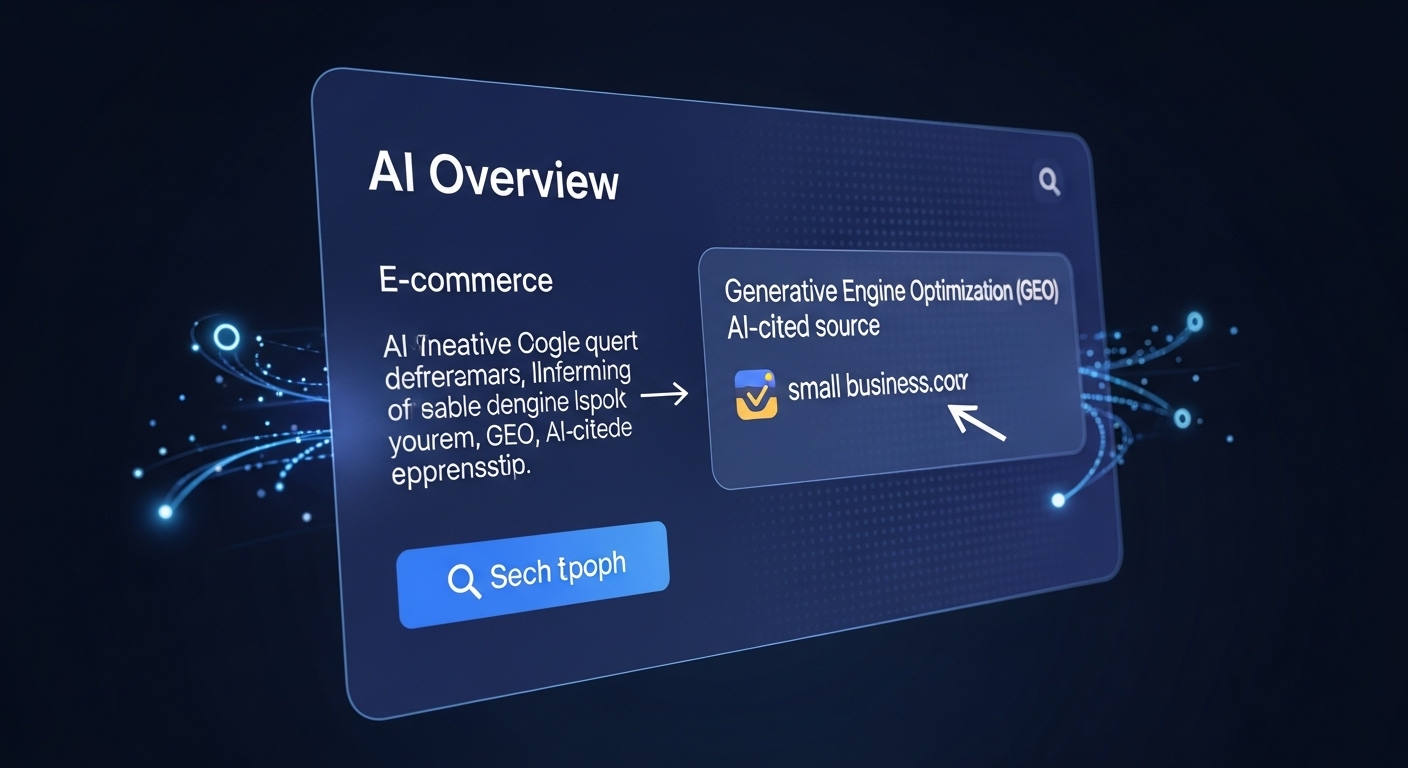
- GEO Checklist:
- Create “Citable” Content: To be included in an AI Overview, content must be easy for AI models to parse and quote. This means writing concise, factual, and answer-focused content. Use clear headings that pose questions, and provide direct answers in the first paragraph, followed by supporting detail. Employing bullet points, numbered lists, and data tables also makes content highly “citable”.
- Reinforce with E-E-A-T: AI models are being trained to prioritize sources that are authoritative and trustworthy. All the efforts made to build E-E-A-T—showcasing expertise, earning quality backlinks, and generating positive reviews—are the best defense and the most effective way to be featured in AI-generated responses.
- Embrace Structured Data: As detailed in Section I, comprehensive schema markup is critical. It provides the explicit, machine-readable context that AI needs to understand the information on a page and confidently include it in a summary.
- Focus on Mid- and Lower-Funnel Content: AI is most effective at answering broad, top-of-funnel informational queries (e.g., “what is merino wool?”). The click-through rate for these terms will likely see the largest decline. Therefore, SEO strategy must pivot to prioritize content that targets mid- and lower-funnel queries with higher commercial or transactional intent (e.g., “best merino wool base layers for skiing,” “Smartwool vs. Icebreaker comparison”). Users are more likely to click through for these complex, decision-oriented searches that require deeper investigation than an AI summary can provide. This forces SEO to become a full-funnel marketing discipline, focused on capturing high-intent demand rather than just broad awareness.
5.2 Preparing for Conversational, Voice, and Visual Search
User interaction with search is diversifying beyond the keyboard. A future-proof strategy must account for these evolving modalities.
- Voice Search Optimization: With nearly half of all searches now being voice-based, content needs to be optimized for natural, conversational language. Voice queries are typically phrased as full questions (e.g., “What are the best running shoes for someone with flat feet?”). The most effective way to capture this traffic is to structure content in a Q&A format, using headings that mirror these questions and providing direct, concise answers.
- Visual Search Optimization: The use of visual search, where a user can search using an image from their phone, is growing rapidly. As detailed in the on-page section, optimizing for this requires high-quality, original product photography with descriptive filenames and comprehensive alt text. This ensures that when a user takes a picture of a product they see in the real world, a business’s product page has a chance of appearing in the results.
- Multimodal Search: The future of search is multimodal, where users can seamlessly combine text, voice, and images within a single query. A robust SEO strategy is one that creates content and technical structures that are prepared to handle all of these input types, ensuring visibility no matter how the user chooses to search.
5.3 Integrating User Experience (UX) as a Core SEO Pillar
By 2026, the distinction between good UX and good SEO has become almost meaningless. The elements that create a positive, frictionless experience for users are the very same signals that search engines use to determine a site’s quality and relevance.
- The Convergence of UX and SEO: Core SEO components like fast site speed, mobile-first design, intuitive navigation, and a secure connection are simultaneously fundamental principles of good user experience design. A site that is frustrating for a user is also difficult for a search engine to rank highly.
- Behavioral Metrics as Signals: While Google does not confirm them as direct ranking factors, user behavior metrics provide invaluable data about user satisfaction. Metrics like a low bounce rate (users not leaving after viewing only one page), a high dwell time (users spending a long time on a page), and a low “pogo-sticking” rate (users not immediately returning to the search results to click a different link) all indicate that the user found the page to be helpful and relevant. A great UX naturally improves these metrics, sending positive quality signals to Google.
- Conversion Rate Optimization (CRO) as an SEO Tactic: The principles of CRO—such as having clear calls-to-action, a seamless and simple checkout process, and persuasive design elements—not only increase sales but also contribute to the overall quality signals of the site. A site that converts well is, by definition, a site that is successfully meeting user needs, which is the ultimate goal of a search engine.
Section VI: Measurement, Analytics, and Continuous Improvement
An SEO strategy without measurement is merely guesswork. This final section provides the framework and tools necessary to track performance, demonstrate return on investment (ROI), and establish a data-driven cycle of continuous optimization. The focus must be on quantifiable business results, not vanity metrics.
6.1 Defining E-commerce SEO KPIs That Drive Business Growth
In the AI-powered search era, traditional metrics like “impressions” and “average ranking position” are becoming less meaningful. A site can be featured prominently in an AI Overview, generating high impressions, but receive zero clicks.
This necessitates a shift in measurement toward KPIs that directly reflect business impact.
- The Core KPI Dashboard: An effective SEO report for leadership should move beyond ranking charts and focus on the following metrics:
- Business Impact KPIs: These are the bottom-line metrics that demonstrate ROI. They include Organic Revenue, Total Organic Transactions, Organic Conversion Rate, and Average Order Value (AOV) from the organic channel.
- Leading Indicators: These metrics provide an early signal of visibility and demand. They include Organic Search Traffic (especially to key category and product pages), Keyword Visibility for a curated list of high-intent transactional keywords, and Click-Through Rate (CTR) from the SERPs.
- Customer-Centric KPIs: These metrics provide insight into the long-term value of SEO. They include Customer Lifetime Value for customers acquired through the organic channel and the Customer Acquisition Cost (CAC) for the organic channel, which should be significantly lower than paid channels.
6.2 The Essential 2026 SEO Audit & Analytics Toolkit
A small e-commerce business can build a powerful analytics stack by starting with free foundational tools and strategically investing in paid platforms as the business grows.
| Function | Free Essential Tool | Recommended Paid Upgrade | Why You Need It |
|---|---|---|---|
| Core Analytics & Reporting | Google Analytics 4 (GA4) | – | The source of truth for tracking traffic, user behavior, and revenue from all channels. |
| Technical Health & Performance | Google Search Console (GSC) | Screaming Frog SEO Spider | GSC is essential for monitoring indexing and crawl errors. Screaming Frog provides deep technical audits. |
| Keyword Research | Google Keyword Planner | Semrush or Ahrefs | The free tool is good for ideas. Paid tools offer competitive data, intent analysis, and tracking. |
| Backlink Analysis | Google Search Console (limited) | Ahrefs or Semrush | Paid tools are necessary for a comprehensive view of the backlink profile and competitor analysis. |
| Local SEO Management | Google Business Profile | – | The primary platform for managing and tracking local search presence and performance. |
6.3 Establishing a Framework for Continuous Optimization
SEO is not a one-time project; it is an ongoing process of adaptation and refinement. The digital landscape, search engine algorithms, and competitor strategies are in a constant state of flux.
- The Audit-Act-Measure-Repeat Cycle: A sustainable SEO strategy should be built on a continuous improvement loop:
- Audit: On a regular basis (e.g., quarterly), use this comprehensive checklist to conduct a thorough audit of the site, identifying new issues and opportunities.
- Act: Prioritize the findings from the audit based on a simple matrix of potential impact versus required effort. Implement the highest-priority changes.
- Measure: Use the KPI dashboard and analytics tools to track the performance of the changes made, determining what worked and what did not.
- Repeat: Use the insights gained from the measurement phase to inform the next cycle of auditing and action, continuously refining the strategy.
- Staying Informed: The world of SEO changes rapidly. It is crucial to stay informed about major algorithm updates and emerging trends by subscribing to reputable industry publications like Search Engine Journal and the Moz Blog.
| KPI | Formula / Definition | Tool to Track It In | Strategic Question it Answers |
|---|---|---|---|
| Organic Revenue | Total revenue generated from users who arrived via organic search. | Google Analytics 4 | Is our SEO effort directly contributing to the bottom line? |
| Organic Conversion Rate | (Organic Transactions / Organic Sessions) * 100 | Google Analytics 4 | Are we effectively turning our search visitors into paying customers? |
| Average Order Value (Organic) | Organic Revenue / Organic Transactions | Google Analytics 4 | Are the customers we attract via search making high-value purchases? |
| Keyword Visibility (High-Intent) | The percentage of clicks a site receives for a tracked set of transactional keywords. | Semrush / Ahrefs | Are we visible to customers who are ready to buy? |
| Customer Acquisition Cost (Organic) | (Marketing & Sales Costs) / New Customers from Organic | Internal Accounting + GA4 | How cost-effective is SEO at acquiring new customers compared to other channels? |
Conclusion: Your 2026 SEO Action Plan
The e-commerce landscape of 2026 demands a more sophisticated, integrated, and strategic approach to SEO than ever before. The path to success is no longer paved with technical tricks or keyword volume, but with the creation of genuine authority, the delivery of an exceptional user experience, and a forward-looking readiness for an AI-first search world. This audit has provided a comprehensive roadmap, but the journey is continuous.
The core strategic imperatives for a small e-commerce business are clear:
- Build a Flawless Technical Foundation: Prioritize site speed, mobile-first design, and a logical architecture. Implement structured data meticulously to ensure your products and content are perfectly understood by AI.
- Pivot to Authority and E-E-A-T: Invest in high-quality, human-centric content that demonstrates real experience and expertise. Your content is your most defensible asset.
- Adapt to the AI-First SERP: Re-engineer your content strategy for “Generative Engine Optimization.” Focus on becoming a citable source for AI Overviews and prioritize mid-to-lower funnel keywords where user intent is highest.
- Measure What Matters: Shift from vanity metrics to business outcomes. Track organic revenue, conversion rates, and customer value to prove the tangible impact of your SEO investment.
By embracing these principles and utilizing the following master checklist for regular audits and continuous improvement, a small e-commerce store can not only compete but thrive, building a resilient, profitable, and authoritative digital presence for 2026 and beyond.
Master SEO Audit Checklist for 2026
I. Technical Health
- Site architecture is shallow (max 3 clicks to key pages).
- URLs are clean, descriptive, and use a consistent case.
- Breadcrumb navigation is implemented on all relevant pages.
- Faceted navigation is managed to prevent duplicate content (canonicals, noindex).
- Core Web Vitals (LCP, INP, CLS) meet Google’s benchmarks.
- Images are compressed and served in next-gen formats (WebP/AVIF).
- Site is designed mobile-first, not just mobile-friendly.
- Essential schema (Product, Review, BreadcrumbList, FAQPage) is implemented and validated.
- robots.txt is not blocking important resources.
- A clean XML sitemap is submitted to Google Search Console.
- The entire site is secured with HTTPS.
II. On-Page Optimization
- A keyword map exists to prevent cannibalization.
- Product pages have unique, compelling titles (<60 chars) and H1s.
- Product descriptions are original (not manufacturer copy) and benefit-driven.
- Meta descriptions (<160 chars) are unique and act as compelling ad copy.
- User reviews and trust signals are prominently displayed on product pages.
- Category pages contain unique, helpful introductory content.
- All images have descriptive filenames and alt text.
III. Content & Authority (E-E-A-T)
- Content is organized into topic clusters (hub-and-spoke model).
- Buying guides and blog content demonstrate genuine “Experience” (first-hand use).
- Author bylines and bios are present to showcase expertise.
- A system is in place to proactively solicit and feature User-Generated Content (UGC) and reviews.
- Content is optimized for “Information Gain” by providing unique data or insights.
IV. Off-Page Strategy
- Backlink profile is regularly audited for quality and relevance.
- A sustainable strategy for earning high-quality links (Digital PR, influencer outreach) is active.
- Google Business Profile is fully optimized and active (if applicable).
- A process is in place to monitor and respond to all customer reviews (positive and negative).
- Brand mentions are being monitored across the web.
V. Future-Readiness (AI & UX)
- Content is structured with clear headings and lists to be “citable” for AI Overviews.
- Strategy is shifting focus to mid- and lower-funnel keywords with high commercial intent.
- Content is optimized for conversational, question-based voice search queries.
- The overall user experience (navigation, checkout) is seamless and frictionless.
VI. Measurement & Analytics
- Google Analytics 4 and Google Search Console are properly configured.
- Reporting focuses on business impact KPIs (Organic Revenue, Conversion Rate) over vanity metrics.
- A regular (quarterly) cycle of “Audit-Act-Measure-Repeat” is scheduled.