


Keyword Research: The Definitive SEO Strategy Guide
Section I: The Strategic Imperative of Keyword Research
Keyword research is the foundational process of any successful digital marketing endeavor. It serves as the strategic blueprint for search engine optimization (SEO), content marketing, and paid advertising campaigns by aligning business objectives with audience behavior. This section defines the practice, establishes its critical role across the digital ecosystem, and connects the process to tangible business outcomes.
1.1 Defining Keyword Research: The Language of Your Audience
At its core, keyword research is the process of identifying and analyzing the specific words and phrases that people enter into search engines like Google and Bing. It is a systematic investigation aimed not only at discovering terms related to a business but at refining this list to find “good” keywords—those that offer a strategic balance of high traffic potential and manageable competition. The primary goal is to uncover the most effective keywords that can drive relevant, organic search traffic to a website.
This process transcends simple word-matching. It involves gathering comprehensive information about what people are searching for online, thereby decoding the language of a target audience. For a business, this understanding is paramount; keywords are the bridge that connects them to their audience, allowing them to provide the exact information, products, or services that users need. For search engines, keywords serve a vital function in contextual understanding. They are the primary signals that help platforms like Google comprehend the topic and relevance of a website’s content, which is a prerequisite for ranking in search results.
1.2 The Foundational Role in SEO, Content, and Market Intelligence
The importance of keyword research cannot be overstated; it is the cornerstone upon which effective digital strategies are built. Without a thorough understanding of the keyword landscape, any attempt to attract new visitors is unlikely to succeed in the modern competitive environment.
- For Search Engine Optimization (SEO): SEO relies fundamentally on keyword research to ensure that a website’s content aligns precisely with what users are actively seeking. It provides the data necessary to optimize a site’s visibility, forming the very foundation of a successful SEO strategy.
- For Content Strategy: The insights gleaned from keyword research directly inform content creation by answering critical strategic questions: What topics should be covered? What specific questions does the audience have? What is the user’s underlying intent when searching for a particular term? This allows businesses to craft content that not only attracts visitors but also resonates deeply, fostering stronger engagement and solving tangible problems for their audience.
- For Market Intelligence: Modern keyword research functions as a form of proactive market research. Analyzing search queries provides invaluable, real-time insights into consumer behavior, emerging market trends, and the strategic positioning of competitors. By studying which keywords drive traffic to competitor websites, a business can identify their rivals’ strengths, weaknesses, and, most importantly, discover underutilized keywords and gaps in their strategies that represent untapped market opportunities.
This process moves beyond a simple SEO task. Understanding why an audience searches for something is the core of market research. By analyzing search queries, a business is effectively conducting a massive, ongoing focus group with its target market. The data reveals the unfiltered voice of the customer, offering insights that should inform not just marketing, but also product development, sales, and customer support.
1.3 Connecting Keywords to Business Objectives
Ultimately, the purpose of keyword research is to achieve specific business goals. The process is not merely about driving traffic, but about driving the right kind of traffic—users who are genuinely interested in a company’s offerings and are more likely to become customers.
Targeting relevant keywords attracts a qualified audience, which has a direct and positive impact on key performance indicators. When users find content that perfectly matches their query, they are more likely to stay engaged, which reduces bounce rates and signals to search engines that the page is a high-quality result. This alignment between user need and content offering is what leads to improved conversion rates, whether the goal is a sale, a lead, or a subscription. A well-executed keyword strategy directly contributes to measurable business outcomes, including increased qualified traffic, improved search engine rankings, and, most critically, higher conversion rates that fuel revenue growth.
Section II: Deconstructing Keywords: A Typology for Modern SEO
Not all keywords are created equal. Understanding the different types of keywords and their strategic implications is essential for developing a nuanced and effective SEO strategy. Keywords are primarily categorized by their length and specificity into two groups: short-tail and long-tail. Each type serves a distinct purpose related to traffic volume, competition, user intent, and conversion potential.
2.1 Short-Tail (Head) Keywords: The Double-Edged Sword of Volume and Competition
Short-tail keywords, also known as “head terms,” are broad, general search queries that typically consist of one to three words. Examples include high-level terms like “dog training,” “digital marketing,” or “birthday cake”. These keywords represent the “fat head” of the search demand curve—a concept illustrating that a small number of general terms account for a massive volume of total searches.
Advantages:
- High Search Volume: The primary appeal of short-tail keywords is their extremely high search volume. Ranking well for these terms can drive substantial organic traffic to a website and significantly increase brand visibility.
- Brand Awareness: Because they capture a broad audience, short-tail keywords are highly effective for top-of-the-funnel marketing efforts aimed at building brand awareness.
Disadvantages:
- Fierce Competition: The high traffic potential of short-tail keywords attracts immense competition. The first page of search results is often dominated by major brands and high-authority websites, making it incredibly difficult for smaller or newer sites to rank. Achieving a high ranking can require years of consistent, resource-intensive SEO strategies.
- Ambiguous Intent and Low Conversion Rates: The intent behind a short-tail search is often vague. A user searching for “boots” could be looking to buy, browse styles, or learn about their history. This lack of specific intent means the traffic generated is less qualified, leading to significantly lower conversion rates compared to more specific queries.
2.2 Long-Tail Keywords: The Power of Specificity and Conversion
Long-tail keywords are longer, more specific search phrases that usually contain three or more words. They zero in on a particular aspect of a broader topic, directly addressing a user’s specific need or question. Examples include “best running shoes for flat feet,” “affordable SEO services for small businesses,” or “gluten-free make your own pizza”. These keywords constitute the “long tail” of the search demand curve—millions of unique, low-volume queries that, in aggregate, can represent substantial traffic potential.
Advantages:
- Lower Competition: Because they are more niche, long-tail keywords face significantly less competition. This makes it much easier for smaller websites or businesses to achieve high rankings and carve out a niche for themselves.
- Specific Intent and High Conversion Rates: A user searching with a long-tail keyword has a very clear idea of what they are looking for. This high level of specificity indicates that the user is often further along in the buying journey and closer to making a purchase. As a result, long-tail keywords consistently generate higher conversion rates.
- Niche Authority: Successfully targeting a range of long-tail keywords allows a website to establish itself as an authority in a specific area, even if its overall domain authority is relatively new or low.
Disadvantages:
- Low Search Volume: The primary drawback is that, individually, each long-tail keyword has a much lower search volume than a short-tail term. A successful strategy relies on targeting many different long-tail keywords to accumulate meaningful traffic.
- Discovery Effort: Identifying the precise long-tail phrases that a target audience uses requires more time, research, and effort than brainstorming broad head terms.
The choice between focusing on short-tail versus long-tail keywords is a fundamental business decision about market positioning.
A business can choose to compete for the high-risk, high-reward blockbuster terms or build a more sustainable presence by aggregating the cumulative traffic from hundreds of lower-risk, niche long-tail terms.
| Feature | Short-Tail Keywords | Long-Tail Keywords |
|---|---|---|
| Length & Specificity | 1-3 words; broad and general in scope. | 3+ words; highly specific and targeted. |
| Search Volume | Extremely high, attracting a large number of visitors. | Significantly lower on an individual basis. |
| Competition Level | Fierce and intense, often dominated by high-authority brands. | Much lower, providing ranking opportunities for smaller sites. |
| User Intent | Broad and often undefined; users are typically in the early research phase. | Highly specific; users know exactly what they want and are often ready to act. |
| Conversion Rate | Lower, due to the general nature of the traffic. | Significantly higher, as the query aligns closely with a specific need or desire. |
| Strategic Goal | Building brand awareness, capturing top-of-funnel traffic. | Driving qualified traffic, generating leads, and securing conversions. |
2.3 Developing a Balanced Strategy: The Hub-and-Spoke (Pillar and Cluster) Model
The most effective SEO strategies do not choose between short-tail and long-tail keywords; they leverage the strengths of both in a synergistic model. The “hub-and-spoke” or “pillar and cluster” model provides a powerful framework for organizing content to achieve this balance.
This model is structured around two main types of content:
-
Pillar Page (The Hub): This is a comprehensive, foundational piece of content that provides a broad overview of a central topic. It is designed to target a high-volume, short-tail keyword. For example, a pillar page might target the keyword “digital marketing.”
-
Cluster Pages (The Spokes): These are multiple, more specific articles that delve into subtopics related to the main pillar. Each cluster page targets a more specific, long-tail keyword. For the “digital marketing” pillar, cluster pages might target long-tail keywords like “how to create a social media content calendar” or “best email marketing software for small business.”
The strategic power of this model comes from its internal linking structure. Each cluster page links back to the central pillar page. This architecture signals to search engines that the website possesses deep expertise and topical authority on the entire subject. The pillar page captures the broad, high-volume traffic, while the cluster pages attract the highly qualified, conversion-ready traffic from long-tail searches. This interconnectedness boosts the ranking potential of all pages within the hub, creating a powerful, authoritative content ecosystem.
Section III: Decoding Searcher Psychology: The Core Principles of Search Intent
While keyword metrics provide valuable quantitative data, the qualitative aspect of why a user is searching is the most critical element of modern keyword research. This underlying motivation is known as search intent. Aligning content with search intent is no longer optional; it is the primary factor that determines whether a page will rank successfully in search results.
3.1 Why Search Intent is the Most Critical Ranking Factor
The fundamental goal of a search engine like Google is to provide users with the most relevant and helpful results for their queries, satisfying their needs as quickly and effortlessly as possible. To achieve this, its algorithms have become incredibly sophisticated at interpreting the probable intent behind a search query, not just the literal words used.
If a website’s content does not match the dominant search intent for a keyword, it will struggle to rank, regardless of its backlink profile or on-page optimization. For example, if a user searches for “how to fix a leaky faucet,” their intent is informational. They want a guide or a tutorial. A product page selling faucets, which is designed for a transactional intent, will not satisfy this user and therefore will not rank for this query.
This principle has profound business implications. By correctly identifying and aligning with search intent, a business can create content that gives users exactly what they are looking for at that specific moment in their journey. This leads to a better user experience, which in turn drives higher engagement, more qualified traffic, and ultimately, increased conversion rates.
3.2 The Four Pillars of Intent: Informational, Navigational, Commercial, and Transactional
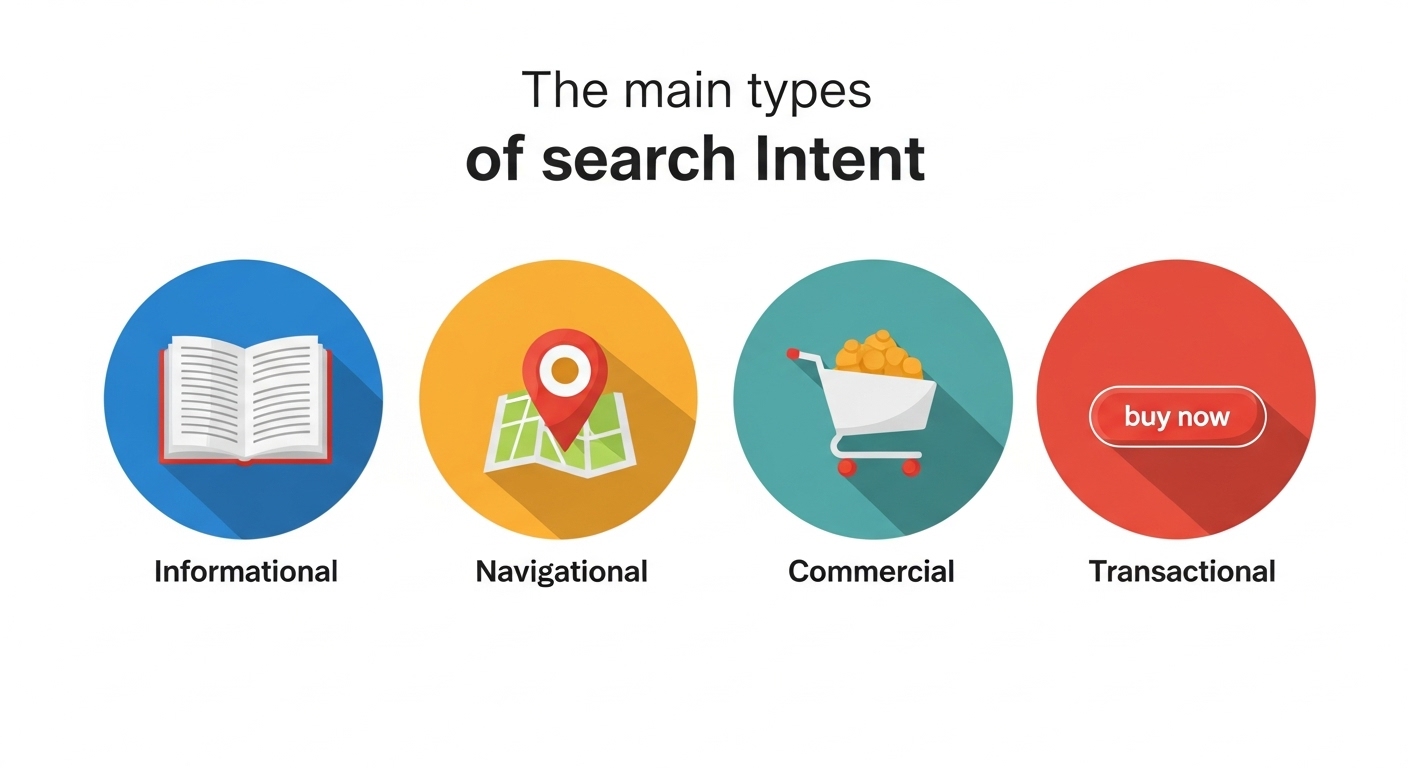
Search intent is typically categorized into four primary types, which serve as a foundational framework for analysis.
-
Informational Intent: The user is seeking knowledge or a solution to a problem. These queries often take the form of a question, using words like “who,” “what,” “where,” “when,” “why,” or “how”.
-
Navigational Intent: The user is trying to reach a specific website, brand, or physical location. They already know where they want to go and are using the search engine as a shortcut. These queries are almost always brand-related.
- Examples: “Amazon,” “Instagram login,” “AEP online bill pay”.
- Optimal Content: The brand’s official homepage, a specific login page, or a “contact us” page. The primary SEO goal here is to ensure the correct brand page ranks in the top position for these terms.
-
Commercial (or Commercial Investigation) Intent: The user is in the research phase before making a purchase. They are actively comparing products, services, or brands to determine the best option for their needs.
- Examples: “best slow cookers,” “Nikon vs. Canon,” “smartphone reviews,” “Ahrefs vs Semrush”.
- Optimal Content: Comparison articles, detailed product reviews, buyer’s guides, and listicles that help the user evaluate their options are most effective.
-
Transactional Intent: The user is ready to take a specific action, which is most often a purchase. These queries often include intent-to-buy words like “buy,” “purchase,” “coupon,” “discount,” or specific product names and models.
- Examples: “buy headphones,” “meal prep kit coupon,” “Nike air jordan blue and white”.
- Optimal Content: Product pages, service pages, pricing pages, and sign-up forms that facilitate a direct conversion are the required formats.
The traditional marketing funnel directly maps onto these types of search intent. Informational queries align with the top of the funnel (Awareness), commercial queries align with the middle (Consideration), and transactional queries align with the bottom (Decision). A comprehensive keyword strategy is therefore a full-funnel marketing strategy, creating a content ecosystem that guides a user from initial problem awareness all the way to a final purchase.
3.3 Advanced Intent Analysis: The “Expansion Pack”
While the four primary types provide a solid foundation, search intent is often more nuanced. A deeper level of analysis can uncover more specific user needs, leading to more precise content targeting.
- Local Intent: The user is looking for a product, service, or information relevant to a specific geographic area. These queries often include modifiers like “near me” or the name of a city or region. Examples include “urgent care near me” or “plumber in Chicago”.
- Visual Intent: The user’s query suggests they expect to see results in the form of images or videos. This is common for topics related to design, aesthetics, or visual instructions. Examples include “hairstyle trends for short hair” or “funny dog videos”.
- News or Current Intent: The user is seeking the most up-to-date information on a developing topic or event. Examples include “current mortgage rates” or “latest news on climate change”.
- Entertainment Intent: The user is looking for content to entertain them, such as videos, music, memes, or games.
3.4 Practical Application: How to Determine and Align with Intent
The most reliable method for identifying the search intent of a keyword is to analyze the Search Engine Results Page (SERP) directly. By typing the keyword into Google and examining the top-ranking results, one can see exactly what type of content Google has determined best satisfies that query.
This SERP analysis should focus on the format of the ranking pages. Are they blog posts? E-commerce product pages? Comparison reviews? Videos? The dominant content format on the first page is the clearest signal of user intent. This analysis must precede any content creation decisions. The process should be: 1) Identify a target keyword, 2) Analyze the SERP to determine the required intent and content format, and 3) Create content in that specific format to compete effectively.
Additionally, SERP features like the “People Also Ask” box and “Related Searches” provide valuable clues about secondary questions and related intents that should be addressed within the content.
Intent Type
Informational
User’s Goal To learn something, find an answer, or solve a problem.
Typical Keyword Modifiers “how to,” “what is,” “why,” “guide,” “tutorial”.
Optimal Content Format Blog Posts, How-To Guides, FAQs, Tutorials, Infographics.
Business Objective Attract top-of-funnel traffic, build brand awareness, establish topical authority.
Navigational
User’s Goal To find a specific website or brand page.
Typical Keyword Modifiers Brand names, specific product names, “login,” “contact”.
Optimal Content Format Homepage, Login Page, About Us Page, Product Category Page.
Business Objective Ensure brand discoverability, facilitate user access to key pages.
Commercial
User’s Goal To research and compare options before making a purchase.
Typical Keyword Modifiers “best,” “vs,” “review,” “comparison,” “affordable”.
Optimal Content Format Product Reviews, Comparison Articles, Buyer’s Guides, Listicles.
Business Objective Nurture middle-of-funnel leads, assist in decision-making, build trust.
Transactional
User’s Goal To complete an action, typically a purchase.
Typical Keyword Modifiers “buy,” “purchase,” “coupon,” “discount,” “free shipping”.
Optimal Content Format Product Pages, Service Pages, Pricing Pages, Sign-up Forms.
Business Objective Drive bottom-of-funnel conversions, generate sales and leads.
The Analyst’s Toolkit: Essential Metrics for Keyword Evaluation
After generating a list of potential keywords, the next step is to analyze them using quantitative data. A set of core metrics helps to evaluate the potential traffic, competitive landscape, and commercial value of each keyword. Understanding these metrics and how they interrelate is crucial for making data-driven decisions and prioritizing efforts effectively.
Search Volume: Gauging Potential Traffic and Topic Popularity
Search volume, often expressed as Average Monthly Volume (AMV) or Monthly Search Volume (MSV), is an estimate of the number of times a specific keyword is searched for within a given period, typically one month. This metric is a primary indicator of a topic’s popularity and the potential traffic a page could receive if it ranks well for that term.
Interpretation and Nuances:
- High-volume keywords can drive significant traffic but are almost always more competitive. Conversely, low-volume keywords often have less competition but attract more targeted traffic.
- It is critical to recognize that search volume figures provided by SEO tools are estimates. They can be influenced by factors like seasonality (e.g., searches for “ski resorts” peak in the winter).
- Solely relying on the search volume of a single keyword can be misleading. A more accurate way to estimate the total traffic potential of a topic is to examine the top-ranking pages for that keyword and see how much total organic traffic they receive from all the different keywords they rank for. A single page can rank for hundreds or even thousands of related long-tail variations.
Keyword Difficulty (KD): Assessing Competitive Landscapes
Keyword Difficulty (KD), also called SEO Difficulty, is a metric designed to estimate how hard it will be for a new page to rank on the first page of Google for a specific keyword. Most SEO tools present this score on a logarithmic scale from 0 to 100, where higher scores indicate greater competition.
Calculation and Interpretation:
- While the exact formulas are proprietary and vary by tool, KD is primarily calculated by analyzing the backlink profiles of the pages currently ranking in the top 10 search results. The quantity and, more importantly, the quality (authority) of referring domains pointing to these pages are the main factors. Other factors like the Domain Authority (DA) or Domain Rating (DR) of the ranking sites and their content quality are also considered.
- A general guide for interpretation is as follows:
- 0-29 (Easy/Very Easy): Ideal for newer websites or those with lower domain authority. Ranking is possible with high-quality content, often without extensive link building.
- 30-69 (Possible/Difficult): Represents moderate to strong competition. Ranking requires well-structured, optimized content and a solid backlink profile.
- 70-100 (Hard/Very Hard): Extremely competitive keywords targeted by high-authority domains. Ranking requires a significant, long-term investment in both content quality and high-authority link building.
It is crucial to note that KD scores are not standardized across different SEO tools. A score of 50 in Ahrefs is not directly comparable to a score of 50 in Semrush. Therefore, it is essential to use a single tool consistently for competitive benchmarking.
Cost-Per-Click (CPC): Using Advertiser Data to Infer Commercial Value
Cost-Per-Click (CPC) is a metric from the world of pay-per-click (PPC) advertising. It indicates the average amount that advertisers are willing to pay for a single click on an ad targeted to a specific keyword. While it is a paid search metric, CPC provides powerful insights for organic SEO strategy.
A high CPC is a strong signal of high commercial value. The logic is straightforward: if businesses are profitably paying a significant amount for each click, it means the traffic generated by that keyword is highly likely to convert into leads or sales. Therefore, ranking organically for a keyword with a high CPC can be extremely lucrative, as it allows a business to capture that valuable, conversion-ready traffic without paying for each click. This makes CPC an excellent proxy for gauging a keyword’s commercial intent and potential return on investment.
Synthesizing Metrics: A Framework for Holistic Keyword Assessment
No single metric tells the whole story. An effective keyword analysis requires synthesizing these data points to form a holistic view. The ideal keyword opportunity often lies at the intersection of reasonable search volume, low keyword difficulty, and high relevance to business goals.
This “sweet spot” must be viewed through the lens of a website’s own authority. A brand-new website should prioritize keywords with very low difficulty scores, even if their search volume is modest, to gain initial traction and build authority. As the site’s Domain Authority grows over time, it can begin to target more competitive, higher-volume keywords.
Ultimately, relevance and search intent should always be the primary considerations. A low-volume keyword with a perfect transactional intent match for a core product can be far more valuable to a business than a high-volume informational keyword that attracts an audience with no intention of ever making a purchase. The metrics are there to guide strategy, not to dictate it in a vacuum.
There is a predictable economic model at play in the SERPs. Keywords with high commercial or transactional intent lead to a higher potential revenue per visitor. This high value justifies a higher CPC for advertisers. The profitability of the traffic then attracts more organic competitors to create content and build links, which in turn drives up the Keyword Difficulty score. Consequently, CPC can be seen as a leading indicator of a keyword’s current and future competitiveness.
A Comprehensive Framework for Keyword Research Execution
A successful keyword research initiative is a structured process, not a random brainstorming session. This framework outlines a systematic, multi-phase workflow that guides the process from initial ideation through to the creation of an actionable content strategy.
Phase 1: Discovery and Ideation
The goal of this initial phase is to generate a large, comprehensive list of potential keywords from a wide range of sources.
Step 1.1: Brainstorm Seed Keywords and Core Topics
The process begins by establishing a high-level thematic foundation. This involves creating a list of 5 to 10 broad topic “buckets” or categories that are directly relevant to the business, its products, and its target audience. One should approach this from the customer’s perspective. For instance, a website selling environmentally friendly products might create categories like “healthy environment,” “non toxic home cleaning,” and “natural beauty”. These broad topics serve as the “seed keywords” that will be used to generate more specific ideas.
Step 1.2: Expand Ideas Using Keyword Research Tools
With seed keywords in hand, the next step is to use specialized tools to expand the list exponentially.
- Seed Keyword Expansion: Input the seed keywords into a keyword research tool such as Ahrefs’ Keywords Explorer, Semrush’s Keyword Magic Tool, or the free Google Keyword Planner. These tools will generate hundreds or even thousands of related keyword suggestions, complete with metrics like search volume and difficulty.
- Competitor-Based Research (Keyword Gap Analysis): This is one of the most powerful techniques for finding high-value keywords. By entering the domains of direct competitors into a tool’s “gap analysis” feature, it is possible to identify keywords that competitors are successfully ranking for, but that one’s own site is not. This reveals proven, relevant keyword opportunities that are already driving traffic in the market. The process involves identifying competitors, using the tool to find “missing” or “untapped” keywords, analyzing the results, and saving the most promising terms for further evaluation.
Step 1.3: Leverage SERP Features and Community Platforms
Beyond dedicated SEO tools, valuable keyword ideas can be found by observing real user behavior.
- Google’s Built-in Clues: Pay close attention to Google’s own suggestion features.
Google Autocomplete (the predictions that appear as one types in the search bar), the “People Also Ask” (PAA) boxes, and the “Related Searches” section at the bottom of the results page are all direct reflections of what real users are searching for in relation to a topic.
- Audience Listening: Explore online communities and platforms where the target audience gathers. Subreddits on Reddit, Q&A sites like Quora, and niche industry forums are goldmines for discovering the natural language, pain points, and questions of potential customers. These discussions provide an endless source of authentic, long-tail keyword ideas. Tools like AnswerThePublic are specifically designed to scrape and organize these question-based queries.
Phase 2: Analysis and Strategic Prioritization
This phase involves transforming the large, raw list of keywords into a refined, prioritized, and actionable set of targets.
Step 2.1: Apply a Multi-Factor Scoring Model
Each keyword from the discovery phase must be rigorously evaluated against a set of key criteria to determine its strategic value. The four pillars of this analysis are:
- Relevance: Is the keyword directly and closely related to the business’s core offerings and the needs of its target audience? This is the most critical filter; irrelevant keywords should be discarded immediately.
- Search Volume: Does the keyword have sufficient search demand to justify the effort required to rank for it?
- Keyword Difficulty: Is it realistically possible to rank for this keyword, given the website’s current domain authority and the competitive landscape?
- Search Intent & Commercial Value: What is the user’s likely goal? Does this intent align with a business objective (e.g., generating leads, making sales)? A high CPC can be a strong indicator of commercial value.
Step 2.2: Identify “Low-Hanging Fruit” and High-Value Strategic Targets
Based on the multi-factor analysis, keywords should be segmented into at least two priority groups:
- Low-Hanging Fruit: These are keywords that typically have moderate search volume combined with low keyword difficulty. They represent the quickest wins. Prioritizing these keywords allows a site to build traffic, momentum, and authority relatively quickly.
- High-Value Strategic Targets: These are keywords with high search volume and/or high commercial value, but which also have high difficulty scores. They are long-term goals that a site can work towards by first establishing topical authority through its content on related low-hanging fruit keywords.
Step 2.3: Filtering and Segmenting Keywords
Modern SEO tools offer robust filtering capabilities that are essential for this phase. The master list of keywords can be narrowed down using filters for KD, search volume, CPC, and the presence of specific keyword modifiers (e.g., question words like “how,” commercial terms like “best,” or local terms like “near me”). This allows for the creation of highly specific, segmented lists of keywords that can be used to plan different types of content (e.g., a list of informational blog post ideas, a list of commercial review topics).
Phase 3: Mapping and Content Integration
The final phase involves assigning the prioritized keywords to specific pages and integrating them into a formal content plan.
Step 3.1: The Art of Keyword Mapping
Keyword mapping is the deliberate process of assigning a primary target keyword to each important page on a website. For existing pages, this involves analyzing which keywords the page already ranks for and selecting the most relevant one to optimize for. For new content, it involves assigning a target keyword before the content is created. Each core page should have a unique primary keyword target to provide a clear focus for both users and search engines.
Step 3.2: Avoiding Keyword Cannibalization
A key benefit of keyword mapping is the prevention of “keyword cannibalization.” This common SEO issue occurs when multiple pages on the same website compete for the same keyword. This confuses search engines, which may struggle to determine which page is the most relevant, ultimately diluting the ranking potential of all competing pages. By assigning one unique primary keyword to each page, a clear and logical site architecture is established.
Step 3.3: Building a Data-Driven Editorial Calendar
The prioritized and mapped keywords form the foundation of a strategic content plan.
- Clustering: Group related keywords into logical topic clusters. As discussed previously, each cluster should have a central “pillar” topic (targeting a broader, short-tail keyword) and several related “sub-topics” (targeting more specific, long-tail keywords).
- Content Planning: Use these topic clusters to build out an editorial calendar. The pillar topic becomes a comprehensive, cornerstone guide, while each sub-topic becomes a more detailed blog post, article, or landing page. This approach ensures that content creation is strategic, data-driven, and designed to build topical authority over time.
This entire framework is not a linear, one-time project but a continuous, cyclical process. The performance data from published content, particularly from Google Search Console, provides a constant feedback loop that fuels the next round of keyword discovery and optimization.
Section VI: The Modern Keyword Research Arsenal: A Comparative Analysis of Essential Tools
Effective keyword research in the modern digital landscape is impossible without the right set of tools. These platforms provide the essential data on search volume, competition, and user behavior needed to make informed strategic decisions. The market offers a wide range of options, from powerful free utilities to comprehensive, enterprise-level paid suites.
6.1 Getting Started: The Best Free Tools and Their Limitations
For those on a limited budget or just beginning their SEO journey, a number of free tools provide an excellent starting point. By combining the capabilities of several free utilities, it is possible to construct a surprisingly robust “tool stack.”
| Tool | Best For | Key Feature | Common Limitation |
|---|---|---|---|
| Google Keyword Planner | PPC Research & Seed Keyword Ideas | Data comes directly from Google’s advertising platform. | Provides broad search volume ranges (e.g., 1k-10k) for non-advertisers. |
| Google Trends | Trend Analysis & Seasonality | Visualizes keyword popularity over time and by region. | Provides relative popularity data, not absolute search volume numbers. |
| AnswerThePublic / Answer Socrates | Content Ideation & Question Research | Visually maps out question-based queries and long-tail variations. | Free versions often have daily search limits and may not include search volume data. |
| Ubersuggest (Freemium) | Basic All-in-One SEO Research | User-friendly interface with keyword data, content ideas, and competitor analysis. | The free tier has a strict limit on the number of daily searches and reports. |
| Google Search Console | Optimizing Existing Content | Reveals keywords a site already gets impressions for, identifying “striking distance” opportunities. | Only provides data for a site one already owns; not used for researching new topics. |
6.2 The Professional Standard: A Deep Dive into Premium Platforms
While free tools are valuable, serious SEO professionals and businesses inevitably require the depth, accuracy, and efficiency of a premium platform. The three industry-leading suites are Ahrefs, SEMrush, and Moz Pro. Each offers a comprehensive set of tools but has distinct strengths, pricing models, and ideal user profiles.
Ahrefs
- Core Strengths: Ahrefs is widely regarded as having the best-in-class backlink index in the industry. Because its Keyword Difficulty (KD) metric is heavily influenced by this robust backlink data, it is often considered one of the most accurate and reliable measures of ranking competition. Its “Site Explorer” tool is exceptionally powerful for deep competitor analysis.
- Key Features: Keywords Explorer (provides KD, search volume, clicks, parent topic, and SERP overview), Content Gap analysis for finding competitor weaknesses, Rank Tracker for monitoring keyword performance, and a comprehensive Site Audit tool.
- Pricing and Plans: Ahrefs offers several tiers, including a new “Starter” plan ($29/month), a “Lite” plan ($129/month), a “Standard” plan ($249/month), and an “Advanced” plan ($449/month), with discounts for annual billing. A key consideration is that lower-tier plans operate on a credit system, where running reports consumes credits, and exceeding the monthly allotment incurs extra costs. This model favors users who perform deep but less frequent analysis.
SEMrush
- Core Strengths: SEMrush is a true all-in-one digital marketing suite with an exceptionally large and diverse keyword database, boasting over 26 billion keywords. Its “Keyword Magic Tool” is unparalleled for generating vast lists of keyword ideas and automatically grouping them into topic clusters, streamlining content strategy. It excels in both SEO and PPC research, making it ideal for integrated marketing teams.
- Key Features: Keyword Magic Tool, Keyword Gap analysis, Position Tracking, Organic Research for competitor analysis, and the SEO Writing Assistant, which provides real-time content optimization recommendations. It also offers unique metrics like “Personal Keyword Difficulty,” which adjusts the difficulty score based on a user’s own domain.
- Pricing and Plans: SEMrush offers three main plans: “Pro” (starting at ~$117/month annually), “Guru” (~$208/month annually), and “Business” (~$416/month annually).
The plans are differentiated by project limits, the number of keywords that can be tracked, and access to more advanced features like historical data and the content marketing toolkit, which are unlocked at the Guru level.
Moz Pro
- Core Strengths: Moz Pro is renowned for its beginner-friendly interface and extensive educational resources, making it an excellent choice for those new to SEO. It is the originator of widely used proprietary metrics like Domain Authority (DA) and Page Authority (PA). Its “Keyword Explorer” tool provides a unique “Priority” score, which is a composite metric that intelligently balances search volume, difficulty, and organic click-through rate (CTR) to highlight the best opportunities.
- Key Features: Keyword Explorer (with volume, difficulty, organic CTR, and priority scores), Link Explorer for backlink analysis, a comprehensive Site Crawl tool, and Rank Checker.
- Pricing and Plans: Moz Pro offers a more accessible entry point. Its plans include “Starter” ($49/month), “Standard” ($99/month), the popular “Medium” plan ($179/month), and “Large” ($299/month), with a 20% discount for annual payment. Moz is also notable for offering a 30-day free trial of its Medium plan, allowing users to fully test its capabilities before committing.
The pricing structures of these tools reveal their target audiences. Ahrefs’ credit system and higher price point are well-suited for specialized consultants. SEMrush’s broad, feature-gated suite is designed for growing, integrated marketing teams. Moz Pro’s accessible pricing and user-friendly design make it the logical choice for small businesses and SEO beginners.
| Feature / Metric | Ahrefs | SEMrush | Moz Pro |
|---|---|---|---|
| Starting Price (Annual) | $29/month (Starter) or $108/month (Lite) | ~$117/month (Pro) | $39/month (Starter) |
| Core Strength | Best-in-class backlink data powering a highly accurate Keyword Difficulty metric. | Massive keyword database and powerful topic clustering via the “Keyword Magic Tool”. | Beginner-friendly interface and unique “Priority” score for identifying opportunities. |
| Keyword Difficulty Metric | Based heavily on the backlink profiles of top-ranking pages (highly regarded). | Uses a proprietary blend of factors; offers a “Personal Keyword Difficulty” metric. | Proprietary score based on Page Authority and Domain Authority of ranking pages. |
| Competitor Analysis | Excellent; “Content Gap” and “Site Explorer” are industry-leading for deep analysis. | Very strong; “Keyword Gap” and “Organic Research” tools are robust and comprehensive. | Good; “Keyword Gap” tool and competitive research features are solid for core analysis. |
| Unique Features | “Parent Topic” clustering, detailed “Clicks” data, SERP history comparison. | Keyword Magic Tool, SEO Writing Assistant, Topical Authority score, extensive PPC data integration. | Keyword “Priority” score, Organic CTR estimates, MozBar browser extension. |
| Ideal User Profile | SEO specialists, content teams, and agencies requiring deep backlink and competitor data. | Integrated marketing teams, agencies, and businesses needing an all-in-one SEO and PPC solution. | Small businesses, beginners, and marketers looking for a user-friendly, all-in-one SEO platform. |
Section VII: Advanced Strategies and Future Outlook
Keyword research is not a static, one-time project but a dynamic and continuous business process. The digital landscape is in constant flux, with user behavior, competitor strategies, and search engine algorithms evolving daily. A forward-thinking approach to keyword research involves ongoing optimization and an awareness of emerging trends that will shape the future of search.
7.1 Continuous Optimization: Keyword Research as an Ongoing Process
A “set it and forget it” approach to keywords is a recipe for failure. An effective strategy requires continuous monitoring, analysis, and adjustment to maintain and improve search visibility.
- The Keyword Refresh Cycle: It is essential to regularly monitor the performance of existing content. Using tools like Google Search Console and a platform’s rank tracker, one can identify pages with declining traffic or keywords that have dropped in rank. When a decline is detected, the next step is to re-run the keyword research process for that topic. Analyzing the current SERP may reveal that the dominant search intent has shifted or that new competitors have emerged with superior content. This analysis provides the data needed to perform a “content refresh”—updating and improving the page to better align with current user expectations and the competitive landscape.
- Performance Tracking as a Feedback Loop: A rank tracking tool is a critical component of this feedback loop. By monitoring positions for a core set of high-value keywords, a business can directly measure the impact of its SEO efforts, validate its strategy, and quickly identify problems before they lead to significant traffic loss.
7.2 The Impact of AI Search and Voice Queries on Keyword Strategy
The rise of new search interfaces, particularly voice assistants and AI-powered search engines (like Google’s AI Overviews and ChatGPT), is reshaping keyword strategy.
- The Shift to Conversational Queries: Users interact with voice assistants and AI chatbots using natural, conversational language rather than abbreviated, machine-like queries. This trend further elevates the importance of long-tail, question-based keywords. Strategies should increasingly focus on identifying and directly answering the specific questions that users are asking.
- Topical Authority as the Ultimate Goal: In an AI-driven search environment, where answers are often synthesized from multiple sources, search engines will place an even greater emphasis on signals of expertise, authoritativeness, and trustworthiness (E-E-A-T). The most effective way to demonstrate this is by building deep, comprehensive content hubs around specific topics, as outlined in the pillar and cluster model. The strategic goal is no longer just to rank a page, but to become the primary, authoritative source from which an AI model pulls its information to construct an answer.
7.3 Final Thoughts: From Data to Dominance
The journey of keyword research is a transformation from raw data to market dominance. Success is built upon a foundation of core principles: a relentless focus on decoding search intent, the development of a balanced portfolio of short-tail and long-tail keywords, and the disciplined execution of a methodical research and analysis process.
While the sophisticated tools detailed in this report provide the essential data, they are not a substitute for strategic thinking. The human element—creativity, critical analysis, and genuine empathy for the user—is what ultimately turns data into a winning strategy. The objective is not to trick an algorithm but to create the genuinely best, most helpful, and most authoritative content that perfectly satisfies a user’s need for a given query. By committing to keyword research as a core, ongoing business function, organizations can build a sustainable competitive advantage, ensuring they are not just found, but are chosen.