

Affinity Photo vs. Photoshop 2026: Deep Dive Comparison
I. Executive Summary: A Paradigm Shift in the Creative Software Landscape
The long-standing rivalry between Serif’s Affinity Photo and Adobe Photoshop has entered a transformative new era. The 2024 acquisition of Serif by Canva has fundamentally reshaped the competitive landscape, escalating the conflict from a simple tool-versus-tool comparison into a clash of deeply divergent business models and creative philosophies. This report provides an exhaustive analysis of this new dynamic, examining the latest iterations of both platforms—the newly unified ‘Affinity by Canva’ application and Adobe’s AI-fortified Photoshop 2026—to provide a definitive guide for creative professionals, students, and enthusiasts navigating this critical software decision.
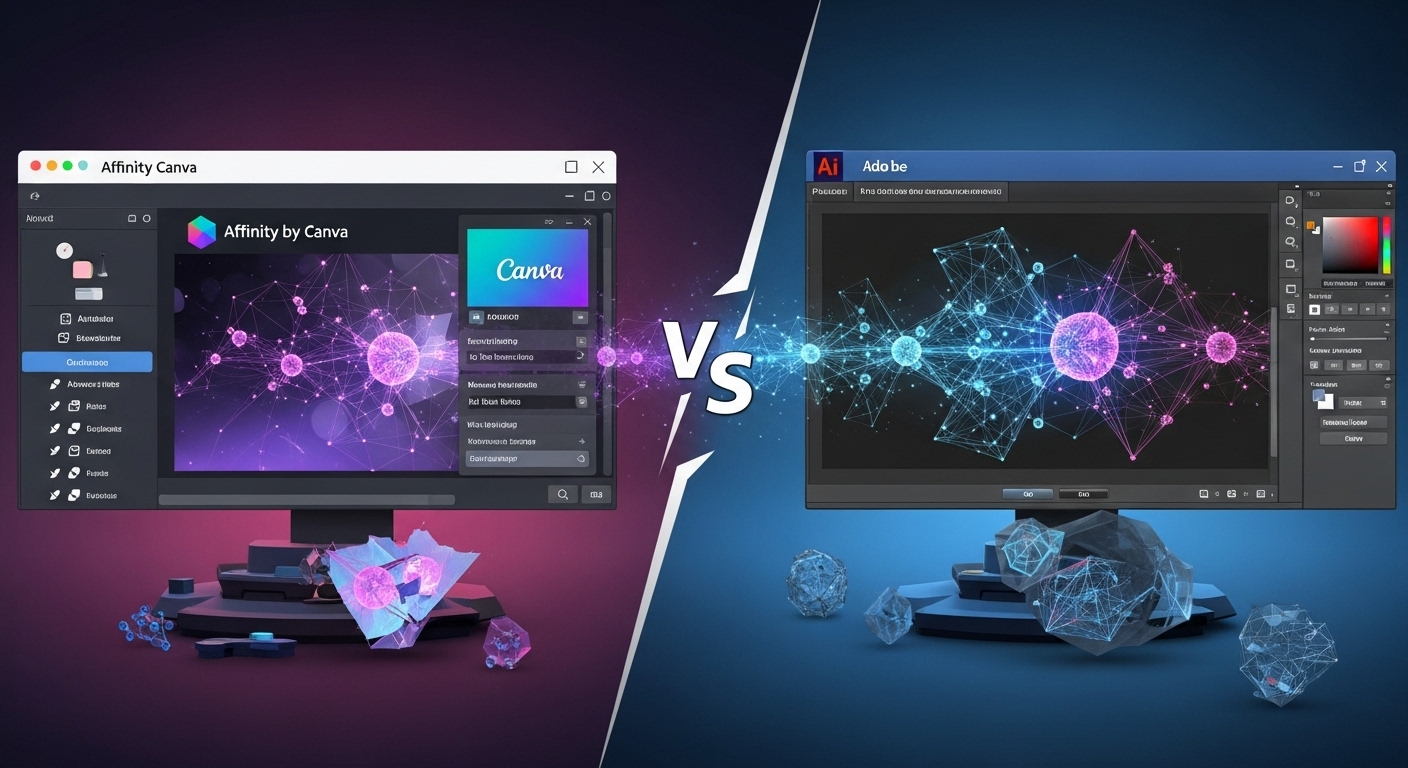
The central thesis of this analysis is that the choice between Affinity and Photoshop is no longer merely about features or price; it is about aligning with a specific ecosystem and its underlying strategy. Canva’s relaunch of the Affinity suite as a free, unified application represents a strategic gambit to democratize professional-grade tools and funnel a new segment of high-end users into its web-based platform. In response, Adobe has fortified its position as the entrenched industry standard by deepening the integration of its Creative Cloud ecosystem and aggressively pioneering the use of generative artificial intelligence, transforming Photoshop into an indispensable, multi-modal AI hub.
The key differentiators that define this new battlefield can be summarized as follows:
- Business Model: The starkest contrast lies between Adobe’s mature, subscription-based model, which offers continuous updates and deep ecosystem integration for a recurring fee, and Affinity’s disruptive new “freemium” model, which eliminates the upfront cost to drive user acquisition for the broader Canva platform, monetizing through premium AI features.
- Artificial Intelligence: Adobe has established a commanding lead in AI, integrating its own powerful Firefly Image Model alongside a suite of best-in-class partner models to offer unparalleled generative and assistive capabilities. Affinity, historically lagging in this area, has received a significant but more basic injection of AI functionality via its integration with Canva AI Studio, a move that closes the feature gap but tethers advanced capabilities to a Canva subscription.
- Ecosystem & Workflow: The Adobe Creative Cloud remains the gold standard for professional production pipelines, offering seamless, deeply integrated workflows across a comprehensive suite of desktop applications. The emerging Affinity-to-Canva bridge presents an alternative workflow, one geared less toward traditional media production and more toward the rapid design, adaptation, and distribution of assets for modern digital marketing.
This evolving dynamic presents creators with an unprecedented level of choice. However, it also introduces complex new considerations regarding long-term costs, platform lock-in, data privacy, and the very definition of what constitutes a professional creative tool in an age of AI-driven workflows and platform-centric ecosystems.
II. The Post-Acquisition Gambit: Deconstructing the New ‘Affinity by Canva’
The relaunch of the Affinity suite under Canva’s stewardship is not merely an update but a radical strategic pivot. It marks the transition of Affinity from a product-focused challenger, beloved for its one-time purchase model, into a platform-centric powerhouse designed to disrupt the market from the ground up.
From Trio to Unity: A Single, Streamlined Application
The most immediate change for users is the consolidation of the three formerly separate applications—Affinity Photo, Affinity Designer, and Affinity Publisher—into a single, unified program titled ‘Affinity by Canva’. This architectural shift is designed to create a more fluid and integrated user experience. The new application features distinct operational modes, accessible via ‘Vector,’ ‘Pixel,’ and ‘Layout’ tabs, which allow a user to seamlessly switch between the specialized toolsets of the former apps without ever leaving the project file.
This unified environment is promoted as a workflow innovation that offers ultimate flexibility. Creatives can now mix and match tools from different disciplines—for example, using precise vector shape tools on one layer and advanced pixel-based retouching on another—and save these custom toolbars and panel layouts as shareable “studios”. This feature is aimed squarely at enhancing productivity for the modern creative who often works across multiple disciplines within a single project.
The “Free Forever” Proposition: A Trojan Horse for a New Ecosystem
The most disruptive element of the relaunch is the complete overhaul of Affinity’s business model. The one-time purchase price, which was the cornerstone of Affinity’s appeal to a user base explicitly hostile to subscriptions, has been eliminated. In its place is a “free for everyone, forever” proposition.
This move is not an act of altruism but a calculated strategic play to acquire users at a massive scale. The “free” offering is, in effect, a freemium model that serves as a powerful on-ramp to the broader Canva ecosystem, with two crucial conditions that redefine the user’s relationship with the software:
- Mandatory Canva Account: To use the new Affinity application, users must sign in with a free Canva account. This simple requirement is a powerful mechanism for user acquisition, immediately enrolling millions of professional and prosumer desktop software users into Canva’s web-based platform, where they can be exposed to its other services.
- Monetization Through AI and Services: The long-term business model pivots from selling software licenses to upselling subscriptions for premium services. While the core, powerful editing tools of the original Affinity suite are now free, access to the newly integrated generative AI features, such as Generative Fill powered by Canva AI Studio, requires a paid Canva subscription.
The strategic logic behind this shift is profound. Serif’s original business model was to sell a product to users who wanted to own their software. Canva’s business model is to build a vast, engaged user base for its platform and monetize that base through recurring subscriptions for value-added services like AI, stock assets, and advanced collaboration tools. By making the high-end Affinity application free, Canva removes the primary barrier to entry and instantly captures a new and valuable user segment: the high-skill creative professional. This transforms Affinity from a product that is sold into a powerful, free gateway to the paid Canva ecosystem, fundamentally shifting the user from a position of product ownership to one of platform participation.
An Injection of AI: Playing Catch-Up Through Integration
A significant historical weakness of Affinity Photo was its lack of sophisticated, state-of-the-art generative AI tools, an area where Photoshop had taken a decisive lead. The Canva acquisition provides an immediate and potent solution to this deficit.
The new ‘Affinity by Canva’ application comes with integrated Canva AI Studio tools, providing users with features like one-click background removal and Generative Fill directly within the Affinity interface. This integration allows the Affinity platform to leapfrog what would have been years of costly in-house AI research and development. It instantly makes the application more competitive on a feature-by-feature basis with Photoshop, even though the most powerful of these new features are locked behind the Canva subscription paywall. This move effectively neutralizes one of Adobe’s key marketing advantages while simultaneously creating a compelling reason for free Affinity users to upgrade to a paid Canva plan.
III. The Incumbent’s Fortress: Adobe’s AI-Powered Creative Cloud
Faced with this disruptive new challenger, Adobe’s strategy has been to reinforce its market dominance by leveraging its two greatest assets: the unparalleled depth of its professional ecosystem and its commanding lead in artificial intelligence. Adobe is not merely competing on features; it is solidifying Photoshop’s position as the indispensable hub of the professional creative world.
The Unmatched Ecosystem & Subscription Value Proposition
Photoshop’s most formidable defense is that it does not exist in a vacuum. It is the gravitational center of the Adobe Creative Cloud, a deeply integrated suite of applications and services that has become the lingua franca of creative industries. This ecosystem provides seamless, native integration with essential tools like Adobe Lightroom for photo management, Adobe Illustrator for vector graphics, and Adobe After Effects for motion graphics. Services like Adobe Fonts and Adobe Stock are woven directly into the applications, creating a powerful, self-reinforcing “moat” that is exceptionally difficult for any single competitor to assail.
While the subscription model remains a point of contention for some users, Adobe justifies the recurring cost through this deep integration, along with a constant stream of powerful updates, cloud storage, and collaborative features. For professional teams and agencies, the productivity gains from this cohesive environment often outweigh the subscription cost.
Dominance Through AI: The Firefly Engine and Beyond
Adobe’s MAX 2025 conference was a clear demonstration of its intent to win the future of creativity through artificial intelligence.
The company unveiled a sweeping set of updates that significantly extend its technological lead.
-
Firefly Image Model 5: At the core of this innovation is the next generation of Adobe’s proprietary generative AI. Firefly Image Model 5 delivers major advancements, including the ability to generate images at a native 4MP resolution, a significant leap in photorealism, and more sophisticated handling of complex details like lighting, reflections, and textures.
-
AI Assistant: Adobe introduced a new conversational, “agentic AI” directly within Photoshop. This assistant allows users to execute complex, multi-step edits using simple, natural language prompts. Commands like “remove the background and make the lighting softer” can be understood and executed by the AI, dramatically lowering the technical barrier to achieving professional-quality results and accelerating expert workflows.
-
Multi-Model Integration: Perhaps the most sophisticated element of Adobe’s AI strategy is its move to become an AI aggregator. Rather than relying solely on its own technology, Adobe is integrating best-in-class third-party AI models directly into Photoshop. The latest version gives users a choice of generative models, including Google’s Gemini 2.5 and Black Forest Labs’ FLUX, for generative fill tasks. Crucially, the new “Generative Upscale” feature is powered by an integration with Topaz Labs’ renowned AI upscaling technology.
This open, multi-model approach is a masterful strategic play. The landscape of generative AI is evolving at a blistering pace, with different specialized models excelling at different tasks. It is nearly impossible for any single company to develop the definitive best-in-class model for every creative need. Instead of attempting to win every individual AI battle, Adobe’s strategy is to become the indispensable battlefield. By curating and integrating top-tier partner models, Adobe ensures that its users always have access to the most powerful technology available, all without leaving the familiar Photoshop workflow. This makes the Creative Cloud ecosystem incredibly “sticky” and insulates Adobe from the threat of being outmaneuvered by a single, superior AI model from a competitor. Switching from Photoshop would mean losing access not just to Firefly, but to an entire suite of the world’s best creative AI tools.
The Moat of Extensibility: A Thriving Developer Ecosystem
Beyond its first-party applications, Photoshop’s power is massively amplified by a vast and mature ecosystem of third-party plugins.
Adobe actively cultivates this ecosystem through its Unified Extensibility Platform (UXP), a modern framework that allows developers to build sophisticated plugins with custom user interfaces using standard web technologies (HTML, CSS, JavaScript) as well as high-performance C++.
This has resulted in a thriving marketplace with thousands of plugins that cater to every conceivable specialized workflow, from high-end portrait retouching and astrophotography stacking to complex prepress automation.
For many professionals, these third-party plugins are not optional extras but essential, non-negotiable components of their daily workflow. This deep extensibility is a critical factor that locks professionals into the Adobe ecosystem.
In stark contrast, Affinity Photo’s plugin support is far more limited. It is largely restricted to compatibility with an older generation of Photoshop-compatible 64-bit C++ plugins and lacks a modern scripting or panel-based API equivalent to UXP. This severely curtails its potential for the kind of advanced automation and workflow customization that is commonplace in high-volume professional environments.
Core Capabilities: A Head-to-Head Technical Comparison
Beyond the strategic positioning and ecosystem dynamics, the choice between these two platforms hinges on their core capabilities and how they facilitate the day-to-day tasks of photographers, designers, and digital artists.
User Interface (UI) and User Experience (UX) Philosophy
The user interfaces of Affinity and Photoshop reflect two fundamentally different design philosophies. Affinity is widely praised for its cleaner, more streamlined, and less overwhelming interface, which presents a gentler learning curve for beginners.
Its defining UX feature is the “Persona-based” workflow. The interface is divided into dedicated workspaces—such as the Photo Persona for general editing, the Develop Persona for RAW processing, and the Liquify Persona for distortion effects—each presenting only the tools relevant to that specific task.
Photoshop, conversely, features an iconic but notoriously dense interface. Its sheer volume of tools, panels, and menus can be intimidating for newcomers and contributes to a steep learning curve.
While it offers unparalleled customization of workspaces, it requires the user to actively curate their own environment without the guided, task-oriented structure that Affinity’s Personas provide.
This distinction highlights a core philosophical difference: a guided workflow versus an open sandbox. Affinity’s Personas act as a structured guide, leading the user through a logical progression of tasks.
This can be exceptionally effective for maintaining focus and for learning the software. Photoshop provides a vast, unified sandbox where all tools are potentially available at all times, offering maximum flexibility and power at the cost of increased complexity. The “superior” approach is entirely subjective, depending heavily on the user’s experience level, discipline, and preferred working style.
Non-Destructive Workflows: Live Filters vs. Smart Objects
Both applications provide robust and essential non-destructive editing capabilities, allowing for changes to be made without permanently altering the original pixel data.
-
Affinity’s Approach: The non-destructive workflow in Affinity is built around “Live Filters” and “Live Adjustments.” These function as distinct, editable layers that can be applied to images, reordered in the layer stack, masked, and have their parameters modified at any point in the future. Affinity also supports the placement of other .afphoto files as linked or embedded documents, which function in a manner very similar to Photoshop’s Smart Objects.
-
Photoshop’s Approach: The cornerstone of non-destructive editing in Photoshop is the “Smart Object.” This is a container that encapsulates image data (raster, vector, or RAW) and protects it from direct, destructive edits. Filters applied to a Smart Object become “Smart Filters,” which remain fully editable. Transformations like scaling and warping are also non-destructive, preserving the original image quality.
While the end results are often functionally equivalent, Photoshop’s Smart Object concept is a more mature and universally understood paradigm, especially in complex workflows that involve round-tripping vector assets from Illustrator or RAW files from Lightroom.
RAW Development Deep Dive: Develop Persona vs. Adobe Camera Raw
The handling of RAW camera files is a critical differentiator and represents a significant bottleneck in Affinity’s professional workflow.
Consistent feedback from the advanced amateur and professional photography communities is highly critical of the capabilities of Affinity’s Develop Persona when compared to dedicated RAW processors like Adobe Camera Raw (ACR) or Lightroom.
The specific, recurring criticisms of Affinity’s Develop Persona include:
-
A “Forced Destructive” Workflow: When a user makes adjustments to a RAW file in the Develop Persona and then clicks “Develop” to move into the main Photo Persona, those initial RAW adjustments are “baked in” to the resulting pixel layer. Unlike ACR or Lightroom, which save RAW adjustments as a set of editable instructions in a sidecar file or catalog, Affinity’s process is one-way. If a user later decides to alter the initial white balance or exposure, they must discard their subsequent edits and start the entire RAW development process over from scratch.
-
Missing Advanced Tools: The Develop Persona lacks tools that are considered essential in a professional RAW workflow, most notably a dedicated HSL (Hue, Saturation, Luminance) panel for fine-grained color control.
-
Inferior Processing Algorithms: The algorithms for recovering detail in blown-out highlights and deep shadows are widely considered to be significantly less effective than those in Adobe Camera Raw, Capture One, or DxO PhotoLab.
These limitations are significant. However, their practical impact depends entirely on the user’s workflow.
Many professional photographers already use a dedicated application like Lightroom or Capture One for RAW management and initial processing.
In this common workflow, they export a high-quality TIFF or PSD file and open that in a pixel editor for detailed retouching.
For these users, the weaknesses of Affinity’s Develop Persona are largely irrelevant, as they would bypass it entirely.
This clarifies Affinity Photo’s strategic positioning: it is a direct Photoshop replacement (a pixel editor), not a comprehensive Lightroom + Photoshop replacement. For photographers seeking a single, all-in-one solution for their entire workflow, this is a major deficiency.
For those who already operate within a multi-application workflow, it is a much smaller concern.
Selection and Retouching Tools
Both platforms offer a comprehensive suite of foundational selection and retouching tools, including highly customizable brushes, cloning and healing tools, and patch tools. Affinity Photo is often praised for including a dedicated Frequency Separation tool as a built-in feature, a technique popular for high-end skin retouching that requires a more manual setup in Photoshop.
However, Photoshop’s “Content-Aware Fill” and object removal tools, now supercharged by the Firefly AI engine, are the undisputed industry benchmark for their power and effectiveness. Affinity has made strides to catch up, recently introducing machine-learning-based “Select Subject” and “Object Selection” tools. While functional, these are generally considered to be a generation behind Adobe’s more mature and refined AI-powered selection technologies.
V. Performance, Stability, and System Requirements
Real-world performance, resource management, and stability are critical factors that directly impact professional productivity and user satisfaction.
Resource Management and Speed
Affinity has cultivated a strong reputation for being a faster, lighter, and more resource-efficient application compared to Photoshop. Users frequently report that Affinity offers smoother panning and zooming, especially at high refresh rates, faster application startup times, and better overall performance on older or mid-range hardware. This is partly due to its modern architecture, which was built from the ground up to leverage contemporary hardware acceleration technologies like Apple’s Metal 2 API and Grand Central Dispatch for multi-core processing.
In contrast, Photoshop, with its decades of legacy code and increasingly demanding AI features, can feel “heavy” and requires a more powerful configuration of CPU, GPU, and RAM to operate smoothly without lag.
Cross-Platform Parity: The iPad Advantage
A key strategic advantage for Affinity lies in its mobile offering. The iPad version of Affinity Photo offers nearly complete feature parity with its desktop counterpart, making it a genuinely powerful and viable tool for professional work on the go. Photoshop for iPad, while continuously improving, is still widely regarded as a more limited “helper app” rather than a full-fledged replacement for the desktop version, lacking many advanced features and tools. For creatives whose workflow heavily involves a tablet, Affinity provides a demonstrably superior and more complete experience.
Professional Reliability: The Stability Question
While Affinity is often lauded for its raw performance, a recurring and significant concern within professional user communities is its stability. Forum discussions and user reports frequently cite issues with frequent crashes, persistent bugs, and a slow pace of releasing critical fixes. This can lead to lost work and make the application feel unreliable for high-stakes, deadline-driven professional projects.
This presents a paradox where performance may come at the cost of reliability. Affinity’s lean, highly optimized engine may be less resilient under the strain of complex, multi-hour editing sessions with hundreds of layers compared to Photoshop’s more mature, albeit heavier and more resource-intensive, codebase. For a working professional, predictable stability and robustness often take precedence over raw operational speed.
Table: System Requirements Comparison
The following table outlines the minimum and recommended system requirements for running ‘Affinity by Canva’ and Adobe Photoshop 2026 effectively on both Windows and macOS platforms. This provides a practical, at-a-glance guide for users assessing their current hardware capabilities or planning future investments.
| Component | Affinity Photo 2 (Minimum) | Affinity Photo 2 (Recommended) | Adobe Photoshop 2026 (Minimum) | Adobe Photoshop 2026 (Recommended) |
|---|---|---|---|---|
| Processor (CPU) | Intel Core i3 or equivalent; ARM64 support | Intel Core i5/i7/i9 or AMD equivalent with multiple cores | 2 GHz+ Intel/AMD processor with 64-bit support, SSE 4.2 | 2 GHz+ Multicore Intel/AMD or Apple Silicon processor |
| Operating System | Windows 10 or later; macOS 10.15 (Catalina) or later | Windows 11; macOS 13 (Ventura) or later | Windows 10 (21H2) or later; macOS 11.0 (Big Sur) or later | Windows 11; macOS 13 (Ventura) or later |
| Memory (RAM) | 4 GB | 8 GB to 16 GB+ | 8 GB | 16 GB for standard use, 32 GB+ for 4K media/large files |
| Graphics (GPU) | DirectX 10 compatible card | DirectX 12 compatible card with 4 GB+ VRAM | GPU with DirectX 12 support and 1.5 GB VRAM; Metal support on Mac | GPU with DirectX 12/Metal support and 4 GB+ VRAM |
| Storage Space | 1 GB (Win) / 2.8 GB (Mac) for install | 30 GB+ free space on an SSD | 20 GB of available hard-disk space | 100 GB+ available space on a fast internal SSD |
| Display Resolution | 1280×768 | 1920×1080 or greater | 1280×800 at 100% UI scaling | 1920×1080 or greater at 100% UI scaling |
VI. Workflow Integration and File Compatibility
An application’s ability to integrate into a broader production pipeline and handle industry-standard file formats is a crucial determinant of its viability in professional, collaborative environments.
Handling the Standard: PSD and PSB File Compatibility
Affinity Photo offers surprisingly robust support for Adobe’s proprietary Photoshop Document (PSD) format, a critical feature for interoperability. It can successfully open PSD files while preserving many core components, including layers, layer styles, masks, and even editable Photoshop Smart Objects (a feature that must be enabled in preferences). The application can also import large-format PSB files, which are used for images exceeding Photoshop’s standard size limits. Furthermore, Affinity provides a comprehensive export function to save work back into the PSD format.
However, this compatibility is not flawless. Because PSD is a closed, proprietary format, Affinity’s support is the result of reverse-engineering and is therefore incomplete. Complex or newer Photoshop features, specific layer effects, vector paths, or text layers may be rasterized, misinterpreted, or lost entirely upon import or export. This creates a potential point of failure in any collaborative workflow that involves round-tripping files between Affinity and Photoshop users. While the compatibility is good enough for many projects, it carries a degree of risk that professionals must be aware of and actively manage.
The Ecosystem Advantage: Desktop Production vs. Web-Based Marketing
The integration strategies of Adobe and the new Affinity/Canva entity highlight their fundamentally different target workflows.
- Adobe’s Production Pipeline: The Creative Cloud ecosystem is engineered for a seamless, high-fidelity professional production workflow. A logo created in Illustrator can be placed as a linked, editable Smart Object into a Photoshop composite, which can then be imported into After Effects for animation. Any changes made to the original Illustrator file can automatically propagate through the entire project. This deeply integrated, non-destructive pipeline is the established standard for creative agencies, publishing houses, and production studios.
- Affinity/Canva’s Marketing Pipeline: The new integration between Affinity and Canva is built around a different, more modern workflow. The intended use case is for a creative professional to build a high-quality source asset in the powerful desktop Affinity application and then seamlessly send that asset to the web-based Canva platform. From there, it can be easily resized, adapted into templates, used in marketing materials, and published directly to social media channels by team members who may not be design professionals.
These two models solve different problems for different, albeit overlapping, user bases. Adobe’s ecosystem is optimized for the creation of master creative assets for traditional and digital media production. The new Affinity/Canva ecosystem is optimized for the distribution and adaptation of those assets for the fast-paced world of digital marketing and business communication.
VII. Final Verdict and User Recommendations
The choice between ‘Affinity by Canva’ and Adobe Photoshop in 2026 is more complex and more consequential than ever before. It is a decision that extends beyond a simple comparison of tools to an alignment with a particular ecosystem, business model, and creative philosophy. The final recommendation depends entirely on the specific context, priorities, and professional requirements of the user.
For the Student and Hobbyist
- Affinity by Canva: For this group, Affinity presents an unparalleled and almost unbeatable value proposition. The ability to access a full suite of professional-grade photo editing, vector design, and page layout tools for free is a revolutionary development for those learning the craft or pursuing personal projects. The cleaner, more intuitive interface is also less intimidating than Photoshop’s, potentially accelerating the learning process.
- Adobe Photoshop: Despite the cost, Photoshop remains the non-negotiable industry standard. Learning Photoshop is a direct investment in career-relevant skills that are expected in the professional world. Generous student and teacher discounts make the Creative Cloud significantly more accessible, and the sheer volume of high-quality tutorials, courses, and community support is unmatched, providing an invaluable learning resource.
For the Freelancer and Small Studio
The financial argument is profoundly compelling.
Eliminating a significant monthly subscription fee can drastically lower business overhead, freeing up capital for other investments. The software is more than powerful enough for the vast majority of professional tasks, and its excellent performance on more modest hardware can extend the life of existing equipment, representing another significant cost saving.
- Adobe Photoshop: The subscription cost must be weighed as a business expense against features that can directly increase profitability. The vast third-party plugin ecosystem can provide specialized tools that save hours of manual work. The advanced AI features, such as the AI Assistant and superior object removal, can dramatically accelerate workflows, allowing for more projects to be completed in less time. Finally, guaranteed file compatibility with clients and collaborators operating within the Adobe ecosystem eliminates friction and potential project delays. The decision is a complex cost-benefit analysis: Affinity is cheaper upfront, but Photoshop may offer greater long-term efficiency, extensibility, and client compatibility.
For the Large Agency and Enterprise
- Adobe Photoshop: For large-scale, collaborative, high-volume production environments, Adobe Photoshop and the Creative Cloud ecosystem remain the non-negotiable industry standard. Its deep integration across applications, advanced automation capabilities through scripting and actions, unmatched third-party plugin support, and role as the universal language of raster graphics are indispensable. In an enterprise context, predictable stability, robust support, and seamless collaboration are paramount, and these are areas where Photoshop has a decades-long, established track record.
- Affinity by Canva: While it is unlikely to replace Photoshop at the core of a high-volume production pipeline, the new Affinity/Canva ecosystem may find a strategic role. It could serve as a powerful tool for in-house design teams that interface directly with marketing departments already using Canva, streamlining the process of creating professional assets and deploying them into marketing campaigns. However, its limitations in advanced automation, extensibility, and the inherent risks of file format fidelity in a mixed-software environment make it unsuitable as a primary replacement in this segment.
Table: Feature & Philosophy Scorecard
This final scorecard provides a summary of the entire analysis, rating each platform across key metrics to facilitate a final, at-a-glance comparison.
| Metric | Affinity by Canva | Adobe Photoshop |
|---|---|---|
| Price & Value Model | 5/5: Unbeatable upfront value. The core professional suite is free, making it accessible to everyone. Monetization via optional AI subscription is a modern, flexible approach. | 3/5: The subscription model is a significant recurring cost and a barrier for many. However, the value is justified for professionals through constant updates and deep ecosystem integration. |
| Core Editing Tools | 4/5: A comprehensive and powerful set of professional-grade tools that rivals Photoshop for most day-to-day tasks. The unified app is a workflow advantage. | 5/5: The most mature, comprehensive, and refined toolset on the market. Decades of development have resulted in unparalleled depth and control. |
| AI & Innovation | 3/5: A massive leap forward via Canva integration, providing key generative features. However, it still lags behind Adobe’s more advanced, multi-modal, and deeply integrated AI. | 5/5: The undisputed industry leader. The combination of the advanced Firefly 5 engine, the conversational AI Assistant, and third-party model integration creates an unmatched AI-powered creative hub. |
| Performance & Stability | 3.5/5: Generally faster and more resource-efficient, especially on lower-end hardware. The superior iPad app is a major plus. However, user reports of instability are a significant concern for professional reliability. | 4/5: Resource-heavy and can feel slow on older machines. However, it has a long-established reputation for stability and robustness in demanding, high-stakes professional environments. |
| Ecosystem & Integration | 3/5: The new Affinity-to-Canva bridge creates a powerful workflow for modern marketing and content distribution, but it lacks the deep, production-oriented integration of the Creative Cloud. | 5/5: The gold standard. Seamless, native integration across a vast suite of industry-leading applications for print, web, video, and 3D makes it the default for professional production pipelines. |
| Third-Party Extensibility | 2/5: Support is limited to older C++ based plugins. The lack of a modern scripting or panel API is a major weakness for professional automation and workflow customization. | 5/5: A vast and thriving ecosystem of third-party plugins, scripts, and extensions built on the modern UXP framework. This allows for near-infinite customization and specialization. |
| Professional Readiness | 4/5: For many freelancers and small studios, it is absolutely ready and a financially smart choice. However, weaknesses in RAW development, stability concerns, and limited extensibility hold it back from unseating the incumbent in large-scale enterprise environments. | 5/5: The definition of the industry standard. Its dominance in agencies and enterprises is built on a foundation of reliability, collaborative efficiency, and a comprehensive ecosystem that addresses every facet of the professional creative process. |
Works cited
- Canva Relaunches Affinity as Free All-in-One Design App to Rival Adobe, accessed October 31, 2025, https://www.webpronews.com/canva-relaunch-affinity-as-free-all-in-one-design-app-to-rival-adobe/
- Affinity resurfaces as an all-in-one illustration, photo editing and layout app, accessed October 31, 2025, https://sg.news.yahoo.com/affinity-resurfaces-one-illustration-photo-204833309.html
- Affinity resurfaces as an all-in-one illustration, photo editing and …, accessed October 31, 2025, https://www.engadget.com/apps/affinity-resurfaces-as-an-all-in-one-illustration-photo-editing-and-layout-app-204833289.html
- All-New Affinity App for Creative Pros Is Completely Free for Everyone | PetaPixel, accessed October 31, 2025, https://petapixel.com/2025/10/30/all-new-all-in-one-affinity-app-for-creative-pros-is-available-now-for-free/
- Adobe MAX 2025: The Creative Suite gets a major AI boost across …, accessed October 31, 2025, https://m.economictimes.com/magazines/panache/adobe-max-2025-the-creative-suite-gets-a-major-ai-boost-across-products/articleshow/124875354.cms
- Adobe brings AI deeper into creativity with Firefly, Photoshop, and more at MAX 2025, accessed October 31, 2025, https://m.economictimes.com/magazines/panache/adobe-brings-ai-deeper-into-creativity-with-firefly-photoshop-and-more-at-max-2025/articleshow/124874668.cms
- Affinity Photo vs Photoshop 2025: Which One Fits You Best – Sr Clipping, accessed October 31, 2025, https://www.srclipping.com/affinity-photo-vs-photoshop/
- Adobe adds AI Assistant in Photoshop, will let you change photos by describing edits, accessed October 31, 2025, https://www.indiatoday.in/technology/news/story/adobe-adds-ai-assistant-in-photoshop-will-let-you-change-photos-by-describing-edits-2810064-2025-10-29
- Introducing the all-new Affinity: Professional design, now free for everyone – Canva, accessed October 31, 2025, https://www.canva.com/newsroom/news/all-new-affinity/
- Affinity Photo vs Photoshop: Your 2025 Guide for Designers – NGD Blog, accessed October 31, 2025, https://ngdblog.africa/affinity-photo-vs-photoshop-your-2025-guide-for-designers/
- Canva announces launch of updated AI Visual Suite, Affinity integration, accessed October 31, 2025, https://www.thehindu.com/sci-tech/technology/canva-announces-launch-of-updated-ai-visual-suite-affinity-integration/article70220230.ece
- Canva Is Making Affinity Free and Launching a ‘Creative Operating System’ | Lifehacker, accessed October 31, 2025, https://lifehacker.com/tech/canva-is-making-affinity-free-and-adding-ai-video
- Affinity V2 New features list – Reddit, accessed October 31, 2025, https://www.reddit.com/r/Affinity/comments/yqh5lc/affinity_v2_new_features_list/
- Serif Affinity Photo: An Affordable But Limited Photoshop … – PCMag, accessed October 31, 2025, https://www.pcmag.com/reviews/serif-affinity-photo
- Affinity Designer vs Photoshop: Which Design Tool is Best in 2025? – NGD Blog, accessed October 31, 2025, https://ngdblog.africa/affinity-designer-vs-photoshop-which-design-tool-is-best-in-2025/
- What’s New in Photoshop 2026 – Game-Changing AI Updates from Adobe MAX!, accessed October 31, 2025, https://www.youtube.com/watch?v=MsX4_p_BbSQ
- Is This The Coolest Photoshop Update Ever?, accessed October 31, 2025, https://www.youtube.com/watch?v=Uk-c5OniTWQ
- Adobe and Google Cloud expand partnership bringing Gemini’s photo and video AI models to creative suit, accessed October 31, 2025, https://timesofindia.indiatimes.com/technology/tech-news/adobe-and-google-cloud-expand-partnership-bringing-geminis-photo-and-video-ai-models-to-creative-suit/articleshow/124885419.cms
- Adobe Photoshop – Wikipedia, accessed October 31, 2025, https://en.wikipedia.org/wiki/Adobe_Photoshop
- Build for Creative Cloud – Adobe Developer, accessed October 31, 2025, https://developer.adobe.com/creative-cloud/
- Photoshop APIs for developers and scripters – Adobe Developer, accessed October 31, 2025, https://developer.adobe.com/photoshop/
- Using Plugins – Affinity Help, accessed October 31, 2025, https://affinity.help/photo2/en-US.lproj/pages/Filters/plugins.html
- Can I migrate my plugins from Photoshop to Affinity? – Greg Benz Photography, accessed October 31, 2025, https://gregbenzphotography.com/photoshop/can-i-migrate-my-plugins-from-photoshop-to-affinity/
- Third party Photoshop plugin – Pre-V2 Archive of Desktop Questions (macOS and Windows), accessed October 31, 2025, https://forum.affinity.serif.com/index.php?/topic/100363-third-party-photoshop-plugin/
- Affinity Photo vs Photoshop: A Comprehensive Review for 2025 …, accessed October 31, 2025, https://www.wallpics.com/blogs/news/affinity-photo-vs-photoshop-a-comprehensive-review-for-2025
- Affinity Photo 2 for iPad 4+ – App Store – Apple, accessed October 31, 2025, https://apps.apple.com/us/app/affinity-photo-2-for-ipad/id1616823773
- Essential Features for Affinity Photo 2 – Feedback for the Affinity V2 Suite of Products, accessed October 31, 2025, https://forum.affinity.serif.com/index.php?/topic/228050-essential-features-for-affinity-photo-2/
- Is Affinity Photo Inadequate for Advanced Amateur and Professional …, accessed October 31, 2025, https://forum.affinity.serif.com/index.php?/topic/96118-is-affinity-photo-inadequate-for-advanced-amateur-and-professional-use/
- Features of Affinity Photo 2, accessed October 31, 2025, https://affinity.help/photo2/en-US.lproj/pages/Introduction/keyFeatures.html?list=allFeatures
- Can and will the Ai features get better? – Desktop Questions (macOS and Windows) – Affinity, accessed October 31, 2025, https://forum.affinity.serif.com/index.php?/topic/228816-can-and-will-the-ai-features-get-better/
- Affinity Photo vs Photoshop: Can a Budget Alternative Compete? | XPPen, accessed October 31, 2025, https://www.xp-pen.com/blog/affinity-photo-vs-photoshop.html
- Affinity Photo – Wikipedia, accessed October 31, 2025, https://en.wikipedia.org/wiki/Affinity_Photo
- Is Affinity Photo ready for professional use? – Feedback for the …, accessed October 31, 2025, https://forum.affinity.serif.com/index.php?/topic/224345-is-affinity-photo-ready-for-professional-use/
- Suggestions after 3 years of professional use of the Affinity Suite, accessed October 31, 2025, https://forum.affinity.serif.com/index.php?/topic/182158-suggestions-after-3-years-of-professional-use-of-the-affinity-suite/
- Importing Adobe documents – Affinity Help, accessed October 31, 2025, https://affinity.help/photo2/en-US.lproj/pages/GetStarted/importAdobe.html
- How Well Does Affinity Photo Handle Adobe PSD files?, accessed October 31, 2025, https://www.beyondphototips.com/affinity-photo-adobe-psd-files/
- Supported file formats – Affinity Help, accessed October 31, 2025, https://affinity.help/photo2/en-US.lproj/index.html?page=pages/Appendix/fileformat.html?title=Supported%20file%20formats
- Compatibility with Adobe photoshop – Affinity | Forum, accessed October 31, 2025, https://forum.affinity.serif.com/index.php?/topic/165976-compatibility-with-adobe-photoshop/
- The Adobe Marketing Mix: a complete overview | Medium, accessed October 31, 2025, https://medium.com/@e.decrescenzo/the-adobe-marketing-mix-a-complete-overview-52a4d9045e54