

Governance Systems & Political Stability: A Comparative View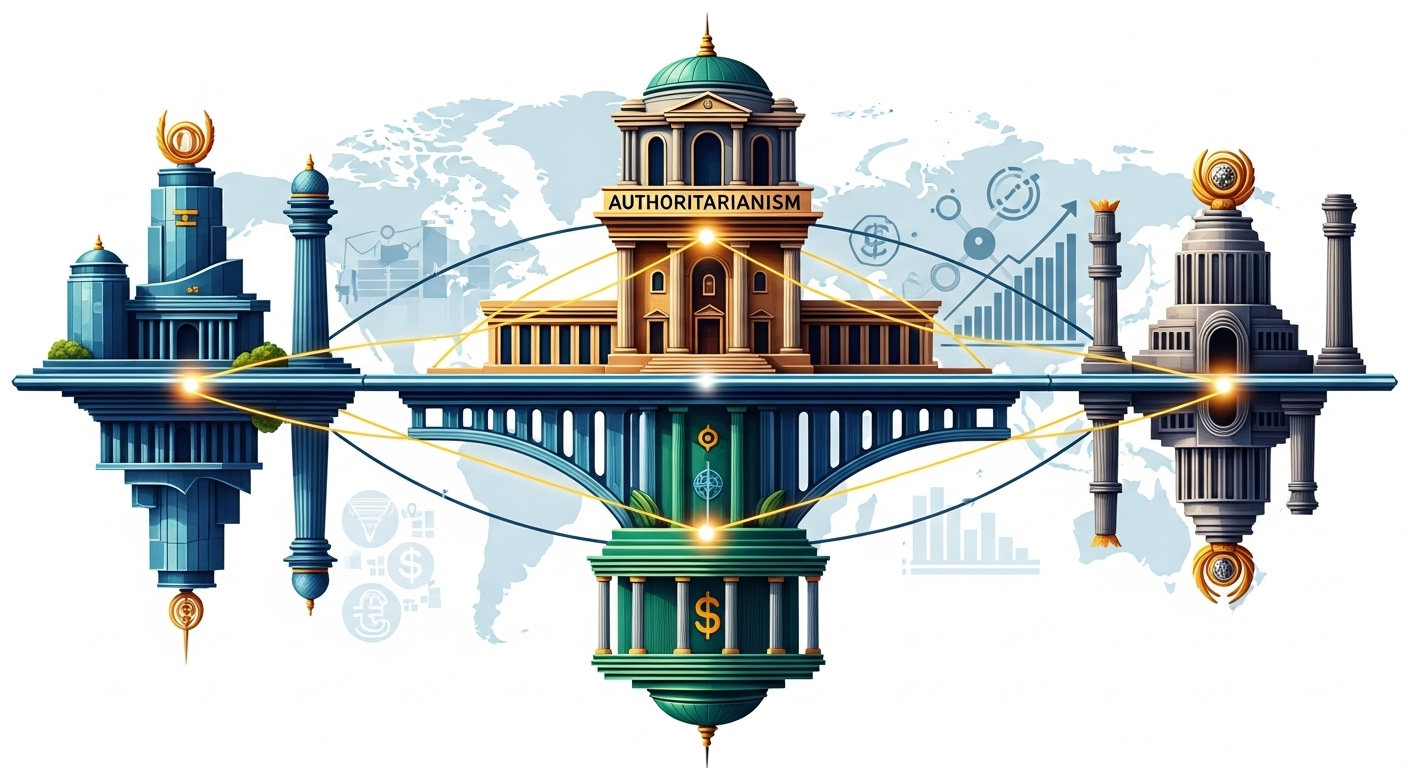
I. Introduction: Deconstructing the Quest for Stability and Prosperity
The enduring pursuit of political stability and national prosperity represents the central challenge of statecraft. For centuries, philosophers, policymakers, and scholars have debated the optimal structure of governance to secure a state against internal collapse while promoting the well-being of its citizenry. This report moves beyond a simplistic search for a single “best” system of governance. Instead, it undertakes a nuanced, comparative analysis of the world’s primary governance paradigms—democratic, authoritarian, and hybrid—to identify the foundational institutional principles that underpin durable states and foster inclusive prosperity. By deconstructing the core concepts of stability and prosperity and examining their complex, often bidirectional relationship, this analysis seeks to illuminate the institutional architecture that enables nations to endure crises, adapt to change, and achieve sustainable development.
Defining Political Stability: Beyond the Absence of Violence
At its most fundamental level, political stability is defined by the absence of abrupt, violent, or unconstitutional changes in government. It is a state of affairs characterized by the preservation of a smoothly functioning political system, free from major political upheavals, civil unrest, or sudden changes in leadership. This basic definition encompasses what might be termed “negative stability“—a condition where a regime, regardless of its nature, survives through crises without descending into internal warfare. History provides numerous examples of despotic monarchies, militarist regimes, and totalitarian systems that have achieved this form of stability through the effective control of social development and the suppression of dissent. Such a state is the political equivalent of a calm, predictable environment, which is essential for long-term planning, investment, and trade.
However, a more sophisticated and analytically useful definition of stability transcends the mere absence of conflict. “Positive stability” refers to a system’s dynamic equilibrium—its capacity to withstand internal and external pressures while maintaining core governance functions and adapting to the forces of change. This conception moves beyond imposed order to include the consistent functioning of political institutions, the upholding of the rule of law, and the presence of political legitimacy, which is the recognition and acceptance of a government’s authority by its citizens as rightful and justified. Stability, in this academic sense, is not a static end-state but a continuous process of negotiation and adaptation within power structures. This distinction is critical, as it challenges the notion that stability is a universally desirable outcome in all its forms. Stability without justice, equity, or democratic accountability can serve to legitimize authoritarianism and perpetuate an unjust social order, representing a form of imposed control rather than genuine societal harmony.
The measurement of this complex concept relies on several key quantitative tools. The World Bank’s Worldwide Governance Indicators (WGI) provide a widely used metric for Political Stability and Absence of Violence/Terrorism (PV.EST). This indicator is explicitly perception-based, aggregating surveys and expert assessments to capture the likelihood that a government will be destabilized by unconstitutional or violent means. It is, in essence, a forward-looking risk assessment rather than a historical record of events. Another crucial tool is the Fund for Peace’s Fragile States Index, which assesses vulnerability to collapse using 12 social, economic, and political indicators, including state legitimacy, provision of public services, and group grievances.
The perception-based methodology of prominent stability indices creates a complex analytical landscape. Because these metrics gauge the likelihood of future disruption as assessed by external observers like businesses and NGOs, they can produce counterintuitive results. Actions often associated with democratic deepening—such as the strengthening of media freedom, increased civil society participation, and the political polarization inherent in robust electoral competition—can be perceived by investors and risk analysts as increasing uncertainty and unpredictability. A 2024 study of Central Asia, using the WGI indicator, found that media freedom and civil society participation were associated with negative effects on stability scores, while the rule of law had a positive effect. This suggests that the “calm and predictable environment” valued by economic actors and captured by the index can be fundamentally at odds with the often “messy” and contentious nature of open democratic discourse. Consequently, a high stability score may not always reflect a healthy, resilient polity. It could instead signify a “negative stability” achieved through the suppression of the very freedoms that register as risk factors, a critical consideration when evaluating authoritarian claims of providing superior stability.
Defining Prosperity: Beyond Economic Output
The traditional metric for national prosperity has long been Gross Domestic Product (GDP) per capita, a measure of the total value of goods and services produced within a country, allocated on a per-person basis. While a useful indicator of economic output, GDP is a profoundly limited tool for measuring the holistic well-being of a society. It fails to account for the distribution of wealth, saying nothing about the level of inequality. It omits crucial aspects of quality of life, such as leisure time, environmental cleanliness, public health outcomes, and the value of non-market production like household labor. A rise in GDP can even mask negative developments; for example, a surge in construction activity after a natural disaster or increased spending on security due to rising crime would both increase GDP without making citizens better off.
A more comprehensive and meaningful definition of prosperity must encompass both wealth and well-being. This approach is embodied by the United Nations’ Human Development Index (HDI), a composite measure that assesses national achievement in three basic dimensions of human development: a long and healthy life (measured by life expectancy at birth), access to knowledge (measured by mean and expected years of schooling), and a decent standard of living (measured by Gross National Income, or GNI, per capita). The HDI framework is based on the work of Amartya Sen, who argued that development should be assessed by the degree of freedom individuals have to achieve goals they value.
This holistic view is further expanded by frameworks like the Legatum Prosperity Index, which defines prosperity through nine distinct “pillars.” These include not only Economic Fundamentals but also crucial governance and social indicators such as Democratic Institutions, Governance, Personal Freedom, Health, Education, and Social Capital. This model posits that the most prosperous nations are not necessarily those with the highest GDP, but those with happy, healthy, and free citizens, underscoring that a growing economy is a necessary, but not sufficient, condition for sustainable national prosperity.
These broader measures of prosperity are not merely outcomes of good governance; they are critical inputs to political legitimacy and, by extension, to stability itself. Political legitimacy is rooted in the citizenry’s acceptance of a government’s right to rule. When a state consistently fails to deliver on core components of human development—such as public health, education, and personal security—it erodes the social contract. This failure to provide essential public services is a key indicator of state fragility. A governance model that pursues narrow GDP growth, for instance through resource extraction, while neglecting human development creates a “hollow” prosperity. Such a model fails to build the social cohesion and public trust necessary for long-term stability, explaining why many resource-rich autocracies remain persistently fragile despite their apparent wealth.
The Central Analytical Tension and Report Overview
The relationship between political stability and economic growth is complex and deeply interconnected. A consensus exists that the uncertainty associated with an unstable political environment can reduce investment and slow economic development. Conversely, poor economic performance can fuel social unrest, leading to government collapse and political upheaval. This report navigates this bidirectional causality by examining how different governance systems mediate this relationship.
The analysis will proceed in four parts. First, it will explore the democratic paradigm, comparing presidential and parliamentary systems and critically assessing their capacity to deliver stability and prosperity. Second, it will analyze the authoritarian paradigm, providing a taxonomy of autocratic rule and evaluating the “authoritarian bargain” of growth for freedom. Third, it will delve into the “grey zone” of hybrid regimes, the most common system type today, to understand their unique dynamics of managed instability. Finally, the report will synthesize these findings to identify the universal institutional pillars—such as the rule of law and control of corruption—that transcend regime type and form the true foundation of stable and prosperous states.
II. The Democratic Paradigm: Stability Through Accountability and Adaptation
Democratic systems of government, in their ideal form, represent a profound departure from the logic of control that underpinning authoritarian rule.
Their capacity for enduring stability lies not in the prevention of conflict or the management of change from above, but in the institutionalization of processes for managing conflict and channeling change from below. Through mechanisms of accountability, representation, and adaptation, democracies aim to build a form of stability rooted in legitimacy and consent rather than coercion.
Foundational Principles: Legitimacy, Adaptation, and Peaceful Change
The stability of a democratic system is derived primarily from its political legitimacy, which is grounded in the ability of citizens to participate in selecting their government and holding it accountable. This principle is captured by metrics such as the WGI’s “Voice and Accountability” indicator, which measures perceptions of citizen participation, freedom of expression, and free media.
The cardinal strength of constitutional democracies is not their ability to avoid crises but their institutional capacity for flexible adjustment and peaceful change in response to social and economic pressures. Whereas authoritarian systems are designed to resist and suppress change, democratic systems are built to process it. A range of institutions and procedures—including the regular election of officials, competition between political parties, constitutional guarantees of freedom of speech and the press, and the right of petition—serve as channels for communicating demands and criticisms to the government. This open political process transforms societal problems into public issues, compelling governments to formulate policies that reflect a variety of pressures and effect compromises among conflicting demands. This adaptive capacity allows for evolutionary change, preventing the build-up of grievances that in more rigid systems can lead to violent upheaval.
Comparative Architectures: Presidential vs. Parliamentary Systems
While sharing core principles, democracies are organized under different institutional architectures, with the relationship between the executive and legislative branches being the primary differentiator.
- Parliamentary Systems:
This model is defined by a fusion of powers, in which the executive branch derives its democratic legitimacy from, and is held accountable to, the legislature. The head of government, typically a prime minister, is usually the leader of the majority party or coalition in the parliament and can be removed by the legislature through a vote of no confidence. This close relationship between the executive and legislative majority can lead to more efficient and decisive policymaking, as the government can generally rely on its legislative majority to pass its agenda. However, this same fusion of powers carries the risk of a significant concentration of power, particularly in systems with weak opposition parties or few institutional checks, potentially enabling a powerful executive to dominate the political landscape.
- Presidential Systems:
In contrast, presidential systems are founded on a strict separation of powers. The president, who serves as both head of state and head of government, is directly elected by the people for a fixed term and is independent of the legislature. The executive and legislative branches are co-equal, each with its own mandate from the electorate. This structure provides direct accountability of the president to the people and the stability of fixed terms, which prevents the frequent government collapses seen in some parliamentary systems. However, the separation of powers is also the system’s primary vulnerability. When the presidency and the legislature are controlled by different political parties—a common occurrence known as divided government—the system is highly susceptible to legislative gridlock, policy paralysis, and intense political conflict.
- Semi-Presidential Systems:
Blending elements of both models, semi-presidential systems feature a directly elected president who serves as head of state and a prime minister, responsible to the legislature, who serves as head of government. This hybrid design attempts to combine the stability of a fixed-term presidency with the flexibility of a parliamentary government, though it can also create ambiguity and conflict over the division of executive authority.
The Democracy-Prosperity Nexus: A Critical Examination
The relationship between democratic governance and economic prosperity is one of the most debated topics in political economy. The theoretical case for a positive link is strong. Democratic institutions are believed to foster economic development by promoting good governance, upholding the rule of law, protecting property rights, and enforcing contracts. This creates a stable and predictable environment that reduces uncertainty for economic agents, thereby stimulating investment, encouraging innovation, and supporting the creation of social capital. Amartya Sen’s influential argument that “development is freedom” posits that political rights and civil liberties are not just ends in themselves but are also instrumental in achieving economic success. Historical case studies lend support to this view. In post-war Japan, externally imposed democratic reforms provided the foundation for land and labor reforms that facilitated widespread economic growth. In contemporary India, a stable democratic framework has provided a conducive environment for gradual but persistent policy changes, including the economic liberalization of the 1990s.
However, this positive narrative is subject to significant critiques and counterarguments. The “Galenson-De Schweinitz” hypothesis, originating in the 1950s, argues that new democracies may be prone to instability because they unleash popular pressures for immediate consumption and redistribution, which can occur at the expense of the savings and investment necessary for long-term growth. Other scholars contend that there is no guarantee that democracies will better protect property rights; indeed, in developing countries with high inequality, the poor may use their newfound political power to expropriate the assets of the rich, deterring investment.
More recent critiques focus on two potent threats to the stability and prosperity of modern democracies. The first is the corrosive effect of high economic inequality. A large-scale cross-national study has established that income inequality is one of the strongest predictors of democratic erosion. High levels of inequality fuel political polarization, weaken public trust in institutions, and create fertile ground for populist leaders who promise to upend the existing order. The second threat is the distorting influence of corporate power. In systems where money is critical for political campaigns and influence, “corruptive dependencies” can emerge, leading to a “captured economy” where democratic processes are bent to serve narrow corporate interests rather than the public good. This undermines both the legitimacy of the democratic system and its ability to deliver inclusive prosperity.
The institutional design of a democracy can significantly mediate these risks. Presidential systems, with their winner-take-all executive elections and fixed terms, appear structurally more vulnerable to a dangerous spiral of polarization and gridlock. The zero-sum nature of a presidential contest intensifies partisan conflict. When this is combined with the high potential for divided government, the result is often policy paralysis, which frustrates citizens and erodes their confidence in the effectiveness of democratic institutions. High economic inequality pours fuel on this fire by creating distinct and opposing economic constituencies that align with different parties, deepening the partisan chasm. This environment creates a political opening for anti-system, populist leaders who campaign against the “broken” establishment and promise decisive action, often by circumventing constitutional norms and checks and balances—a classic pathway to democratic backsliding. Thus, the institutional architecture of presidentialism, when interacting with the societal condition of high inequality, can create a uniquely destabilizing feedback loop that threatens the foundations of both democratic stability and long-term prosperity.
The Authoritarian Paradigm: Stability Through Control and Coercion
Authoritarian systems of governance operate on a fundamentally different logic from democracies. Where democracies seek stability through accountability and adaptation, authoritarian regimes pursue it through centralized control and the suppression of independent political activity. Their claim to legitimacy often rests on an implicit “bargain”: the surrender of political freedom in exchange for order, security, and economic development. While some authoritarian states have achieved remarkable success on these terms, the paradigm as a whole is characterized by inherent vulnerabilities that render its stability brittle and its prosperity often exclusive and unsustainable.
Foundational Principles: The Logic of Centralized Control
The core principle of authoritarianism is the concentration of political power in the hands of a single leader (an autocrat), a small elite (an oligarchy), a single political party, or the military. The primary objective of such regimes is self-preservation, which is achieved by controlling social development, managing or preventing change, and neutralizing any forces that could produce innovations threatening to the system.
To maintain their grip on power, authoritarian regimes employ a combination of three key mechanisms of control:
- Coercion: This involves the use of the state’s repressive apparatus—the military, police, and intelligence agencies—to suppress dissent and opposition through surveillance, intimidation, violence, and imprisonment.
Co-optation: This is the strategy of securing loyalty from key supporters and potential rivals by selectively distributing benefits. These can include patronage appointments, economic privileges, access to state resources, and positions within the power structure.
Legitimation: Regimes seek to justify their rule and cultivate public support through various strategies, including the propagation of a unifying ideology (e.g., communism, nationalism), appeals to religion or tradition, and, most commonly, promises of stability and economic performance.
A Taxonomy of Authoritarian Rule
Authoritarian regimes are not monolithic. Their internal structures vary significantly, with profound implications for their durability, policy orientation, and economic performance. Key subtypes include:
- Personalist Regimes: In these systems, power is concentrated in a single, dominant individual, and control is exercised through networks of personal loyalty and patronage rather than through formal institutions. These regimes are highly arbitrary and unpredictable, as policy often reflects the whims of the leader. Their greatest vulnerability is succession; the death or overthrow of the leader can cause the entire political structure to collapse, leading to a violent power vacuum.
- Military Regimes: Governed by a junta or coalition of high-ranking military officers, these regimes typically seize power in a coup d’état, often justifying their intervention as necessary to restore order and stability. While they may govern pragmatically, they generally lack a long-term ideological vision and struggle to build broad-based legitimacy beyond the promise of security, making them prone to internal divisions and eventual transitions back to civilian rule.
- Single-Party Regimes: In this model, power is institutionalized within a dominant political party that monopolizes the political arena and controls access to state power. The party provides a durable organizational structure for elite recruitment, policy formulation, and, crucially, managing leadership succession. This institutionalization makes single-party regimes, such as that of the Chinese Communist Party, generally more stable, predictable, and durable than personalist or military rule.
The Authoritarian Bargain: Prosperity Without Freedom?
The central claim of many modern authoritarian regimes is that they can deliver economic growth more effectively than messy, inefficient democracies. The argument, echoing earlier theories of development, is that by insulating economic policymaking from popular pressures for immediate consumption or redistribution, an authoritarian state can enforce the high rates of savings and investment necessary for rapid industrialization.
The historical record presents a starkly divided picture of this “authoritarian bargain.” On one hand, there are notable success stories. States like Singapore, South Korea under Park Chung-hee, and China since its 1978 reforms have demonstrated that authoritarian governments can preside over periods of spectacular economic growth. These successful cases are typically characterized by a high degree of state capacity, a cohesive and disciplined ruling elite (often institutionalized in a dominant party), and the implementation of what economists Daron Acemoglu and James Robinson term “inclusive enough” economic institutions—such as secure property rights and functioning markets—even while maintaining extractive political institutions.
On the other hand, the more common outcome of authoritarian rule is economic stagnation and predation. For every Singapore, there are numerous examples like Zaire under Mobutu Sese Seko, North Korea under the Kim dynasty, or contemporary Venezuela, where the absence of political accountability has enabled ruling elites to engage in rampant corruption and pursue extractive economic policies that enrich themselves while impoverishing the nation. Without the checks and balances of a free press, an independent judiciary, or a viable political opposition, there are few constraints on the abuse of power.
This highlights the inherent vulnerabilities of the authoritarian model. The very lack of feedback mechanisms that allows for decisive policy implementation also makes these regimes blind to growing economic problems and social discontent. Furthermore, the absence of legitimate, transparent procedures for leadership succession creates high-stakes, behind-the-scenes power struggles that can erupt into open conflict and regime collapse. The stability offered by authoritarianism is often the “negative stability” of repression, a brittle foundation that can shatter under pressure.
The long-term stability and economic viability of an authoritarian state appear to be less dependent on a leader’s personal qualities and more on the degree to which political power is institutionalized within a durable organization, most notably a ruling party. A personalist dictatorship, where power is tied to an individual, is inherently fragile. Its economic policies are often erratic, designed to reward loyal cronies rather than to foster broad-based growth. Crucially, it has no institutionalized solution to the problem of succession. When the dictator departs, the system implodes, creating profound instability. In contrast, a well-established single-party state institutionalizes the processes of elite recruitment, policy debate (within the confines of the party), and leadership transition. This structure provides the continuity and predictability that are essential for long-term economic planning. The party’s survival as an institution becomes linked to its ability to deliver sustained economic performance, creating powerful incentives for more rational policymaking. This fundamental difference in institutional architecture helps explain the divergent historical paths of a state like China, which has successfully institutionalized one-party rule, and the many personalist regimes in Africa and Latin America that have ultimately failed and collapsed.
The “Grey Zone”: Hybrid Regimes and the Dynamics of Enduring Instability
In the 21st century, the clear dichotomy between democracy and autocracy has become increasingly blurred. The most widespread political system globally is neither a consolidated liberal democracy nor a closed authoritarian state, but rather a hybrid regime that occupies the vast “grey zone” in between. These systems, which alloy democratic rules with authoritarian governance, have proven surprisingly durable, creating a unique and persistent form of instability characterized by constant political contestation on a profoundly uneven playing field.
Defining the Grey Zone: The Rise of Hybridity
Hybrid regimes are political systems that combine formal democratic institutions, such as regular elections, with autocratic features, such as political repression and the systemic abuse of state power. They often emerge from incomplete democratic transitions, where a country moves away from authoritarianism but fails to consolidate genuine democracy, or from the gradual erosion of an existing democracy. This category encompasses a wide spectrum of systems, but several key typologies are central to understanding their dynamics:
- Illiberal Democracy: This is a governing system where competitive elections take place, but they are divorced from the principles of constitutional liberalism. Rulers in illiberal democracies may be democratically elected but routinely disregard constitutional limits on their power, suppress civil liberties such as freedom of speech and assembly, and undermine the rule of law. The emphasis is on majoritarian rule, where the will of the majority is seen as justification for overriding the rights of minorities and the opposition.
- Electoral Autocracy: In this model, the facade of multiparty elections is maintained, but the electoral process itself is systematically manipulated to ensure the incumbent’s victory. While opposition parties are allowed to exist and compete, the incumbent government uses its control over state resources, the media, and the legal system to create an electoral contest that is not free and fair. Tactics include voter suppression, electoral fraud, unequal access to media and resources, and the harassment or banning of opposition candidates.
- Competitive Authoritarianism: Coined by scholars Steven Levitsky and Lucan Way, this concept provides the most robust framework for analyzing many hybrid regimes. In a competitive authoritarian system, democratic institutions are not merely a facade; they are the primary arenas for gaining and contesting power. Elections are regularly held and are genuinely competitive, meaning the opposition has a real, albeit small, chance of winning. However, the regime is not democratic because the incumbent systematically abuses state power to skew the playing field. This creates a contest where competition is real, but profoundly and enduringly unfair. The legislature, judiciary, and media serve as arenas of contestation, but the incumbent works relentlessly to subordinate them.
Legitimation and Survival in the Grey Zone
Hybrid regimes are masters of navigating a complex political environment. They utilize the “decorative nature” of democratic institutions to generate a veneer of legitimacy, both for domestic audiences and the international community. Holding elections, even flawed ones, allows the regime to claim a popular mandate and avoid the international condemnation and sanctions often directed at closed autocracies.
However, this very strategy of combining democratic rules with autocratic methods creates what Levitsky and Way call an “inherent source of instability”. Unlike in a closed autocracy, the opposition is not completely eliminated. It is allowed to exist and compete, albeit under severe disadvantages.
This leads to a state of perpetual, low-grade conflict, where the regime must constantly work to manage and contain opposition challenges without resorting to the kind of overt, large-scale repression that would shatter its democratic facade. Case studies of countries like Russia under Vladimir Putin, Hungary under Viktor Orbán, and Venezuela under Hugo Chávez and Nicolás Maduro illustrate the common tool kit of hybrid rule: the steady consolidation of executive power, the weakening of judicial independence, the takeover or censorship of media outlets, and the use of legal and administrative means to harass and repress opponents.
This dynamic leads to a paradoxical form of durability. Hybrid regimes are often surprisingly resilient, not because they are genuinely stable, but because they are exceptionally adept at managing instability. A fully closed autocracy, by offering no peaceful channels for expressing dissent, forces all opposition underground and risks the build-up of revolutionary pressure that can lead to a violent overthrow. Hybrid regimes, by contrast, provide institutional “arenas of contestation” like elections and parliaments. These arenas function as political “safety valves,” allowing the opposition to organize and compete, which gives citizens a sense that change is possible without resorting to revolution. However, the incumbent systematically rigs the game through media control, abuse of state resources, and manipulation of electoral rules to ensure that they rarely, if ever, lose power. This creates a self-perpetuating cycle: the opposition remains weak and fragmented, unable to win but visible enough to lend a degree of legitimacy to the system. Public discontent is perpetually channeled, contained, and dissipated through these flawed processes, but it is never truly resolved. The regime thus avoids both genuine democratic accountability and the existential threat of a unified revolutionary movement, achieving a form of stagnant, long-term durability. This explains the persistence of regimes like Russia’s, which have weathered significant economic crises and popular protests without either democratizing or fully closing off political space.
V. The Universal Pillars of Stable and Prosperous Governance
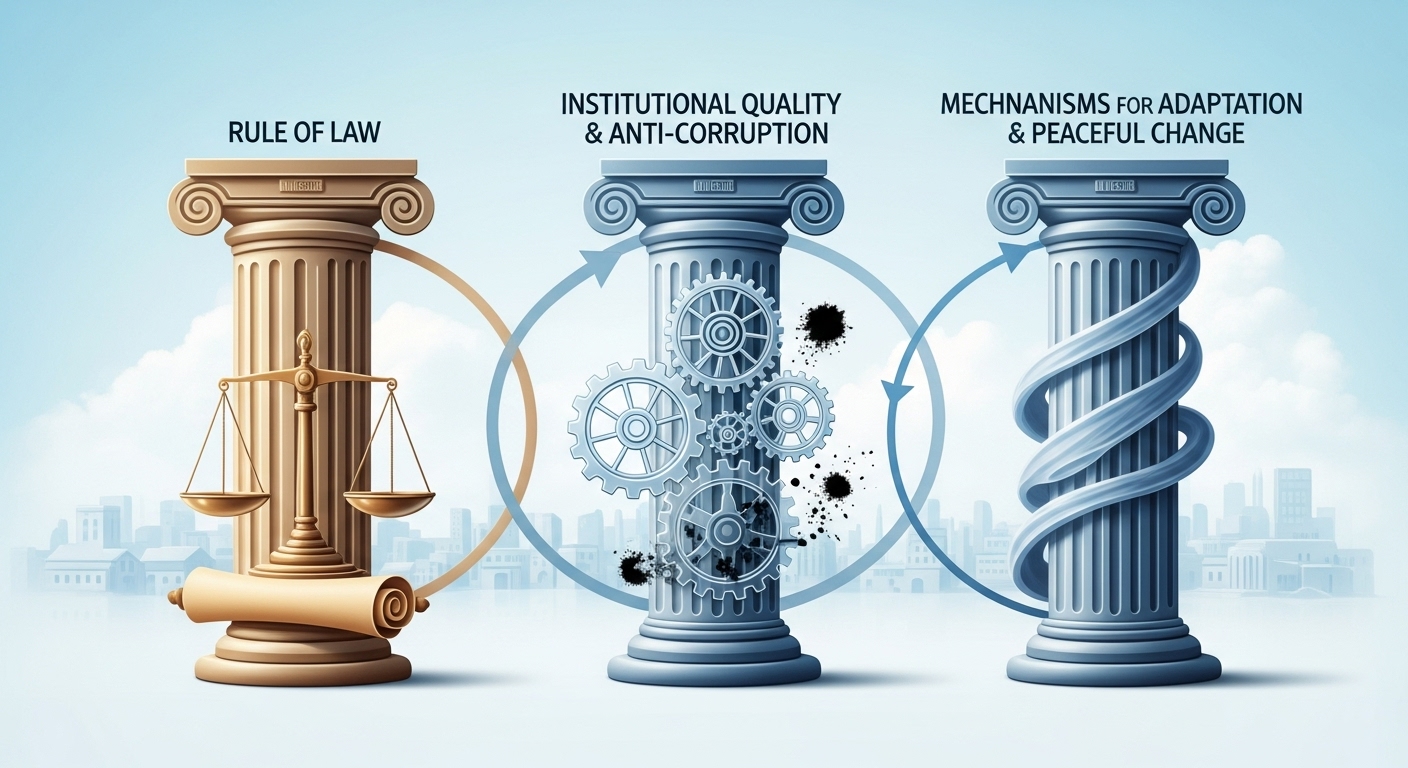
The comparative analysis of democratic, authoritarian, and hybrid systems reveals a crucial truth: the formal classification of a political regime is often a less reliable predictor of stability and prosperity than the underlying quality of its core governing institutions. While different systems offer distinct advantages and disadvantages, certain institutional pillars appear to be universally critical for achieving durable peace and inclusive development. These are the rule of law, the quality of state institutions and control of corruption, and the existence of mechanisms for adaptation and change.
The Primacy of the Rule of Law
The rule of law is the bedrock upon which stable and prosperous societies are built. It is defined as the extent to which all agents in a society, including the state itself, have confidence in and abide by the rules of society. It encompasses the quality of contract enforcement, the security of property rights, the effectiveness and impartiality of the police and the courts, and the general likelihood of crime and violence. Fundamentally, it is a constitutional principle that restricts the arbitrary exercise of governmental power.
The importance of the rule of law transcends regime type. Empirical research demonstrates that a strong rule of law is a powerful positive predictor of political stability and a crucial prerequisite for economic growth. By creating a predictable legal framework, protecting property rights, and ensuring that contracts are enforced, the rule of law reduces uncertainty and transaction costs, which in turn bolsters investor confidence and encourages long-term investment. Even otherwise oppressive regimes can benefit from the credibility and legitimacy that adherence to legal processes provides. While legal traditions vary—for instance, between the common law systems originating in England and the civil law systems of continental Europe—the critical factor for success is the effectiveness of the legal institutions in practice.
The Imperative of Institutional Quality and Corruption Control
Closely linked to the rule of law is the broader quality of a state’s governing institutions. This concept is captured by several of the World Bank’s Worldwide Governance Indicators, including Government Effectiveness (which measures the quality of public services, the competence of the civil service, and its independence from political pressures), Regulatory Quality (the ability to formulate and implement sound policies that permit private sector development), and Control of Corruption.
High institutional quality and low levels of corruption are consistently associated with greater political stability and higher rates of economic growth. Effective governance ensures that state resources are used for public good rather than private gain, and that policies are designed and implemented to achieve long-term development goals. Corruption—defined as the abuse of public office for private gain—is a deeply corrosive force. It undermines the ability of states to deliver services, eradicates public trust in institutions, deters foreign and domestic investment, and ultimately eviscerates a country’s economic potential and political legitimacy.
The relationship between regime type and corruption is complex. While well-established, transparent democracies generally exhibit lower levels of corruption, the process of democratization can itself create new opportunities for graft, particularly in transitional periods where institutions are weak. Conversely, some authoritarian regimes, such as Singapore, have successfully achieved very low levels of corruption by building a strong, meritocratic, and highly institutionalized state that enforces anti-corruption laws with rigor. This demonstrates that while democratic accountability is a powerful tool against corruption, the existence of a highly effective and disciplined state apparatus is the direct mechanism for its control.
Mechanisms for Change and Adaptation
The ultimate test of a political system’s long-term stability is its ability to manage and adapt to societal change peacefully. Social and economic forces are in constant flux; populations grow, technologies evolve, and new political philosophies emerge. A system that cannot accommodate these pressures is destined to break.
Here, democratic systems possess a clear structural advantage. They are designed with built-in, legitimate mechanisms for adaptation and the peaceful transfer of power. Elections, legislative debate, and freedoms of speech and assembly provide regular, institutionalized channels for citizens to express grievances and demand policy changes, allowing for evolutionary adjustments that can prevent revolutionary pressures from building to a breaking point.
Authoritarian systems, by their very nature, are designed to resist and suppress change, which they view as a threat to their survival. This makes them inherently brittle. Lacking formal, legitimate mechanisms for channeling public discontent or managing leadership succession, they are vulnerable to sudden and violent collapse when pressures for change become overwhelming.
The following table provides a data-driven snapshot that juxtaposes these institutional pillars with stability and prosperity outcomes across a diverse set of countries, illustrating the patterns that transcend simple regime labels.
| Country | Regime Type (Classification) | WGI Political Stability (PV.EST) Score | Fragile States Index Rank | WGI Rule of Law Score | WGI Control of Corruption Score | Human Development Index (HDI) |
|---|---|---|---|---|---|---|
| Norway | Consolidated Parliamentary Democracy | 0.89 | 170 (Very Sustainable) | 1.83 | 2.08 | 0.970 |
| Switzerland | Consolidated Parliamentary Democracy | 1.07 | 171 (Very Sustainable) | 1.80 | 1.95 | 0.970 |
| United States | Consolidated Presidential Democracy | 0.03 | 143 (Stable) | 1.33 | 1.12 | 0.932 |
| Singapore | Successful Authoritarian (Single-Party) | 1.42 | 161 (Sustainable) | 1.73 | 2.12 | 0.949 |
| UAE | Successful Authoritarian (Monarchy) | 0.68 | 136 (More Stable) | 1.05 | 1.18 | 0.937 |
| Botswana | Developing Democracy | 1.04 | 119 (Stable) | 0.51 | 0.70 | 0.680 |
| India | Developing Democracy | -0.66 | 68 (Elevated Warning) | 0.13 | -0.12 | 0.644 |
| Russia | Hybrid/Competitive Authoritarian | -0.83 | 48 (High Warning) | -0.81 | -0.90 | 0.821 |
| Hungary | Hybrid/Competitive Authoritarian | 0.73 | 137 (More Stable) | 0.28 | -0.05 | 0.851 |
| Nigeria | Unsuccessful Hybrid/Authoritarian | -1.97 | 15 (Alert) | -0.89 | -1.13 | 0.548 |
| Venezuela | Unsuccessful Authoritarian | -1.14 | 30 (Alert) | -1.94 | -1.63 | 0.690 |
| Sudan | Failed State/Military Rule | -2.52 | 2 (Alert) | -1.82 | -1.49 | 0.516 |
| Somalia | Failed State | -2.48 | 1 (Alert) | -2.13 | -1.64 | 0.380 |
Sources: WGI Scores; Fragile States Index Ranks; HDI Values. Note: FSI ranks are inverted for clarity (higher rank = more stable).
This table powerfully illustrates the report’s central arguments. It shows that while high-performing democracies like Norway and Switzerland excel across all metrics, an authoritarian state like Singapore can achieve exceptionally high scores for stability, rule of law, and corruption control, correlating with its high levels of prosperity. It also reveals the weaknesses of certain models: the United States, despite its wealth and democratic history, shows a notably low political stability score, reflecting deep polarization.
Russia demonstrates the brittle nature of some authoritarian systems, with a poor stability score and extremely low scores for rule of law and corruption control, despite a relatively high HDI. Finally, the table starkly visualizes the collapse of all institutional pillars in failed states like Somalia and Sudan, resulting in catastrophic outcomes for both stability and human development.
VI. Conclusion: Identifying the Key to Political Stability and Prosperity
This comprehensive analysis of governance systems reveals that the quest for a single “best” political model is misguided. The evidence does not point to a simple victory for one regime type over another. While consolidated, high-quality liberal democracies consistently demonstrate the most robust capacity for delivering long-term, inclusive prosperity and adaptive stability, the global landscape is replete with exceptions and complexities. Some authoritarian regimes have presided over remarkable economic transformations, while many nominal democracies and hybrid systems have faltered, succumbing to instability, corruption, and economic stagnation. The key to enduring stability and prosperity lies not in the formal label a regime adopts, but in the substantive quality of its underlying governing institutions.
Synthesis of Findings: Beyond the Democracy-Autocracy Dichotomy
The investigation confirms that no system is inherently immune to failure. Democracies, particularly presidential systems, are vulnerable to gridlock and polarization, risks that are severely exacerbated by high levels of economic inequality. Authoritarian systems, while capable of imposing order and directing rapid growth under specific conditions, are structurally brittle, prone to succession crises, and more often lead to predation than to prosperity. Hybrid regimes, the most common contemporary system, achieve a form of durable dysfunction by managing, rather than resolving, political conflict, trapping their societies in a low-level equilibrium of repression and stagnation. Across this diverse spectrum, the ultimate determinant of a nation’s success is the presence of a functional, rule-based state. The data clearly show that countries with strong rule of law, effective state institutions, and low levels of corruption are more stable and prosperous, regardless of whether they hold competitive elections.
The Core Argument: The Key is an Adaptive, Accountable, Rule-Based State
Synthesizing the evidence, the “key” to political stability and prosperity is not a specific governance system but a set of interconnected institutional attributes. These are the universal pillars that form the architecture of an enduring and successful state:
- A Strong, Impartial Rule of Law: This is the non-negotiable foundation. It provides the predictability, security of property, and enforcement of contracts necessary for a modern economy to function and for citizens to have confidence in their institutions. It is the primary bulwark against arbitrary power and the essential precondition for all other social and economic progress.
- High Institutional Quality: A capable, meritocratic, and relatively autonomous state bureaucracy is critical for translating political will into positive outcomes. An effective state can deliver public services, implement sound economic policies, and, crucially, control corruption, thereby preserving state resources and maintaining public trust.
- Mechanisms for Accountability and Adaptation: The most durable political systems are those that possess legitimate, institutionalized mechanisms for channeling societal demands and adapting to change peacefully. Democracies are structurally designed to fulfill this function through elections, a free press, and civil society, giving them a profound long-term advantage in resilience. Authoritarian systems inherently lack these adaptive mechanisms, making their stability contingent on their capacity for repression and rendering them vulnerable to collapse in the face of transformative pressures.
Concluding Reflections: The Future of Governance
The contemporary global environment poses significant challenges to this institutional framework. The trend of democratic backsliding, even in long-established democracies, demonstrates that no system’s stability is guaranteed. Simultaneously, the rise of sophisticated, technologically-enabled authoritarian and hybrid models presents a formidable challenge to the liberal democratic order.
The ultimate lesson from this comparative analysis is that the pursuit of stability and prosperity must be a pursuit of good governance itself. The critical task for policymakers, leaders, and citizens is not simply to advocate for a particular regime type, but to focus relentlessly on the difficult, generational work of building and defending the core institutions that matter most: an impartial rule of law, an effective and uncorrupted state, and robust mechanisms of accountability. These are the ultimate arbiters of a nation’s fate and the true keys to unlocking a future of enduring stability and shared prosperity.