


Find Digital Marketing Agencies Online: Guide to Directories
The 2025 Digital Marketing Agency Procurement Landscape: A Comprehensive Analysis of Directories, Marketplaces, and Partner Ecosystems

I. Executive Summary: The Modern Framework for Agency Discovery
The procurement of a digital marketing agency, once a straightforward process of referrals and requests for proposals (RFPs), has evolved into a complex decision-making journey dominated by a fragmented landscape of digital platforms. The simple search for “listing websites” masks the true complexity of the market. Modern procurement managers are not merely seeking a list; they are seeking a solution to a specific business challenge, whether that be transactional speed, verified trust, deep technical expertise, or strategic, enterprise-level scale.
This report provides a comprehensive framework for navigating this landscape. It categorizes the agency discovery ecosystem into four distinct procurement models, which will be analyzed in detail:
- B2B Review Directories: Platforms such as Clutch and G2 that have built architectures of trust, where verified, third-party validation is their primary product.
- Procurement Marketplaces: Platforms like Upwork and MarketerHire, which are designed for active hiring, contracting, and project management. Their value proposition is transactional efficiency and access to vetted, on-demand talent.
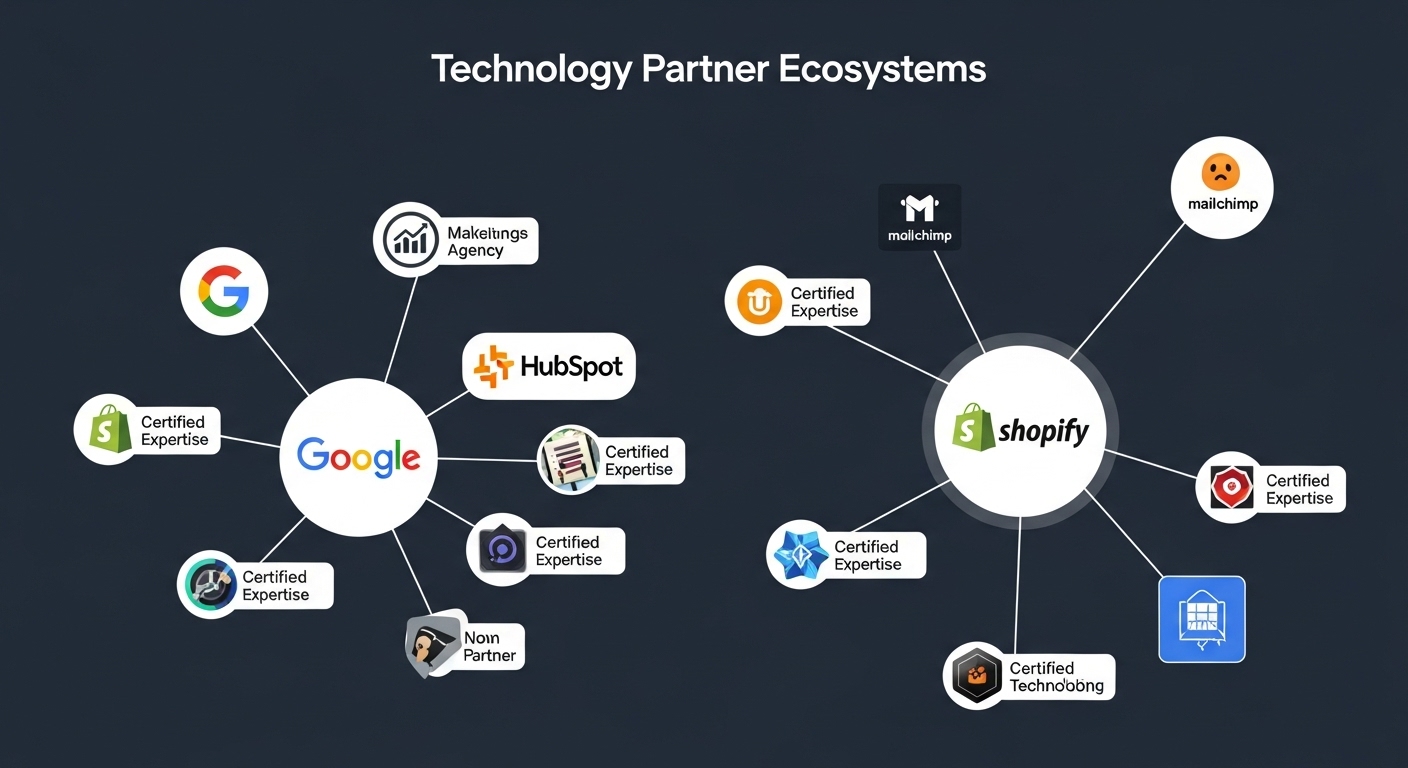
- Technology Partner Ecosystems: Directories managed by technology vendors like Google and HubSpot, where an agency’s legitimacy is derived from its certified expertise on a specific, critical technology stack.
- Enterprise & Association Lists: High-level strategic intelligence from analyst firms like Gartner and Forrester, complemented by member directories from professional associations such as the 4A’s, which are used for enterprise-level vetting and due diligence.
The choice of platform is the first and most critical step in the procurement strategy. Beginning the search on Gartner’s Magic Quadrant implies the selection of a multi-year, enterprise-level strategic partner. In contrast, beginning on MarketerHire implies an immediate need for a specialized, on-demand expert for a single campaign. The “where” of the search fundamentally dictates the “how” and “who” of the hiring process.
This report will dissect the ranking methodologies, verification processes, and business models of the key players in each category, providing a comparative analysis to guide strategic selection. It will conclude with a practical case study of the procurement landscape in Nepal and a persona-based recommendation framework for SMEs, mid-market companies, and large enterprises.
II. The B2B Review Directory: Architectures of Trust and Verification
This section analyzes platforms whose primary value proposition is the aggregation and verification of client reviews to build a trusted, searchable directory for B2B service providers.
A. Clutch.co: The Analyst-Driven Review Model
Clutch has established itself as a “one-stop-shop” for B2B service provider procurement, leveraging a database of over 280,000+ global provider reviews. Its directory is vast, covering core digital marketing categories such as Digital Marketing, SEO, Social Media Marketing, and Creative services.
The core of Clutch’s verification and ranking methodology is its “in-depth, verified client reviews“. This process is its key differentiator. Unlike a simple web-based form, Clutch’s process involves analyst-led interviews with an agency’s past and current clients, creating a qualitative, case-study-like dataset that is published on the agency’s profile. This rich, qualitative data is then synthesized into the “Leaders Matrix,” a proprietary visualization that maps agencies based on their “Ability to Deliver” and their “Focus” within a specific service line.
This methodology allows for detailed profile analysis and filtering. Users can filter by project budget (e.g., “$1,000+” or “$10,000+”), geographic location, specific industry focus, and service line. Agency profiles provide granular breakdowns of service focus (e.g., “60% Digital Strategy, 10% Email Marketing…”) and list notable clients and average project costs.
Clutch’s model is effectively a hybrid between a directory and a light-touch analyst firm. The manual, interview-based review collection is resource-intensive, positioning Clutch as a premium directory. While it does feature “Sponsored” and “Featured” listings, its primary value is the high-trust, qualitative data. This makes it an ideal platform for mid-market companies making high-consideration, five-to-six-figure agency hiring decisions, where reading a detailed, verified case study on a provider like WebFX or Disruptive Advertising is more valuable than a simple quantitative star rating.
B. G2: The User-Generated Software and Services Grid®
G2, a dominant force in B2B software reviews, has strategically and successfully expanded its model into B2B services. It now features dedicated categories for “B2B Services Review Platforms”, “Marketing Strategy”, “Content Marketing Agencies”, and “Digital Marketing”.
G2’s primary differentiator is its public commitment to “unbiased reviews,” stating that it does “not allow paid placements in any of our ratings, rankings, or reports“. This is a direct strategic counterpoint to other models that rely on sponsored placements.
Its ranking methodology is famously visualized in the G2 Grid®, which plots providers based on “Satisfaction” (derived from user reviews) and “Market Presence.” The “Grid Leader” designation is a highly coveted and recognizable mark of quality.
G2’s expansion from software into services creates a critical decision point for a procurement manager and signals a fundamental schism in the B2B review market. The choice is now between two trust models. On one hand, Clutch offers deep, qualitative, analyst-vetted (but potentially sponsored) reviews. On the other, G2 offers high-volume, quantitatively significant, unbiased (but less-qualitative) user-generated scores. G2’s model is a bet that in the B2B services space, as in software, the aggregated “wisdom of the crowd” is a more powerful trust signal than “expert analyst” curation.
C. DesignRush: The Creative-Centric Hybrid Marketplace
DesignRush maintains a directory of over 40,000 agencies, with a clear specialization in creative, branding, and design-forward digital agencies. It lists top-rated agencies and allows filtering by location, expertise, and reviews.
Its verification and ranking model is curated. DesignRush employs an “executive selection team” and a “strict screening process” to evaluate agencies. Agency profiles are assessed based on their client roster, case studies, industry reputation, and team expertise. Furthermore, client reviews undergo a separate “stringent verification process” to ensure reliability.
The most significant aspect of DesignRush is its dual model. It operates as both a standard, searchable “Agency Directory” and an active “Digital Marketing Marketplace“. In the Marketplace, a user submits a project brief. The DesignRush team “will handle the whole research and shortlisting process for FREE“, acting as a no-cost concierge service. This process culminates in the user receiving “5 competitive proposals” from agencies that DesignRush has hand-picked and verified as qualified for the specific project.
This hybrid model fundamentally changes the platform’s value proposition. By offering a free, high-touch matchmaking service, DesignRush competes directly with premium “vetted networks” like Credo, which will be discussed later. This makes it a powerful lead-generation tool for its listed agencies and a highly efficient, time-saving resource for small to medium-sized businesses that lack a dedicated procurement team.
D. Comparative Analysis: Other Key Directories
- UpCity: As a direct competitor to Clutch, UpCity helps businesses find B2B service providers through “objective, independent research and verified user reviews“. Its primary strength lies in its highly granular filtering capabilities. Users can sort agencies not just by service but by per-project cost, monthly retainer cost, specific industry expertise (e.g., “Attorneys,” “Dental,” “SaaS”), and the size of business they typically work with (e.g., “Small, Medium, Enterprise”). This makes it highly effective for finding niche-specific partners.
- GoodFirms: A global B2B review and rating platform that employs a “Leaders Matrix“, similar to Clutch. It has a strong international focus, making it a key resource for procurement in specific countries and regions. Its utility for this purpose is demonstrated in the Nepal case study, where it provides detailed listings for agencies in Kathmandu. It also offers free listing options for agencies, broadening its database.
- TopSEOs: A highly specialized and long-standing directory, established in 2002. It focuses exclusively on “internet marketing products and services“, with a deep, authoritative focus on SEO. Its longevity gives it credibility within this niche. It offers rankings for over eighty different countries, including a specific, ranked list for agencies in Nepal.
- TechBehemoths: A newer, fast-growing platform (est. 2021) with a strong focus on the IT and technology services sector. It lists over 50,000 service providers and is an excellent resource for finding partners that blend technical development with marketing services.
Its database includes “Verified Company” profiles and detailed filters for location, team size, and hourly rate.
Section II: Key Insights Table
| Platform | Primary Focus | Verification Model | Ranking System | Ideal Use Case |
|---|---|---|---|---|
| Clutch.co | High-touch B2B Services (Broad) | Analyst-led Client Interviews | Leaders Matrix (Proprietary) | Mid-market, high-value ($10k+) agency hire requiring qualitative, in-depth validation. |
| G2 | Software-first, expanding to B2B Services | Verified User-Generated Reviews | G2 Grid® (Satisfaction & Market Presence) | Finding a service partner, particularly for SaaS or tech, with unbiased, high-volume user data. |
| DesignRush | Creative, Branding & Design-Forward Agencies | Executive Curation & Verified Reviews | Internal Scoring System | Finding a creative or design-focused agency; SME use of the free “Marketplace” concierge. |
| UpCity | US-Market B2B Services (Niche-Specific) | Verified User Reviews | UpCity Ranking (Proprietary) | Finding a partner with specific industry (e.g., “Dental”) or budget (e.g., “$1,000 retainer”) expertise. |
| GoodFirms | Global IT & B2B Services | Vetted Company Profiles & Reviews | Leaders Matrix (Proprietary) | International procurement; finding vetted technical and marketing partners in specific countries. |
| TopSEOs | SEO & Internet Marketing Services | Proprietary Analyst Evaluation | Monthly Rankings (Smart Rank Algorithm) | Finding a hyper-specialized, pre-vetted SEO or PPC agency. |
III. The Procurement Marketplace: From Freelancers to Vetted Agency Teams
This section analyzes the shift from passive directories to active marketplaces—platforms that are not just lists but integrated systems for contracting, project management, and payment.
A. Upwork: The Scalable Agency Marketplace
Upwork has evolved significantly beyond its freelance roots to become a robust B2B contracting marketplace. A key component of this is its “Agency” model. On Upwork, an agency is a formal group of freelancers who collaborate under a single profile. This structure allows them to combine their skills—for example, a designer, developer, and copywriter—to take on larger, more complex projects that a solo freelancer could not handle.
The platform’s verification and ranking methodology is multi-layered:
- Identity Verification: The baseline of trust on Upwork is not pre-vetting of skill, but rigorous verification of identity and location. The platform requires users to submit government-issued IDs, confirm locations, and in some cases, complete visual verification. This provides a secure and compliant environment for transactions.
- Performance Ranking (Job Success Score – JSS): An agency’s rank is not pre-vetted; it is earned through proven performance. The Job Success Score (JSS) is the platform’s central quality metric, measuring client satisfaction based on public and private feedback, long-term relationships, and successful contract outcomes. Agencies have their own aggregated JSS, reflecting the collective performance of all their agency contracts.
- Talent Badges: This is the platform’s elite tier system. The “Top Rated” (top 10% of talent) and “Top Rated Plus” (top 3%) badges are awarded to agencies and freelancers who maintain a 90%+ JSS, meet significant earnings thresholds (e.g., $10,000+ in 12-month earnings for an agency to be Top Rated, $20,000+ for Top Rated Plus), and have a sustained history of success.
Upwork has effectively become a comprehensive B2B contracting infrastructure. A procurement manager can visit the platform and choose their method: hire talent via the “Talent Marketplace,” buy a predefined service from the “Project Catalog,” or get expert advice via “Consultations.” A manager can hire a “Top Rated Plus” agency with a 95% JSS and access a history of verifiable performance data that is often more transparent than a traditional agency’s curated case studies. As one user noted, freelancers often scale into agencies on the platform specifically to meet high client demand. This ecosystem allows a manager to build a scalable, “blended workforce” of individuals and agencies, all managed under one contract and payment system, representing a profound shift from the traditional, high-friction RFP and retainer model.
B. The Vetted Network Model: Credo and MarketerHire
This category includes platforms that are not open directories but exclusive, “concierge” networks. Their value proposition is selling certainty and speed, not choice.
- Credo: Credo’s entire model is built to solve the problem that “good providers are hard to find”. Its process is centered on high-touch, manual pre-screening. Every provider in its exclusive network must first pass a rigorous “3 step and 28 point vetting process”. The user experience is designed for maximum efficiency. Instead of browsing, the user has a single 20-minute call with a Credo matching expert. Based on that brief, Credo hand-picks and introduces them to 3 qualified agencies from its network.
- MarketerHire: This platform focuses on on-demand, pre-vetted specialists. Its primary promise is connecting companies with top-tier freelance marketing talent in “under 48 hours”. It vets its talent for specific, hands-on experience in high-demand channels and tools, such as paid social, Google Ads, and demand generation.
The user of a platform like Clutch or Upwork is willing to conduct their own research in exchange for broad choice and granular data. The user of Credo or MarketerHire is typically a time-poor executive or manager. They are willing to pay a premium (or have the platform take a commission) to skip the research phase entirely and be presented with a guaranteed-quality, pre-vetted shortlist. These platforms are, in effect, selling trust and efficiency as their primary products.
C. Specialized Marketplaces: Fiverr, Wix, and Niche Platforms
The marketplace category is further segmented by specialization:
- Fiverr: While historically known for small “gig” work, Fiverr has seen a significant “up-market” shift. It now features “some of the top professionals” in digital marketing. This is validated by user reports, such as one from a DTC brand that, after breaking seven figures a month, found their Fiverr hires were as good or better than the prominent, expensive agencies they later hired.
- Wix Marketplace: This is a platform-specific marketplace, designed for users of the Wix website builder to hire freelancers or agencies specifically to work on their Wix site, including marketing and promotional services.
- Niche Platforms: Other platforms like Pangea.app, Guru, and Twine cater to specific needs, such as startup-friendly, remote, or fractional engagements, further segmenting the marketplace for any project requirement.
IV. Technology Partner Ecosystems: Aligning Agency to Stack
This section analyzes a distinct and increasingly critical category of agency directories: those maintained by technology vendors. For many companies, the most important procurement filter is not budget or location, but technical alignment. The “best” agency is the one that is a certified expert on the company’s existing and essential martech stack. In this “stack-first” procurement model, the technology vendor (e.g., Google, HubSpot) performs the initial vetting, and the agency’s rank or tier is a direct proxy for its expertise and success on that specific platform.
A. The Google Partners Directory
The Google Partners program is designed for advertising agencies and third parties that manage Google Ads accounts on behalf of other businesses. The directory is stratified into two main tiers: “Partner” and the elite “Premier Partner.”
The “Premier Partner” status is the critical designation. This is not a simple certification one can pass. It is a relative and competitive status that is re-evaluated annually. Google awards this status to the “top X% of agencies” in a given country, based on ongoing performance, ad spend, and client retention.
The “Premier Partner” badge is one of the most reliable, data-driven quality signals in the industry. Because the status is relative to peers and re-evaluated annually, an agency cannot “rest” on this badge. For a procurement manager whose business relies on Google Ads, this badge is a guarantee of current excellence and deep platform expertise, vetted directly by Google’s own performance data. A similar structure exists for the Google Cloud Partner program, which awards “Specialization” badges for technical areas like “Marketing Analytics.”
B. The HubSpot Solutions Directory
The HubSpot Solutions Directory connects HubSpot customers with partners for a wide range of services, including marketing, sales, web design, and CRM implementation.
The directory’s verification and ranking system is built on a transparent, multi-level tiering system: Elite, Diamond, Platinum, and Gold. These tiers are not subjective; they are earned based on “the level of success they’ve achieved for their clients using… HubSpot’s software,” which includes factors like monthly recurring revenue (MRR) managed and client retention. The directory then ranks partners by a combination of “review count” and “tier.”
This tiering system creates a transparent, meritocratic “farm league” for agencies and a clear quality signal for clients. A procurement manager can instantly gauge an agency’s commitment and scale within the HubSpot ecosystem. A “Gold” partner may be the perfect, agile partner for an SME, while an “Elite” partner is clearly vetted for handling a complex, enterprise-level CRM implementation. This system aligns agency capabilities with client needs with unparalleled precision.
C. E-commerce Partner Directories: Shopify and Mailchimp
- Shopify Experts Directory: This is a mission-critical resource for e-commerce businesses. The directory allows users to hire partners for over 30 different services.
Its key strength is its granular categorization. A user can find an expert for “Marketing and sales” and then filter by sub-specialties like “SEO,” “Social media marketing,” or “Conversion rate optimization”. Crucially, they can also find experts for the technical side, such as “Store build or redesign” and “Systems integration”. This enables a holistic e-commerce procurement strategy, allowing a brand to find a single partner that can manage both the technical (store build, CRO) and marketing (SEO, paid ads) aspects of their business.
- Mailchimp Experts Directory: This is a directory of vetted, certified freelancers and agencies. It is designed to connect users with specialists for specific needs like “Email Template Design,” “Marketing Automation,” and “Audience management”. The directory also allows filtering by service, language, and budget and highlights experts who can integrate Mailchimp with other platforms like Salesforce and HubSpot. This is the ideal resource for finding a true specialist to maximize the value of a specific tool, as opposed to a generalist agency.
V. Enterprise and Professional Association Directories
This final category of resources moves from direct procurement to strategic intelligence. These lists and reports are used for enterprise-level vetting, where the goal is to assess global partners, understand market trends, and confirm industry legitimacy.
A. Enterprise Analyst Reports: Gartner and Forrester
- Gartner: Gartner provides two distinct tools for enterprise procurement.
- Gartner Magic Quadrant for Global Digital Marketing Agencies: This is the definitive high-level tool for enterprise C-suites. It is an analyst-driven report that positions the largest global agencies (e.g., Accenture Song, Deloitte Digital, Dentsu, WPP) into one of four quadrants: “Leaders, Visionaries, Niche Players and Challengers”. This report is the starting point for any Fortune 500 company’s agency selection process.
- Gartner Peer Insights: This is Gartner’s user-review platform, which is functionally distinct from the Magic Quadrant. It consists of the “opinions of individual end users” and operates more like G2, allowing users to filter vendors by company size, industry, and region. A sophisticated enterprise procurement team uses both. They use the Magic Quadrant to identify the strategic “Leaders” and then use Peer Insights to cross-reference real-world, end-user satisfaction with those same vendors.
- Forrester: Forrester provides similar high-level strategic resources.
- The Forrester Wave: This is Forrester’s equivalent to the Magic Quadrant, evaluating “performance marketing agencies” and B2B agencies. These reports rank vendors on detailed criteria, including “multichannel planning,” “strategy,” and “proprietary tech”.
- Market Trend Analysis: Forrester also provides critical trend reports that shape procurement strategy itself. These analyses cover the impact of AI on agency models, shifting B2B budget priorities, and the rise of new categories like CRM marketing services. Forrester’s value is twofold: it ranks vendors (The Wave) and explains the market (trend reports). This allows a CMO to not only select a partner but also to defend the strategic reason for that choice based on documented, market-wide shifts.
B. Professional Association Member Lists
- American Marketing Association (AMA): The AMA is the “largest community-based marketing association in the world”. While it does not offer a comprehensive national agency directory for procurement, its value lies in its extensive network of local chapters. Local directories, such as the “Chicago Marketing Directory” or the “AMA Phoenix Business Directory”, are powerful tools for businesses to find local partners who are professionally engaged and vetted by their immediate community.
- 4A’s (American Association of Advertising Agencies) and IAB (Interactive Advertising Bureau):
- 4A’s: As the national trade association for the agency business, the 4A’s provides key resources for marketers conducting an agency search. This includes a “list of Agency Search Consultants”—firms that specialize in managing the enterprise RFP process. An agency’s 4A’s profile serves as a powerful credential, listing key clients and staff.
- IAB: The IAB “empowers the media and marketing industries”. Its member directory is a “who’s who” of the entire digital ecosystem, categorized by “General Members,” “Brand Members,” and “Agency Members”.
These association lists are not typically used for discovery. A procurement manager is unlikely to browse the IAB list to find a new agency. Rather, these lists are used for due diligence. When a mid-market or enterprise company has a shortlist of three agencies from Clutch, a final, critical step is to check if those agencies are members in good standing of the 4A’s or IAB. Membership signals stability, industry engagement, and adherence to professional standards, acting as a final-stage filter for legitimacy.
VI. Case Study Application: Procuring a Digital Agency in Nepal
This section applies the report’s global framework to the specific, localized market of Nepal, demonstrating how a procurement manager can synthesize these disparate platforms in a real-world scenario.
A. Mapping the Nepali Agency Landscape (Platform Triangulation)
A search for digital marketing agencies in Nepal reveals that the major global B2B directories have a significant and useful presence. A procurement manager can effectively map the market by triangulating data from multiple platforms:
- Global Directories:
- GoodFirms: Lists numerous agencies in Nepal, providing details on hourly rates ($25 – $49/hr), team size (10 – 49), and location (e.g., Chaitanya Design, Gurkha Technology in Kathmandu).
- Clutch: Lists agencies in Kathmandu and Lalitpur, complete with detailed service breakdowns (e.g., YetiStudio: “20% Search Engine Optimization,” “20% UX/UI Design”).
- TechBehemoths: Features “Verified” agencies in Nepal (Kathmandu, Bhaktapur), detailing team size, hourly rates, and services.
- Sortlist: Provides listings for agencies in key hubs like Kathmandu and Janakpur.
- Specialized Directories:
- TopSEOs: Offers a specific, ranked list of the “best digital marketing companies in Kathmandu,” identifying local agencies like Digital Terai and Pracas Infosys.
- Local Intelligence:
- Local industry blogs and articles (such as those from IIDE) provide curated “Top 5” lists, offering qualitative descriptions of prominent local agencies like Big Ad Co., Digital Terai, and Hansikar Technologies.
B. Local Market Insights and Procurement Challenges
This data triangulation reveals two critical characteristics of the Nepali digital marketing landscape:
- The IT/Marketing Convergence: The most significant finding is that the Nepali digital marketing industry is deeply intertwined with the IT and web development sector. Numerous agencies explicitly brand themselves as an “IT Company in Nepal” or a “Web Development Company” that also offers digital marketing services. Others, like Lone Tree, position themselves as an agency that “connects design and technology”. This suggests a market with a strong technical foundation, likely excelling in web development, app development, and technical SEO. A procurement manager must be aware of this and should specifically vet for capabilities in creative, brand strategy, and content marketing, which may be less developed.
- Geographic Clustering: The data overwhelmingly indicates that digital marketing talent and agencies are heavily clustered in two primary locations: Kathmandu and the nearby city of Bhaktapur. This provides a clear geographic focus for any search.
C. A Recommended Procurement Workflow (Synthesis)
Based on this analysis, a recommended procurement workflow for finding a digital agency in Nepal would be:
- Start Broad (Global Directories): Use GoodFirms and TechBehemoths to build an initial long list. Their strong global and IT-centric listings are well-suited to the Nepali market’s profile.
- Filter by Specialty (Niche Directories): If the primary need is SEO, cross-reference this long list with the TopSEOs rankings for Kathmandu.
- Verify Quality (Qualitative Reviews): Take the resulting shortlist (e.g., “Digital Terai,” “Gurkha Technology,” “Chaitanya Design”) and search for them on Clutch to find in-depth, verified client reviews and case studies.
- Confirm Local Reputation (Local Intel): Finally, check local blog rollups to see if the same agencies are consistently recognized by local experts.
This multi-platform triangulation process leverages the strengths of each directory type (global breadth, niche specialty, qualitative depth, and local reputation) to mitigate risk and identify a best-fit partner.
VII. Final Recommendations: A Strategic Procurement Framework
This report concludes by synthesizing all findings into an actionable framework, providing clear recommendations based on three common business procurement personas.
A. For the SME / Startup
- Primary Need: Speed, affordability, and specialized, project-based skills.
- Recommended Platforms:
- Vetted Networks: Use Credo or the DesignRush Marketplace for a free, high-speed matchmaking service. These platforms will absorb the research burden and deliver a qualified shortlist of vetted, budget-appropriate agencies.
- Marketplaces: Use Upwork or Fiverr to hire specialized freelancers or small agencies for specific, well-defined tasks (e.g., “run a Google Ads campaign,” “design a landing page,” “write 4 blog posts”). Prioritize talent with “Top Rated” or “Top Rated Plus” badges.
The testimony that Fiverr talent can be superior to expensive agencies is particularly relevant for high-growth, budget-conscious startups.
- Stack-Specific: If the business is built on a specific platform, use the native directories: Wix Marketplace, Shopify Experts, or Mailchimp Experts.
For the Mid-Market Company
- Primary Need: A trusted, long-term agency partner with verifiable results, deep platform expertise, and specific industry experience.
- Recommended Platforms & Workflow:
- Start with Tech Alignment: The search should begin with the company’s existing technology stack. Check the relevant Technology Partner Ecosystem (e.g., HubSpot Solutions Directory, Google Partners Directory, Shopify Experts) to find a long list of agencies already certified as experts on the core platforms. Note their tier (e.g., “Elite,” “Premier”).
- Cross-Reference for Quality: Take that shortlist to the B2B Review Directories. Use Clutch to read deep, qualitative, analyst-interviewed reviews for the high-consideration finalists.
- Compare Quantitatively: Use G2 and UpCity for quantitative, unbiased user-satisfaction scores and to apply granular filters for specific industry expertise (e.g., “SaaS,” “Healthcare”).
For the Enterprise
- Primary Need: A large-scale, global, strategic partner capable of handling multi-year, multi-million dollar contracts, digital transformation, and brand strategy.
- Recommended Platforms & Workflow:
- Define the Market (Analyst Reports): Start with Gartner’s Magic Quadrant for Global Digital Marketing Agencies and the relevant Forrester Wave reports. These are the definitive tools for identifying the established “Leaders” in the global agency market.
- Conduct Strategic Vetting (Peer Reviews): Use Gartner Peer Insights to read detailed reviews and satisfaction scores from other enterprise-scale users who have implemented solutions from the shortlisted “Leaders.”
- Confirm Legitimacy (Associations): As a final due diligence step, confirm the shortlisted agencies are members in good standing of the 4A’s and the IAB. This verifies their industry commitment and stability.
- Engage Search Consultants: For the final, complex RFP process, engage a specialist firm from the 4A’s List of Agency Search Consultants to manage the selection.