

Lord of the Rings Digital Marketing: World-Building Brands
Section 1: The Lay of the Land – World-Building as Foundational Content Strategy
In the modern digital landscape, brands are no longer mere purveyors of goods and services; they are the architects of worlds. The most resilient and beloved brands are those that construct an immersive universe for their audience, a place of shared values, unique language, and deep history. J.R.R. Tolkien’s Middle-earth stands as the preeminent example of this principle. Its power lies not just in the central narrative of the War of the Ring, but in the vast, meticulously crafted world that gives the story its weight and meaning. For the digital marketer, Tolkien’s legendarium offers a foundational blueprint: a successful brand is not built on a single campaign, but on the creation of a world so compelling that customers choose to inhabit it. This section will deconstruct how the principles of world-building can be translated into a dominant and defensible content strategy.
1.1 Crafting Your “Middle-earth”: The Power of Immersive Brand Worlds
Tolkien’s mastery of storytelling is rooted in his ability to draw the reader into his world and keep them there. This immersion is not accidental; it is the result of a deliberate and exhaustive process of creation, encompassing languages, genealogies, calendars, and geographies. This meticulous construction serves as the ultimate model for a comprehensive content strategy that aims to build a brand universe, not just a product catalog.
The sense of history and authenticity that permeates Middle-earth is largely due to what one scholar terms Tolkien’s “undoubted gift for language in inventing names, particularly names of places”. Names like Gondor, Rohan, and Lothlórien are not mere labels; they are imbued with linguistic history, evoking a past that feels real and tangible. This is directly analogous to the development of a unique brand voice, a consistent design language, and a specific lexicon that defines the brand’s identity. When a brand’s messaging, visual style, and terminology are consistent across every digital touchpoint—from a website’s microcopy to a major video campaign—it creates a cohesive and seamless experience. This consistency prevents the narrative fragmentation that can dilute a brand’s impact, ensuring that customers remain engaged and immersed in the brand’s story, regardless of the channel or device.
To apply this principle, marketers must move beyond basic style guides to create a comprehensive “brand bible.” This document should codify not only logos and color palettes but also the brand’s foundational mythology, its core values, its unique perspective on the industry, and even an internal lexicon of terms. This investment in deep, seemingly non-essential detail is what separates a fleeting campaign from an enduring brand world. The true strength of Tolkien’s world-building lies in the elements that are not strictly necessary for the plot of The Lord of the Rings—the appendices, the histories of Númenor, the linguistic notes. This depth creates an intellectual and emotional moat around the narrative, making it unique and difficult for competitors to replicate. Marketers often face pressure to focus only on content with a direct and immediate call-to-action, cutting “unnecessary” details to optimize for short-term conversions. However, the most vibrant and dedicated fan communities cluster around the rich lore of Middle-earth, not just its central plot. This suggests a powerful correlation: deep, non-essential lore builds a sense of authenticity and discovery that fosters a stronger, more resilient community than purely product-focused content ever could. Therefore, brands should strategically invest in “lore-building” content—detailed company histories, philosophical deep dives into product design, stories about the people behind the brand—that builds a defensible identity and cultivates a community of true fans, not just transient customers.
1.2 The Red Book of Westmarch: Fostering Community and User-Generated Content
A deeply realized brand world does more than just engage an audience; it invites them to become co-creators and citizens. The immense and passionate fandom of The Lord of the Rings, with its myriad online forums, fan clubs, social media groups, and creative works, is a direct consequence of the world’s depth and the sense of belonging it cultivates. When a world feels real, people want to live in it, discuss it, and contribute to its legacy.
The most potent physical manifestation of this principle is the transformation of New Zealand’s tourism industry following Peter Jackson’s films. The Hobbiton movie set, preserved as a permanent tourist attraction, is the ultimate example of a brand world made tangible. The landowners, in a brilliant act of negotiation, understood the long-term value of the experience. They insisted that the film studio build a permanent set, recognizing that fans would want to do more than just see a location; they would want to inhabit a piece of the story. The result is a pilgrimage site that brings fans together from across the globe, fostering a powerful sense of camaraderie and shared identity.
Digital marketers can replicate this by creating strategic “havens” within their digital ecosystems. These are the modern equivalents of Rivendell or Lothlórien—places of refuge and community where the most dedicated followers can gather. This could take the form of a well-moderated forum, an exclusive Discord server, a private social media group, or a dedicated platform for user-generated content (UGC). By providing these spaces, brands empower their most passionate advocates, giving them a sense of ownership and a platform to connect with like-minded individuals. This, in turn, fuels the creation of UGC—reviews, tutorials, fan art, testimonials—which is often perceived as more authentic and trustworthy than brand-created marketing materials. The brand’s role shifts from being a broadcaster to being a facilitator of community, a steward of the shared world.
This approach also reveals a sophisticated understanding of modern content marketing, as exemplified by the business model behind Amazon’s The Rings of Power prequel series. While HBO’s core business is producing and selling content subscriptions, Amazon’s is online retail. Amazon created its series not primarily to generate revenue from subscriptions, but as a strategic tool to “keep people signed up to Prime, whose main benefit is free delivery of Amazon purchases“. The content is not the end product; it is the marketing for the core product. This is a masterclass in modern strategy. Marketers should evaluate their content not just on its ability to be monetized directly, but on its power to attract and retain customers within the brand’s broader ecosystem. A valuable, free webinar or an insightful white paper may not have a price tag, but its ability to keep a customer engaged with a software suite or a service platform is an invaluable long-term asset.
1.3 The Light of Eärendil: Visual Storytelling and Unforgettable Imagery
In a crowded digital space, a memorable visual identity is paramount. Tolkien’s vivid, descriptive prowess provided the blueprint, but Peter Jackson’s cinematic adaptation demonstrated the power of translating rich language into unforgettable imagery that leaves a lasting impact. For a brand, its aesthetic is not mere decoration; it is a fundamental pillar of its narrative and a powerful tool for emotional connection.
Consider the depiction of the Balrog. In the text, the creature is wreathed in flame and shadow. Jackson’s films elevated this concept, depicting the Balrog as an immense creature of living, molten rock with fire burning from within. This creative choice transformed a terrifying monster into a visually stunning and unforgettable cinematic moment. This is a lesson in how brands can take a core concept and elevate it through powerful visual execution to create an unforgettable image of a challenge, a competitor, or a solution. Similarly, Tolkien’s use of language creates an immediate auditory brand. The elegant, flowing sounds of Elvish names like “Galadriel” and “Lothlórien” inherently feel good and noble, while the harsh, guttural sounds of “Orc” and “Nazgûl” signal evil and discord. This demonstrates how both visual and auditory branding can be used to instantly communicate a brand’s values and positioning.
The modern application is clear: brands must invest in a rich and consistent visual identity. This includes high-quality photography, captivating video, and immersive graphics that ignite the imagination and create a memorable customer experience. This visual language must be cohesive across all platforms, from a large-scale television advertisement to the smallest social media icon. Just as the characters in the saga embark on a journey that spans different lands while maintaining a cohesive narrative, a brand’s story must remain consistent and captivating as customers interact with it across a multitude of devices and channels. This cross-media consistency ensures that the brand’s world feels whole and immersive, strengthening its narrative and leaving a lasting impression on the audience.
Section 2: The Two Towers of Marketing – A Tale of Competing Philosophies
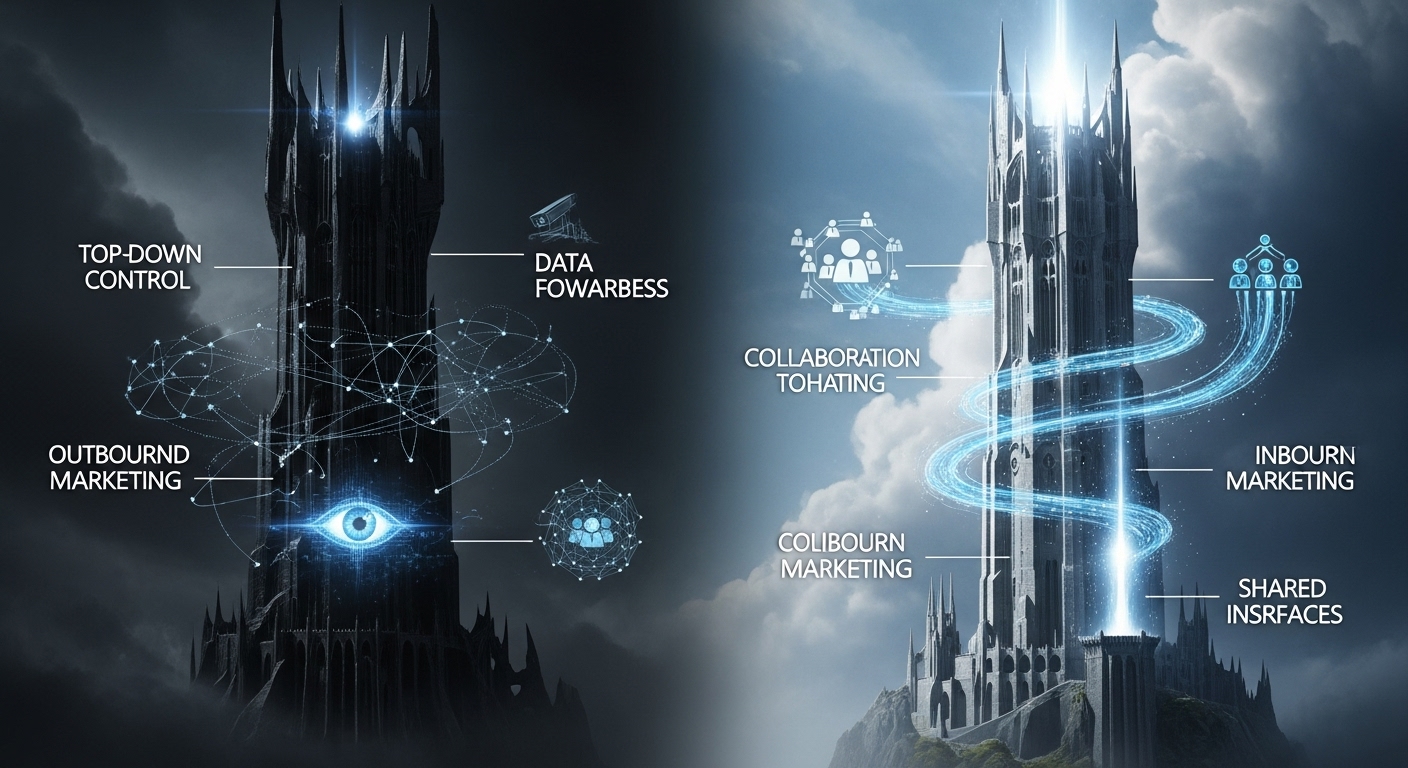
At the heart of The Lord of the Rings lies a fundamental conflict not just between armies, but between two opposing strategic philosophies. The first, embodied by the Dark Lord Sauron, is a strategy of absolute control, domination, and fear—a top-down, coercive model that seeks to bend the world to a single will. The second, practiced by the Free Peoples and guided by Gandalf, is a strategy of alliance, inspiration, and shared purpose—a decentralized, collaborative model built on trust and free will.
2.1 The Eye of Sauron: The Strategy of Domination (Outbound Marketing)
This dichotomy serves as a powerful and nuanced allegory for the modern clash between outbound and inbound marketing, offering profound lessons on the long-term viability and ethical implications of each approach.
Sauron’s entire methodology is predicated on coercion and the imposition of his will upon Middle-earth. His original virtue was a love of order and a dislike for “wasteful friction,” which, twisted by his lust for power, became a desire to order the world according to his design, by force if necessary. This mirrors the philosophy of traditional outbound marketing, which seeks to impose a message upon a broad, often untargeted audience through interruption and repetition. Tactics like cold calling, mass advertising, and unsolicited email campaigns are the marketing equivalent of Sauron’s legions—sent forth to conquer territory with the assumption that sheer volume and force will yield results.
Sauron’s armies are described as “little more than slaves, driven by fear,” with no genuine loyalty to his cause. This is the inherent weakness of an outbound-centric strategy. It views the audience not as a community to be nurtured, but as a resource to be exploited or an obstacle to be overcome. While this approach can be effective when competitors are weak or fragmented, it inspires no lasting affinity. Customers acquired through aggressive, interruptive tactics are customers won by coercion, not conviction. They are more likely to churn and less likely to become brand advocates.
Furthermore, the narrative of The Lord of the Rings repeatedly illustrates that evil, as a strategic model, is parasitic and ultimately self-destructive. It cannot create; it can only corrupt or consume what is already good. This is shown in the very fabric of Sauron’s forces. After the battle in the tower of Cirith Ungol, Samwise discovers that the Orcs have slaughtered each other in their greed for Frodo’s mithril coat. The wizard Saruman, after falling to the temptation of power, is ultimately slain not by the heroes, but by his own debased servant, Gríma Wormtongue. Most critically, the quest succeeds because Gollum’s all-consuming greed for the Ring leads him to his own destruction, taking the Ring with him. These events serve as a potent metaphor for the consequences of a marketing strategy built on domination. Overly aggressive sales tactics, deceptive advertising, and a relentless focus on conquest over customer value inevitably lead to brand erosion, high customer churn, internal team burnout, and a toxic market reputation. Like Sauron’s empire, a brand built on such principles is a house of cards, powerful in appearance but rotten from within and destined to collapse.
2.2 The White Council: The Strategy of Alliance (Inbound Marketing)
In stark contrast to Sauron’s monolithic command structure, the strategy of the Free Peoples is decentralized, collaborative, and built on a foundation of trust and shared values. This approach is the essence of inbound marketing: attracting a willing audience by providing value, solving problems, and building a community around a common purpose.
The figurehead of this strategy is Gandalf. He does not command armies or rule kingdoms; he counsels, guides, and unites disparate peoples by appealing to their better nature and shared interest in preserving their freedom. The Fellowship of the Ring itself is the perfect model of an inbound campaign’s core audience. It is a coalition of specialists from different “audience segments”—Elves, Dwarves, Men, and Hobbits—each with their own culture and motivations, who voluntarily join the quest because they believe in its mission. Their strength lies not in uniformity, but in their diversity and the synergy of their combined skills. The core message that unites them is not one of domination, but of hope and empowerment, encapsulated in the idea that “small everyday deeds of ordinary folk…keep the darkness at bay”. This empowers the individual rather than subjugating them to a central will.
The communication methods employed by the Free Peoples further reinforce this inbound philosophy. Sauron has the Palantíri, tools for surveillance and top-down control. The forces of good have the Beacons of Gondor. The lighting of the beacons is not a command; it is a signal, a plea for aid that an ally, Rohan, is free to answer or ignore. It is a piece of high-value, urgent “content” that communicates a clear need. Rohan’s choice to ride to Gondor’s aid is a “conversion” based on a pre-existing relationship of trust and mutual respect. This is the inbound model in its purest form: creating valuable, relevant content and experiences that attract qualified leads, who then choose to engage with the brand on their own terms. The goal is to be a trusted signal in the noise, not the loudest shout.
This strategic difference reveals Sauron’s greatest weakness. His closed, top-down system is incapable of innovation; it can only mimic and corrupt what already exists. His power, though immense, is finite and entirely bound to the Ring. The Fellowship, conversely, represents an open, decentralized network that allows for unpredictable, emergent solutions. Sauron’s fatal flaw is his inability to comprehend any motivation other than the lust for power. He cannot conceive that his enemies would seek to destroy the Ring rather than wield it for themselves. He cannot factor variables like pity, mercy, or friendship into his strategic calculations. This blind spot is his ultimate undoing. The quest’s success hinges on a series of “irrational” acts of mercy—Bilbo and Frodo’s repeated sparing of Gollum’s life—that Sauron’s command-and-control model could never predict. For marketers, this is a profound lesson. A strategy that is purely top-down and data-driven, focused only on predictable conversion funnels, is brittle and vulnerable. It misses the powerful, often unquantifiable, human elements of community, serendipity, and genuine goodwill. An inbound strategy that empowers its community allows for unexpected positive outcomes—a “eucatastrophe,” as Tolkien called it, a sudden and joyous turn of events —that a rigid outbound plan could never engineer.
2.3 The One Ring: The Peril of a Single, Corrupting Message
The One Ring is the narrative and symbolic heart of the saga. It is the ultimate personification of the will to power, a physical manifestation of the desire to dominate all life. Forged by Sauron to control the wearers of the other Rings of Power, it symbolizes a brand message or value proposition that is built entirely on control and market domination. Its inscription, “One Ring to rule them all, One Ring to find them, One Ring to bring them all and in the darkness bind them,” is the ultimate outbound marketing slogan.
The Ring’s primary power is the “domination of the wills of their users“. Its influence is so potent that it corrupts even those with noble intentions. Boromir, a valiant man who loves his people, falls to its temptation because he wishes to use its power as a weapon to defend Gondor. His downfall is a cautionary tale for brands and marketers. A core message focused solely on power, on crushing the competition, or on achieving absolute market dominance (“One Ring to rule them all“) is inherently corrupting. It inevitably leads to a focus on short-term gains at the expense of long-term trust, pushing the organization toward unethical practices and a toxic culture. The brand becomes a slave to its own aggressive positioning, just as the Ring-bearer becomes a slave to the Ring.
Therefore, brands must consciously resist the temptation to build their identity around a message of domination. The alternative, modeled by the Fellowship, is a message centered on service, community, empowerment, and shared values. The goal of a healthy brand is not to “bind” customers in a restrictive ecosystem, but to empower them and help them succeed. The destruction of the Ring symbolizes the rejection of this corrupting philosophy—the understanding that true, sustainable success comes not from wielding power over others, but from letting it go in service of a greater good.
| Feature | Sauron’s Strategy (Outbound Marketing) | The Fellowship’s Strategy (Inbound Marketing) |
|---|---|---|
| Core Driver | Fear, Power, Domination | Hope, Trust, Shared Purpose |
| Communication | Top-Down, Unidirectional (The Eye, Palantíri) | Decentralized, Networked (Council, Beacons, Messengers) |
| Message | “One Ring to Rule Them All” (Monolithic, Control-Focused) | “Unite to Defend the Free Peoples” (Coalition, Value-Focused) |
| Tactics | Coercion, Armies, Threats, Deception | Inspiration, Alliance, Sacrifice, Authenticity |
| Audience View | Subjects to be Controlled (Slaves) | Partners to be Empowered (Allies) |
| Long-Term Result | Internal Corruption, Betrayal, Self-Destruction | Enduring Loyalty, Growth, Eucatastrophe (Sudden Joyful Turn) |
Section 3: The Fellowship of the Brand – Assembling Your High-Performance Marketing Team
The success of the quest to destroy the One Ring was not the work of a single hero, but the achievement of a diverse, collaborative, and cross-functional team. The Fellowship of the Ring, composed of nine walkers from the four Free Peoples of Middle-earth, serves as an ideal model for the structure and dynamics of a modern, high-performance marketing department. Each member brings a unique set of skills, a distinct cultural perspective, and a vital role to the mission, illustrating the principle that breaking down organizational silos and fostering collaboration between specialists is the key to overcoming insurmountable challenges.
3.1 The Nine Walkers: A Model for the Cross-Functional Team
The composition of the Fellowship was a strategic masterstroke by Elrond and Gandalf, balancing the strengths and weaknesses of its members to create a whole far greater than the sum of its parts.
This provides a clear blueprint for assembling a marketing team capable of navigating the complex journey from brand awareness to customer advocacy.
-
Gandalf, the Chief Strategist / CMO: As a wizard, Gandalf possesses deep knowledge of the history and lore of Middle-earth, allowing him to understand the long-term stakes of the conflict and devise the overarching strategy. He is the visionary who sees the big picture, from the Shire to Mount Doom. He acts as a mentor, guiding the other members but allowing them to make their own choices and grow into their roles. His pragmatism, wisdom, and ability to unite disparate factions make him the ideal Chief Marketing Officer. His transformation from Gandalf the Grey to Gandalf the White after his battle with the Balrog represents a strategic pivot—a necessary re-branding and enhancement of power in response to a changing and more dangerous market landscape.
-
Aragorn, the Brand Evangelist / CEO: Initially introduced as the mysterious ranger “Strider,” Aragorn’s journey is one of embracing his true identity as the heir to the throne of Gondor. He is a reluctant leader who earns loyalty not through his title, but through his actions, integrity, and unwavering commitment to the mission. He embodies the brand’s authentic values, leading from the front and inspiring deep devotion in those who follow him. His famous line to the hobbits, “My friends, you bow to no one,” demonstrates a leadership style based on respect and service. His arc from a lone wanderer to a unifying king represents the journey of a brand that fully steps into its leadership potential, earning its market position through authentic action and unifying its diverse customer base.
-
Frodo, the Core Advocate / Product Manager: As the Ring-bearer, Frodo is tasked with carrying the brand’s most critical and burdensome asset. He is not the strongest, wisest, or most skilled warrior in the Fellowship. He is chosen for his humility and resilience—a temperament well-suited to resist the Ring’s corrupting influence. This mirrors the role of a Product Manager, who is intimately responsible for the core product or message. They bear the weight of its success or failure, navigating internal and external pressures while staying true to the product’s essential purpose. Frodo’s journey highlights the immense personal toll and responsibility placed on those who are closest to the mission’s core.
-
Samwise Gamgee, Head of Customer Loyalty & Support: While Frodo is the Ring-bearer, Tolkien himself identified Sam as the “chief hero” of the story, and for good reason. Sam represents the absolutely critical function of customer support and loyalty. His role is defined by unwavering service, practical problem-solving (he is the one who remembers the rope), and profound emotional support. He keeps the mission on track when the core advocate, Frodo, falters under the weight of his burden. Sam’s famous declaration, “I can’t carry it for you, but I can carry you,” is the ultimate mission statement for any customer success team. It demonstrates that the goal is to ensure the customer (Frodo) successfully completes their journey, even when it requires extraordinary effort. Without Sam, the mission would have failed.
-
Legolas & Gimli, Multi-Channel Specialists (e.g., Social Media & SEO): The Elf and the Dwarf begin their journey as representatives of historically rival cultures, their interactions marked by suspicion and competition. Their developing friendship and powerful partnership become one of the saga’s most potent symbols of unity. This serves as a perfect analogy for the integration of different marketing channels. Legolas, with his keen sight, grace, and long-range precision, can be seen as the social media or content marketing specialist, focused on elegant execution and broad engagement. Gimli, grounded, sturdy, and focused on the hidden wealth beneath the mountains, represents the technical specialist in areas like SEO or data analytics, delving deep to find foundational value. Their friendly rivalry (“That still only counts as one!”) shows how different channels can be measured and optimized in concert to achieve a common goal, transforming initial friction into a powerful, synergistic force.
-
Merry & Pippin, Content Creators / Community Managers: The two younger hobbits begin the journey as naive and somewhat reckless companions, representing the perspective of a new, uninitiated customer. They provide comic relief but also ask the simple, essential questions that more experienced members might overlook. Their journey is one of significant growth; they are captured, escape, and play pivotal roles in the victories at Isengard and in the Scouring of the Shire. This arc mirrors the evolution of a community member into a powerful brand advocate. They learn the “lore,” become seasoned experts, and are eventually able to lead and defend their own segment of the community (the Shire), demonstrating a deep understanding of their local audience’s needs and motivations.
-
Boromir, the Voice of Traditional Sales / Outbound: Boromir of Gondor is a good man with a noble goal: to protect his people. However, his perspective is rooted in the traditional use of power. He sees the Ring not as an absolute evil to be destroyed, but as a “weapon of the enemy” to be wielded against him. He represents the results-driven, traditional sales or outbound marketing mindset that prioritizes immediate, tangible power to achieve quarterly goals. His tragic fall to the Ring’s temptation is a powerful lesson: even team members with the best intentions can be corrupted and undermine the mission if they do not fully align with the core inbound philosophy of building trust over wielding force. His heroic death and redemption, defending Merry and Pippin, show the immense value and sacrifice that this perspective can bring to the team once it is fully committed to the shared, selfless mission.
The success of the Fellowship demonstrates a critical organizational principle. It is not enough to have a brilliant strategist like Gandalf or a loyal executor like Sam working in isolation. The two functions are symbiotic. Gandalf’s high-level plan—”The Ring must be taken to Mordor”—provides the essential direction and purpose. Without this guiding vision, Sam’s loyalty would be aimless. Conversely, Sam’s ground-level execution and unwavering support are what make the strategy possible. Gandalf’s plan would have failed at the Ford of Bruinen, on the slopes of Mount Doom, and most certainly in the tower of Cirith Ungol without Sam’s intervention. A marketing strategy, no matter how brilliant, is merely a theoretical document without a dedicated team to execute it and support the customer through their journey. Likewise, a world-class customer support team cannot achieve its full potential without a clear, overarching strategic vision to guide its efforts. The CMO’s office and the customer loyalty department must be deeply integrated, with strategy informing support and the on-the-ground insights of support continuously refining the strategy. They are two halves of the same whole, and only by working in perfect concert can the quest succeed.
Section 4: There and Back Again – Mapping the Customer’s Journey
The epic quest undertaken by Frodo Baggins is more than a simple adventure narrative; it is a sophisticated and emotionally resonant model for the modern customer journey. Traditional marketing often depicts this journey as a linear funnel, a straightforward progression from awareness to purchase. Tolkien’s narrative, however, offers a more realistic and powerful framework—one that acknowledges the emotional costs, the unexpected trials, and the profound transformation that characterize deep and lasting brand engagement. From the initial call to adventure in the quiet of the Shire to the arduous return and the final, bittersweet departure, the saga maps the complete lifecycle of a true brand advocate.
4.1 The Call to Adventure: From the Shire to Rivendell (Awareness & Consideration)
Every customer journey begins in an “Ordinary World.” For Frodo, this is the Shire—a place of comfort, peace, and a blissful ignorance of the great dangers in the world beyond its borders. This represents the customer’s initial state before they become aware of a problem or a need that a brand can solve. The “Call to Adventure” arrives with Gandalf, who reveals the true nature of Bilbo’s ring and the existential threat it poses. This is the moment of awareness, when a piece of content, an advertisement, or a recommendation makes the customer conscious of a challenge or opportunity.
Crucially, the hero’s first reaction is often a “Refusal of the Call”. Frodo is initially reluctant and terrified, wishing the Ring had never come to him. This mirrors a customer’s natural inertia and hesitation to change their habits, adopt a new technology, or invest in a complex solution. The subsequent journey from the Shire to the sanctuary of Rivendell represents the consideration and evaluation phase of the customer’s journey. Along the way, Frodo and his companions face tests (the Black Riders), encounter enemies (the Barrow-wights), and find allies and mentors (Tom Bombadil, Aragorn). This is analogous to a customer’s research process, where they encounter competing brands (“enemies”), seek out reviews and testimonials (“allies”), and look for expert guidance (“mentors”). The Council of Elrond in Rivendell is the culmination of this phase. It is the critical decision-making moment—the final sales meeting or demo—where all the stakeholders gather, the full scope of the problem is laid bare, and a commitment to a course of action is made.
4.2 The Road to Mordor: The Trials of Conversion and Loyalty
In many marketing models, the customer’s signature on a contract or their click on the “buy” button marks the end of the journey.
In Tolkien’s framework, it is merely the beginning of the most critical phase. The perilous journey from Rivendell to Mordor—through the Mines of Moria, across the Dead Marshes, and into the heart of the enemy’s land—represents the post-purchase experience. This is where the customer implements the solution and where their true loyalty to the brand is forged or broken.
This phase is defined by a series of ordeals that test the customer’s commitment and the brand’s promises. The breaking of the Fellowship at Amon Hen symbolizes the moment a customer transitions from the guided implementation of a sales team to using the product on their own. The brand must provide ongoing support to help the customer navigate challenges and achieve their ultimate goal (the “destruction of the Ring“). This support can take many forms: the Elves’ gift of lembas bread, the “waybread” that sustains the hobbits on their journey, is a perfect metaphor for valuable, sustaining content like a knowledge base, tutorials, or proactive customer support that helps users persevere when they might otherwise give up. It is in overcoming these post-purchase difficulties, with the brand’s support, that a mere customer is transformed into a deeply loyal advocate.
4.3 An Inverted Hero’s Journey: The True Cost and Nature of Advocacy
The most profound and strategically vital lesson from Frodo’s quest lies in its radical departure from the traditional “Hero’s Journey.” In a typical monomyth, the hero starts weak and grows in power, confidence, and ability as they progress, returning home victorious and enhanced. Frodo’s journey is the inverse of this. He begins the story as relatively brave, knowledgeable, and resolute—the first of the hobbits to draw a sword against the Nazgûl on Weathertop. However, as he travels closer to Mordor, the Ring’s burden makes him progressively weaker, more wounded, less mentally stable, and more dependent on Sam. He returns to the Shire not as a celebrated conqueror, but as a “broken and defeated person,” so traumatized by his ordeal that he cannot enjoy the peace he fought to secure. He is, in the end, “damaged beyond repair” and must leave Middle-earth forever to find healing.
This tragic arc is a powerful and sobering metaphor for the experience of a brand’s most dedicated “super-advocates.” These are the customers who go above and beyond: they defend the brand in public forums, they write detailed product reviews, they spend countless hours providing unpaid feedback, they onboard new users in the community. They are, in effect, carrying the “Ring” for the brand, and this advocacy takes a heavy toll. They absorb the negativity of detractors, they grapple with product flaws, and they invest their own emotional energy into the brand’s success.
This presents a critical imperative for any company with a strong community. Brands must recognize that their most valuable advocates are not simply assets to be leveraged for marketing reach. They are individuals making a significant personal sacrifice. The brand’s role, therefore, is to be Samwise to their Frodo. It must provide dedicated support, listen actively to their feedback, acknowledge their immense contribution, and share the load wherever possible. This can be achieved through formal advocate programs, dedicated support channels, exclusive access to product teams, and public recognition of their efforts. Failure to do so risks advocate burnout, a scenario where the brand’s most passionate supporters become so exhausted that they quietly “sail into the West,” leaving the community and the brand forever.
This journey model must also account for the final, often-overlooked stage of the customer lifecycle, which is represented by the Scouring of the Shire. The story does not end with the destruction of the Ring at Mount Doom. When the hobbits return home, they find the Shire has been corrupted by Saruman’s ruffians. This represents the challenge of internal adoption a customer faces after implementing a new solution. It is not enough to achieve the primary objective; they must then return to their own “company” and champion the new way of doing things, overcoming resistance from those invested in the status quo. Significantly, Frodo, the primary advocate, is too traumatized and exhausted from the main quest to lead this final battle. Instead, it is Merry and Pippin—who have undergone their own, more traditional hero’s journeys of growth—who rally the hobbits and lead the successful rebellion. This provides a crucial lesson for B2B marketers in particular: the primary user who led the implementation may be too spent to drive internal adoption. A complete customer journey strategy must include a “Scouring the Shire” phase, where the brand actively identifies and empowers secondary champions—the “Merrys and Pippins” who have grown through the process—with the case studies, training materials, and support they need to evangelize the solution and overcome resistance within their own organization.
Section 5: Strategic Recommendations: Lighting the Beacons for Your Brand
The rich tapestry of Middle-earth offers more than just high-level philosophical frameworks; it provides a wealth of practical, actionable strategies that can be directly applied to the challenges of modern digital marketing. By synthesizing the lessons from Tolkien’s narrative, Peter Jackson’s adaptations, and the real-world phenomena they inspired, marketers can develop a more resonant, resilient, and effective approach to building their brand and community. This final section translates the core principles of the saga into a set of strategic recommendations for lighting the beacons of your own brand.
5.1 The Hobbiton Model: From Immersive Content to Premium Experience
The real-world Hobbiton tourist attraction in New Zealand is a masterclass in translating a beloved brand world into a premium, experience-driven business. Its success is not accidental; it is built on principles that any digital brand can and should adopt.
- Provide a Great Experience: A key factor in Hobbiton’s success is the quality of its tour guides. They are not merely reciting a script; they are genuine, passionate fans of the films, and their enthusiasm is infectious. They know the deep lore, the behind-the-scenes stories, and can answer questions from the most dedicated “uber geek” fans.
- Application: Your customer-facing teams—from sales and support to community management—must be authentic brand evangelists. Invest in training that goes beyond product features to include brand history and values. Hire for passion, as genuine enthusiasm for the brand’s mission cannot be faked and is a powerful tool for building customer rapport.
- Attention to Detail Creates Social Proof: One of the most memorable parts of the Hobbiton tour is receiving a complimentary drink at the Green Dragon Inn, served in mugs that are exact replicas of those used in the films. This is a relatively low-cost detail, but it provides an immense experiential payoff. It creates a moment of authentic immersion that visitors are eager to capture and share, resulting in a ridiculous number of selfies and social media posts that serve as powerful, user-generated marketing.
- Application: Scrutinize your digital user experience (UX) and customer service processes to identify opportunities for small, delightful details. This could be a witty confirmation email, a personalized onboarding video, or a surprisingly helpful error message. These “Green Dragon mug” moments are what make an experience memorable and shareable, generating positive word-of-mouth and valuable social proof.
- Create Premium Tiers for Super-Fans: Hobbiton understands that not all customers are the same. While most visitors take the standard tour, the park also offers premium upsell opportunities for its most dedicated fans. These include “early access” small-group packages that allow for photos without crowds, and the chance to have “second breakfast” inside the Green Dragon Inn for an additional charge.
- Application: Do not assume that all your customers want the most basic or cheapest option. Identify your most engaged users and develop premium offerings specifically for them. This could include early access to new features, exclusive content, direct access to your product team, or premium support tiers. Many of your most loyal customers will be happy to pay a premium for a deeper, more exclusive experience that acknowledges and rewards their dedication.
5.2 Know Your Audience: Segmenting Elves, Dwarves, Men, and Hobbits
The diverse races of Middle-earth provide a sophisticated framework for audience segmentation that goes far beyond simple demographics. By understanding the core values, motivations, and psychographics of each group, marketers can tailor their messaging, content, and channel strategy for maximum resonance and effectiveness.
- Elves (The Aesthetes & Purists): Elves are defined by their immortality, which gives them a long-term perspective. They value beauty, wisdom, history, and the preservation of what is good and fair. They are masters of art and lore but can be resistant to change and prone to a certain melancholy for a fading world.
- Marketing To Them: This segment represents your brand’s long-term, high-value purists. Reach them with elegant, minimalist design and sophisticated, intellectual content like in-depth white papers, brand heritage stories, and philosophical essays. Avoid aggressive sales tactics and focus on building a relationship based on shared values and mutual respect. They are not swayed by fleeting trends but by timeless quality and craftsmanship.
- Dwarves (The Pragmatists & Artisans): Created from stone, Dwarves are stubborn, resilient, and fiercely loyal to their kin. Their culture revolves around masterful craftsmanship, mining, and the accumulation of tangible wealth and heirlooms.
They are secretive, value tradition, and place a high premium on honor and keeping oaths.
Marketing To Them
This segment represents the pragmatic, ROI-focused customer. Your messaging should emphasize product quality, durability, security, and long-term value. Use case studies and testimonials from trusted sources within their industry (“clan”). Communication should be direct, honest, and free of hyperbole. They value reliability and tangible results over aesthetic appeal or lofty promises.
Men (The Ambitious & Volatile)
The defining characteristic of Men is their mortality, the “Gift of Men,” which fuels their ambition. They desire to make their mark on the world, to build legacies, and to wield power in their short time. They are the most diverse race, capable of the greatest heroism (Aragorn) and the most profound weakness (Boromir’s temptation).
Marketing To Them
This segment is motivated by growth, achievement, and efficiency. Appeal to their ambitions with content that showcases success stories, clear paths for advancement, and tools that grant them power and influence in their field. Your messaging should be inspiring and aspirational but must be backed by concrete data and evidence of effectiveness. They are the drivers of change and innovation in the market.
Hobbits (The Community & Comfort-Seekers)
Hobbits value peace, comfort, good food, and strong community bonds above all else. They are generally parochial, resistant to adventure, and distrustful of the “big folk” and their complicated affairs. However, they possess a surprising resilience and a deep-seated loyalty to their friends and their way of life.
Marketing To Them
This segment represents the user who prioritizes ease of use, reliability, and community consensus. Focus your marketing on user-friendliness, customer support, and the ways your product simplifies their life and fosters connection. Use warm, friendly, and approachable language. Social proof, community forums, and testimonials from peers are far more effective than appeals to power or ambition. They are the heart of your user base, and their quiet, steady loyalty is an invaluable asset.
Conclusion: Deciding What to Do With the Time That Is Given Us
In a moment of despair in the Mines of Moria, Frodo laments the burden that has fallen to him. Gandalf’s reply contains the central moral thesis of the entire saga and the ultimate guiding principle for any strategic endeavor: “All we have to decide is what to do with the time that is given us”. This is a call to purposeful action, long-term vision, and a belief in the power of good, which should form the foundation of any enduring marketing strategy.
The lessons from Middle-earth are clear and profound. First, plan for the long road. A successful marketing strategy is not a series of disconnected gimmicks but a long, arduous journey that requires foresight, endurance, and a clear destination. It is about building a world, not just launching a product.
Second, understand that quality beats quantity. An army of brutish Orcs is ultimately no match for the courage and diverse skills of a small, dedicated Fellowship. In marketing, this means focusing on creating high-quality, valuable content and nurturing a core community of passionate advocates, rather than chasing the vanity metrics of mass, low-engagement audiences.
Finally, and most importantly, never underestimate the power of the small and the seemingly insignificant. The great and the wise of Middle-earth debated and despaired, but the final victory was achieved by the “small hands” of two hobbits, because “the eyes of the great are elsewhere”. For the modern marketer, this is the ultimate takeaway. Your individual customers, your quietest community members, your most humble advocates—they are the hobbits of your brand. A strategy built on domination and control will overlook them. But a strategy built on empathy, empowerment, and a genuine desire to serve will recognize their true power. It is their small, everyday acts of kindness, loyalty, and love for your brand that will, in the end, keep the darkness at bay.