

Nepal’s Democratic Progress: Achievements & People’s Sovereignty
I. Introduction: The Long Arc Towards a Republic
Nepal’s journey through the modern era is a compelling narrative of a nation’s relentless pursuit of self-determination. It is a history often defined by its turbulence—marked by revolutions, a decade-long civil war, royal coups, and persistent political instability. While this narrative of struggle is accurate, it is incomplete. A deeper analysis reveals a more profound and ultimately affirmative story: a long, arduous, yet successful arc bending towards a sovereign republic. This report presents a systematic assessment of Nepal’s democratic history, with a deliberate focus on its positive outcomes and foundational achievements. It advances the central thesis that Nepal’s democratic experience, characterized by a series of popular movements, has progressively and irrevocably vested sovereignty in its people. These movements were not disparate failures but interconnected phases of a multi-generational struggle that fundamentally reshaped the Nepali state, creating the essential framework for unprecedented gains in human rights, social inclusion, and socio-economic development.
The cyclical nature of Nepal’s major democratic upheavals—in 1951, 1990, and 2006—is often misinterpreted as a sign of systemic failure. A more nuanced perspective, however, sees this pattern as evidence of a deeply embedded and resilient democratic aspiration within the populace that periods of autocracy could suppress but never extinguish. Each movement built upon the legacy of the last, progressively dismantling layers of autocratic control. The 1951 revolution ended a century of oligarchic Rana rule but was subverted by a resurgent monarchy in 1960. This did not terminate the democratic project; rather, it clarified the next obstacle. The 1990 Jana Andolan (People’s Movement) was a direct continuation of this struggle, explicitly demanding the restoration of the multi-party system and successfully constraining the power of the absolute monarch. When this constitutional arrangement was again abrogated by a royal seizure of power in 2005, the 2006 Loktantra Andolan (Democracy Movement) drew its strength from the political parties and civil society that had flourished post-1990, culminating in the final abolition of the monarchy itself. This progression demonstrates a clear learning curve, where each phase addressed the structural limitations of the previous one, leading to the final establishment of a republic where sovereignty rests, at last, with the people.
This report will trace this trajectory by examining the tangible, positive outcomes that are a direct consequence of these democratic victories. It will proceed thematically, moving from an analysis of the foundational political triumphs that established popular rule to an exploration of their institutional and societal impacts. The analysis begins by dissecting the three pivotal movements that dismantled autocracy. It then evaluates the institutionalization of rights through the landmark 2015 Constitution and the flourishing of a free press and civil society. Subsequently, the report quantifies the tangible socio-economic dividends of democracy, presenting data on human development, public health, and poverty reduction. Finally, it examines unique and successful governance models, such as community forestry and federalism, that have emerged from Nepal’s democratic experience. Through constitutional analysis, historical review, and quantitative data, this report constructs a robust, evidence-based argument for what went right in Nepal’s long and noble struggle for democracy.
II. Foundational Political Victories: Establishing the Pillars of Democracy
The establishment of a democratic republic in Nepal was not a single event but a cumulative process of dismantling successive layers of autocratic rule. Three historical moments stand as the primary pillars of this transformation: the 1951 revolution, which introduced the modern concept of democracy; the 1990 Jana Andolan, which institutionalized political pluralism; and the post-2006 process, which culminated in the abolition of the monarchy. Viewed collectively, these events represent a coherent and successful progression toward vesting full sovereignty in the Nepali people. The political achievements were not merely about changing rulers but about fundamentally redefining the source of state power, moving from an oligarch, to a king, to a parliament, and finally, to the people themselves.
2.1 The 1951 Revolution: The Dawn of Democratic Aspiration
The 1951 revolution marks the genesis of Nepal’s modern democratic consciousness. For 104 years prior (1846–1951), the country was under the de facto rule of the Rana dynasty, a hereditary line of prime ministers who wielded absolute power. The Rana regime was a highly centralized, isolationist autocracy that effectively held the Shah monarch as a figurehead in a “palace prison”. Popular dissatisfaction began to simmer in the mid-20th century, particularly among a newly educated elite and Nepalis who had been influenced by the Indian independence movement and sought to liberate their own nation from autocratic rule. Political parties, such as the Nepal Praja Parishad (established 1936) and the Nepali Congress Party (formed in India in 1947), began organizing against the regime.
The revolution itself was a strategic and successful alliance between King Tribhuvan, who sought to reclaim his authority, and the nascent political parties, chiefly the Nepali Congress, which launched an armed uprising via its military wing, the Nepali Congress’s Liberation Army. After King Tribhuvan sought asylum in India in 1950, international pressure mounted on the Ranas. The conflict concluded with the Delhi Accord, a tripartite agreement between the Ranas, the Nepali Congress, and King Tribhuvan, which formally ended Rana rule on February 18, 1951.
The primary and enduring achievement of the 1951 revolution was its foundational success in overthrowing a deeply entrenched, century-old oligarchy. This act alone was a monumental victory that introduced the very concept of modern constitutional democracy to Nepal and reasserted the nation’s sovereignty on the world stage. The revolution led to the formation of an interim government—a coalition cabinet including both Rana and Nepali Congress members—and the promulgation of an interim constitution. While this initial experiment with democracy proved short-lived, its importance cannot be overstated. It opened what has been described as the “floodgates” of Nepal’s politics, economy, and foreign relations after centuries of self-imposed isolation, allowing the country to join the United Nations in 1955 and begin a process of national reconstruction with a new sense of direction. It was the first, indispensable step in transferring state power, moving it from the Rana prime minister back to the Shah monarch, which, in the context of the time, was a necessary precursor to the longer struggle for popular sovereignty.
2.2 The 1990 Jana Andolan: The Triumph of Pluralism
The democratic opening of the 1950s was abruptly terminated in 1960 when King Mahendra dismissed the elected government of B. P. Koirala, suspended the constitution, and banned all political parties. He then instituted the partyless Panchayat system, a tiered structure of councils that concentrated all effective power in the hands of the monarch. For three decades, this system curtailed civil liberties, imposed heavy censorship, and suppressed political dissent. While the Panchayat era saw some modernization of infrastructure, it was fundamentally an autocratic system that denied Nepalis their political rights.
By the late 1980s, internal discontent was mounting, catalyzed by a severe economic crisis exacerbated by a trade and transit dispute with India that led to a border blockade in 1989. Inspired by a global wave of democratic movements, Nepal’s political forces, which had been operating underground or in exile, saw an opportunity. The 1990 Jana Andolan was a powerful demonstration of political unity, coordinated by the Nepali Congress and a coalition of leftist groups known as the United Left Front. The movement officially began on February 18, 1990, and quickly grew into a mass civil resistance. It saw broad participation from students, lawyers, doctors, journalists, and workers, who took to the streets in massive protests, strikes, and demonstrations across the country. Despite a brutal crackdown by security forces that resulted in hundreds of deaths and mass arrests, the movement intensified, culminating in a protest of some 200,000 people in Kathmandu in early April. On April 8, 1990, King Birendra capitulated, lifting the ban on political parties and agreeing to establish a multi-party democracy.
The paramount achievement of the 1990 movement was the definitive restoration of political pluralism and the successful transition from an absolute monarchy to a constitutional one. This victory was institutionalized in the 1990 Constitution, a document widely praised at the time for its democratic character. Crucially, this constitution enshrined the principle of popular sovereignty, formally identifying “the people as the source of political legitimacy” and guaranteeing a host of fundamental human rights, including freedoms of expression, press, and assembly. This created the essential legal and political space for the subsequent flourishing of independent media, civil society, and competitive politics. After 30 years of royal autocracy, the democratic forces had correctly identified the monarchy as the primary obstacle to popular rule.
The 1990 victory successfully constrained the king, making him accountable to an elected parliament and decisively shifting the locus of state power from the palace to the people’s representatives.
2.3 The Republic’s Rise: The Culmination of the People’s Will
The democratic settlement of 1990, while a major advance, proved to be an unstable compromise. The new political system struggled to address Nepal’s deep-seated problems of poverty, social inequality, and the marginalization of rural and ethnic populations. These unresolved grievances provided fertile ground for the Communist Party of Nepal (Maoist) to launch a “People’s War” in 1996, aiming to overthrow the monarchy and establish a republic. The decade-long civil war resulted in an estimated 17,000 deaths and widespread displacement. The political situation was further destabilized by the 2001 royal massacre, which brought the more assertive King Gyanendra to the throne. Citing the government’s failure to quell the insurgency, King Gyanendra dismissed the prime minister in 2002 and ultimately seized absolute power in a coup on February 1, 2005, suspending the constitution and repressing civil liberties.
This royal takeover proved to be a critical miscalculation, as it united both the mainstream parliamentary parties and the Maoist insurgents in a common cause against the monarchy. The Seven-Party Alliance and the Maoists forged a 12-point understanding that paved the way for the 2006 Loktantra Andolan. This second “people power” movement, marked by weeks of violent strikes and mass protests, forced a cornered King Gyanendra to relinquish absolute power and reinstate the dissolved parliament on April 24, 2006. This pivotal moment led directly to peace talks and the signing of the Comprehensive Peace Accord (CPA) on November 21, 2006, formally ending the decade-long civil war.
The ultimate and crowning achievement of Nepal’s long democratic struggle was the abolition of the 240-year-old Shah monarchy. On May 28, 2008, the newly elected Constituent Assembly, in its very first meeting, voted overwhelmingly to abolish the kingdom and declared Nepal a Federal Democratic Republic. This historic act represented the final and complete transfer of sovereignty from the crown to the people. The civil war and the king’s 2005 coup had demonstrated that even a constitutional monarchy was an untenable arrangement for Nepal’s future. The establishment of the republic fulfilled the core demand of the most radical democratic and leftist movements and marked the successful culmination of a popular will for self-governance that had been building for over half a century. It was the final step in a logical progression, resolving the central contradiction of Nepali politics and firmly establishing the people as the sole source of state power.
III. The Institutionalization of Rights and Liberties
The political victories that dismantled autocracy were not ends in themselves but means to a greater end: the creation of a state founded on the principles of liberty, equality, and justice. The democratic periods, particularly after 1990 and 2006, were characterized by the difficult but essential work of translating popular aspirations into durable institutions. The promulgation of the 2015 Constitution stands as the capstone of this effort, creating a rights-based framework for an inclusive republic. Concurrently, the political space opened by democracy allowed for the organic growth of two critical pillars of a free society: an independent press and a vibrant civil society, which serve as essential watchdogs of state power.
3.1 The 2015 Constitution: A Charter for an Inclusive Republic
The promulgation of the Constitution of Nepal on September 20, 2015, was a historic achievement, fulfilling a promise first made to the Nepali people in 1951: the right to draft their own constitution through a popularly elected Constituent Assembly. The process was arduous, spanning nearly eight years and requiring two separate Constituent Assembly elections after the first failed to produce a consensus document. The final constitution, endorsed by over 90% of the assembly’s members, represents the largest democratic exercise in the nation’s history and serves as a social contract designed to rectify historical injustices. Its emphasis on inclusion is a direct outcome of the lessons learned from the civil war and various identity-based movements, reflecting a hard-won consensus that a stable democracy in Nepal is impossible without addressing the grievances of its diverse and often marginalized communities.
The constitution’s key achievements lie in its progressive and comprehensive framework:
- Institutionalization of Political Gains: The document formally establishes Nepal as a secular, federal democratic republic, cementing the core political victories of the post-2006 era. The shift to secularism was a significant break from the 1990 Constitution, which had declared Nepal a Hindu state, thereby formally recognizing the nation’s multi-religious character.
- A Robust Charter of Fundamental Rights: The constitution enshrines an extensive list of 31 fundamental rights. These go beyond traditional civil and political liberties to include a wide range of economic, social, and cultural rights. In a landmark provision, Article 35 establishes basic healthcare as a fundamental right of every citizen, mandating that the state provide basic health services free of cost and ensuring no one is deprived of emergency care.
- A Framework for Radical Inclusion: Perhaps the constitution’s most significant and forward-looking achievement is its deep-seated commitment to proportional inclusion and social justice. It explicitly aims to end all forms of discrimination based on class, caste, region, language, religion, and gender. To achieve this, it mandates the proportional inclusion of marginalized communities—including women, Dalits (formerly “untouchable” castes), Janajatis (Indigenous Nationalities), Madhesis (plains people), Tharus, and Muslims—in all state bodies and public services. This principle is embedded in the electoral system, requiring political parties to ensure representation from these groups in their candidate lists for proportional representation seats in federal and provincial parliaments. These provisions are a direct, institutionalized response to the root causes of the decade-long conflict, representing a deliberate attempt to build a more equitable and thus more stable republic.
3.2 The Fourth Estate and Civil Society: Watchdogs of Democracy
A key measure of a democracy’s health is the freedom and capacity of its citizens and institutions to hold power to account. The autocratic Panchayat era was defined by the severe restriction of freedoms of speech, press, and assembly. The democratic opening of 1990 created the fertile ground necessary for the growth of these essential democratic watchdogs.
- The Growth of Independent Media: The post-1990 period witnessed an explosive growth in independent media. The progressive 1990 Constitution, which guaranteed press freedom, combined with economic liberalization policies, allowed private investors to enter the sector and establish media as a legitimate industry rather than a mere political tool. The number of private newspapers, FM radio stations, television channels, and, more recently, online news portals grew exponentially. This media boom dramatically enhanced the public’s access to information and amplified a diversity of voices, including those of marginalized communities, particularly through the rise of community radio in rural areas. This burgeoning free press played a critical role during Nepal’s subsequent political crises. Despite facing immense pressure, censorship, and violence from both the state and Maoist insurgents during the civil war and King Gyanendra’s direct rule, the media largely remained steadfast in its commitment to democratic values, serving as a crucial watchdog by exposing abuses of power and advocating for reform.
- The Flourishing of Civil Society: In parallel with the media, civil society in Nepal expanded significantly after the restoration of democracy in 1990. Thousands of non-governmental organizations (NGOs), human rights groups, professional associations, and community-based organizations were established. These organizations have become vital actors in Nepal’s democratic landscape, contributing to social development, delivering essential services in areas like health and education, advocating for legal and political reform, and mobilizing citizens during the major pro-democracy movements. Professional associations of lawyers, journalists, and doctors were instrumental in adding legitimacy and momentum to the 1990 movement by voicing demands for the rule of law and civic rights. The 2015 Constitution formally protects the freedom to form unions and associations, providing a secure legal foundation for the continued work of this vibrant and essential sector.
IV. Tangible Gains: Socio-Economic and Developmental Progress
The ultimate test of any political system is its ability to improve the lives of its citizens. While Nepal’s democratic journey has been fraught with instability, a clear analysis of key development indicators reveals that the transition away from autocracy, particularly after 1990, served as a critical inflection point for broad-based national progress. The political shift unlocked new policy priorities and created an environment conducive to remarkable achievements in human development, public health, and poverty alleviation.
These tangible gains represent the most compelling evidence of what went right in Nepal’s democratic era.
A Revolution in Human Development
The contrast between the developmental stagnation of the Panchayat era and the progress achieved during the democratic period is starkly illustrated by the United Nations’ Human Development Index (HDI), a composite measure of life expectancy, education, and income. As shown in Table 1, Nepal’s HDI value surged by over 50% in the decades following the restoration of democracy, a clear indicator of a profound improvement in the overall quality of life.
| Year | HDI Value | Life Expectancy at Birth (Years) | Expected Years of Schooling (Years) | Mean Years of Schooling (Years) | GNI per capita (2017 PPP$) |
|---|---|---|---|---|---|
| 1990 | 0.399 | 54.3 | 7.5 | 2.0 | 1,168 |
| 2000 | 0.446 | 62.4 | 9.0 | 2.4 | 1,526 |
| 2010 | 0.529 | 67.9 | 12.0 | 3.3 | 2,001 |
| 2015 | 0.566 | 69.9 | 12.2 | 4.7 | 2,353 |
| 2022 | 0.602 | 70.1 | 12.2 | 4.9 | 2,471 |
| Sources: Data compiled from multiple sources tracking UNDP Human Development Reports. | |||||
This dramatic improvement was driven by progress across all components of the index:
- A Leap in Life Expectancy: Life expectancy at birth, a fundamental indicator of a nation’s health and well-being, increased from just 54.3 years in 1990 to over 70 years by 2022. This gain of roughly 16 years in three decades reflects significant improvements in healthcare, nutrition, and sanitation.
- An Explosion in Education: The democratic era ushered in a massive expansion of access to education. The adult literacy rate, which languished at a mere 21% in 1981 and had only reached 33% by 1991, soared to 71.15% by 2021. This achievement was the result of a concerted policy focus on education, which had been deliberately restricted for the general populace during the preceding Rana and Panchayat regimes. Mean years of schooling for adults more than doubled, from 2.0 years in 1990 to 4.9 years in 2022, signifying a fundamental shift in the nation’s human capital.
Public Health: A Global Success Story
Nepal’s achievements in public health, particularly in maternal and child health, are recognized globally as a remarkable success story. This progress was not accidental but the result of a deliberate policy choice, enabled by the 1990 democratic transition, to prioritize a decentralized, community-based primary healthcare model. The 1991 National Health Policy was a landmark document that shifted the state’s focus from centralized, curative care to extending Primary Health Care (PHC) services to the most remote and disadvantaged rural populations.
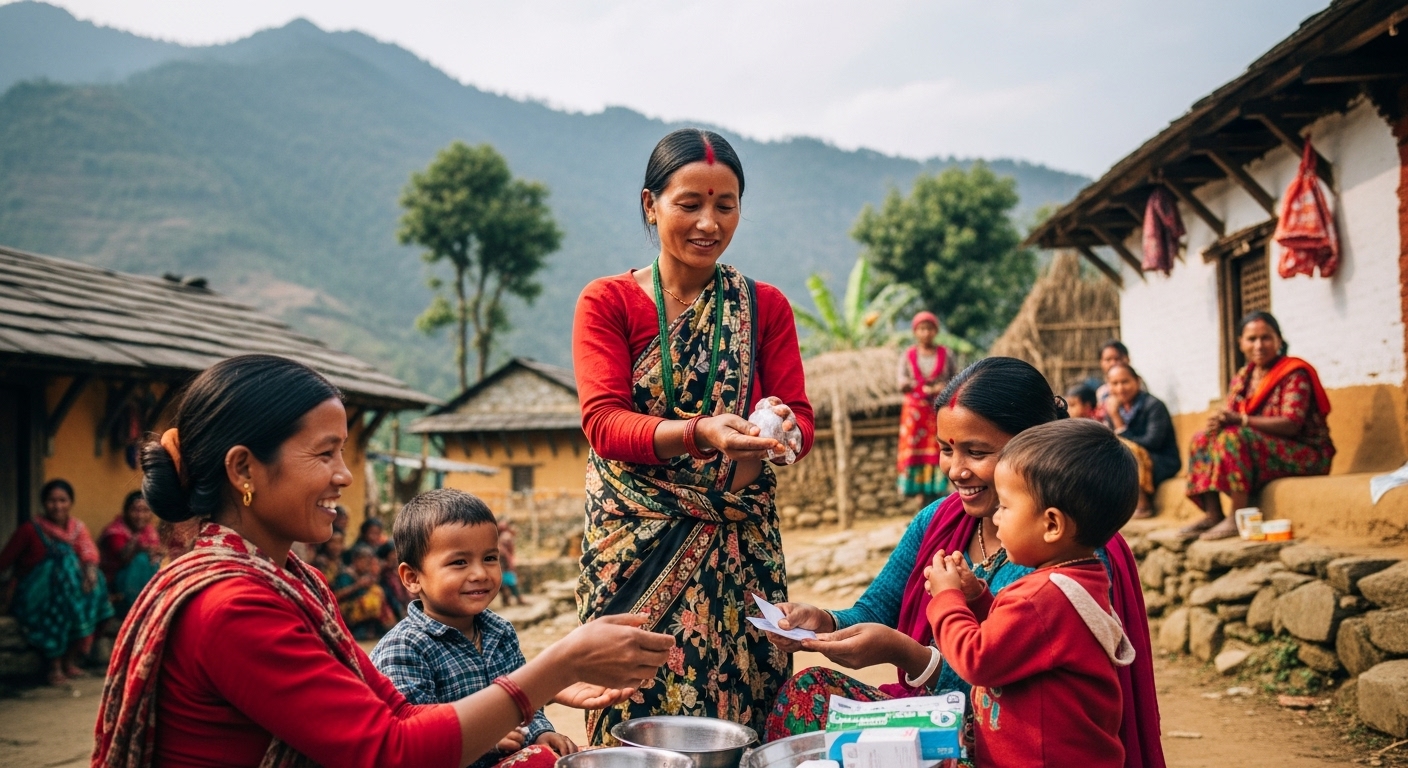
This policy was brought to life through several innovative and highly effective programs:
- Female Community Health Volunteers (FCHVs): The FCHV program, which was scaled up nationwide after 1991, stands as the cornerstone of Nepal’s public health success. This initiative created a network of tens of thousands of local women who serve as a vital bridge between their communities and the formal health system. These volunteers have been instrumental in delivering high-impact, low-cost interventions, including promoting family planning, distributing vitamin A supplements and oral rehydration salts, providing essential maternal health advice, and helping to manage common childhood illnesses. This decentralized, participatory approach proved uniquely effective for Nepal’s challenging geography and socio-economic context.
- Targeted Maternal and Child Health Programs: Building on the FCHV network, democratic governments launched targeted initiatives like the Safe Motherhood Program and the Aama (“Mother”) incentive scheme, which provides cash payments to women for delivering their babies in a health facility. These programs, combined with a massive expansion of PHC centers and birthing facilities, led to one of the world’s fastest declines in maternal and infant mortality rates. As shown in Table 2, maternal mortality plummeted from 850 deaths per 100,000 live births in 1990 to 170 by 2013, while infant mortality fell from 108 to 46 per 1,000 live births over the same period.
- High Immunization Coverage: The expansion of the PHC system also enabled highly successful immunization campaigns. By 2013, an impressive 87% of Nepali children were receiving all basic vaccinations, protecting a generation from preventable diseases.
Poverty Alleviation and Economic Change
The democratic period has overseen a significant reduction in poverty. While the Panchayat era was marked by economic stagnation, the post-1990 era saw poverty reduction become a central objective of successive governments’ periodic development plans. The results have been substantial.
| Indicator | Value in Panchayat Era (c. 1985-1991) | Value in Modern Democratic Era (c. 2019-2021) |
|---|---|---|
| Adult Literacy Rate (%) | 33% | 71.15% |
| Poverty Rate (% below national line) | 42% | 15.1% |
| Maternal Mortality Rate (per 100,000 live births) | 850 | 170 |
| Infant Mortality Rate (per 1,000 live births) | 108 | 21 |
| Forest Cover (%) | 26% | 45% |
| Sources: Data compiled from multiple sources. | ||
As detailed in Table 2, the proportion of the population living below the national poverty line fell from 42% in 1996 to just 15.1% by 2019. The Multidimensional Poverty Index (MPI), which captures deprivations in health, education, and living standards, shows an even more dramatic decline, from 59% in 2006 to 17.4% in 2019. This progress was significantly propelled by a massive increase in remittances from Nepalis working abroad. This economic lifeline, however, was itself a dividend of democracy; obtaining a passport and the freedom to travel for foreign employment became widely accessible to ordinary citizens only after the restrictions of the Panchayat system were lifted in 1990. This influx of capital, combined with government-led social programs, fundamentally improved the economic resilience of millions of households across the country.
Innovations in Governance: The Nepali Model
Beyond establishing foundational democratic institutions and delivering tangible socio-economic gains, Nepal’s democratic era has also been a laboratory for innovative governance models tailored to its unique context. The principles of decentralization, popular participation, and local autonomy—core tenets of the democratic movements—have been applied to solve complex developmental and environmental challenges. The establishment of a federal state and the globally acclaimed success of the community forestry program stand out as two of the most significant and positive outcomes of this approach, demonstrating that empowering people through democratic governance can yield remarkable results.
Decentralization and Federalism: Bringing Government to the People
The drive to decentralize power away from the capital, Kathmandu, has been a consistent theme throughout Nepal’s democratic history. Early efforts following the 1990 transition, such as the Local Self-Governance Act (LSGA) of 1999, aimed to devolve significant powers, responsibilities, and resources to elected local bodies. While the full implementation of the LSGA was severely hampered by the escalating civil war and the subsequent absence of local elections for nearly two decades, it laid the crucial legal and conceptual groundwork for a more profound restructuring of the state.
The adoption of a federal structure in the 2015 Constitution represents the culmination of this long-standing demand. The creation of seven provinces and 753 autonomous local government units is a landmark achievement in governance reform, designed explicitly to make public services more responsive and to accommodate the political aspirations of historically marginalized regions and communities. Despite facing significant challenges in capacity and resource allocation, this new system has already shown positive results. Local governments have garnered considerable public trust, particularly for their proactive and effective response during national crises like the COVID-19 pandemic and the 2023 earthquake, often proving more agile than their federal or provincial counterparts. A 2022 Asia Foundation survey underscored this positive perception, finding that an impressive 70.4% of Nepalis see their local areas improving, a testament to the growing effectiveness of governance at the grassroots level.
Case Study: The Global Success of Nepal’s Community Forestry Program
The community forestry program is arguably Nepal’s most celebrated and impactful governance innovation, and it stands as a quintessential example of what went right after the restoration of democracy. In the 1970s and 1980s, Nepal was facing an environmental catastrophe. Centralized state management of forests under the Panchayat system had failed, leading to widespread deforestation and degradation as local communities, who were denied any formal management role, had no incentive to conserve the resources they depended on. A 1979 World Bank report grimly predicted that without drastic action, the country’s hill forests would be largely gone by 1990.
The democratic transition of 1990 provided the necessary political opening for a radical new approach. The pivotal Forestry Act of 1993, passed by a democratically elected government, was a revolutionary piece of legislation. It legally empowered the state to hand over vast tracts of national forest to local communities, to be managed by them as autonomous and self-governing Community Forest User Groups (CFUGs). This transfer of power and ownership from the center to the periphery created the conditions for a stunning reversal of forest degradation.
The results have been nothing short of spectacular.
Nepal’s community forestry program is now widely hailed as a global success story in participatory natural resource management. Between 1992 and 2016, the country’s total forest cover nearly doubled, from 26% to 45% of its land area. This remarkable regeneration was achieved because local people, now the direct beneficiaries and legal custodians of the forests, enforced conservation rules far more effectively than the central government ever could. CFUGs developed their own operational plans, restricted destructive practices like open grazing and unregulated tree cutting, and actively patrolled their forests. The program has delivered a triple dividend:
- Environmental Restoration: It successfully reforested millions of hectares of degraded land, improving biodiversity and ecosystem health.
- Livelihood Improvement: It has built significant social, human, and financial capital in rural communities. CFUGs generate income from the sustainable sale of forest products, which is often reinvested in community development projects like schools, trails, and micro-credit schemes.
- Democratic Deepening: It has created a network of over 22,000 grassroots democratic institutions, empowering millions of households, including women and marginalized groups, to participate in local governance and resource management.
The regeneration of Nepal’s forests is a direct and tangible dividend of the 1990 democratic revolution. It is a powerful demonstration that empowering citizens through decentralized and participatory governance is not merely a political ideal but a highly effective strategy for achieving sustainable development.
Conclusion: A Resilient Democracy’s Enduring Promise
Nepal’s path to democracy has been neither linear nor tranquil. It has been a journey punctuated by profound struggle, sacrifice, and periods of disheartening reversal. Yet, an objective assessment of the outcomes reveals a clear and positive trajectory. The persistent, multi-generational struggle for popular sovereignty has yielded a series of foundational victories that have fundamentally and permanently transformed the Nepali state and society for the better. Despite the persistent challenges of political instability and corruption, the democratic era has delivered tangible and life-altering progress for millions of its citizens.
The political triumphs are monumental: the overthrow of a century-old oligarchy in 1951, the dismantling of a 30-year royal autocracy in 1990, and the final abolition of a 240-year-old monarchy in 2008. These victories were not isolated events but cumulative steps that progressively transferred sovereignty from unelected elites to the people. This political transformation created the necessary space for institutionalizing rights and liberties. The 2015 Constitution stands as a testament to this, a progressive charter forged through democratic deliberation that establishes Nepal as a secular, federal republic and, crucially, embeds the principle of social inclusion as a cornerstone of the state. The parallel flourishing of a vibrant civil society and a free, diverse press has provided the essential architecture for public accountability.
These institutional gains have translated into remarkable real-world achievements. The post-1990 democratic period has overseen a revolution in human development, with dramatic increases in life expectancy and literacy rates. Nepal’s community-based public health programs, particularly the Female Community Health Volunteer network, have become a global model, engineering one of the world’s fastest reductions in maternal and child mortality. Poverty has been cut by more than half. Furthermore, democratic principles have fostered innovative governance models, most notably the world-renowned community forestry program, which simultaneously restored the nation’s environment and empowered its rural communities.
It is crucial to acknowledge that Nepal’s democracy remains a work in progress. The challenges of forming stable governments, combating corruption, and ensuring the full and equitable implementation of the constitution’s inclusive promises are real and significant. However, these are not failures of democracy itself, but rather challenges to be addressed through the democratic process. The institutions, rights, and public consciousness that now exist provide the mechanisms for continued reform and progress.
In the final analysis, the establishment of a federal democratic republic, built on a foundation of popular sovereignty, fundamental rights, and a commitment to inclusion, is Nepal’s single greatest achievement. This democratic framework, however imperfectly realized, represents the enduring promise of the long and arduous struggle of the Nepali people. It provides the only viable and legitimate path for navigating the complexities of the future and continuing the vital work of building a more just, prosperous, and equitable nation.