

One Piece & Digital Marketing: Grand Line Strategy Guide
Introduction: The Voyage to Brand Legend
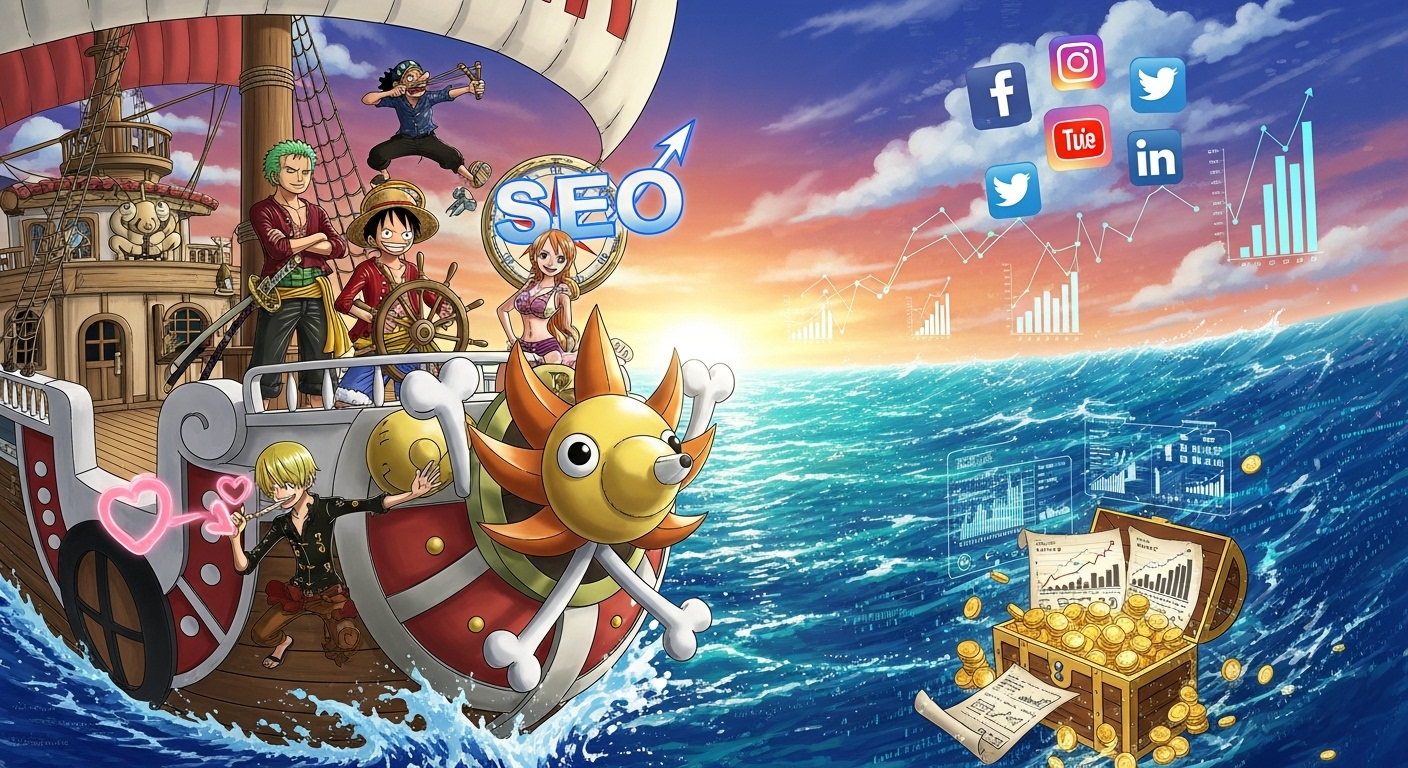
For over two decades, Eiichiro Oda’s One Piece has transcended its medium to become a global cultural phenomenon. It is more than a manga or anime; it is a multi-decade masterclass in sustained brand relevance, audience captivation, and narrative-driven growth. While business schools dissect the strategies of Fortune 500 companies, the journey of the Straw Hat Pirates offers a more compelling, dynamic, and arguably more practical playbook for modern marketing. This report deconstructs the epic adventure of Monkey D. Luffy and his crew, translating their quest for the legendary treasure into a tangible strategic framework. By examining the series through the lens of core marketing disciplines—brand identity, storytelling, community building, phased market strategy, public relations, performance analytics, and strategic alliances—this analysis will demonstrate how the Straw Hats’ voyage provides a comprehensive guide to building a brand that not only captures market share but also inspires unwavering loyalty and creates a lasting legacy.
Section 1: Forging the Jolly Roger – Establishing an Unbreakable Brand Identity
The foundation of any successful marketing endeavor is a clear, compelling, and consistent brand identity. It represents everything a business embodies, distinguishing it from the competition and shaping consumer perception. The Straw Hat Pirates serve as an exemplary case study in forging such an identity, built upon a powerful core purpose, distinct values, and an iconic visual system that resonates globally.
1.1 The Core of Brand Identity: Purpose, Vision, and Values
A strong brand identity begins with defining its core mission, which guides every subsequent action and communication. This identity is how a business strategically presents itself to be perceived by the public, built on a foundation of purpose, vision, and values that differentiate it and foster trust. The Straw Hat crew’s identity is anchored by the simple yet profound dream of its captain, Monkey D. Luffy: to find the treasure One Piece and become the King of the Pirates. This is not a goal of conquest but of ultimate freedom, as Luffy believes the Pirate King is the freest person in the world. This singular, powerful mission statement functions as the brand’s ultimate “why,” a North Star for all its activities.
This mission is visually encapsulated in the crew’s Jolly Roger—a skull wearing Luffy’s signature straw hat. This emblem serves as the brand’s logo: a simple, unique, and memorable symbol that is instantly recognizable. Its meaning runs deeper than mere piracy; as described by CNN, the flag symbolizes Luffy’s quest to “chase his dreams, liberate oppressed people, and fight the autocratic World Government”. This articulation of the brand’s values—freedom, the pursuit of dreams, and justice for the downtrodden—forms the bedrock of its identity and appeal.
1.2 The Crew as a Multi-Faceted Value Proposition
While a singular mission provides focus, a brand can broaden its appeal by offering a range of value propositions that cater to different audience segments, all while remaining cohesive under the main brand identity. The composition of the Straw Hat crew masterfully executes this principle. Each member, recruited for their unique skills, also brings a powerful, relatable dream that functions as a distinct “product line” or value proposition, supporting the overarching brand mission.
- Roronoa Zoro (Swordsman): To become the world’s greatest swordsman, representing ambition and the pursuit of mastery.
- Nami (Navigator): To draw a map of the entire world, embodying exploration and the quest for knowledge.
- Usopp (Sniper): To become a brave warrior of the sea, a narrative of personal growth and overcoming fear.
- Sanji (Cook): To find the mythical All Blue, a symbol of passion and the discovery of the extraordinary.
- Tony Tony Chopper (Doctor): To be able to cure any disease, representing compassion and service to others.
- Nico Robin (Archaeologist): To uncover the true history of the world, a mission of seeking truth and wisdom.
- Franky (Shipwright): To build a dream ship that can circumnavigate the world, a testament to innovation and craftsmanship.
- Brook (Musician): To reunite with a long-lost friend, Laboon the whale, a story of loyalty and keeping promises.
- Jinbei (Helmsman): To achieve equality and harmony between humans and fish-men, a powerful message of justice and social change.
This structure avoids the pitfall of a monolithic brand promise. While the core mission of “freedom” provides the central theme, the individual dreams of the crew create multiple entry points for audience connection. A consumer might be initially attracted by Luffy’s grand vision but become a devoted loyalist because they personally identify with Zoro’s relentless ambition, Robin’s pursuit of forbidden knowledge, or Jinbei’s fight for social justice. This creates a brand ecosystem rather than a single brand pillar, resulting in a more resilient and deeply rooted identity with broader, more diverse appeal.
Section 2: The Power of the Origin Story – Marketing Through Compelling Narrative
In modern marketing, storytelling is not a peripheral activity but a core strategic function. A compelling narrative can forge deep emotional connections, build brand loyalty, and make a message vastly more memorable than facts and figures alone. Research indicates that people are 22 times more likely to remember a fact when it is wrapped in a story. One Piece masterfully employs this principle, using the origin stories of its characters to demonstrate, rather than merely state, its core values, thereby transforming passive viewers into a deeply engaged audience.
2.1 Storytelling as the Ultimate Engagement Tool
Successful brand narratives allow consumers to understand a brand’s personality, authenticity, and values, fostering powerful connections based on shared principles. One Piece dedicates entire story arcs to revealing the “why” behind each Straw Hat’s dream. These backstories are often deeply emotional and tragic, providing the perfect stage to showcase the crew’s values in action.
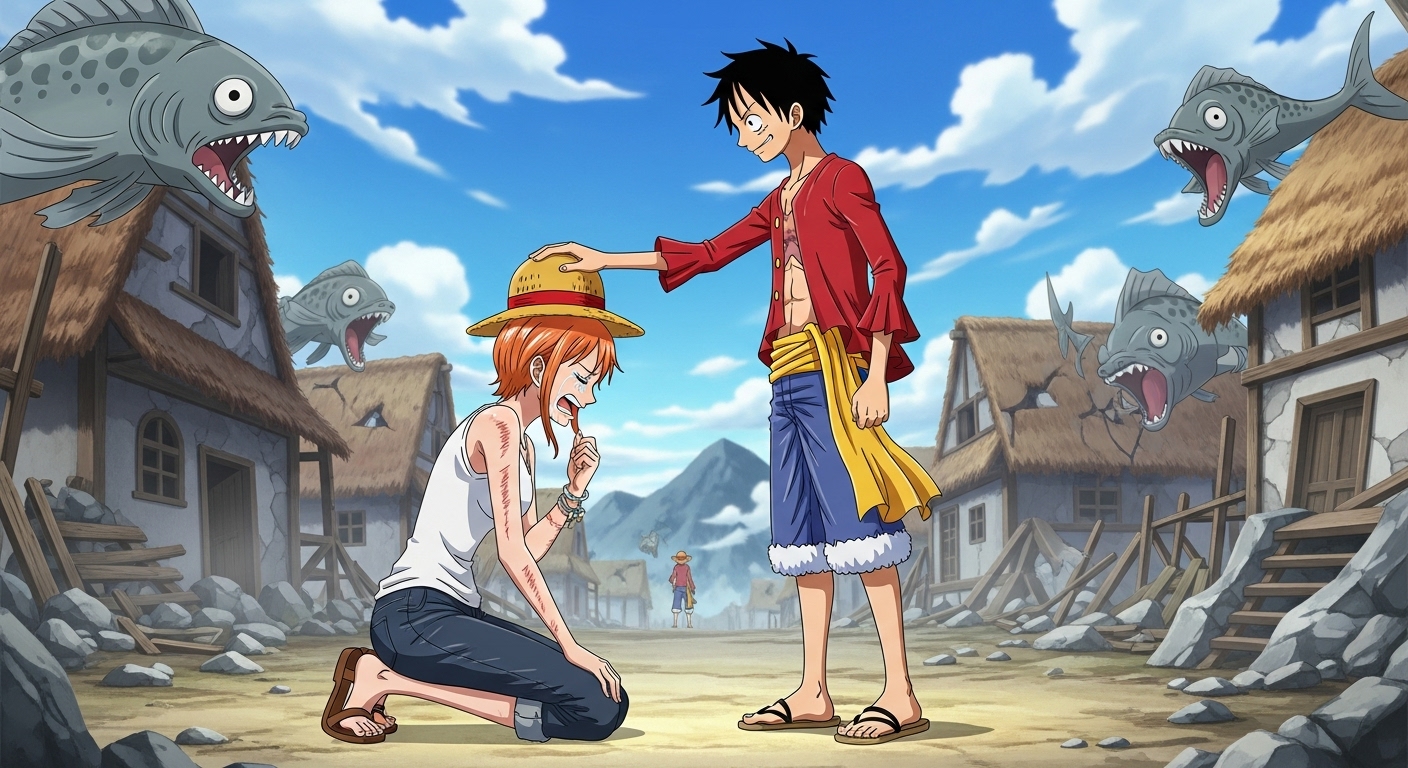
- Nami’s Story (Arlong Park Arc): The audience learns that Nami’s dream to map the world is born from trauma; she was forced by the tyrannical fish-man Arlong to draw maps for him as he oppressed her village. Her story is one of subjugation and a desperate fight for freedom. When Luffy and his crew arrive and defeat Arlong to liberate her and her home, the brand’s core value of fighting for one’s friends and freeing the oppressed is powerfully and unforgettably demonstrated.
- Sanji’s Story (Baratie & Whole Cake Island Arcs): Sanji’s quest for the All Blue is rooted in a near-death starvation experience and the profound sacrifice of his mentor, Zeff, who gave Sanji all their food and his own leg to ensure the boy’s survival. This backstory establishes the brand’s deep commitment to compassion, gratitude, and the importance of nourishment. This theme is later amplified during the Whole Cake Island arc, which contrasts his found family on the Baratie with his cruel, royal birth family, the Vinsmokes, reinforcing the powerful message that the bonds you choose are stronger than the ones you are born into.
- Chopper’s Story (Drum Island Arc): Chopper’s ambition to cure all diseases stems from the tragic death of his mentor and father figure, Dr. Hiriluk. Hiriluk, a quack doctor with a heart of gold, sacrificed his life for his beliefs and his country. This narrative powerfully demonstrates the brand’s values of self-sacrifice, healing, and carrying on the will of those who came before.
2.2 Onboarding Customers Through Narrative
A brand’s origin story should be a central component of its marketing strategy, defining its mission and eliciting specific emotions to build a strong, lasting connection with its audience. The process by which a new member joins the Straw Hat crew serves as a perfect allegory for customer acquisition and onboarding through narrative. A potential “customer”—such as Nami, Robin, or Franky—is introduced with a significant problem that they cannot solve alone. The Straw Hat “brand” then intervenes, applying its core values and capabilities to resolve the conflict. The successful resolution of their personal story arc functions as their “conversion,” at which point they fully buy into the crew’s mission and officially join. Each new recruitment serves as another powerful case study and testimonial for the brand’s effectiveness, values, and unwavering commitment to its promises.
This narrative structure achieves something remarkable by merging internal team building with external brand validation. Each time the crew fights for a potential new member, they are not only demonstrating their values to the world but are also reaffirming their own commitment to those values internally. For instance, declaring war on the entire World Government to save Nico Robin was a public spectacle of the brand’s promise of loyalty. For the audience, this provides irrefutable proof of the brand’s authenticity; they witness a brand that doesn’t just talk about its values but lives them, even at an immense cost. This creates an incredibly powerful feedback loop where the act of marketing externally simultaneously strengthens the internal culture, building both team cohesion and customer trust in a single, unified motion.
Section 3: Assembling the Grand Fleet – From Audience Engagement to Brand Advocacy
The ultimate goal of modern marketing is not merely to acquire customers but to create a thriving community of brand advocates.
Community marketing shifts the focus from transactional relationships to building a loyal following around a shared interest or purpose, fostering a sense of belonging that can transform customers into active contributors to a brand’s success. The spontaneous formation of the Straw Hat Grand Fleet provides a powerful case study in how to achieve this pinnacle of brand loyalty.
3.1 The Principles of Community Marketing
Effective community marketing is centered on bringing customers together in an engaging and non-intrusive way that puts their needs first. The aim is to build brand loyalty, generate authentic user-generated content (UGC), and cultivate brand advocates who will amplify the brand’s message organically. The formation of the Straw Hat Grand Fleet at the conclusion of the Dressrosa arc is a perfect illustration of this principle in action. Seven different groups, comprising over 5,000 individuals, voluntarily pledged their allegiance to Luffy and his crew. This was not the result of a targeted recruitment campaign or a direct call to action. On the contrary, Luffy explicitly rejected the formal, hierarchical structure of a traditional pirate fleet, as his core value is freedom, and he had no desire to command others or restrict their autonomy.
3.2 Inspiring Action, Not Demanding It
The most resilient and passionate brand communities are built organically when a brand’s actions and values inspire people to join, rather than being explicitly asked to do so. It is through authentic, two-way engagement and a consistent demonstration of purpose that a brand earns its following. The leaders of the seven crews that formed the Grand Fleet—figures like Bartolomeo, Cavendish, and Sai—did not follow Luffy because he asked them to. They chose to align themselves with his mission because they were profoundly inspired by his actions in liberating the kingdom of Dressrosa from the tyranny of the Warlord Donquixote Doflamingo. They witnessed the Straw Hat brand’s values in action and made an independent choice to support that cause.
Bartolomeo, in particular, represents the ultimate brand evangelist. He was a fan of the Straw Hats long before meeting them, and his devotion is entirely organic. He actively promotes the crew, defends their reputation, and carries their banner without any prompting, essentially creating a constant stream of positive “UGC” and acting as a powerful, highly credible influencer.
The structure of the Grand Fleet offers a sophisticated marketing lesson in scaling influence through empowerment rather than control. It functions as a decentralized, self-organizing community of brand advocates. The seven fleet commanders do not wait for orders from a central authority (Luffy). They operate independently, carrying the Straw Hat brand and its associated values into new “markets” and enhancing its reputation through their own separate adventures and accomplishments. This mirrors the modern concept of community-led growth, where a brand provides a purpose and a platform, but the community members themselves drive engagement, expansion, and advocacy. This creates a powerful network effect, where the core brand’s reach and influence are amplified exponentially by a loyal, self-motivated community that acts as an extension of the marketing team.
Section 4: Navigating the Grand Line – A Phased Content and Market-Entry Strategy
A successful brand journey is not a single sprint but a series of strategic stages, each with its own unique challenges and opportunities. Effective marketing requires mapping content and strategy to the different phases of the customer journey—from initial awareness to long-term loyalty—and adapting to an increasingly competitive landscape. The world of One Piece, with its geographically segmented seas of escalating difficulty, provides a perfect allegory for a brand’s lifecycle and the necessity of a phased market-entry strategy.
4.1 The Customer Journey Mapped to the High Seas
The narrative structure of One Piece is divided into distinct geographical regions that mirror the stages of a brand’s growth from a nascent startup to a dominant market leader.
- Stage 1: East Blue (Market Entry / Awareness): Described as the “calmest” of the four seas, the East Blue is where the Straw Hats begin their journey. This initial phase is focused on assembling the core team (the “product”) and building initial brand awareness by defeating local threats. It is analogous to a startup phase, where the primary goals are to establish product-market fit—in this case, a functional and cohesive crew—and gain initial traction in a relatively low-competition environment.
- Stage 2: “Paradise” – The First Half of the Grand Line (Growth / Consideration): Upon entering the Grand Line, the crew faces a chaotic and unpredictable sea with far stronger and more established competitors, such as the Seven Warlords of the Sea. This stage represents the growth phase of a business, where it must scale up, refine its offerings, and prove its viability against more formidable, mid-tier market players. The challenges are greater, and the strategies required are more complex.
- Stage 3: The New World (Market Leadership / Loyalty): The second half of the Grand Line, the New World, is the most dangerous sea in the world, ruled by the dominant market players: the Four Emperors (Yonko). To survive and thrive here, a brand must be at the absolute top of its game, capable of forming strategic alliances and directly challenging industry leaders for market share and influence. This is the enterprise level, where the focus shifts from mere growth to achieving market dominance and cementing a lasting legacy.
4.2 Adapting Strategy to the Competitive Landscape
The digital marketing landscape is in constant flux, and strategies must continuously adapt to new trends, technologies, and competitive pressures to remain effective. The Straw Hat Pirates are forced to evolve dramatically at each stage of their journey. Navigating the treacherous Grand Line requires a special compass called a Log Pose (adopting new tools). After a crushing defeat at the hands of superior foes, the crew recognizes their limitations and undertakes a two-year training arc to master a new power system called Haki (a critical skill upgrade). Their approach to conflict also evolves, shifting from defeating individual villains to orchestrating large-scale, multi-faceted alliances to topple the regimes of Emperors, demonstrating a profound strategic evolution.
This journey contains a crucial, if radical, lesson for marketers in the form of the “time skip.” Many promising brands fail during the scaling phase because they prioritize continuous, linear growth over foundational improvement. The Straw Hats’ defeat at Sabaody Archipelago was a clear signal that their current “product” was not yet ready for the hyper-competitive “New World market”. Instead of pushing forward into certain failure, Luffy made the difficult but strategically brilliant decision to halt their journey for two years of intensive training. This period is analogous to a company pausing new product launches to invest heavily in research and development, infrastructure upgrades, and employee training before entering a more mature market. Their re-emergence post-time skip reveals a massive leap in capability, allowing them to compete at the highest level. This strategic retreat teaches a vital lesson: sometimes the most effective path to long-term growth is to pause, reassess, and invest in the core capabilities required to win in the next stage of competition.
Section 5: “Big News” Morgans and Bounties – Mastering Digital PR and Performance Analytics
In the digital age, public perception and data-driven performance are two sides of the same coin. A successful brand must not only perform well but also manage its public narrative effectively. Digital Public Relations (PR) is the art of shaping this narrative across online channels, while performance analytics provide the data to measure impact and refine strategy. The world of One Piece features sophisticated analogues for both of these concepts in the form of its global media and its unique bounty system.
5.1 The World Economic Journal as a Mass Media Channel
Digital PR aims to increase a brand’s awareness and visibility by securing coverage in online publications, thereby shaping public perception and driving engagement. The World Economic Journal, led by the influential “Big News” Morgans, serves as the primary mass media outlet in the One Piece world. Delivered globally by dedicated “News Coos,” this newspaper is the main source of information for everyone from common citizens to the world’s most powerful figures.
Morgans wields immense power, capable of shaping global narratives with a single headline. His decision to publish the events of Whole Cake Island and declare Luffy the “Fifth Emperor of the Sea” is a prime example of the media’s ability to define a brand’s public image, often independent of the brand’s own messaging. Morgans’ editorial choices, sometimes made to suit his own agenda, demonstrate the critical and often uncontrollable role that the press plays in public relations. The very existence of this independent press, which reports on the actions of pirates and challenges the official narrative of the World Government, highlights how popular media can question and even undermine established power structures.
5.2 Bounties as Public-Facing KPIs
Modern marketing is a data-driven discipline that relies on Key Performance Indicators (KPIs) to track performance, measure return on investment (ROI), and make informed strategic decisions. In One Piece, the bounty system functions as a brilliant, gamified, and public-facing KPI.
A pirate’s bounty is a single, easily understood number that quantifies their perceived threat level to the World Government, the established market authority.
While not a direct measure of a person’s physical strength, a bounty serves as a powerful proxy for their reputation, influence, and accomplishments. Each significant increase in the Straw Hats’ bounties acts as a public press release, announcing their latest major, market-disrupting achievement to the entire world. Luffy’s bounty, for example, experiences exponential growth following his victories over powerful Warlords like Crocodile and Doflamingo, and later, after his defeat of the Emperor Kaido, solidifying his new status on the world stage.
The bounty system creates a fascinating feedback loop where the actions of a competitor—the World Government—become a brand’s most effective marketing tool. The Government issues and raises bounties to signal danger and incentivize the capture of pirates. This is intended as a defensive, suppressive measure. However, within the culture of the pirate world, a high bounty is seen as a badge of honor and a public validation of strength and success. Consequently, every time the World Government attempts to label Luffy as a greater threat, his target audience of potential rivals and allies interprets it as a mark of increased credibility. This dynamic forces the Government into a reactive cycle: Luffy’s disruptive actions compel them to raise his bounty, which in turn boosts his fame and influence, enabling him to achieve even greater feats that necessitate another bounty increase. This is a powerful lesson in how a challenger brand can leverage a dominant player’s own ecosystem and reporting mechanisms against them, turning competitive attacks into unintentional and highly effective free marketing.
5.3 Table 1: Straw Hat Pirates Bounty Progression as a Performance Metric
The following table tracks the bounty progression for key members of the Straw Hat crew across major story arcs, illustrating the direct link between their actions and their publicly measured “performance.”
| Crew Member | Event/Saga | Previous Bounty (Berries) | New Bounty (Berries) | Increase (Value) | Justification (PR Narrative) |
|---|---|---|---|---|---|
| Monkey D. Luffy | Post-Enies Lobby | 100,000,000 | 300,000,000 | 200,000,000 | Declared war on the World Government; defeated CP9’s Rob Lucci. Recognized as a major global threat. |
| Roronoa Zoro | Post-Enies Lobby | 60,000,000 | 120,000,000 | 60,000,000 | Key combatant in the Enies Lobby invasion; defeated CP9’s Kaku. |
| Nico Robin | Post-Enies Lobby | 79,000,000 | 80,000,000 | 1,000,000 | The central figure of the conflict; her knowledge of the Poneglyphs remains a critical threat to the World Government. |
| Sanji | Post-Enies Lobby | 0 | 77,000,000 | 77,000,000 | First bounty; defeated CP9’s Jabra and was a key player in the Enies Lobby incident. |
| Monkey D. Luffy | Post-Dressrosa | 400,000,000 | 500,000,000 | 100,000,000 | Defeated Warlord Donquixote Doflamingo, liberating Dressrosa and disrupting the underworld arms trade. |
| Roronoa Zoro | Post-Dressrosa | 120,000,000 | 320,000,000 | 200,000,000 | Defeated Doflamingo Family executive Pica, a major feat of strength. |
| Usopp (“God Usopp”) | Post-Dressrosa | 30,000,000 | 200,000,000 | 170,000,000 | Credited with saving thousands by defeating Sugar, a key officer in Doflamingo’s crew; hailed as a savior. |
| Monkey D. Luffy | Post-Whole Cake Island | 500,000,000 | 1,500,000,000 | 1,000,000,000 | Invaded the territory of Emperor Big Mom, defeated two of her Sweet Commanders, and escaped. Dubbed the “Fifth Emperor” by the press. |
| Monkey D. Luffy | Post-Wano | 1,500,000,000 | 3,000,000,000 | 1,500,000,000 | Defeated Emperor Kaido and liberated Wano Country. Officially recognized as one of the Four Emperors of the Sea. |
| Roronoa Zoro | Post-Wano | 320,000,000 | 1,111,000,000 | 791,000,000 | Defeated King, Kaido’s strongest commander, solidifying his status as a top-tier combatant. |
| Jinbei | Post-Wano | 438,000,000 | 1,100,000,000 | 662,000,000 | Officially joined the crew and defeated Who’s-Who, a former CP9 agent, during the raid on Onigashima. |
| Sanji | Post-Wano | 330,000,000 | 1,032,000,000 | 702,000,000 | Defeated Queen, one of Kaido’s top commanders, and awakened his latent genetic enhancements. |
Section 6: The Art of the Alliance – Strategic Partnerships and Influencer Marketing
In any competitive market, no brand can succeed in a vacuum. Strategic partnerships, collaborations, and the cultivation of influential advocates are essential for achieving goals that would be impossible alone. The Straw Hat Pirates, despite their formidable power, are a relatively small organization. Their success, particularly in the high-stakes New World, is heavily reliant on their mastery of forming strategic alliances and leveraging a diverse network of influencers and evangelists.
6.1 Strategic Alliances for Market Disruption
To challenge dominant market leaders, smaller players must often combine their resources, expertise, and influence. The Straw Hats’ journey is defined by their ability to form powerful coalitions to take on seemingly insurmountable foes. The Pirate Alliance formed with Trafalgar Law and the Heart Pirates is a textbook example of a strategic B2B collaboration. Both crews, while strong, were insufficient to challenge an Emperor like Kaido alone. By forming an alliance with the clear, shared objective of taking down Kaido, they created a force capable of disrupting the established power structure of the New World. This core alliance later expanded to include the Mink Tribe and the samurai of Wano, transforming a small partnership into a massive coalition powerful enough to liberate an entire nation and defeat two Emperors. These alliances are often formed with former rivals or unexpected parties, but they are essential for achieving market-defining victories.
6.2 Influencers, Evangelists, and Unlikely Allies
Beyond formal alliances, brands can amplify their message by leveraging individuals with established credibility and a dedicated following. The most powerful of these advocates are often organic fans who genuinely believe in the brand’s mission. The Straw Hats’ network of allies is a diverse portfolio of such figures:
- Brand Evangelist: Bartolomeo is the quintessential brand evangelist. As a “super-fan,” his devotion is entirely organic, and his promotion of the Straw Hats is passionate, authentic, and relentless. He serves as a highly effective and credible marketing asset who builds the brand’s reputation without any direct incentive.
- High-Tier Influencers: The Straw Hats also benefit from alliances with extremely powerful and influential figures who lend their significant credibility and resources to the cause. Boa Hancock, one of the Seven Warlords, uses her status to help Luffy infiltrate the world’s most secure prison. Yamato, the child of the fearsome Emperor Kaido, betrays their own father to fight alongside Luffy, providing critical intelligence and combat power. These high-impact collaborations can sway public opinion and provide access to resources that would otherwise be unattainable.
- Earned Allies: Many of Luffy’s most crucial and loyal allies were once adversaries. Figures like Bentham (Mr. 2 Bon Clay) and Bartholomew Kuma were won over by Luffy’s character, actions, and unwavering values. This demonstrates the profound power of consistently living one’s brand promise, which can turn competitors or neutral parties into the most dedicated of partners.
The alliances in One Piece represent a masterclass in what can be termed “ecosystem marketing.” Luffy does not simply form transactional, short-term partnerships. Instead, he builds an interconnected network of allies whose fates become intertwined with his own. The liberation of Dressrosa leads to the formation of the Grand Fleet. The alliance to free Wano strengthens the centuries-old bond between the Kozuki Clan and the Minks of Zou, both of whom are now staunch allies of the Straw Hats. This creates a resilient and mutually supportive ecosystem where the success of one group benefits all the others. This advanced form of partnership marketing focuses on long-term, shared value creation, building a powerful network that can collectively withstand market shocks and challenge even the most entrenched industry giants.
Conclusion: The King of the Marketers’ Playbook
The enduring global success of One Piece is not an accident of fiction; it is the result of a masterfully executed, long-term strategy that contains profound lessons for any modern marketer. By analyzing the journey of the Straw Hat Pirates, a clear and actionable playbook emerges, one that prioritizes authenticity, narrative, and community over traditional, transactional tactics. The core tenets of this playbook provide a strategic framework for building a brand that can not only compete but inspire a generation.
The key strategic lessons can be synthesized as follows:
- Build from a Core Truth: Anchor your brand in an authentic, unwavering mission. The Straw Hats’ quest for freedom is a simple, powerful idea that guides every action and provides a clear, consistent identity.
- Market Through Story: Use compelling, emotional narratives to build deep connections and demonstrate values. The backstories of the crew are not just content; they are the primary mechanism for building trust and loyalty.
- Inspire, Don’t Instruct: Cultivate a community by consistently living your brand promise. The Grand Fleet was not recruited; it was inspired. True advocacy is earned through action, not solicited through campaigns.
- Evolve or Perish: Strategically adapt your capabilities and tactics to the maturity and competitiveness of your market. The Straw Hats’ “time skip” teaches the vital lesson that sometimes a strategic pause for R&D is the most critical move for long-term growth.
- Measure What Matters and Make it Public: Use clear, understandable KPIs to track progress and leverage them as powerful PR tools. The bounty system turns a competitor’s metric into a badge of honor, a public testament to the brand’s growing influence.
- Win Together: Move beyond simple partnerships to build strategic ecosystems. By creating an interconnected network of allies with shared goals, a brand can achieve market-defining results that would be impossible alone.
Ultimately, the saga of One Piece encourages marketers to look beyond conventional business frameworks and find inspiration in the power of a grand vision. The future of marketing belongs not to those with the largest budgets, but to those who, like Monkey D. Luffy, can combine an audacious dream with unwavering loyalty to their “crew”—their team and their customers—and embark on a journey to genuinely change their world.