

Zakaria’s Revolutions: Nepal’s Gen Z Uprising Explained
Part 1: The Zakaria Framework: Progress and Its Inevitable Backlash
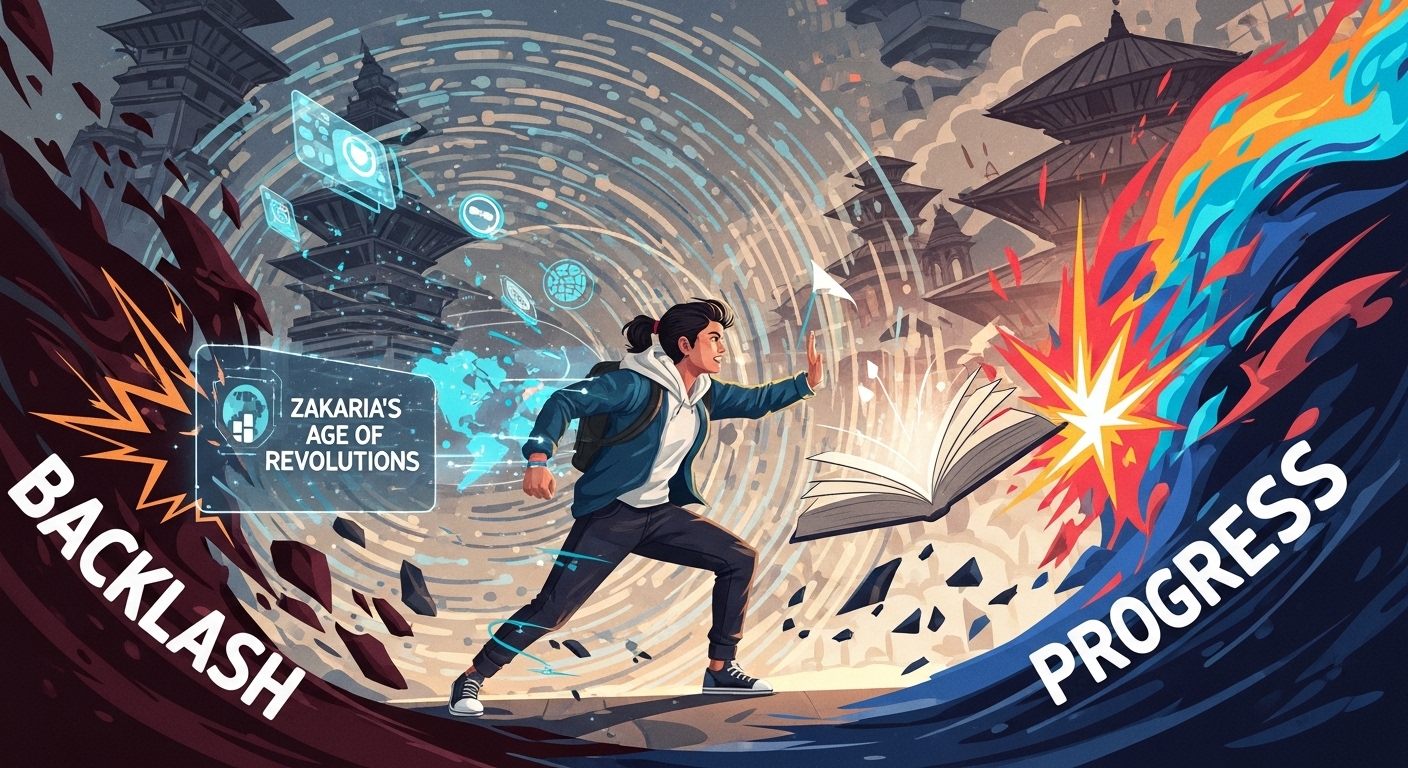
An analysis of contemporary political upheaval requires a robust theoretical model. The framework presented by Fareed Zakaria in his book, Age of Revolutions: Progress and Backlash from 1600 to the Present, provides such a model. It posits that historical change is not a linear march toward progress but a series of disruptive, cyclical transformations.
1.1 The Thesis of Cyclical Transformation
The central argument of Zakaria’s work is that periods of significant “progress“—which can be political, economic, or technological—fundamentally reshape society. This progress, while often improving lives, simultaneously creates new societal tensions, disrupts established orders, and marginalizes certain groups.
This disruption, in turn, inevitably triggers a “backlash“. This reaction is frequently characterized by populist anger, a nostalgic yearning for a perceived “golden age“, and the rise of “illiberalism” as a political force resisting the new changes. The book’s subtitle, “Progress and Backlash,” defines this recurring historical pattern.
Zakaria’s project is ultimately prescriptive. He contends that navigating these revolutionary periods requires wise action, compromise, and a renewed commitment to liberal principles. The goal is to balance the dynamism of change with the need for stability, a process he suggests can, if handled correctly, relegate illiberal populism to “history’s dustbin“.
1.2 The Triad of Modern Revolution: Globalization, Technology, and Identity
Zakaria argues that the contemporary world is currently experiencing one of these transformative “ages of revolutions“. This transformation is driven by a powerful combination of three primary forces:
- Globalization and Economic Disruption: This refers to the profound integration of the global economy, particularly the estimated three billion people who entered the global marketplace between 1985 and 1995. This globalization, while creating immense wealth, also generated significant economic disruptions and anxieties, fueling populist resistance.
- The Technological (Digital) Revolution: This is the second driver. Zakaria describes the “complete transformation of the economy into a digital economy” and the rise of artificial intelligence as a disruption on par with the Industrial Revolution. This force has a dual nature: it creates unprecedented connection and access to knowledge, but it also serves as a “delivery system for misinformation and social and psychological dysfunction“, leading to depersonalization, digital addiction, and ideological echo chambers.
- The Revolution in Identity: This is a crucial component of the modern revolutionary triad. Zakaria posits that as societies achieve material prosperity, their political focus often shifts from purely economic concerns to “higher-order concerns“. These concerns frequently center on group identity—be it “racial, sexual, or religious“. This rise of identity politics has fundamentally reshaped global democracies, moving the central political debate from a traditional Left-versus-Right (economic) axis to a new “open-versus-closed” (cultural/identity) axis.
1.3 The Causal Chain: How Structural Change Begets Political Backlash
Zakaria’s framework is not merely an observation that “progress” and “backlash” coexist. Instead, it proposes a specific, three-stage causal mechanism that explains how one generates the other. This analytical chain is the most critical element for understanding contemporary events:
- Step 1: Structural Change: “First we see broad structural changes—tremendous advances in technology and accelerations of economic activity and globalization”.
- Step 2: Identity Shift: These “disruptions trigger another significant shift—in identity“.
- Step 3: Political Backlash: These combined forces (technology, economics, and the resulting identity shift) “almost always generate backlash that produce a new politics”.
In this model, “identity” is the critical mediating factor. Structural changes do not automatically create a political backlash; they first create or activate a new sense of group identity among those who feel disrupted, left behind, or threatened by the “progress.” The political backlash is the expression of that new identity.
1.4 The Historical Precedent: The Dutch Revolution
To illustrate this chain, Zakaria uses the 17th-century Netherlands as a key historical case study.
- The Progress (Structural Change): The Dutch established the “first modern republic” by embracing individual liberty, republican representation, market expansion, and religious tolerance. This led to immense economic prosperity.
- The Identity Shift: This economic progress, however, had a “negative impact” on “rural inland communities and traditional guilds,” which lost their monopolies and economic standing. This created a new identity group defined by economic anxiety.
- The Backlash: This new identity’s political expression was “augmented by nostalgia” for the “social cohesion and unity of purpose” that the past, pre-market society supposedly offered. This provides a clear historical parallel for modern populist movements that mobilize those dislocated by globalization and technological change.
Part 2: Nepal’s “Progress“: A New Generation’s Digital Revolution
When applying the Zakaria framework to the 2025 Nepal uprising, the “progress” element must be carefully defined. It was not a story of economic prosperity, but rather the story of a new generational identity forged by the combination of digital saturation and systemic economic failure.
2.1 The Context: A Republic of Disillusionment
The backdrop for the GenZ movement was not progress, but decay. Nearly two decades after the 2008 revolution ended the monarchy and established a republic, its “revolutionary ideals” had been “turned on their back”. The leaders who had promised transformation instead joined the ruling class and perfected what critics describe as a “kleptocratic system“.
This failure manifested as “decades of systemic corruption“, “dynastic politics“, and a culture of “elite impunity“. Politics had become a stagnant “game of musical chairs between three people for 30 years“. For Generation Z, this abstract corruption had devastatingly concrete consequences: a staggering 20.8% youth unemployment rate, endemic bribery for basic services, and mass youth migration for foreign employment.
2.2 The New Cohort: A “Generational Reckoning“
This context created a new, distinct political cohort. Nepal’s GenZ, with a median national age of just 25, is “a cohort raised in the republic but deprived of its promises“. They have no memory of the monarchy or the civil war, only of the “decay” of the democratic project.
This generation’s identity is defined by two key factors:
- A Modified “Post-Materialism“: This cohort’s political demands diverge from Zakaria’s Western model. They are not “post-materialist” in the sense of having achieved prosperity and moving on to “higher-order” identity concerns. Rather, they demand “post-materialist” values—transparency, accountability, integrity—precisely because the lack of these values (i.e., corruption) is the mechanism denying them material prosperity.
- The Digital Native Identity: This generation was “born digital“. With 14.3 million social media identities in a nation of 30 million, their identity is inseparable from the digital sphere. Social media is not merely a tool; it is their “principal arena of dissent“, their primary space for “collective conversation“, and the forge for their “horizontal solidarity“.
2.3 The Digital “Progress” as X-Ray: The #Nepobabies Phenomenon
This new generational identity was activated and crystallized by a specific social media trend that served as the “progress” in the Zakaria model: the “#nepobabies” phenomenon.
This trend, which seized on a “global cultural obsession“, was applied locally as a digital X-ray, exposing the “dynastic privilege” and “lavish” lifestyles of the children of Nepal’s political elite. One viral Instagram post, showing a provincial minister’s son posing with a Christmas tree made of luxury-brand boxes, became a potent symbol of this injustice in a country with a GDP per capita below $1,500.
The trend was the mechanism that completed the first two stages of Zakaria’s causal chain. The “structural change” (digital technology) allowed a “shift in identity” (the aggrieved GenZ) to articulate its core grievance. The “#nepobabies” trend connected the abstract “systemic corruption” to the concrete reality of “20.8% youth unemployment“. It created a clear, identity-based “us vs. them” narrative: the parasitic, politically-connected “#nepobabies” versus the excluded, struggling, but digitally-empowered GenZ.

Part 3: Precursor and Catalyst: The “Balen Effect” and the State’s Backlash
The 2025 revolution did not emerge from a vacuum. It required a “proof of concept” to demonstrate the vulnerability of the old guard, which was provided by the 2022 elections.
It also required an immediate catalyst, which was provided by the state’s “backlash”—a fatal miscalculation that turned digital dissent into a physical uprising.
3.1 The 2022 “Rapper Revolution”: A Proof of Concept
The 2022 mayoral election of Balendra Shah (known as Balen Shah) in Kathmandu was a political earthquake that served as a beta test for the 2025 revolution. Shah, a rapper and structural engineer in his early 30s, ran as an independent and won a “landslide” victory against candidates from Nepal’s “entrenched political families”.
His campaign methods prefigured the 2025 uprising:
- Digital-First Mobilization: He was the “first candidate who primarily campaigned digitally”. He skillfully used TikTok and Instagram, and was supported by popular social media groups like “Routine of Nepal Banda” to mobilize a youth vote that felt unrepresented by the major parties.
- Anti-Establishment Pragmatism: His brand was built on “refusing to align with Nepal’s dominant political parties”. He avoided grand ideology and instead offered concrete, engineer-backed plans for tangible, everyday problems like “garbage management,” “traffic management,” and improving “public school” quality.
The “Balen Effect” was profound. It “inspired a wave of young, independent candidates” and, most importantly, it proved to GenZ that the political “old guard” was not invincible. It revealed a new, powerful political “force the traditional political parties had long ignored: the youth”.
3.2 The Backlash as Trigger: The September 4th Social Media Ban
This section represents a critical modification of the Zakaria framework. In his historical examples, the “backlash” is a slow-moving, populist political movement that follows progress. In Nepal 2025, the “backlash” was an immediate, repressive state action in direct response to digital “progress,” and this action, in its failure, became the catalyst for revolution.
The Act: On September 4, 2025, the government of K. P. Sharma Oli banned 26 social media platforms, including Facebook, Instagram, X (Twitter), YouTube, and WhatsApp.
The Motive: The official justification was the platforms’ “noncompliance with new registration rules”. However, this was “widely seen as an attempt to suppress criticism of the government”. The ban came “shortly after” the “#nepobabies” trend had gone viral, exposing the political elite to unprecedented digital ridicule and scrutiny.
The Fatal Miscalculation: This act of backlash was the “tipping point”.
- It was an attack on GenZ’s core identity. For a generation that “from their earliest days have expressed… and organised online,” the ban “made clear the government didn’t care about them”.
- It was an unenforceable “Chinese-style” control that only “silenc[ed] a generation” and led to a massive surge in VPN registrations.
- It unified every disparate grievance—corruption, unemployment, nepotism—into a single, actionable cause.
The government “attempted to control the information ecosystem and lost control of the state itself”. This reveals an accelerated, cyclical version of Zakaria’s thesis: Progress-1 (Digital Dissent) -> Backlash-1 (State Repression) -> Progress-2 (Mass Revolution). The backlash, in this case, was not the end of the cycle but the engine of its escalation.
Part 4: The 2025 Uprising: A Case Study in Revolutionary Dynamics
The state’s repressive backlash on September 4th catalyzed “Progress-2”: a full-blown physical revolution that toppled the government in five days. The speed and form of this revolution are direct products of the digital “progress” and generational “identity” that defined the movement.
4.1 From Digital Dissent to “National Fury”: A Timeline
The extraordinary speed of the revolution illustrates the accelerant effect of digital technology. Zakaria’s historical “ages of revolution” span decades; this one reached its zenith in 120 hours.
Table 1: Timeline of the 2025 Nepalese GenZ Revolution
| Date | Event | Significance |
|---|---|---|
| Sept 4 | Government bans 26 social media platforms, citing registration rules. | The “Backlash-1” (state repression) that acts as the “tipping point” for the digitally-native GenZ. |
| Sept 8 | Peaceful protests begin. The state responds with “live ammunition”. At least 19 protesters, many in school uniforms, are killed. | The state’s second backlash (violent repression) backfires, transforming the protest into a “national fury”. |
| Sept 9 | Prime Minister K.P. Sharma Oli resigns. In a “vengeful” rage, mobs burn state symbols: Parliament, the Singha Durbar (PM’s Office), and homes of politicians. | The “Progress-2” (revolution) succeeds in its primary goal: decapitating the “old guard” government. |
| Sept 12 | After days of a power vacuum, protest leaders and the army negotiate. Sushila Karki, a former chief justice, is appointed interim Prime Minister. | A new, extra-constitutional government is formed based on the revolution’s mandate. |
| Sept 13 | Protests die down as the revolution’s immediate goals (lifting the ban, ousting the government) are achieved. | The destructive phase of the revolution concludes, and the unstable constructive phase begins. |
4.2 The “Leaderless” Revolution: Strengths and Pitfalls
The form of the revolution was a direct product of the digital age.
Strengths:
The movement’s “greatest strength” was its deliberate lack of a single figurehead. Past Nepali revolutions were “undone… by those who claimed to lead it”; this one, by contrast, emerged from “the collective rather than the charismatic”. This “spontaneous, networked” structure made it impossible for the state to decapitate. Coordination occurred in “impromptu public squares” like the “Youths Against Corruption” Discord channel. The interim PM nominee, Sushila Karki, was selected in a chaotic “Discord Election” by participants.
Pitfalls:
This same “leaderless” structure, however, contains the seeds of its own backlash. Analysis of such movements shows they are inherently vulnerable.
- Lack of Structure: They are left “without sustained organizational structures” or “clear chains of command”.
- Devolving into Mobs: This makes it difficult to set “common ground rules”, allowing protests to “devolve into violent mobs”. The widespread arson in Kathmandu, which torched the parliament and Supreme Court buildings, is a stark example of this dynamic.
- Fragmentation: Online culture “elevates individual celebrities,” which can fuel “internal power struggles and infighting”.
The very digital “progress” that enabled the revolution (decentralized, rapid) also cripples its ability to govern. The movement was perfectly structured for a destructive goal (toppling a government) but structurally incapable of the “compromise” and “stability” that Zakaria argues are necessary to manage change.
Part 5: The New Backlash: Nepal’s Unstable Future
The “protesters’ victory” of September 2025 was not the end of the “progress and backlash” cycle. It was merely one violent turn. The revolution (Progress-2) has now triggered a new, more organized, and arguably more dangerous backlash (Backlash-2), as the resilient “old guard” mounts its counter-revolution.
5.1 The Revolution’s Aftermath: A Shattered State
The revolutionary “progress” created a power vacuum and a devastated state:
- Economic Devastation: The economic damage is estimated at $21-22.5 billion, “nearly half of Nepal’s GDP”. The vital tourism sector was “devastated”, severely constraining the new government’s capacity to act.
- A Fragile Government: The interim Karki government was sworn in via “extra-constitutional means”. Its sole mandate is to hold elections by March 2026.
- Public Impatience: One month after the revolution, protesters are already expressing “unease at the slow pace of change”. Key demands, like the arrest of K.P. Sharma Oli, remain unmet. The new government faces “major bureaucratic obstacles” and must “rebuild dialogue” with a fractured society.
5.2 “The Old Guard Digs In”: The New Backlash
“Backlash-2” is the organized political resistance of the “old guard” to the “Progress-2” of the revolution. This backlash is underway and is being waged on multiple fronts:
- Rejection of Legitimacy: Nepal’s biggest political parties (Nepali Congress, CPN-UML, and the Maoists) are “growingly attempting to question the legitimacy” of the Karki government.
- Political Boycott: They have released statements calling the dissolution of parliament “unconstitutional and dangerous”. In a “notable break from tradition,” none of the major parties attended Karki’s swearing-in ceremony.
- Inflammatory Rhetoric: Ousted PM Oli delivered an “inflammatory speech” accusing the GenZ protesters of being part of an “attack on the sovereign power of this country”. This is classic backlash politics, painting the revolutionary “progress” as an illegitimate, foreign-backed threat.
- Risk of Electoral Futility: The “old guard” retains its “robust nationwide organizations and hundreds of thousands of active members”. The greatest risk of this backlash is that the March 2026 election “simply reinstates the status quo”, rendering the entire revolution “meaningless”.
5.3 The Movement’s Internal Backlash: Fragmentation
Simultaneously, the “progress” of the leaderless movement is backlashing against itself.
Its key vulnerability—fragmentation—is being realized. The GenZ movement is now “divided”:
- One faction wants to work within the current constitutional framework.
- A second faction demands radical constitutional change, such as a directly elected executive, a debate now being influenced by geopolitical players like China and India.
- A third “royalist leaning” group is attempting to co-opt the anti-establishment anger to restore the monarchy.
This “structural fragility” is the “leaderless” paradox in action. The movement was brilliant at destruction but has no unified mechanism for construction. This power vacuum is precisely what the organized “Backlash-2” of the old guard is positioned to exploit.
Part 6: Conclusion: Synthesis and Future Implications
The 2025 Nepal GenZ uprising is a textbook, albeit radically accelerated and cyclical, example of Fareed Zakaria’s “progress and backlash” thesis. The causal chain is clear and demonstrates the framework’s potent explanatory power:
- A “structural change” (digital saturation combined with economic failure) created a new generational identity (GenZ, the “digital natives deprived of their promises”).
- This new identity found its voice in Progress-1 (the “#nepobabies” digital dissent and the “Balen Effect”).
- The “old guard” (the state) launched Backlash-1 (the repressive social media ban).
- This backlash, however, failed and catalyzed Progress-2 (the 2025 revolution that toppled the government).
- This revolution has now triggered Backlash-2 (the “old guard’s” organized political resistance to the new Karki government).
The Nepal case study both validates and updates the Zakaria framework for the 21st century. It demonstrates that:
- “Identity” is Generational: The primary political cleavage is not just “racial, sexual, or religious” but can be generational, defined by digital fluency and economic exclusion.
- “Progress” is Digital Dissent: “Progress” is not limited to economic prosperity but can be the capacity for digital dissent, which exposes the lack of prosperity.
- The “Backlash” is the Catalyst: The “backlash” is not just a slow-moving populist reaction but can be an acute, repressive state action that, in its failure, becomes the immediate catalyst for revolution.
- The Cycle is Accelerated: The entire “progress -> backlash -> revolution” cycle can now unfold in months or even days, not generations.
The future of Nepal hangs in the balance, a real-time race between progress and backlash. Can the “progress” of the revolution (the Karki government) institutionalize itself, manage the “leaderless” fragmentation of its own base, and hold successful elections? Or will the “backlash” of the “old guard” exploit this fragility, de-legitimize the process, and “reinstate the status quo”?
As Zakaria’s historical analysis warns, without “wise action” and “compromise”, revolutionary progress is often consumed by its own backlash. The 2025 Nepal uprising, in its success and its profound fragility, serves as a stark lesson for all nations struggling to manage the twin revolutions of digital technology and generational identity.