


Nepal’s Constitutional Crossroads: Government & Parliament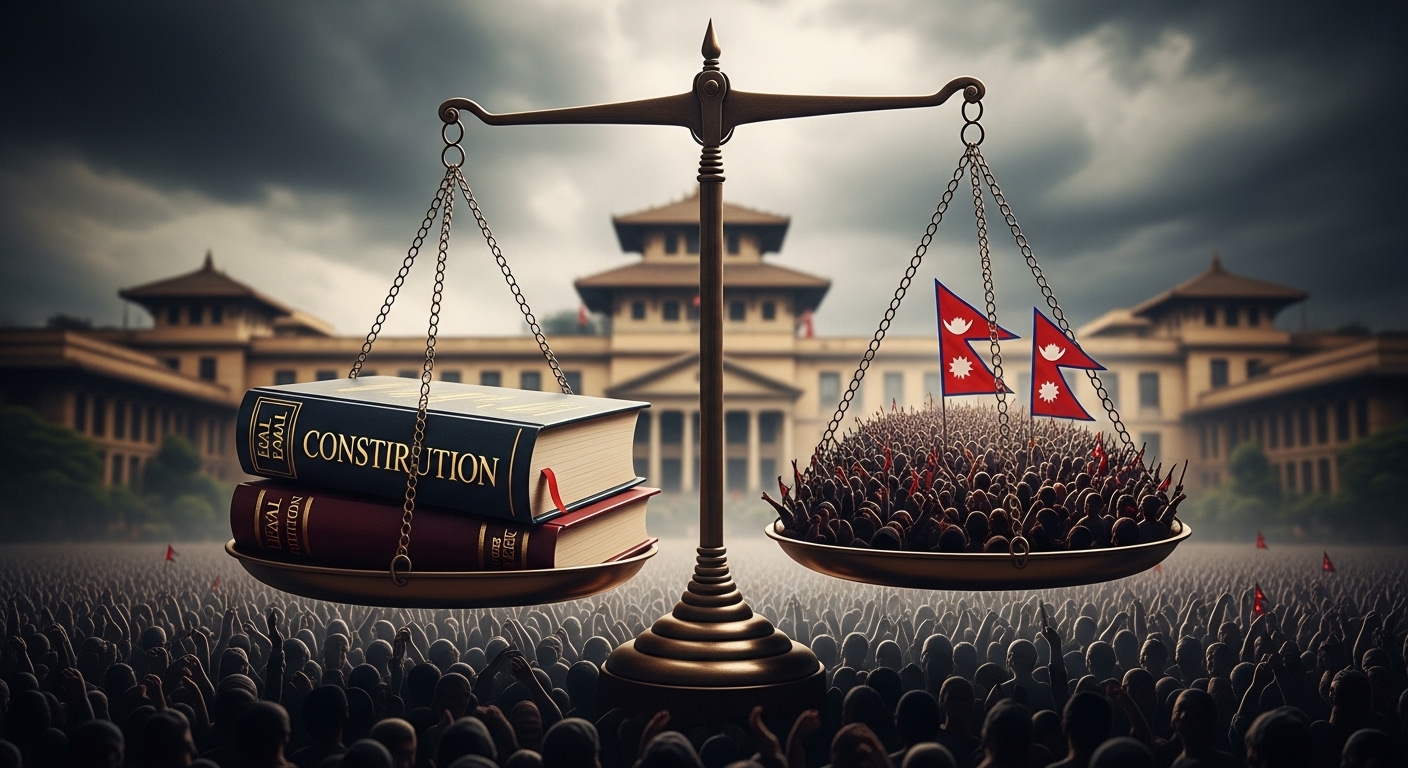
Executive Summary
This report provides a detailed constitutional analysis of recent political events in Nepal, focusing on the legality of successive dissolutions of the House of Representatives and the formation of the current interim government. The analysis finds that the dissolutions of Parliament by then-Prime Minister K.P. Sharma Oli in December 2020 and May 2021 were unequivocally unconstitutional, representing a clear executive overreach against a constitutional framework deliberately designed to ensure legislative stability. The Supreme Court of Nepal correctly identified these actions as violations of the letter and spirit of the 2015 Constitution, particularly Article 76, which strictly limits the conditions for such a move.
In contrast, the events of September 2025—namely the appointment of former Chief Justice Sushila Karki as interim Prime Minister and her subsequent recommendation to dissolve Parliament—exist in a state of profound constitutional ambiguity. While a direct reading of the Constitution renders both her appointment and the dissolution illegal, these actions were justified by the President under the extra-constitutional “doctrine of necessity” in response to a nationwide popular uprising that created a constitutional vacuum. This has pitted the principle of popular sovereignty against the principle of constitutional supremacy. The Karki-led dissolution, while politically expedient to quell the crisis, directly contravenes the legal precedents set by the Supreme Court in 2021. These events pose a significant long-term challenge to the rule of law in Nepal, leaving the nation’s democratic future contingent on the Supreme Court’s ability to navigate a crisis where legal precedent and political reality are in direct conflict.
Section 1: The Constitutional Framework for Political Stability in Nepal
1.1 Preamble and Foundational Principles: A Break from the Past
The Constitution of Nepal, promulgated in 2015, represents a fundamental departure from the country’s history of political instability. Its preamble explicitly recalls the “glorious history of historic people’s movements, armed conflict, dedication and sacrifice” undertaken to achieve democracy and progressive change. A core objective of the charter is to end “all forms of discrimination and oppression created by the feudalistic, autocratic, centralized, unitary system of governance”. It was designed to fulfill the public’s aspirations for “perpetual peace, good governance, development and prosperity” through a federal democratic republican system.
Central to this new order is the principle of constitutional supremacy. Article 1 of the Constitution declares it the “fundamental law of Nepal,” stipulating that any law inconsistent with its provisions shall be void to the extent of the inconsistency. This provision establishes the Constitution as the ultimate source of legal authority, binding on all state organs and individuals. The framers, keenly aware of past political turmoil, adopted what has been described as a “reformed parliamentary system.” A key feature of this system is a provision that a vote of no confidence cannot be tabled against a Prime Minister for the first two years of their term, a measure explicitly designed to foster governmental stability.
1.2 The Executive and Legislature: A Deliberately Constrained Relationship
The 2015 Constitution meticulously structures the relationship between the executive and the legislature to prevent the arbitrary exercise of power that had plagued previous political systems. This is most evident in the detailed, sequential process for forming a government and the strict limitations placed on the Prime Minister’s power to dissolve the House of Representatives (Pratinidhi Sabha).
The design of Article 76, which governs the formation of the Council of Ministers, is not merely a set of procedural steps; it is a substantive barrier against executive whim. The framers, responding directly to a history of frequent government collapses, engineered a multi-step process intended to force political compromise and maximize the lifespan of the elected legislature. This constitutional architecture reflects a deliberate choice to prioritize parliamentary stability over executive convenience. The process unfolds as a cascade, where each subsequent step can only be initiated upon the failure of the preceding one:
- Article 76: The President appoints the leader of the parliamentary party that commands a majority in the House of Representatives as the Prime Minister.
- Article 76: If no single party has a clear majority, the President appoints a member of the House who can command a majority with the support of two or more parties.
- Article 76: If a government cannot be formed within 30 days under clause , the President appoints the leader of the party with the highest number of members in the House as Prime Minister. This Prime Minister must then win a vote of confidence within 30 days.
- Article 76: If a Prime Minister appointed under clause fails the confidence vote, the President gives a final opportunity to any member of the House who presents grounds on which they can obtain a vote of confidence.
- Article 76: Only after all the preceding avenues for forming a government have been exhausted and failed may the incumbent Prime Minister recommend that the President dissolve the House of Representatives for new elections.
Complementing this is Article 85, which stipulates the term of the House of Representatives. As interpreted by the Supreme Court, this article envisions a full five-year term as the norm, with premature dissolution being an extraordinary exception rather than a political tool at the Prime Minister’s disposal. The complexity of Article 76 is therefore its central feature—a constitutional technology designed to make dissolution the absolute last resort, compelling political actors to seek parliamentary solutions rather than allowing a Prime Minister to call snap elections for political advantage.
Section 2: The Supreme Court’s Jurisprudence on Parliamentary Dissolution
2.1 The First Dissolution (December 2020): An Unconstitutional Move
On December 20, 2020, then-Prime Minister K.P. Sharma Oli, whose Nepal Communist Party (NCP) commanded a near two-thirds majority in Parliament, made the surprise move to recommend the dissolution of the House of Representatives. He justified the decision by citing intense infighting within his own party, which he claimed created “hurdles in service delivery” and made governance impossible. President Bidhya Devi Bhandari promptly approved the recommendation and scheduled mid-term elections for April and May 2021.
The move was immediately challenged by constitutional experts, who argued that the 2015 Constitution explicitly disallows a majority Prime Minister from dissolving the House. On February 23, 2021, the Constitutional Bench of the Supreme Court delivered a historic verdict, unanimously overturning the dissolution as unconstitutional. The court ruled that the government had failed to provide sufficient constitutional grounds for its action under Articles 76 and 85 and ordered that Parliament be summoned within 13 days.
2.2 The Second Dissolution (May 2021) and the Court’s Definitive Ruling
Following his reinstatement, Prime Minister Oli failed to win a mandatory vote of confidence in the House on May 10, 2021. This triggered the constitutional process for forming a new government. The President invited parties to stake a claim under Article 76. Both K.P. Sharma Oli and opposition leader Sher Bahadur Deuba submitted claims, each arguing they had the support of a majority of lawmakers. Citing uncertainty over both claims, the President invalidated them and, once again on the recommendation of Oli’s caretaker cabinet, dissolved the House of Representatives for a second time.
This second dissolution prompted another, more forceful intervention from the Supreme Court. In a landmark judgment, the court not only reinstated the House but also issued a writ of mandamus—an extraordinary judicial command—ordering the President to appoint Sher Bahadur Deuba as the new Prime Minister under Article 76. This ruling established several critical constitutional principles:
- Dissolution as a Last Resort: The court clarified that the Prime Minister’s power to recommend dissolution under Article 76 is not a discretionary prerogative. It can only be invoked after all possibilities of forming a government under the preceding clauses, including Article 76, have been demonstrably exhausted and have failed.
- The President’s Role is Not Discretionary: The court ruled that the President’s role in the appointment process is to verify whether a claimant has presented a prima facie basis for commanding a majority. The President does not have the discretionary power to pre-judge or reject a claim; the ultimate test of a majority is the vote of confidence on the floor of Parliament.
- Individual Lawmaker’s Rights under Article 76: The court held that political parties cannot issue a whip or take disciplinary action against their members for supporting a candidate during the government formation process under Article 76. This prioritizes the constitutional imperative of forming a government over party discipline in that specific, critical context.
The Supreme Court’s evolution from its first ruling to its second marks a significant recalibration of the balance of power. The first ruling was a standard act of judicial review, declaring an executive action unconstitutional. However, when the executive branch circumvented the spirit of that ruling, the court adapted. By issuing a writ of mandamus, it moved from being a passive arbiter to an active enforcer of the constitutional process.
This established a powerful precedent: if the political branches fail to adhere to the constitutional roadmap for government formation, the judiciary has the authority to step in and complete the process itself, thereby cementing its role as the ultimate guardian of parliamentary longevity.
Table 1: Timeline and Key Rulings of the 2020-2021 Parliamentary Dissolution Cases
| Date | Action by Executive | Justification Cited by Executive | Supreme Court Ruling | Key Constitutional Principle Established |
|---|---|---|---|---|
| Dec 20, 2020 | PM Oli recommends first dissolution; President Bhandari approves. | Internal party strife; Articles 85, 76, 76.10 | Unconstitutional; House of Representatives (HoR) reinstated. | Dissolution is not a PM’s prerogative; must exhaust all government formation options first. |
| May 10, 2021 | PM Oli loses vote of confidence after reinstatement. | Constitutional requirement. | N/A | N/A |
| May 22, 2021 | President invalidates claims by both Oli and Deuba under Art. 76; dissolves HoR again on Oli’s recommendation. | No basis for either claimant to win a confidence vote. | Unconstitutional; HoR reinstated; Mandamus issued to appoint Deuba as PM. | President’s role under Art. 76 is not discretionary; the floor of parliament is the sole venue to test a majority. |
Section 3: The September 2025 Political Crisis and the Doctrine of Necessity
3.1 The “Gen Z Protests”: A Catalyst for Constitutional Crisis

The political crisis of September 2025 was ignited by the Oli government’s decision on September 4 to ban 26 social media platforms, including Facebook and YouTube, for failing to register under new government regulations. This act served as a flashpoint for deep-seated public discontent. The ban galvanized Nepal’s youth, who merged their anger over the loss of digital platforms with broader frustrations regarding systemic government corruption, rampant nepotism (highlighted by the “Nepo Kid” social media trend), and persistent economic distress, including low GDP growth and high youth unemployment.
The protests, led by a loose coalition of young citizens dubbed the “Gen Z” movement, escalated with unprecedented speed and intensity. Peaceful demonstrations gave way to deadly clashes with police, riots, and the storming and arson of key government buildings, including the Parliament, the Supreme Court, and the Singha Durbar government seat. Faced with a complete breakdown of law and order and the collapse of his government’s authority, Prime Minister K.P. Sharma Oli resigned on September 9, 2025, leaving a dangerous political and constitutional vacuum.
3.2 The Appointment of Sushila Karki: An Extra-Constitutional Solution
In the chaotic aftermath of Oli’s resignation, protest leaders, coordinating through online platforms like Discord, put forward the name of Sushila Karki, a former Chief Justice known for her anti-corruption stance, to lead a neutral interim government. On September 12, 2025, President Ram Chandra Poudel, following tense consultations with military leaders and political parties, appointed Karki as interim Prime Minister.
This appointment, while a politically pragmatic response to the crisis, was made in direct violation of the constitutional text. It contravenes at least two explicit provisions:
- Article 76: This article requires the Prime Minister to be a member of the House of Representatives, which Karki is not.
- Article 132: This article explicitly states that any person who has held the office of Chief Justice is ineligible for appointment to any government office.
The President’s Office justified this extra-constitutional measure not under the standard procedures of Article 76, but by invoking the President’s broad, inherent powers under Article 61—which outlines the duty to uphold and protect the constitution and safeguard national unity—and the unwritten “doctrine of necessity”. This doctrine posits that in a state of extreme emergency, actions that would normally be illegal can be taken to preserve the state itself. President Paudel later acknowledged the constitutional deviation, stating, “If there has been a small amount of violence done to the Constitution, it has been only with regard to appointment of the Prime Minister. The rest of the constitutional system is intact”.
This sequence of events created a constitutional paradox. The President, in exercising his duty to “protect the Constitution,” was forced to violate specific articles within it. This act effectively prioritized the perceived spirit of the constitutional order (stability, continuity of the state) over the explicit letter of the law. It established a moment where popular sovereignty, as expressed through the demands of a successful street revolution, was placed above constitutional sovereignty, as embodied in the written text, creating a precarious precedent for handling future crises.
Section 4: A Legal Dissection of the September 2025 Parliamentary Dissolution
4.1 The Dissolution as a Political Precondition
The dissolution of the sitting Parliament was not a constitutional afterthought but a central and non-negotiable demand of the Gen Z protest movement, which viewed the legislature as part of the corrupt establishment that needed to be swept away. This demand created a significant constitutional dilemma. Sushila Karki, the protesters’ choice for interim Prime Minister, initially insisted that she would only assume office after Parliament was dissolved. This was constitutionally impossible, as only a sitting Prime Minister and their cabinet can recommend dissolution to the President.
The impasse was resolved through a political deal brokered by President Paudel. The agreement stipulated that Karki would be appointed Prime Minister first. Her very first act in office would be to convene a cabinet meeting to formally recommend the dissolution of the House, a recommendation the President had pre-agreed to approve. This arrangement makes it clear that the dissolution was a pre-determined political concession to the protest movement, not a decision arrived at through the constitutional process of exploring all avenues for government formation.
4.2 The Act of Dissolution and the Legal Backlash
True to the agreement, on September 12, 2025, immediately following her swearing-in ceremony, the interim cabinet led by Prime Minister Karki recommended the dissolution of the House of Representatives. President Paudel approved the recommendation that same night, dissolving the House and calling for new elections to be held on March 21, 2026.
The reaction from the established political and legal communities was swift and uniformly negative. All major political parties—including the Nepali Congress, CPN-UML, and CPN (Maoist Centre)—along with the Nepal Bar Association (NBA), fiercely condemned the move as “unconstitutional,” “arbitrary,” and a “serious blow to democracy”. Critics explicitly stated that the dissolution was “against the spirit of our Constitution and the interpretation of the Supreme Court” from the 2021 cases, which had established that dissolution was only permissible after the failure of all government formation possibilities.
This situation has created a state of legal schizophrenia in Nepal. The same act—the dissolution of Parliament—is viewed through two irreconcilable lenses. For the protest movement and the interim government born from it, the dissolution is a legitimate and necessary outcome of a popular revolution against a corrupt system. For the entire political and legal establishment, it is a blatant violation of settled constitutional law and judicial precedent. This schism reveals a fundamental conflict between revolutionary legitimacy, derived from the will of the people on the streets, and constitutional legitimacy, derived from the written law and its interpretation by the courts. This clash of two different sources of authority is inherently destabilizing for a constitutional democracy and suggests that future popular movements may feel empowered to demand extra-constitutional actions, citing the events of 2025 as a valid precedent.
Section 5: Comparative Analysis within International Democratic Practice
5.1 Models of Parliamentary Dissolution: A Spectrum of Executive Power
The power to dissolve parliament prematurely varies significantly across democratic systems, falling along a spectrum from broad executive discretion to highly constrained conditions.
- Discretionary/Westminster Model: In systems like the United Kingdom (historically), the Prime Minister has significant latitude to request a dissolution from the Head of State at a politically opportune moment. The Head of State’s power to refuse is governed by unwritten conventions (such as the Lascelles Principles) and is rarely exercised.
- Constrained/Constructive Model: Countries like Germany and Spain heavily restrict dissolution to promote stability. Germany’s “constructive vote of no confidence” requires Parliament to select a successor before an incumbent Chancellor can be removed, making dissolution exceptionally rare.
- Parliament-led Dissolution: In some systems, the legislature can vote to dissolve itself, often requiring a special or absolute majority of its members.
This places the power in the hands of the legislature rather than the executive.
- Automatic Dissolution: Some constitutions mandate dissolution automatically under specific circumstances, such as the repeated failure to form a government after an election or a loss of confidence.
Situating Nepal’s Constitution and Crises
The framers of Nepal’s 2015 Constitution, and the Supreme Court in its 2021 rulings, deliberately positioned Nepal at the highly constrained end of this spectrum. The multi-layered process in Article 76 was designed specifically to eliminate the Prime Minister’s ability to use dissolution as a political weapon, making the Nepali system functionally much closer to the German model of stability than the traditional Westminster model of executive flexibility.
K.P. Sharma Oli’s actions in 2020-2021 were a clear attempt to claim a Westminster-style prerogative that the Constitution was written to prevent. He even drew a parallel to the actions of UK Prime Minister Boris Johnson as a defense for his move. The Supreme Court’s emphatic rejection of this argument was a firm declaration that Nepal had chosen a different constitutional path.
The September 2025 dissolution, however, is an anomaly that fits no established democratic model. It was not triggered by any internal constitutional mechanism, such as a failed confidence vote or an exhausted government formation process. Instead, it was compelled by external political pressure from a popular uprising. This represents a breakdown of the constitutional framework itself, rather than the use or misuse of a provision within that framework.
| Country | Primary Basis for Dissolution | Key Actor with Initiative | Key Restrictions |
|---|---|---|---|
| Nepal (per Constitution & SC) | Art. 76 after exhaustion of all government formation options. | Prime Minister | Must be the absolute last resort; not a discretionary prerogative. |
| United Kingdom | Royal Prerogative on advice of PM (revived post-2022). | Prime Minister | Largely conventional; Monarch could refuse if an alternative government is viable. |
| Germany | Failure to elect a Chancellor; or Chancellor loses a confidence vote that they call. | President (on proposal of Chancellor) | Heavily restricted; constructive vote of no confidence is the primary mechanism for changing government. |
| India | President’s power on the binding advice of the Council of Ministers. | Prime Minister / Council of Ministers | President may ask the Council to reconsider but is generally bound by the advice; may refuse if PM has lost majority and an alternative government is possible. |
Conclusion: The Rule of Law in a State of Exception
Synthesizing the Constitutional Questions
The analysis of Nepal’s recent political upheavals yields distinct conclusions regarding the constitutionality of the actions taken by different state actors.
- On the K.P. Sharma Oli Dissolutions: These actions were unequivocally unconstitutional. They represented a deliberate attempt by the executive to bypass the strict limitations on dissolution power enshrined in the 2015 Constitution. The Supreme Court’s rulings that overturned these moves were a correct and robust defense of the constitutional order and established a clear legal precedent against such executive overreach.
- On the Sushila Karki-led Interim Government: The formation of this government is unconstitutional based on a literal reading of Article 76 (requiring the PM to be a member of the House) and Article 132 (barring a former Chief Justice from government office). Its legitimacy is not derived from the constitutional text but from the extra-constitutional “doctrine of necessity” invoked by the President during a moment of extreme national crisis. While politically pragmatic, its legal foundation is tenuous and remains vulnerable to judicial challenge.
- On the September 2025 Dissolution: Based on the clear precedent set by the Supreme Court in 2021, this dissolution is also unconstitutional. The necessary precondition—the exhaustion of all possibilities for forming a government from within the sitting Parliament—was not met. The dissolution was a political concession to a protest movement, executed through a pre-arranged deal, rather than a step taken in accordance with the established constitutional process.
Broader Implications for Nepal’s Democratic Future
The events of 2025 have pushed Nepal into uncharted constitutional territory, creating a dangerous precedent where the explicit provisions of the Constitution can be set aside in the name of “necessity” or in response to popular demand. This fundamentally weakens the rule of law, which depends on the consistent and impartial application of established legal norms.
The crisis has exposed a deep fissure between two competing forms of legitimacy: the formal, legal legitimacy derived from the Constitution and the judiciary, and the informal, popular legitimacy derived from the will of the people expressed on the streets. The long-term stability of Nepal’s democracy will depend on the ability of its institutions to reconcile these two forces. This may ultimately require constitutional reforms that address the root causes of public discontent, particularly systemic corruption and failures in governance, which were the catalysts for the uprising.
The ultimate resolution now rests with the Supreme Court. It faces an extraordinary challenge: it can either uphold its own hard-won precedents from 2021, which would mean declaring the interim government and the dissolution unconstitutional and risk plunging the nation back into chaos; or it can find a legal rationale to legitimize the extra-constitutional actions of September 2025, thereby validating the “doctrine of necessity” but potentially weakening the principle of constitutional supremacy for generations to come. The Court’s decision will be a defining moment for the future of constitutional democracy in Nepal.