

UG Cakes: E-commerce Case Study in Nepal’s Emerging Market
Introduction and Methodology
Background of the Study
The global economic landscape has undergone a radical transformation over the last three decades, driven by the advent and pervasive adoption of the Internet. Electronic Commerce, or e-commerce, has evolved from a novel method of digital exchange into a fundamental pillar of modern trade, reshaping how businesses operate, how consumers behave, and how value is created and distributed across borders. For students of business administration, understanding e-commerce is no longer optional; it is a prerequisite for navigating the contemporary corporate environment. This report serves as a detailed exploration of these dynamics through the lens of UG Cakes, a pioneering digital enterprise in Nepal.
The study is grounded in the theoretical framework of the IT 204: E-Commerce course, applying academic concepts—from infrastructure and security to marketing and supply chain management—to a real-world entity. By dissecting UG Cakes, we observe the practical application of e-commerce principles in a developing economy, offering insights that are both academically rigorous and industrially relevant.
Global and Local Trends in E-commerce
Globally, the e-commerce sector has moved past its infancy and into a phase of mature diversification. Early models dominated by simple catalog-based sales (e.g., Amazon in the late 90s) have given way to complex, algorithm-driven ecosystems. Key global trends currently shaping the industry include:
- Artificial Intelligence and Hyper-Personalization: Utilizing machine learning to predict consumer needs before they are explicitly expressed.
- Omnichannel Retailing: The seamless integration of physical (brick-and-mortar) and digital experiences.
- Social Commerce: The collapse of the funnel between “socializing” and “buying,” where transactions occur directly within social media platforms.
- Fintech Integration: The rise of “Invisible Payments” and “Buy Now, Pay Later” (BNPL) schemes that remove friction from the checkout process.
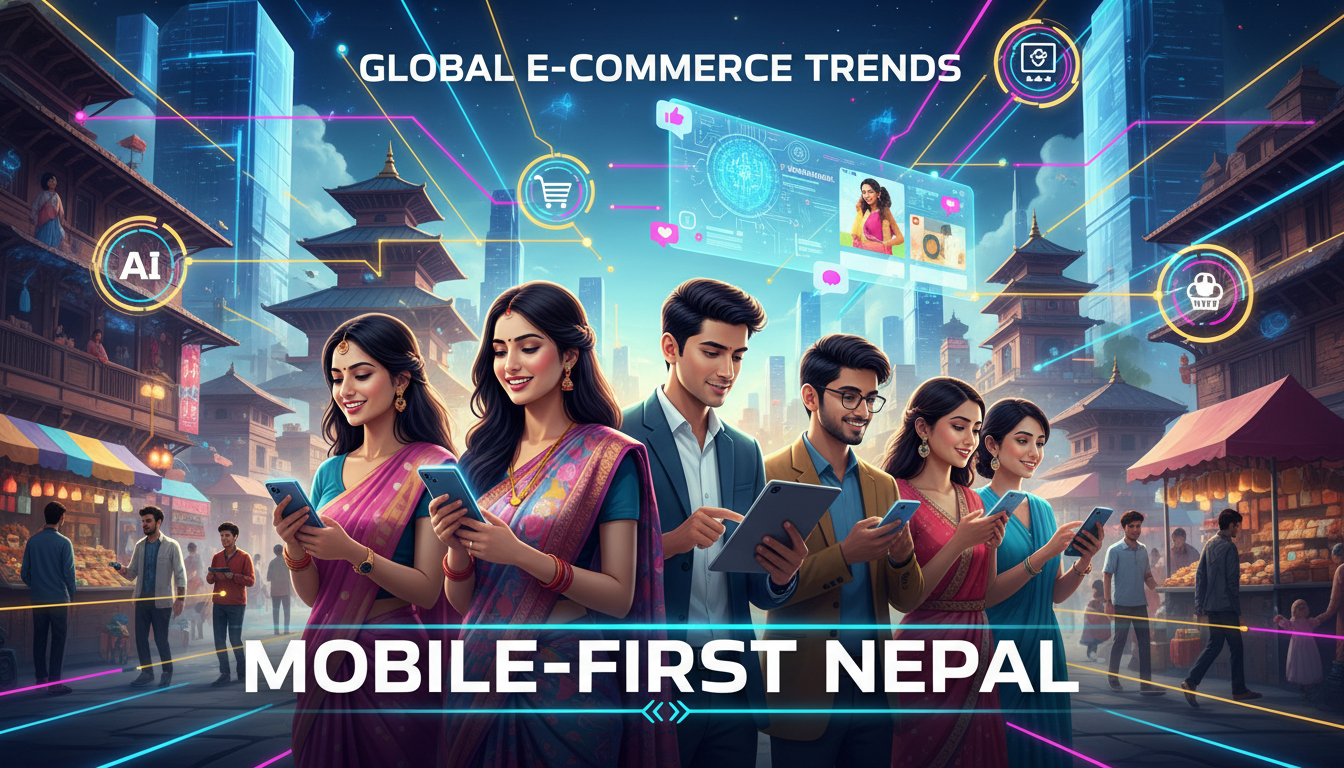
In the context of Nepal, these global trends are mirrored but adapted to local realities. Nepal’s digital economy is currently experiencing a “leapfrog” phenomenon. Unlike Western markets that transitioned from desktop to mobile, Nepal is a “mobile-first” nation. Internet penetration has exploded, largely driven by affordable mobile data and smartphone adoption, reaching over 45% of the population.
However, the local market is also characterized by unique challenges:
- The Trust Deficit: A historical reliance on Cash on Delivery (COD) due to skepticism regarding digital fulfillment.
- Infrastructural Bottlenecks: A lack of standardized addressing systems, making “last-mile” delivery a complex logistical puzzle.
- Regulatory Evolution: The recent enactment of the E-commerce Act, 2025, which has finally brought legal clarity to a previously grey sector.
E-commerce in Nepal
The history of e-commerce in Nepal is relatively short but dynamic. It began with pioneering efforts like Thamel.com and Muncha.com, which primarily targeted the Nepali diaspora looking to send gifts home. The second wave saw the rise of marketplaces like Sastodeal and Daraz (acquired by Alibaba), which attempted to replicate the “Amazon model” of aggregation.
UG Cakes (Urban Girl) represents a “third wave” of specialized, vertical-specific players. Unlike generalist marketplaces that struggle with quality control across thousands of SKUs, vertical players like UG Cakes focus on a specific niche (bakery and gifting) to control the entire value chain—from production to delivery. This model has proven particularly resilient in Nepal, where quality assurance is the primary differentiator.
The COVID-19 pandemic acted as a massive catalyst for this sector. Lockdowns forced a behavioral shift; consumers who were previously hesitant to buy online began ordering daily essentials and celebration items out of necessity. This period validated the operational models of companies like UG Cakes, which saw sales surges as traditional retail shuttered.
Types of E-commerce (B2C, B2B, C2C, C2B, etc.)
To understand UG Cakes’ position, we must first define the standard archetypes of electronic commerce as per the course curriculum:
- Business-to-Consumer (B2C): The most common form, where businesses sell directly to the general public.
- Business-to-Business (B2B): Transactions between businesses, such as a manufacturer selling to a wholesaler.
- Consumer-to-Consumer (C2C): Individuals selling to one another, typically facilitated by a platform (e.g., eBay, Hamrobazar).
- Consumer-to-Business (C2B): Individuals creating value that businesses consume (e.g., freelance marketplaces).
UG Cakes operates primarily as a B2C entity, selling bakery products directly to end-users. However, as the analysis in Chapter 2 will demonstrate, it has evolved into a Hybrid Model. Through its corporate gifting arm, it engages in significant B2B commerce. Furthermore, its parent platform, UG Bazaar, facilitates C2C interactions through auctions and used-goods sales. This hybridity is a strategic response to the limited market size of any single vertical in Nepal.
Introduction to Group Members
This report is submitted by Group 7 of the BBA 6th Semester cohort.
- Lead Researcher: [Name], responsible for business model analysis and regulatory review.
- Technical Analyst: [Name], responsible for infrastructure evaluation and security protocols.
- Marketing Specialist: [Name], responsible for consumer behavior analysis and digital strategy assessment.
Objectives of the Case Study
The overarching objective of this case study is to bridge the gap between the theoretical concepts taught in IT 204 and the practical realities of running an e-commerce business in Nepal.
Specific Objectives:
- Business Model Deconstruction: To analyze how UG Cakes creates, delivers, and captures value, specifically examining its pivot from accessories to bakery.
- Infrastructure Assessment: To evaluate the technological stack (Hardware, Software, Telecommunications) that powers the platform, with a focus on its custom-built “MERN” stack architecture.
- Security & Payment Analysis: To investigate the security protocols (SSL, 2FA) and payment integrations (CyberSource, eSewa) used to mitigate fraud and ensure trust.
- Marketing & Social Strategy: To explore how UG Cakes utilizes “Social Commerce” and influencer marketing to acquire and retain customers in a cost-effective manner.
- Regulatory Compliance: To assess the impact of the newly implemented E-commerce Act 2025 on the company’s operations.
Scope and Limitations of the Study
Scope:
- The research is centered on UG Cakes and its integrated ecosystem within UG Bazaar. The temporal scope covers the company’s inception in 2012 through to the post-pandemic landscape of late 2025. Geographically, the study focuses on their operational hubs in the Kathmandu Valley and Pokhara, while acknowledging their international customer base (the diaspora).
Limitations:
- Financial Opacity: As a private limited company, UG Cakes is not required to publish audited financial statements. Revenue and profitability figures are derived from public interviews and estimates rather than hard accounting data.
- Dynamic Regulatory Environment: The E-commerce Act 2025 is in its early stages of implementation. Its long-term effects on compliance costs and market consolidation are currently predictive.
- Platform Integration: At the time of research, the standalone domain ugcakes.com appeared to be redirecting or integrating with ugbazaar.com, requiring the analysis to focus heavily on the mobile application and the broader marketplace interface.
Research Methodology
This report employs a Descriptive and Analytical Research Design.
Secondary Data Collection: The core of the research relies on a comprehensive review of existing literature. This includes:
- Media Interviews: In-depth analysis of video and text interviews with founders Nikita Acharya and Kiran Timsina.
- Technical Portfolios: Review of public developer portfolios (e.g., Sushovan Bhattarai) to identify the specific technology stack used.
- Legal Texts: Analysis of the E-commerce Act 2025 and Consumer Protection Act to understand the legal framework.
- Market Reports: Utilization of World Bank and industry reports on Nepal’s economic status.
Platform Testing (Digital Ethnography):
- The research team conducted functional testing of the UG Bazaar mobile application (Android/iOS) to simulate the user journey, evaluating UI/UX, checkout flows, and gamification features.
Sentiment Analysis:
- Analysis of public customer reviews on Google Maps and social media platforms to gauge consumer satisfaction and identify pain points.
Overview of the Selected E-commerce Platform
Company Profile
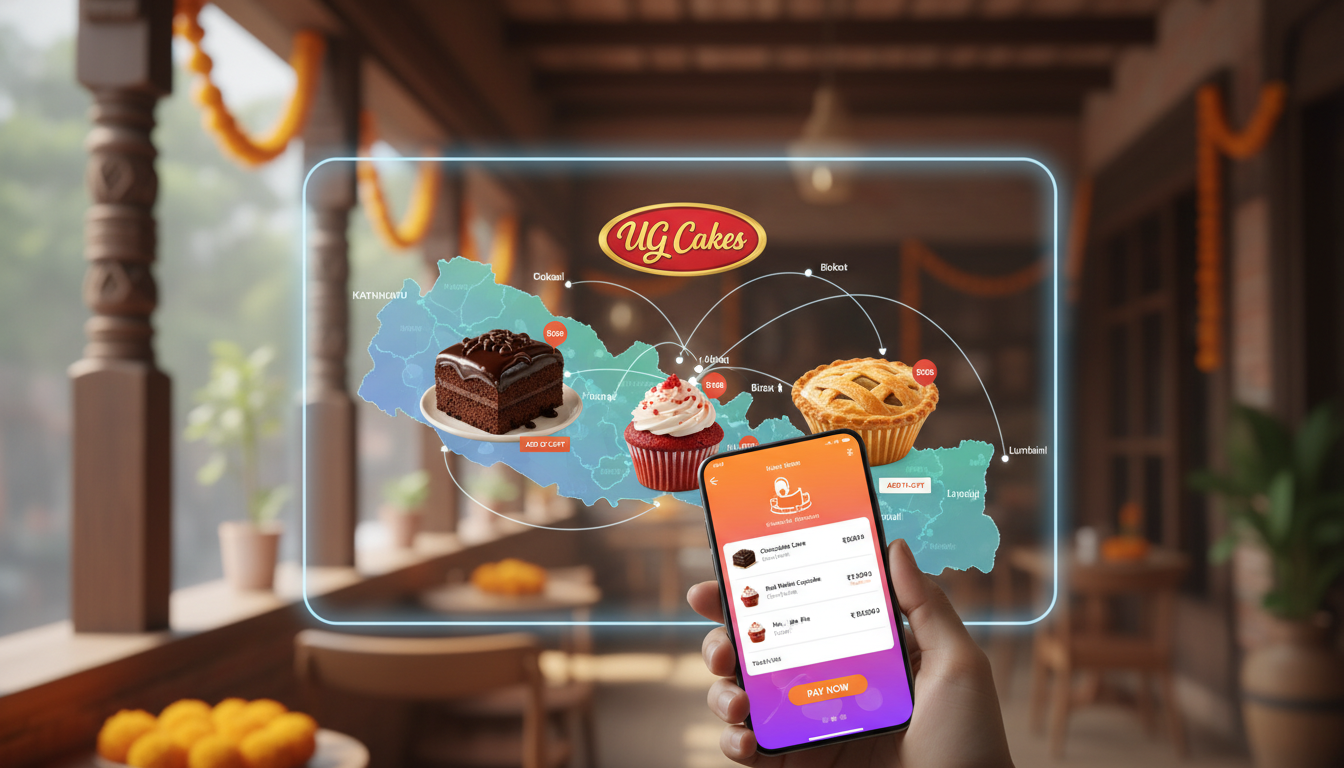
UG Cakes is a subsidiary brand of Urban Girl Inc. (UG), a pioneering name in Nepal’s startup ecosystem. The company was co-founded in 2012 by Nikita Acharya and Kiran Timsina.
The genesis of the company is a classic example of “bootstrapping.” Starting with a meager investment of just $200 (approx. NPR 20,000), the founders initially launched “Urban Girl” as an online retailer for fashion accessories (jewelry, watches) aimed at young women.
In 2014, the company pivoted—or rather, expanded—into the bakery sector, launching UG Cakes. This strategic move was driven by data and customer feedback.
The founders noticed a significant volume of inquiries from Nepalis living abroad who wanted to send gifts to their families in Nepal but lacked a reliable service provider. The existing bakeries lacked online payment facilities (accepting international cards) and delivery reliability. UG Cakes was created to fill this void, positioning itself not just as a bakery, but as a “happiness delivery service.”
Key Milestones:
- 2012: Launch of Urban Girl (Accessories).
- 2014: Launch of UG Cakes (Bakery).
- 2017: Awarded “Best Startup Company” by New Business Age.
- 2020: Co-founder Nikita Acharya listed in Forbes 30 Under 30 Asia (Retail & Ecommerce).
- 2020: Launch of UG Bazaar, a consolidated social e-commerce platform.
- 2025: Operational compliance with the new E-commerce Act.
The company is also noted for its strong social mission. It actively hires women (who make up the majority of the workforce) and has specific programs for hiring differently-abled individuals, such as deaf women in their bakery operations, in collaboration with the Gandaki Deaf Association.
Key Features of the Platform
UG Cakes is not merely a website; it is part of a “Super App” ecosystem (UG Bazaar) that integrates commerce, social interaction, and entertainment.
Distinctive Features:
-
Social Commerce Integration: Unlike traditional e-commerce sites that are purely transactional, the UG platform encourages interaction. It features auction mechanisms where users can bid on products, a “Make an Offer” system for negotiation, and direct messaging between buyers and sellers.
-
Gamification: To increase user retention and “stickiness,” the app includes games like Roulette and Quizzes. Users earn “Game Credits” by completing orders or winning games, which can be redeemed for discounts. This strategy increases the Daily Active User (DAU) metric even when users aren’t immediately purchasing.
-
Process Automation: The backend of UG Cakes is highly automated. As described by co-founder Kiran Timsina (a former programmer), the company automates complex business processes such as order routing, inventory deduction, and delivery dispatch. This reduces the “human error” factor common in manual bakery operations.
-
Real-Time Tracking: Addressing the “anxiety of the sender” (especially international ones), the platform offers detailed status updates: Order Received -> Baking -> Decorating -> Out for Delivery -> Delivered.
-
Automobiles & Jobs: The UG Bazaar platform has diversified to include listings for automobiles (with test-drive booking features) and a job portal (“Vacancies module”), attempting to capture a larger share of the user’s digital life.

Products/Services Offered
While the brand is synonymous with cakes, the product portfolio is extensive, designed to cater to the “Gifting” use case.
Core Product Categories:
-
Bakery:
- Custom Cakes: The flagship offering. Users can customize flavor (Black Forest, White Forest, Chocolate Truffle, Red Velvet), shape (Round, Heart, Square), and weight.
- Signature Items: The “Rasmalai Cake” is highlighted as a hot-selling item, blending traditional dessert flavors with modern cake formats.
- Dietary Specifics: Options for Eggless cakes, Sugar-free versions (for diabetic gifting), and vegan options.
-
Gifts & Bundles:
- Flowers: Fresh bouquets sourced from local florists but quality-controlled by UG.
- Personalized Items: Printed mugs, cushion covers, and photo frames.
- Combos: “Cake + Flower + Chocolate” bundles are popular for efficient gifting.
-
Corporate Services (B2B):
- Bulk supply of pastries for office canteens.
- Custom logo cakes for corporate anniversaries.
- Hampers for festivals like Dashain and Tihar.
-
Marketplace (UG Bazaar):
- Fashion, Electronics, Second-hand items (Garage sale style), and even Automobiles.
Buying and Selling Workflow
The workflow at UG Cakes is a blend of digital efficiency and physical craftsmanship.
Customer Journey (Buying Process)
-
Discovery & Entry: Customers typically land on the platform via a Facebook ad or a Google Search for “Cake Delivery Nepal.” International users often arrive via direct referrals from the diaspora community.
-
Product Configuration:
- Selection: User selects “Chocolate Truffle Cake.”
- Customization: The UI mandates selection of weight (e.g., 2lbs), Egg/Eggless preference, and the custom message (e.g., “Happy 50th Birthday Buwa”).
- Scheduling: Users must select a delivery date and time slot. This is critical for perishable goods.
-
Authentication: Login is required (Google/Facebook/Email) to establish an audit trail for the order.
-
Payment Selection:
- Domestic: Choice of Mobile Wallet (eSewa, Khalti), ConnectIPS, or Cash on Delivery.
- International: Credit/Debit Card (Visa/Mastercard) via CyberSource.
-
Post-Purchase: The user receives an email/SMS confirmation. They can track the “Stage” of the cake on the app.
-
Delivery & Feedback: The specialized delivery team (using temperature-controlled bags) delivers the cake. A follow-up notification requests a review.
Seller Onboarding (Selling Process)
As UG Bazaar operates as a marketplace, it allows third-party vendors to sell alongside UG Cakes.
-
Registration: Vendors sign up as “Business Sellers.”
-
KYC & Compliance: Under the E-commerce Act 2025, vendors must submit their PAN/VAT registration certificates. The platform validates these to ensure no “grey market” selling occurs.
-
Inventory Management: Sellers access a “Beautiful Dashboard” to upload products, manage stock levels, and set prices.
-
Order Fulfillment: When an order is placed, the seller packs the item. UG’s logistics arm (or a 3PL partner) picks it up for delivery.
-
Payout: Funds are settled to the seller’s bank account after a cooling-off period (to account for returns), minus the platform commission.
Business Model
UG Cakes employs a Hybrid E-commerce Business Model.
B2C/B2B/Hybrid Analysis
-
Direct-to-Consumer (DTC) Manufacturer:
- Model: This is the core revenue driver for the “Cakes” division. UG is not just an aggregator; they own the bakery.
- Advantage: Vertical Integration. By owning the production, they capture the full margin (manufacturing + retail). They also control quality, which is the biggest risk in food delivery.
- Revenue: Sales revenue from products.
-
Two-Sided Marketplace (Platform):
- Model: UG Bazaar operates as a platform connecting buyers and third-party sellers (fashion, electronics).
- Advantage: Network Effects. More sellers attract more buyers, which attracts more sellers. This allows UG to sell categories (like cars) without holding inventory.
- Revenue: Commission fees on successful sales, listing fees for premium placement (e.g., featured auctions).
-
Business-to-Business (B2B):
- Model: Corporate gifting partnerships.
- Advantage: High volume, recurring orders. Contracts with banks or IT companies to send cakes to employees on their birthdays provide predictable cash flow.
Network Infrastructure & Technology Stack
The technological backbone of UG Cakes is robust, reflecting the IT background of its co-founder. The platform has evolved from a simple PHP site to a modern, scalable architecture.
-
Frontend Architecture: The platform utilizes React.js, a JavaScript library for building user interfaces. Recently, the team migrated from React 16 to React 18.
- Benefit: React 18 introduces “Concurrent Mode” and “Automatic Batching,” which significantly improves the rendering performance of the app, ensuring smooth scrolling and interaction even on lower-end devices common in Nepal.
- Styling: The shift from Ant Design to Tailwind CSS indicates a focus on highly custom, lightweight design systems that load faster.
-
State Management: The app uses Redux Toolkit. This manages the complex state of the application (e.g., keeping track of cart items, user session data, and auction timers) efficiently across different screens.
-
Backend & Database: The stack is likely MERN (MongoDB, Express, React, Node.js).
- Node.js/Express: Handles server-side logic. Its non-blocking I/O model is perfect for handling thousands of concurrent connections during flash sales or auctions.
- MongoDB: A NoSQL database ideal for storing product data with variable attributes (e.g., a cake has “flavor” attributes, while a listed car has “mileage” attributes).
-
Mobile: The mobile applications are likely built using React Native, allowing code sharing between the web and mobile platforms, reducing development time and ensuring feature parity.
Security Features and Policies
Security is paramount, especially given the strict data protection mandates of the E-commerce Act 2025.
-
Data Encryption: All data in transit is encrypted using TLS/SSL (Transport Layer Security). This prevents “Man-in-the-Middle” attacks where hackers could intercept customer addresses or passwords.
-
Payment Security: UG Cakes does not store credit card numbers on its own servers (a practice known as PCI de-scoping). Instead, it uses Tokenization. When a user enters card details, they are sent directly to the Payment Gateway (CyberSource), which returns a secure “token” to UG. If UG’s database were hacked, the attackers would find only useless tokens, not card numbers.
-
Access Control: Seller accounts are protected with strict password policies and likely Two-Factor Authentication (2FA) to prevent unauthorized access to business dashboards.
-
Legal Compliance: The platform’s privacy policy explicitly states how data is collected and used, complying with the transparency requirements of the new Nepali laws.
Payment Gateways and Systems Used
UG Cakes has successfully integrated a “Payment Stack” that bridges the local and global financial divides.
- CyberSource (Visa/Mastercard):
- Provider: Integrated via NIC Asia Bank.
- Why: This is the critical link for the diaspora market. It allows reliable acceptance of international USD/AUD/GBP cards, complete with fraud detection algorithms (e.g., spotting if a card from the UK is being used by an IP address in Russia).
- Local Digital Wallets (eSewa, Khalti, IME Pay):
- Why: These are ubiquitous in Nepal. Integrating them allows frictionless payment for locals who do not possess credit cards.
- SCT/ConnectIPS:
- Why: Facilitates direct bank-to-bank transfers, often used for larger B2B transactions or high-value Bazaar purchases.
- Cash on Delivery (COD):
- Why: Despite digital progress, COD remains essential for trust. However, UG employs strategies to minimize COD (like offering small discounts for prepayment) to reduce the risk of “fake orders”.
Marketing and Customer Engagement
Digital Marketing Strategies
UG Cakes’ marketing strategy is deeply rooted in the concept of “inbound marketing”—creating content that pulls customers in, rather than just pushing ads at them.
Social Media Integration
The company adopts a “Social-First” approach.
- Facebook: With over a million users in Nepal, Facebook is the primary engine. UG uses it for community engagement, customer service (Messenger), and viral content (photos of unique cake designs).
- Instagram: Used as a visual catalog. The “Story” feature is utilized to show behind-the-scenes footage of the bakery, humanizing the brand and proving hygiene standards—a crucial trust factor.
- Conversational Commerce: A significant portion of sales is closed via chat. Customer service agents act as “Cake Consultants,” guiding users through customization options in real-time on Messenger or WhatsApp.
SEO/SEM Approaches
- Search Engine Optimization (SEO): The platform targets “long-tail keywords” relevant to the diaspora, such as “Send Birthday Cake to Kathmandu from Australia” or “Online Gift Delivery Nepal.”
- Search Engine Marketing (SEM): Paid Google Ads are strategically deployed during high-intent periods (festivals). By bidding on keywords like “Mother’s Day Nepal,” they capture traffic at the exact moment of purchase intent.
Content & Influencer Marketing
- Emotional Storytelling: Marketing campaigns often focus on the narrative of “connection.” They share real stories of mothers receiving cakes from children abroad, triggering an emotional response that drives sales.
- Influencer Strategy: Rather than just using mega-celebrities, UG partners with micro-influencers (food bloggers, lifestyle TikTokers) who have high engagement rates. These influencers create “unboxing” videos, which serve as authentic social proof.
Mobile and Location-Based Marketing Techniques
- Geo-Fencing: Marketing efforts are geographically targeted. Ads for “Same Day Delivery” are only shown to users within the Kathmandu Valley to strictly manage expectations.
- App Push Notifications: The UG Bazaar app sends personalized pushes. For example, if a user browsed “Red Velvet” but didn’t buy, a push notification offering a 5% discount on that specific item might be triggered a few hours later.
- Local SEO: The business is optimized for “Near Me” searches (e.g., “Cake shop near Baneshwor”), ensuring they appear in the Google Maps “Local Pack”.
Social Commerce and Online Communities
UG Cakes is at the forefront of Social Commerce in Nepal.
- Community Features: The app allows users to create public profiles, follow sellers, and share product listings.
- Auctions: The auction feature creates a sense of community and excitement. Users return to the app not just to buy, but to compete in bidding wars for deals, effectively turning shopping into a multiplayer game.
- Live Selling: Occasional live streams on Facebook/TikTok where hosts showcase products and answer questions in real-time, driving immediate sales.
Advertising Campaigns and Communication Channels
- Festival Campaigns: In Nepal, the calendar is driven by festivals. UG Cakes creates specific product lines for each (e.g., “Bhai Tika Hampers”). Marketing ramp-up begins 2-3 weeks prior to the event across all channels (Email, SMS, Social).
- Retargeting: Using the Meta Pixel and Google Analytics, UG tracks users who visited the site but left without buying. These users are then “retargeted” with ads on Facebook/Instagram, often featuring the exact product they viewed.
Customer Retention and Loyalty Programs
- Data-Driven Retention: By analyzing order history, UG identifies “key dates” for each customer (e.g., a birthday they ordered for last year). Automation scripts send a reminder email 1 week before that date: “It’s almost Mom’s birthday again! Order now?” This automated personalization drives high repeat purchase rates.
- Gamified Loyalty: The “Game Credits” system in the app rewards engagement. Users earn points for logging in daily or playing games, which they can convert into purchase discounts, creating a “sunk cost” psychological effect that keeps them loyal to the platform.
Technical and Strategic Analysis
Website and App UI/UX Evaluation
A heuristic evaluation of the UG Bazaar platform reveals a design philosophy centered on User-Centricity.
- Navigation: The taxonomy is clear. Categories are logical (Cakes > Flavor > Weight).
- Visual Hierarchy: High-resolution images dominate the screen real estate, essential for food retail. The “Call to Action” (Buy Now) buttons are prominent and contrasting.
- Speed: The use of React 18 and Tailwind CSS ensures that the app feels “snappy.” Transitions between screens are smooth, and load times are minimized, which is crucial for retaining users on 4G networks.
- Friction Reduction: The “One-Page Checkout” or minimized steps to payment reduces cart abandonment. Guest checkout options (where legally permissible) also help.
SWOT Analysis
| Strengths (Internal) | Weaknesses (Internal) |
|---|---|
| Vertical Integration: Owning the bakery ensures product quality and higher margins compared to pure aggregators. | Logistical Dependency: Maintaining an in-house fleet is capital intensive and hard to scale rapidly to new cities. |
| Tech DNA: Founders’ IT background results in a superior, stable platform with advanced automation features. | Product Perishability: High risk of waste (spoilage) if demand forecasting is inaccurate. |
| Brand Equity: Strong reputation for social impact (women empowerment) and reliability among the diaspora. | App Complexity: Integrating diverse verticals (Cakes, Cars, Jobs) in one “Super App” might dilute the brand identity and confuse users. |
| Opportunities (External) | Threats (External) |
| Geographic Expansion: Utilizing the franchise model to enter Tier-2 cities (Butwal, Chitwan) where e-commerce is nascent. | Regulatory Compliance: The E-commerce Act 2025 imposes strict penalties for non-compliance, increasing operational overhead. |
| Corporate B2B: Deepening ties with HR departments for automated employee gifting. | Competition: Aggregators like Foodmandu and Pathao Food are entering the delivery space with massive venture backing. |
| Cross-Border Marketing: Increasing penetration in newer diaspora markets (e.g., Japan, Europe). | Talent Flight: The “Brain Drain” of skilled IT professionals and management staff from Nepal poses a risk to innovation. |
Mobile Commerce and Cross-Platform Features
UG Cakes has embraced m-commerce not just as a channel, but as the primary channel.
- Responsive Design: The web interface adapts fluidly to all screen sizes.
- App Specifics: The app utilizes hardware features like the camera (for scanning QR codes/taking profile pics) and GPS (for precise delivery location pinning).
- Cross-Platform Sync: A user can add items to their cart on the desktop website at work and complete the checkout on their mobile app on the way home; the state is persistent via the cloud database.
Use of EDI or Integration Tools
While traditional EDI is less common in this segment, API Integration is extensive.
- Banking APIs: Real-time settlement and refund processing.
- SMS/Communication APIs: Integration with providers like Sparrow SMS for transactional alerts.
- Mapping APIs: Google Maps API for logistics planning.
- Social APIs: Facebook Graph API for login and sharing features.
Reviews, Ratings, and Customer Feedback Loop
- Aggregate Rating: UG Cakes holds a rating of 4.1/5 on Google Maps based on nearly 1,000 reviews. This indicates a generally high level of satisfaction (“Very Good”).
- Sentiment:
- Positive: Customers praise the “Rasmalai Cake,” timeliness, and the surprise element for recipients.
- Negative: Occasional complaints about pricing (“Not worth the price”) or delivery mishaps during peak rain/traffic.
- The Loop: The company actively monitors these channels.
Responses to negative reviews are often personalized, offering apologies or compensation, which turns a dissatisfied customer into a brand advocate.
Innovation, Trends, and Future Technologies
- Artificial Intelligence (AI): The future roadmap likely includes AI-driven “Chatbots” for handling Level-1 customer queries (Order status, Price checks), freeing up humans for complex issues.
- Predictive Analytics: Using historical data to predict how many “Black Forest Cakes” will be needed next Tuesday to minimize waste.
- Green Logistics: With rising fuel costs, a shift to Electric Vehicle (EV) scooters for delivery is a logical and eco-friendly innovation trend in Nepal.
Conclusion and Strategic Recommendations
Summary of Key Findings
The comprehensive analysis of UG Cakes reveals a robust, mature, and socially conscious e-commerce entity.
- Strategic Positioning: UG Cakes has successfully positioned itself as the “Gold Standard” for gifting in Nepal, effectively monetizing the emotional needs of the diaspora.
- Operational Excellence: The decision to vertically integrate (own the bakery and logistics) rather than outsource has allowed them to maintain quality in a market where trust is fragile.
- Technological Maturity: The transition to a modern stack (React 18, Microservices) and the development of a “Super App” (UG Bazaar) demonstrates a forward-thinking technical strategy that prioritizes scalability and user experience.
- Resilience: The company has weathered economic blockades, pandemics, and regulatory shifts, emerging stronger each time.
Limitations of the Study
It is important to acknowledge that this study relies on external observation and public data. The lack of access to internal financial ledgers prevents a precise calculation of ROI or Net Profit Margin. Furthermore, the rapidly evolving nature of the E-commerce Act 2025 means that the full impact of these regulations is still unfolding and warrants future study.
Strategic Suggestions and Recommendations
- Leverage Compliance as a Marketing Tool: In a market rife with unregulated sellers, UG Cakes should aggressively market its status as a fully compliant, VAT-registered, and secure platform. Displaying “E-commerce Act Compliant” badges can further enhance trust.
- Hyper-Local Logistics Optimization: Implement algorithm-based route planning software. Given the chaotic traffic of Kathmandu, optimizing delivery routes can save fuel costs and improve delivery times.
- Subscription Models (UG Prime): Launch a subscription service for frequent buyers (or corporate clients) offering free delivery and priority slots for a monthly fee. This creates a “moat” against competitors.
- B2B Automation Portal: Develop a dedicated self-service portal for corporate clients to upload bulk employee data (Birthdays/Anniversaries) and automate the dispatch of cakes year-round, securing long-term revenue.
- Fintech Expansion: Fully integrate BNPL (Buy Now Pay Later) services to encourage higher average order values (AOV) on the UG Bazaar platform for electronics and high-ticket gifts.
Potential for Expansion or Innovation
The greatest potential lies in Geographic and Category Expansion.
- Franchising: Aggressively expand the franchise model to the top 10 cities in Nepal. The “UG” brand is known nationwide; local production hubs can fulfill this demand.
- Export: Explore the export of non-perishable “Made in Nepal” goods (handicrafts, pashmina) to their existing diaspora customer base, effectively reversing the flow of trade using the same platform trust.
UG Cakes stands as a beacon of what is possible in Nepal’s digital economy: a homegrown solution solving local problems with global standards of technology and service.