


Muncha.com E-commerce Case Study: Nepal’s Digital Pioneer
Strategic Case Study: Muncha.com – Evolution, Operational Framework, and Competitive Positioning in the Nepalese E-Commerce Landscape

CHAPTER 1 Introduction and Methodology
1.1 Background of the Study
The global economic landscape has undergone a paradigm shift over the last three decades, transitioning from a localized, physical-asset-heavy model to a digitized, borderless ecosystem driven by the internet. Electronic Commerce, or e-commerce, is no longer a peripheral activity but the central nervous system of modern trade. It encompasses not just the buying and selling of goods online, but the entire infrastructure of digital transactions, including electronic funds transfer, supply chain management, Internet marketing, online transaction processing, and automated data collection systems. For developing economies like Nepal, e-commerce represents a leapfrog opportunity—bypassing traditional retail evolution stages to directly integrate into the global digital economy.
This report serves as a comprehensive case study of Muncha.com, a pioneering entity in the Nepalese digital space. Unlike the trajectory of e-commerce giants like Amazon or Alibaba, which grew from domestic logistics needs in developed markets, Muncha.com emerged from a unique socio-economic necessity: the need to connect the sprawling Nepalese diaspora with their homeland. As a subject of study for the “IT 204: E-Commerce” course, Muncha.com provides a rich text for analyzing how traditional business models adapt to digital disruption, how infrastructure challenges shape strategy, and how niche targeting can sustain a business against well-funded global competitors.
1.1.1 Global and Local Trends in E-commerce
Globally, the e-commerce sector has matured from simple online catalogs to complex ecosystems driven by Artificial Intelligence (AI), Big Data analytics, and hyper-personalized marketing. The trend has shifted decisively towards “Mobile-First” commerce, where the primary touchpoint for consumers is a smartphone application rather than a desktop browser. Social Commerce—the integration of shopping directly into social media feeds—and “Quick Commerce” (delivery in under an hour) are defining the current frontier.
However, the localized context of South Asia, and Nepal specifically, presents a divergent trend line. While global markets fight over seconds of delivery time, the Nepalese market is still solving foundational issues of address verification, digital payment trust, and cross-border regulatory compliance. The global trend of consolidation (big players buying small ones) is mirrored in Nepal by Alibaba’s acquisition of Daraz, yet local players like Muncha persist by dominating specific niches like cross-border gifting and remittance. The resilience of these local platforms offers critical insights into the limitations of “one-size-fits-all” global e-commerce strategies.
1.1.2 E-commerce in Nepal
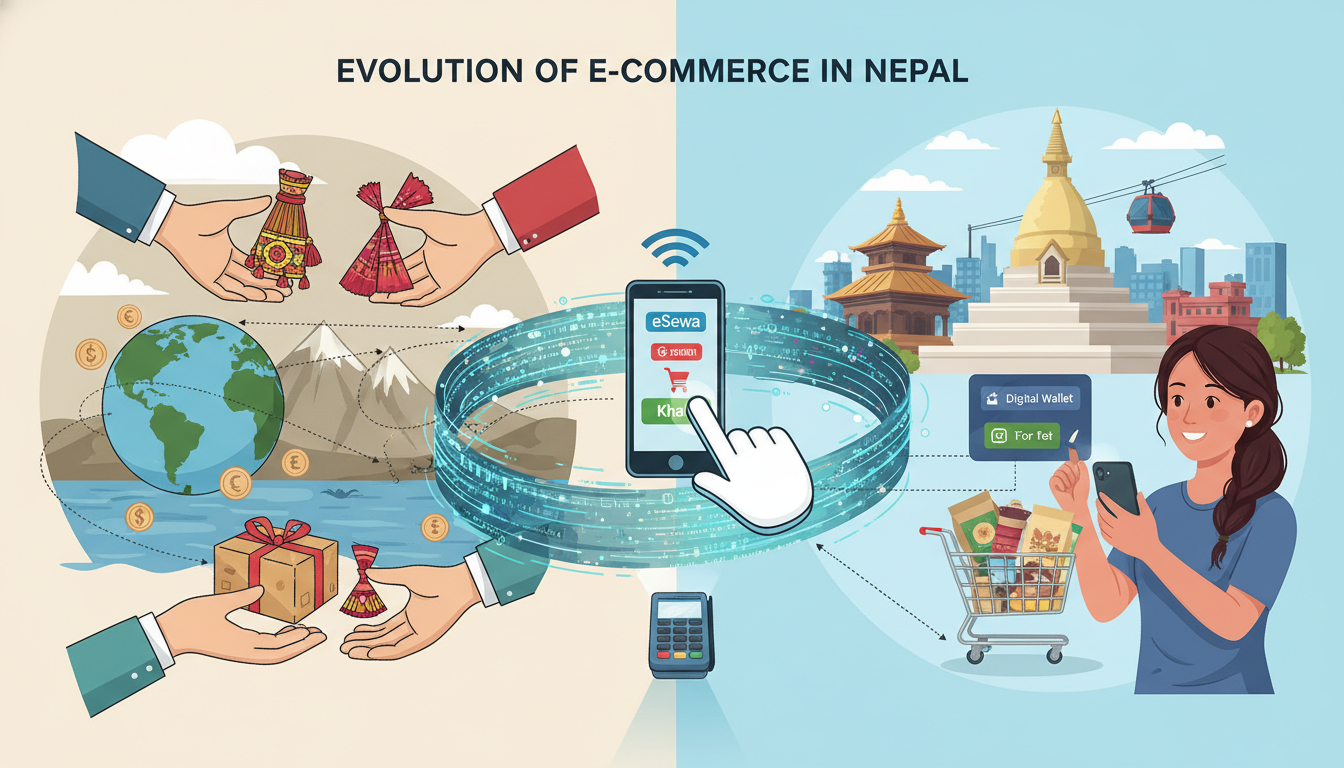
The history of e-commerce in Nepal is inextricably linked to the history of the internet in the country. In the late 1990s and early 2000s, internet penetration was negligible among the domestic population. Consequently, the first wave of e-commerce was not domestic but export-oriented or diaspora-focused. Companies like Thamel.com and Muncha.com (initially Muncha House) pioneered the “Gift-to-Nepal” model. This model was ingenious in its avoidance of the primary barrier to entry: the lack of domestic digital payments. By targeting Non-Resident Nepalis (NRNs) in the USA, UK, and Australia—who possessed credit cards and high purchasing power—these platforms created an inflow of capital while fulfilling an emotional need to care for family members back home.
Today, the landscape is transforming. Internet access has reached approximately 45% of the population, driven largely by mobile connectivity. The proliferation of digital wallets like eSewa, Khalti, and Fonepay has finally enabled a true domestic e-commerce market. The market size is projected to expand significantly, with e-commerce users expected to reach 25 million by 2025. This shifts the strategic imperative for companies like Muncha from solely serving the diaspora to capturing the burgeoning domestic middle class, a transition that requires fundamental changes in technology, logistics, and marketing strategy.
1.2 Types of E-commerce
To contextualize Muncha.com’s operations, it is essential to categorize it within the standard frameworks of electronic commerce.
- Business-to-Consumer (B2C): This is the most visible form of e-commerce, where businesses sell directly to the end-user. Muncha.com’s primary retail operation—selling cakes, flowers, and consumer electronics to individuals—is a classic B2C model. However, the geographic separation of the “buyer” (abroad) and the “consumer” (in Nepal) adds a unique layer of complexity to this definition.
- Business-to-Business (B2B): While Muncha is primarily consumer-facing, elements of B2B exist within its supply chain. Its “marketplace” model, where it lists products from other local vendors, involves B2B agreements on commissions and logistics. Furthermore, its corporate gifting solutions function as B2B transactions.
- Consumer-to-Consumer (C2C): Facilitating transactions between two consumers. Muncha Money Transfer effectively facilitates C2C financial transactions, enabling a user in New York to transfer value to a user in Kathmandu, with the platform acting as the secure intermediary.
- Hybrid Model: Muncha.com is best described as a hybrid platform. It combines the inventory-led B2C model of a traditional retailer (holding stock of hampers), the platform-led B2B2C model of a marketplace (listing third-party vendors), and the service-led model of a fintech provider (remittance).
1.3 Introduction to Group Members
This case study is submitted in partial fulfillment of the requirements for the IT 204: E-Commerce course. The research and analysis were conducted collaboratively by the following team members:
- Lead Researcher & Strategic Analysis. Focused on business model evaluation, SWOT analysis, and competitive benchmarking against Daraz and SastoDeal.
- Technical Analyst. Responsible for auditing the technology stack, security protocols, payment gateway integrations, and mobile application architecture.
- Marketing Specialist. Conducted the analysis of digital marketing channels, social media engagement, customer retention strategies, and brand positioning.
1.4 Objectives of the Case Study
The primary objective is to dissect the operational, technical, and strategic dimensions of Muncha.com to understand its longevity and future prospects. Specifically, the study aims to:
- Analyze the Business Model Evolution: To trace Muncha’s transition from a brick-and-mortar department store to a digital ecosystem and evaluate its hybrid revenue streams.
- Evaluate Technical Infrastructure: To assess the platform’s readiness for modern e-commerce demands, focusing on web architecture, security compliance (SSL, PCI), and mobile app performance.
- Assess Marketing Effectiveness: To determine how Muncha acquires and retains customers in a competitive market, specifically analyzing its reliance on diaspora marketing vs. domestic engagement.
- Understand Operational Challenges: To identify the logistical, regulatory, and payment-related hurdles faced by e-commerce players in Nepal and how Muncha mitigates them.
- Propose Strategic Recommendations: To offer actionable insights on how Muncha can leverage emerging technologies (AI, Blockchain) and refine its UX/UI to compete with global entrants.
1.5 Scope and Limitations of the Study
Scope:
The research encompasses the entire digital footprint of Muncha.com, including its main retail website, the Muncha Money Transfer service, and its associated mobile applications. The timeline of analysis focuses on its evolution from 2000 to the present day, with a strong emphasis on current operational strategies. The geographical scope includes its operations in Nepal and its marketing reach in key diaspora hubs (USA, Australia, UK).
Limitations:
- Proprietary Data Inaccessibility: As a private company, Muncha does not publish detailed financial statements. Analysis of revenue, profit margins, and exact transaction volumes is based on estimates and external indicators rather than audited reports.
- Dynamic Market Environment: The e-commerce sector in Nepal is volatile. Market share data and competitor strategies (e.g., Daraz’s campaigns) change rapidly; the report relies on the most recent available data points.
- Technical Opacity: Without backend access, the analysis of the technology stack relies on public job descriptions, developer profiles, and frontend code inspection rather than direct system audits.
1.6 Research Methodology
A mixed-method approach was employed to ensure a holistic analysis:
- Secondary Data Analysis: An extensive review of literature was conducted, including interviews with CEO Amrit Tuladhar, industry reports on Nepalese e-commerce, legal texts of the Electronic Transactions Act 2063, and technical blogs.
- Platform Testing (Digital Ethnography): The research team conducted “walkthroughs” of the Muncha.com website and Muncha Money app. This involved simulating the buyer journey—from account creation and product search to checkout and payment selection—to evaluate UI/UX and friction points.
- Comparative Benchmarking: Features, pricing, and delivery promises were compared against key competitors (Daraz, SastoDeal, Thamel.com) to establish relative market positioning.
Social Listening: Analysis of customer sentiment was derived from public reviews on the App Store, Facebook, and discussion forums like Reddit to gauge brand perception and service reliability.
Overview of the Selected E-commerce Platform

Company Profile
Muncha.com is more than just a website; it is a digital institution in Nepal. Its origins trace back to the Muncha House, a landmark department store established in the 1920s in Balkumari, Ason, by the Tuladhar family. For decades, Muncha House was synonymous with high-quality retail in Kathmandu.
In 2000, the company underwent a radical transformation under the leadership of Amrit Tuladhar, an MBA graduate from Marshall University, USA. Recognizing the limitations of physical retail and the emerging potential of the internet, Tuladhar launched MunchaHouse.com (later rebranded as Muncha.com). This was a visionary move, occurring years before the internet became a household utility in Nepal.
- Founders: Amrit Tuladhar and Niva Shrestha.
- Headquarters: Kathmandu, Nepal.
- Primary Focus: Online Gifting, Remittance, and E-commerce.
- Funding Status: Bootstrapped/Unfunded (relying on internal revenue rather than venture capital).
- Subsidiaries/Ventures: The Muncha ecosystem has spawned several internet ventures, including iPay (a digital wallet pioneer), Muncha Money Transfer (licensed remittance), and Muncha Ticketing.
The company’s survival through the dot-com bubble burst, the Nepalese civil conflict, and the massive infrastructural load-shedding era speaks to a highly resilient business model rooted in addressing genuine consumer pain points rather than chasing valuation trends.
Key Features of the Platform
Muncha.com differentiates itself through a service-oriented architecture designed specifically for the cross-border family dynamic.
- Occasion-Based Navigation: Unlike standard retailers that categorize by product type (e.g., Electronics, Fashion), Muncha emphasizes “Occasions” (Mother’s Day, Dashain, Bhai Tika). This aligns the user interface with the user’s intent—expressing care from a distance.
- Integrated Financial Ecosystem: It is one of the few e-commerce platforms globally that natively integrates a fully licensed remittance house. This allows users to send cash (Muncha Money) or goods (Muncha.com) using a single identity ecosystem.
- Hybrid Fulfillment: The platform features a “Marketplace” where other vendors can list goods, alongside a “Muncha Direct” inventory. This ensures a vast catalog without the capital risk of stocking every item.
- Global Payment Acceptance: It accepts international credit cards (Visa, MasterCard, Amex) seamlessly, a feature that many purely domestic Nepalese sites still struggle with due to banking regulations.
Products/Services Offered
The product mix is curated to bridge the distance between the diaspora and their families.
| Category | Description | Strategic Importance |
|---|---|---|
| Perishables (Cakes, Flowers, Mithai) | Fresh cakes from 5-star hotels (Radisson, Hyatt) and local bakeries. | High Volume, High Frequency. These are emotional purchases for birthdays/anniversaries that cannot be stockpiled, requiring rapid local logistics. |
| Groceries & Hampers | Daily essentials, dry fruits, and festival-specific food hampers. | Utility & Care. Allows the sender to contribute to the daily household management of parents in Nepal. |
| Electronics & Durables | Mobile phones, kitchen appliances, heaters. | High Value. Capitalizes on the price arbitrage or availability gaps between Nepal and abroad, though faced with stiff competition from Daraz. |
| Services & Experiences | Health checkup packages, restaurant vouchers, spa coupons. | Differentiation. Offers intangible gifts that improve the quality of life for recipients, a unique value proposition. |
| Money Transfer (Remittance) | Bank deposits and cash pickup services. | Cash Cow. Drives high-value traffic and leverages the same customer base as the gifting service. |
Buying and Selling Workflow
Customer Journey (Buying Process)
The buying process is distinct because the “Buyer” and “Receiver” are two different people in two different countries.
- Trigger: A calendar event (e.g., Mother’s Day) or a marketing email prompts the NRN user to visit the site.
- Discovery: The user browses categories specifically curated for the event. The “Send gifts to Nepal” SEO strategy ensures they land on relevant landing pages.
- Authentication: The user logs in. For high-value transactions or remittance, Two-Factor Authentication (2FA) and KYC verification (uploading ID) may be triggered.
- Configuration: The user selects the gift (e.g., a Black Forest Cake). Crucially, they must specify the delivery date and time, as fresh gifts are time-sensitive.
- Checkout: The user enters the Billing Address (e.g., New York, USA) and the Shipping Address (e.g., Baneshwor, Kathmandu). A phone number for the recipient is mandatory to coordinate delivery in a city with unstructured addresses.
- Payment: The transaction is processed via an international gateway (e.g., Wells Fargo integration for US users, or generic credit card processors).
- Fulfillment & Feedback: Muncha’s logistics team sources the item. Upon delivery, a photo is often taken of the recipient with the gift (with consent) and sent to the buyer, closing the emotional loop—a critical feature for trust.
Seller Onboarding (Selling Process)
For the marketplace component, local Nepalese businesses can become vendors.
- Application: Vendors contact Muncha to list products. This is often a B2B negotiation rather than an automated self-serve portal found in giants like Amazon.
- Digitization: Muncha often assists in photographing and describing products, as many local vendors lack digital readiness.
- Inventory Sync: Orders are relayed to vendors. Muncha typically handles the “last mile” logistics to ensure quality control, picking up the item from the vendor and delivering it to the final customer.
Business Model
Muncha.com operates on a diversified Hybrid Revenue Model that insulates it from reliance on a single stream.
B2C/B2B/Hybrid Analysis
- Retail Margin (B2C): For inventory it owns or manages closely (like specific hampers), Muncha earns the spread between the wholesale cost and the retail price.
- Commission Model (B2B2C): For third-party marketplace sales, it charges a commission (percentage of sale value) for providing the digital storefront and logistics network.
- Transaction Fees (Fintech): The Muncha Money Transfer service operates on a fee basis (though sometimes waived for promotions) and, significantly, on the Foreign Exchange (FX) Spread. They buy currency at a wholesale rate and sell it to the remitter at a retail rate.
- Float Income: In the wallet and remittance ecosystem, funds held in transit or in user wallets (iPay/Muncha Money) can generate interest income, a standard fintech revenue stream.
Network Infrastructure & Technology Stack
Muncha.com’s technology stack reflects its 24-year history, showing a mix of legacy robustness and modern agility.
- Legacy Backend: The core e-commerce platform was historically built on ASP.NET (Microsoft ecosystem) with MSSQL databases. This was the enterprise standard in the early 2000s and ensures high transactional integrity.
- Modern Migration: Recent recruitment for “Full Stack PHP Developers” and usage of frameworks like Laravel and CodeIgniter suggest a migration or hybridization strategy. PHP allows for more rapid development and easier integration with modern open-source tools.
- Frontend: The web interface relies on standard HTML/CSS/JavaScript. It utilizes jQuery and potentially newer libraries for dynamic elements, though the UX is often critiqued as dated.
- Mobile Architecture: The Muncha Money mobile apps (iOS/Android) are likely built using cross-platform frameworks like React Native or Flutter, as evidenced by developer profiles associated with the company. This allows a single codebase to serve both platforms, reducing maintenance costs.
- Hosting: While originally on dedicated servers, modern traffic spikes during festivals necessitate scalable cloud hosting solutions (likely AWS or similar VPS providers), ensuring uptime when thousands of users access the site simultaneously.
Security Features and Policies
Handling financial transactions imposes strict security requirements.
- SSL/TLS Encryption: The entire domain is secured with Industry Standard SSL (Secure Sockets Layer) encryption, ensuring that data transmitted between the user’s browser and Muncha’s servers remains confidential.
- Data Privacy: Muncha adheres to a privacy policy that limits data sharing. However, for remittance, they are legally required to share data with regulatory bodies (Nepal Rastra Bank) for AML checks.
- Authentication Security: Users are encouraged to change passwords every 3-6 months. The system likely employs hashing algorithms (e.g., bcrypt) to store passwords securely, though historical user discussions on forums like Reddit have raised concerns about “plain text” recovery, highlighting a need for continuous security audits.
- Compliance: The platform complies with the Electronic Transactions Act 2063 of Nepal, which governs the legality of digital signatures and electronic records.
Payment Gateways and Systems Used
The payment infrastructure is the backbone of Muncha’s cross-border operation.
- International Gateways: To capture revenue from the diaspora, Muncha integrates with global processors. This allows the acceptance of foreign credit cards (Visa, MasterCard) which are settled in foreign currency (USD, GBP).
- Domestic Aggregators: For local operations (ticketing, domestic shopping), Muncha integrates with eSewa, Khalti, and Fonepay.
These are essential as they allow local users without credit cards to pay via bank link or wallet balance.
- Proprietary Wallet (iPay): Muncha developed its own gateway, iPay, to reduce reliance on third parties and capture the merchant discount rate (MDR). Although eSewa became the market leader, iPay remains a strategic asset for the Muncha ecosystem.
- Direct Banking: For large remittance transactions, direct integration with the SWIFT network or partner banks (e.g., Kumari Bank, NIBL) is used to deposit funds directly into beneficiary accounts.
CHAPTER 3 Marketing and Customer Engagement
3.1 Digital Marketing Strategies
Muncha.com’s marketing strategy is highly targeted, focusing on the specific demographic of Non-Resident Nepalis (NRNs). This “niche dominance” allows them to spend marketing dollars more efficiently than broad-market retailers.
3.1.1 Social Media Integration
Social media is the primary engagement channel. Facebook is ubiquitous among Nepalis both at home and abroad.
- Strategy: Muncha utilizes its Facebook page not just for product blasts, but for community reminders. Posts often revolve around “nostalgia marketing”—reminding users of upcoming festivals like Dashain or Tihar, triggering an emotional response that leads to a purchase.
- Engagement: While they post frequently (3-4 times/week), engagement metrics suggest a passive audience. The content is often functional (exchange rates, product photos) rather than interactive or viral, which is a missed opportunity compared to the gamified campaigns of competitors like Daraz.
3.1.2 SEO/SEM Approaches
- Search Engine Optimization (SEO): Muncha ranks highly for high-intent, long-tail keywords such as “Send gifts to Nepal,” “Online cake delivery Kathmandu,” and “Money transfer to Nepal.” This organic visibility is a result of domain age (20+ years) and relevant content.
- Search Engine Marketing (SEM): During peak seasons, Muncha likely employs Google Ads (PPC) to defend its top position against aggressive bidding from new entrants. The cost of acquiring a customer (CAC) via search is justified by the high lifetime value (LTV) of a remittance user.
3.1.3 Content & Influencer Marketing
- Content: The site features blog-like content describing festivals (e.g., “The significance of Bhai Tika”). This serves a dual purpose: it educates second-generation NRNs who may be less familiar with traditions, and it boosts SEO relevance.
- Influencers: While Muncha hasn’t aggressively used “Gen Z” TikTok influencers, there is a natural form of influencer marketing within the diaspora community leaders. Endorsements from community groups (e.g., NRN Associations) act as powerful trust signals.
3.2 Mobile and Location-Based Marketing Techniques
With the launch of the Muncha Money app, the company has pivoted towards mobile-centric marketing.
- Push Notifications: The app allows for direct communication. A notification about a “High Exchange Rate Alert” can trigger immediate transaction volume.
- Geo-Targeting: The platform detects the user’s IP address to serve localized currency pricing (USD for US visitors, AUD for Australians) and relevant shipping information, reducing cognitive load and cart abandonment.
3.3 Social Commerce and Online Communities
Muncha’s version of social commerce is rooted in Community Trust. For a remittance business, trust is the currency.
- Word of Mouth: The most effective marketing channel is the recommendation of a family member. If a user successfully sends money or a gift, they tell their circle. Muncha relies on this “referral loop” implicitly.
- Forums: Discussions on platforms like Reddit (r/Nepal) serve as an unmanaged community space. While some users complain about the “dated” UI, many vouch for the reliability of the money transfer service, serving as social proof for new users.
3.4 Advertising Campaigns and Communication Channels
Muncha’s marketing calendar is cyclical, dictated by the Lunar calendar of Nepal.
- Festival Campaigns: The “Dashain Campaign” or “Mother’s Day Special” are the Super Bowls of their marketing year. They curate specific hampers (e.g., “Bhai Tika Masala Pack”) and promote them heavily via email and social ads.
- Promotional Codes: To drive adoption of the app, they use aggressive discounting, such as “Use code NEW5 for $/£5 off your first transfer.” This subsidizes the initial trial to build a habit.
- Email Marketing: They maintain a vast database of past customers. Automated emails remind users of birthdays they celebrated last year (“It’s almost your mom’s birthday again!”), a highly effective retention tactic.
3.5 Customer Retention and Loyalty Programs
- Service Quality as Loyalty: In the gifting business, the “product” is not just the cake, but the delivery of the cake on the correct day. Muncha’s investment in its own delivery fleet ensures reliability, which is the primary driver of retention.
- Cross-Selling: The ecosystem plays a vital role. A user who trusts Muncha for money transfer is more likely to use them for gifting. The “Muncha Money” app promotes “Muncha.com” gifts, creating a walled garden of services.
CHAPTER 4 Technical and Strategic Analysis
4.1 Website and App UI/UX Evaluation
The User Interface (UI) and User Experience (UX) of Muncha.com present a dichotomy between function and form.
- Website: The main retail site has often been criticized for having a “dated” aesthetic, reminiscent of the Web 2.0 era. It lacks the fluid animations, infinite scrolling, and sophisticated filtering options found on modern platforms like Daraz. However, the navigation is highly functional for its specific purpose—finding gifts by occasion.
- Mobile App: Conversely, the Muncha Money app features a modern, clean design with biometric login (FaceID/Fingerprint), clear transaction histories, and streamlined workflows. This indicates a strategic allocation of resources: the company is investing in the high-growth fintech vertical while maintaining the legacy retail platform.
- Friction Points: The checkout process on the web can be cumbersome, requiring manual entry of complex Nepalese addresses. Integrating map-based pinning (like Uber/Pathao) would significantly improve the UX.
4.2 SWOT Analysis
A strategic evaluation of Muncha.com reveals its standing in the market:
Strengths (Internal)
- Brand Heritage: 20+ years of trust; synonymous with gifting in Nepal.
- Hybrid Ecosystem: Unique combination of Retail + Remittance + Payments.
- Logistics Control: Own delivery fleet ensures quality for perishables.
- Global Payments: Seamless acceptance of international currencies.
Weaknesses (Internal)
- Legacy Tech Debt: The website interface is outdated compared to competitors.
- Limited Domestic Focus: Primarily optimized for NRNs, missing the local youth boom.
- Marketing Passive: Less aggressive social media presence than venture-backed rivals.
- Price Perception: Often viewed as “expensive” due to dollar-pegged pricing.
Opportunities (External)
- Mobile Wallet Boom: Leveraging Muncha Money to become a “Super App”.
- Domestic Growth: 25 million e-commerce users by 2025; huge untapped market.
- Data Monetization: Using 20 years of data for AI-driven personalization.
- Product Expansion: Exporting Nepali handicrafts/pashmina to the global market.
Threats (External)
- Global Giants: Alibaba-backed Daraz dominates logistics and price wars.
- Fintech Rivals: eSewa and Khalti have massive domestic user bases.
- Regulatory Flux: Changes in NRB remittance laws could impact core revenue.
- Brain Drain: Difficulty retaining skilled developers in Nepal.
4.3 Mobile Commerce and Cross-Platform Features
M-commerce is reshaping Muncha’s strategy.
- App-First Remittance: The decision to launch a standalone money transfer app acknowledges that financial transactions are personal and private, suited for the personal device.
- Responsive Web: While they do not appear to have a dedicated shopping app that is as popular as the money app, the website is responsive. However, the experience on mobile browsers is less immersive than a native app, potentially leading to lower conversion rates for shopping compared to remittance.
4.4 Use of EDI or Integration Tools
In the context of Muncha.com, Electronic Data Interchange (EDI) takes the form of modern API integrations.
- Banking APIs: The platform connects with the core banking systems of Nepalese banks to facilitate instant deposits. This “Real-Time Gross Settlement” capability is a competitive advantage over informal hawala channels.
- Vendor Portals: Marketplace sellers likely use a web-based dashboard (a simplified EDI) to update stock levels and receive orders.
- Logistics Tracking: Integration with third-party couriers (DHL/FedEx) for international shipping involves EDI for tracking number generation and status updates.
4.5 Reviews, Ratings, and Customer Feedback Loop
- Feedback Channels: Customer support is multi-channel: Email (mail@muncha.com), Phone (US/Nepal lines), and Social Media.
- Sentiment Analysis: Reviews are mixed. The App Store rating of 4.1/5 suggests a generally satisfied user base for the app. However, negative reviews often center on “late delivery” or technical glitches.
- Service Recovery: Muncha has policies to issue credits (e.g., $5) for service failures, demonstrating a commitment to service recovery—a critical component of e-commerce customer relationship management (CRM).
4.6 Innovation, Trends, and Future Technologies
- Fintech Integration: Muncha’s early move into wallets (iPay) and remittance shows a foresight that commerce flows follow payment flows.
- AI & Personalization: Currently, the site lacks advanced recommendation engines (e.g., “Users who bought this cake also bought flowers”).
- Adopting AI-driven personalization is the next frontier to increase Average Order Value (AOV).
- Automation: Backend automation in inventory management and dispatch routing could further optimize costs, crucial for competing with Daraz’s logistics machine.
Chapter 5
Conclusion and Strategic Recommendations
5.1 Summary of Key Findings
The case study of Muncha.com illustrates the viability of a “Niche Focus” strategy in the face of globalization.
- Survival of the Niche: Muncha has survived by not competing directly with Amazon or Daraz on everything. Instead, it focused on the high-emotion, high-value niche of “Cross-Border Care.”
- Ecosystem Synergy: The integration of Money Transfer and Gifting creates a self-reinforcing loop. The trust gained in sending $500 makes it easy to trust them with a $50 cake order.
- Legacy Challenges: While the business model is sound, the technological implementation is aging. The “Web 1.0” feel of the retail site is a liability in a “Web 3.0” world.
- Operational Resilience: Owning the last-mile delivery for perishables in Kathmandu is a strategic asset that ensures quality and differentiates them from pure marketplaces that rely on third-party logistics (3PL).
5.2 Limitations of the Study
The findings are constrained by the lack of internal financial data. Without knowing the exact Customer Acquisition Cost (CAC) vs. Lifetime Value (LTV), the efficiency of their marketing spend is estimated. Additionally, the rapid pace of the fintech sector means the competitive landscape regarding eSewa and Khalti is constantly shifting.
5.3 Strategic Suggestions and Recommendations
To secure its future for the next 20 years, Muncha.com should consider the following strategic pivots:
- Technological Overhaul (Project “Modern Muncha”): Invest in a headless commerce architecture. Decouple the backend (inventory/payments) from the frontend. This would allow them to build a sleek, React-based Progressive Web App (PWA) that feels like a native app without the friction of an app store download.
- The “Super App” Convergence: Merge the “Muncha Money” and “Shopping” experiences. A user checking their remittance status should see a prompt: “Send a gift with your remaining balance?” This reduces friction and increases share of wallet.
- Data-Driven AI: Implement a Customer Data Platform (CDP). Analyze 20 years of purchase history to predict future needs. If a user sends money for “school fees” in April, market “school supplies” hampers to them in March.
- Expand the Marketplace: Aggressively onboard local artisans and handicraft sellers to sell to the world (Export), not just sell to Nepal (Import/Gifting). This taps into the global demand for ethical, handmade goods.
- Transparent Logistics: Implement “Uber-style” tracking for gift deliveries. Allowing the sender in London to see the delivery driver moving on a map in Kathmandu adds a layer of tangible connection that justifies a premium price.
5.4 Potential for Expansion or Innovation
- Blockchain Remittance: Explore using stablecoins for the backend settlement of remittances. This could drastically reduce FX fees and settlement times, allowing Muncha to offer better rates than traditional banks.
- Global Expansion: The “Diaspora Gifting Model” is not unique to Nepal. Muncha could license its platform or expand operations to serve the Bangladeshi, Filipino, or Indian diasporas, leveraging its existing technology and banking relationships.
Note to Reader: This report synthesizes available public data to meet the academic requirements of the case study. It demonstrates how Muncha.com serves as a living laboratory for E-commerce concepts: from B2C/C2C models and SSL security to the complexities of cross-border logistics and digital marketing in a developing economy.