

Mastering Guest Experience: Booking to Advocacy Journey
The Architecture of Immersion: Strategic Guest Experience Design from Booking to Advocacy in Modern Hospitality
The global hospitality sector has arrived at a critical juncture where the traditional markers of luxury and quality have been irrevocably decoupled from physical assets and redirected toward the ephemeral yet profound domain of human experience. In the 2025 landscape, the “Quiet Revolution” dictates that the gold standard of hospitality is no longer defined by the thickness of a towel or the presence of a marble bathtub but by the degree of emotional resonance and narrative depth a property can instill in its guests. This paradigm shift, often summarized as “experience beats amenities,” posits that modern travelers—specifically Millennials and Gen Z—are not merely booking rooms; they are booking feelings, stories, and connections to local authenticity.
To master this environment, hotel operators and experience designers must move beyond the transactional mindset of the guest cycle and adopt a holistic view of the guest journey as a continuous lifecycle of psychological and emotional engagement. This journey, spanning from the initial spark of discovery through to post-departure nostalgia, requires a sophisticated orchestration of high-tech digital efficiency and high-touch human empathy. The following analysis dissects the strategic pillars of this journey, focusing on the nuanced intersections of communication technology, cultural intelligence, and the psychological mechanisms of service recovery.
The Psychological Evolution of the Guest Journey
The contemporary hospitality journey is far more complex than the five-stage model traditionally taught in hospitality schools. Modern guest behavior is characterized by a seven-stage lifecycle: Discovery, Research, Evaluation, Booking, Anticipation, Experience, and Advocacy. Each of these stages represents an emotional state that the property must actively curate to ensure brand loyalty and long-term revenue performance.
From Discovery to Commitment: The Pre-Booking Mindset
In the early stages of the journey—Discovery and Research—the potential guest is motivated by a search for authenticity and “story-worthy” experiences. Research suggests that properties that provide more than basic hotel information, such as service guides, videos of local benefits, and “guided-selling quizzes,” significantly increase their direct booking conversions. This stage is about establishing trust through transparency. A fast, well-designed website and a sharp online presence are the initial touchpoints that set the tone for the entire relationship.
When a guest moves into the Evaluation and Booking phases, their focus shifts to the seamlessness of the digital interface. Any friction in the booking engine—such as complex steps or lack of mobile optimization—can lead to immediate abandonment. The integration of advanced Property Management Systems (PMS) with tax compliance and payment processing is essential to prevent delays that could sour the relationship before it has physically begun.
The Anticipation Phase: Managing Emotional Highs and Lows
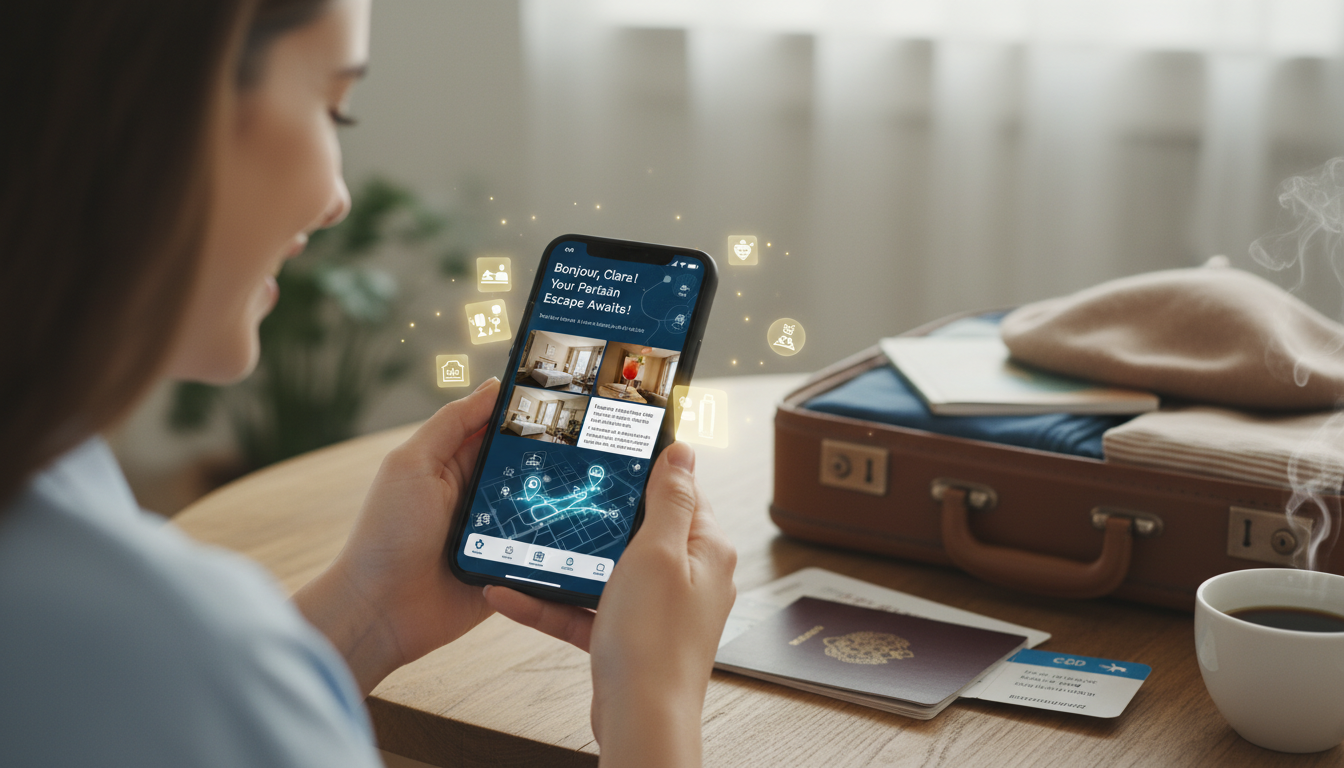
Perhaps the most overlooked stage in the guest journey is the “Anticipation” phase, which occurs between the booking and the arrival. During this window, guests often experience a distinct emotional shift from excitement to anxiety. They may have second thoughts about their investment or feel overwhelmed by the logistical planning required for their trip. Proactive communication is the primary tool for mitigating this anxiety.
Pre-arrival messaging should be meticulously timed to address these psychological needs. A confirmation email sent immediately after booking provides instant peace of mind, while a tailored upsell offer or local activity recommendation sent 3 to 5 days before arrival serves to heighten excitement and anticipation. This phase is also a critical opportunity for “preference gathering”—collecting data on room temperature, pillow types, and dietary restrictions so that the guest arrives to a “known” environment.
- Stage of Lifecycle: Discovery
- Guest Emotional State: Inspiration & Curiosity
- Strategic Communication Goal: Establish brand awareness through storytelling
- Key Digital Tools: Social Media, SEO, Content Marketing
- Stage of Lifecycle: Research
- Guest Emotional State: Evaluation & Skepticism
- Strategic Communication Goal: Provide transparency and social proof
- Key Digital Tools: Direct Website, Reviews, Rich Media
- Stage of Lifecycle: Evaluation
- Guest Emotional State: Comparison
- Strategic Communication Goal: Highlight unique value propositions
- Key Digital Tools: Metasearch, Comparison Engines
- Stage of Lifecycle: Booking
- Guest Emotional State: Commitment
- Strategic Communication Goal: Ensure a frictionless transaction
- Key Digital Tools: Integrated PMS, Mobile-first Engine
- Stage of Lifecycle: Anticipation
- Guest Emotional State: Anxiety & Excitement
- Strategic Communication Goal: Reduce uncertainty and drive excitement
- Key Digital Tools: Automated Emails, SMS, Pre-stay Surveys
- Stage of Lifecycle: Experience
- Guest Emotional State: Expectancy & Relaxation
- Strategic Communication Goal: Deliver personalized, proactive service
- Key Digital Tools: Mobile Key, AI Concierge, Human Staff
- Stage of Lifecycle: Advocacy
- Guest Emotional State: Nostalgia & Gratitude
- Strategic Communication Goal: Nurture memories and incentivize return
- Key Digital Tools: Post-stay Thank-you, Loyalty Programs
The Digital Paradox: Orchestrating Human-Centric Automation
One of the most significant challenges in modern hospitality design is the “Digital Paradox”: the use of technology to make an experience feel more human. In 2025, automation is not a replacement for human staff but a tool that removes administrative friction, allowing personnel to focus on high-value emotional engagement.
Automated Messaging Without Robotic Interference
The primary fear of automated messaging is that it will sound robotic and alienate guests. To overcome this, sophisticated hotels are leveraging Natural Language Processing (NLP) and advanced prompt engineering to maintain a consistent and authentic brand voice. The objective is to facilitate “natural conversations” that feel genuine and helpful.
The implementation of “hybrid AI chatbots” allows for a seamless transition between automated responses and human intervention. AI handles routine tasks—such as providing the Wi-Fi password, setting wake-up calls, or confirming pool hours—while human staff are alerted to step in when a request becomes complex or emotionally charged. This approach ensures that the 90%+ of incoming questions that are routine are resolved instantly, while the remaining 10% receive the personalized attention they require.
The Role of Prompt Engineering in Guest Trust
In the realm of guest communication, the precision of the AI’s input (the prompt) directly dictates the quality and human-likeness of its output. Modern hospitality managers are now expected to possess “Prompt Engineering” as a core competency. By using techniques such as “Chain-of-Thought” prompting, where the AI is instructed to think step-by-step, responses become more logical and contextually aware.
For example, a poorly engineered prompt might result in a generic response: “We are sorry for the noise. We will try to resolve it”. In contrast, a sophisticated prompt that includes hotel-specific details and an empathetic tone generates a far more resonant message: “We truly regret that the poolside music disturbed your rest. We have introduced a security guard after 10 PM to ensure a quiet environment, and we would like to offer you a complimentary lunch at our award-winning restaurant as a gesture of our apology”. This specificity builds guest trust through transparency and concrete action.
Strategic Timing and Multi-Channel Engagement
Effective communication is not just about what is said, but when and where it is said. Most guests in 2025 prefer mobile-first communication via SMS, WhatsApp, or dedicated hotel apps. The cadence of these messages must be orchestrated to follow the natural rhythm of the stay:
- Booking Confirmation (Instant): Verifies details and sets the stage for future service.
- Pre-Arrival Reminder (3-5 days out): Offers upsells (spa, dining) and gathers final preferences.
- Arrival Day (Morning): Provides directions and mobile check-in links to reduce lobby wait times.
- In-Stay Pulse Check (After check-in): Engages the guest at the moment of highest expectancy to ensure satisfaction.
- Departure (Morning of): Facilitates a quick exit and offers late checkout options.
- Communication Channel: Email
- Best Use Case: Long-form confirmations, detailed itineraries, surveys
- Guest Perception: Informative but less urgent
- Communication Channel: SMS / WhatsApp
- Best Use Case: Quick alerts, check-in links, service requests
- Guest Perception: Immediate, convenient, and personal
- Communication Channel: Mobile App
- Best Use Case: Digital keys, room controls, loyalty points
- Guest Perception: High-tech, empowering, and centralized
- Communication Channel: AI Chatbot
- Best Use Case: FAQs, routine requests, 24/7 assistance
- Guest Perception: Efficient and responsive
- Communication Channel: Human Voice
- Best Use Case: Complex issues, emotional de-escalation
- Guest Perception: High-touch and deeply empathetic
The Architecture of the Welcome Flow: Designing the Threshold
The “Arrival” stage is perhaps the most critical moment of truth in the guest journey. It is the physical inception of the narrative, and it must ignite curiosity while delivering on the promises made during the pre-arrival phase. A seamless welcome flow is the primary mechanism for transitioning the guest from the stress of travel into the relaxation of the stay.
The Human-Digital Hybrid Welcome
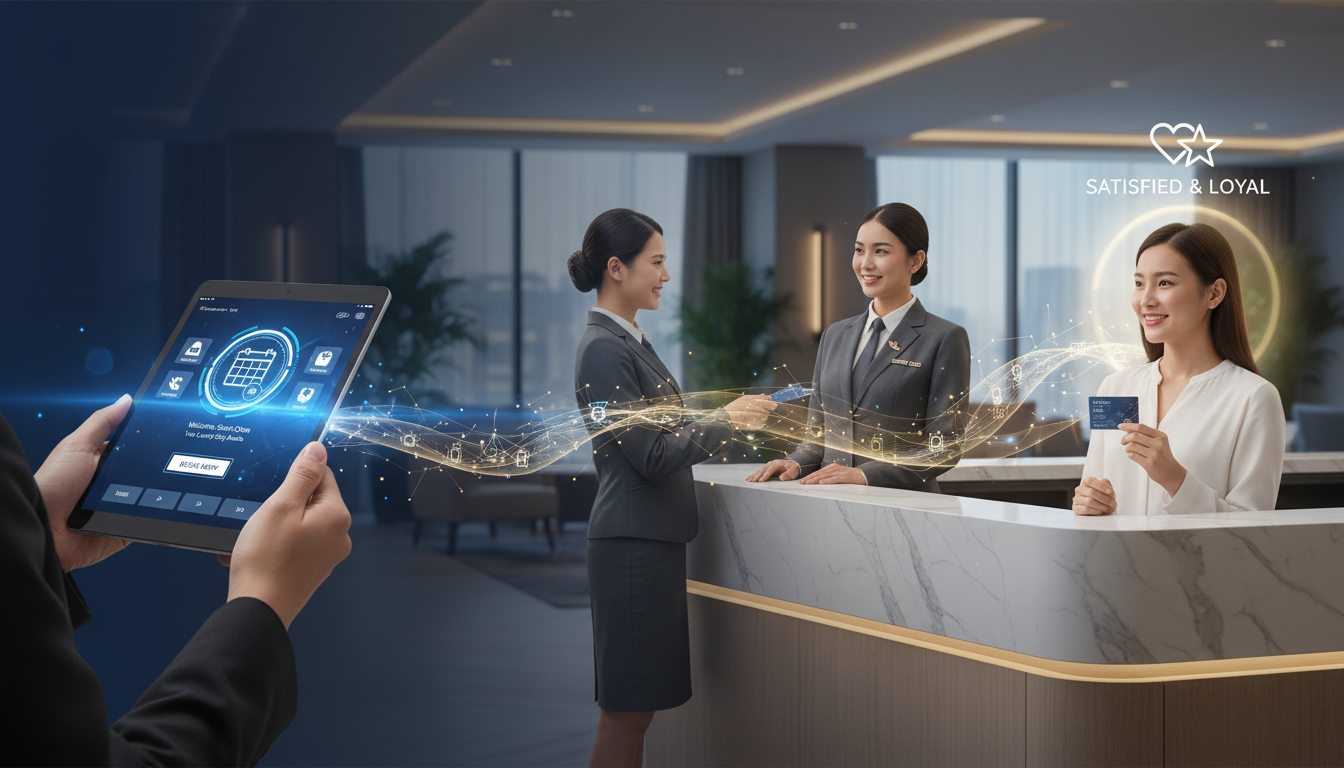
Modern welcome flows prioritize the removal of administrative friction through technology, which in turn frees up staff to focus on genuine human warmth. Mobile room keys and self-service kiosks allow guests to “skip the line,” an innovation that has become a baseline expectation for travelers who value convenience. However, the presence of trained personnel remains vital.
Address the guest by name, offer a welcome drink that reflects the local culture, and ensure that the check-in process is as brief as possible.
Sensory Design and Biophilic Integration
Experience design at the arrival stage involves “de-stimulating” the senses through a thoughtful selection of colors, textures, and spatial layouts. Biophilic design—the integration of natural elements such as water, light, and plants—is increasingly used in hotel lobbies to create a sense of calm and tranquility. Research has shown that a biophilic environment positively and significantly affects guest pleasure and arousal, which in turn increases their peace of mind and willingness to pay more.
This emotional resonance is far more potent than aesthetic memory. A guest might forget the specific furniture in a lobby, but they will never forget how they felt the moment they stepped inside and were greeted with a signature scent, a warm cookie, or the sound of flowing water. Hotels are now employing “experience designers” and “guest journey curators” to map these emotional highs and lows and intentionally design interventions that delight or surprise.
Personalization as the New Standard of Service
The welcome flow is the first physical manifestation of personalization. If a guest has indicated a preference for a hypoallergenic pillow or a room near the elevator during the pre-arrival stage, these needs should be addressed without the guest having to ask. Success is being able to welcome a returning guest by name, wish them a happy anniversary, and have a bottle of their favorite champagne already chilled in their room. This level of recognition creates a powerful sense of being “known,” which is a primary driver of long-term loyalty.
Cross-Cultural Intelligence: Serving the Global Guest
In an increasingly globalized industry, the definition of “service excellence” is fundamentally shaped by culture. What a Western traveler perceives as helpful attentiveness, a guest from a different culture may view as intrusive or disrespectful. Cultural fluency is no longer a “soft skill” but a core competency for hospitality professionals.
Navigating Hofstede’s Cultural Dimensions
To provide a tailored experience, staff must understand the frameworks that predict guest expectations regarding authority, formality, and communication.
- Power Distance: Guests from high power distance cultures (e.g., the Middle East, parts of Asia) often expect more formal address, deference, and hierarchical communication.
- Individualism vs. Collectivism: In collectivist cultures, maintaining group harmony and “saving face” is paramount. Guests from these regions may be hesitant to criticize service directly to avoid causing offense.
- Communication Style: Direct cultures (e.g., USA, Germany) value straightforwardness, while indirect cultures (e.g., Japan, China) rely heavily on non-verbal cues and context.
Regional Nuances and Expectations
| Region / Culture | Communication Style | Privacy vs. Interaction | Key Etiquette Points |
|---|---|---|---|
| Western | Direct, task-oriented, informal | High value on privacy and self-sufficiency | Preference for efficiency; value clear “Yes/No” answers. |
| Chinese | Indirect, relationship-oriented | High expectation of proactive attention | Sensitivity to lucky numbers and unlucky numbers; need for mobile payment. |
| Indian | Formal, ritualistic, warm | “Atithi Devo Bhava” (The guest is God) | Expectation of traditional welcome rituals (Aarti/Bindi); communal dining culture. |
| Middle Eastern | Formal, high power distance | High sensitivity to gender and privacy | Strict use of the right hand for greetings/gifts; emphasis on warm, generous hospitality. |
Adapting to the Modern Chinese Traveler
The Chinese luxury traveler of 2025 represents a critical market segment with specific needs. Digital presence in China—including websites in Mandarin and a presence on platforms like WeChat or Little Red Book—is essential for the “Research” stage. Once on property, small details can make a significant impact: offering kettles and Chinese tea, providing maps and menus in Chinese, and ensuring stable high-speed internet. Importantly, luxury travelers in this segment appreciate being given choices (e.g., “Would you prefer a kettle or a coffee machine?”) rather than being treated as a monolith based on stereotypes.
Cultural Sensitivity in Service Recovery
Culture also dictates how problems should be addressed. In some cultures, a collaborative and empathetic approach is appreciated, while in others, an authoritative and decisive resolution is expected. For guests from high-context cultures, staff must be trained to “read the air” and identify dissatisfaction even when it is not explicitly stated. Using “cushioned” refusals—”I’m sorry, that is not possible, but I can offer you this alternative”—is a vital technique for protecting the guest’s dignity and maintaining the relationship.
Service Recovery Excellence: Turning Complaints into Assets
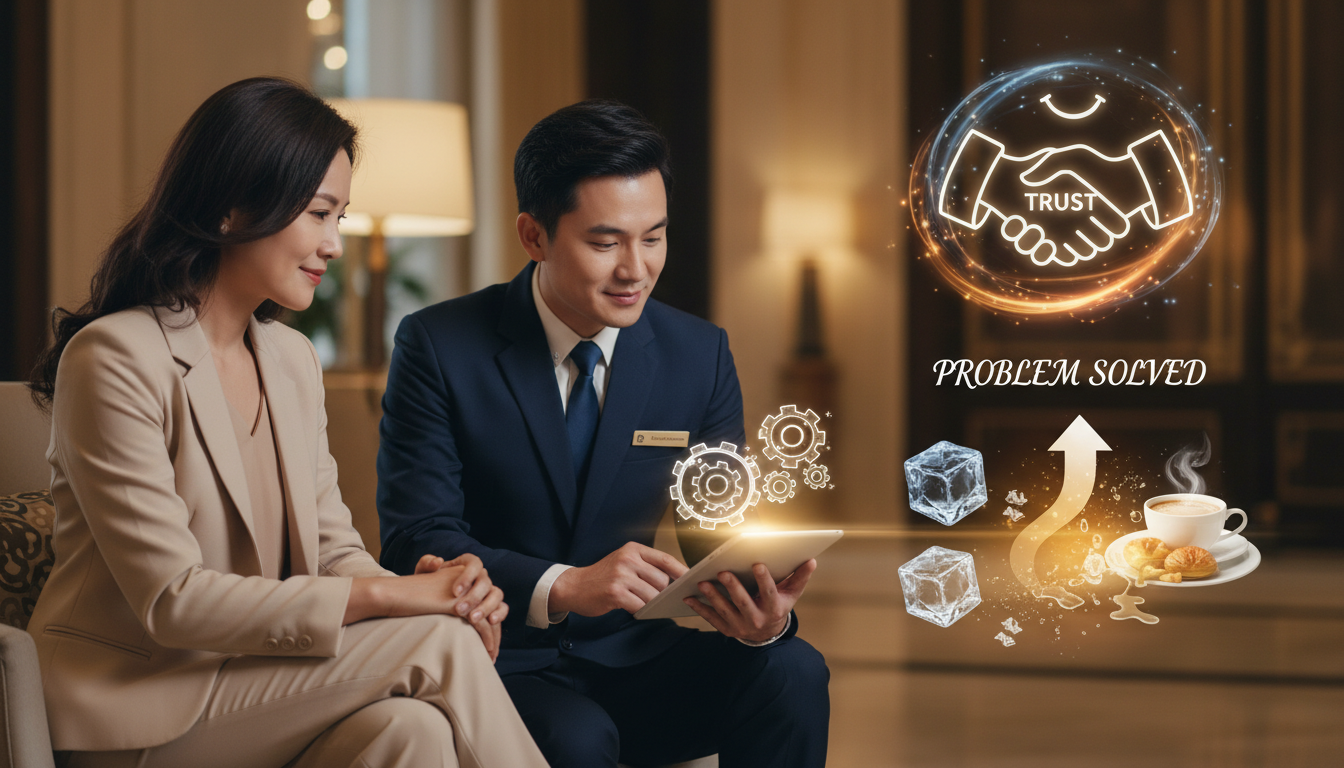
In the hierarchy of guest touchpoints, “Problem Resolution” is the most significant factor in guest satisfaction, rated at 9.2/10 in importance. A service failure represents a moment of high emotional intensity; if handled poorly, it leads to devastating reviews and loss of business, but if handled expertly, it can result in higher loyalty than if the problem had never occurred—a phenomenon known as the Service Recovery Paradox.
The HEARD Method of Conflict Resolution
The HEARD method is the industry standard for five-step service recovery, designed to ensure the guest feels validated and the hotel takes systemic action.
- Hear: Listen actively and without interruption. Let the guest dump their “emotional baggage” until only the factual content remains. Repeat key points to confirm understanding.
- Empathize: Show genuine understanding. Use phrases like “I can see how frustrating that would be” to de-escalate tension.
- Apologize: Take ownership sincerely, even if the problem was not your fault. Focus on the guest’s experience rather than making excuses.
- Resolve: Find a swift and fair solution that matches the severity of the issue. Empower frontline staff with compensation guidelines (e.g., room upgrades, refunds, or personalized gestures) so they can act immediately.
- Diagnose: Investigate the root cause to prevent recurrence.
If multiple guests complain about the same issue, it is a systemic failure that requires an operational fix.
Alternative Frameworks: LEARN and HEART
Other frameworks follow similar psychological logic, emphasizing different aspects of the interaction. The LEARN mnemonic (Listen, Empathize, Apologize, React, Now!) focuses on the speed of the “React” phase, acknowledging that the longer a guest waits for a solution, the harder it is to produce a positive outcome. The HEART model (Hear, Empathize, Apologize, Respond, Thank) adds a critical final step of gratitude, thanking the guest for their feedback and reinforcing that the property values their loyalty.
The Systemic Value of Complaints
Professionally handling complaints allows a hotel to identify operational gaps and improve service quality. By maintaining a detailed log of guest complaints, management can track trends—such as a specific room with recurring Wi-Fi issues or a shortage of complimentary items during peak hours. Furthermore, responding publicly to online reviews demonstrates accountability and can actually increase repeat bookings by showing potential guests that the hotel is responsive and committed to improvement.
| Resolution Step | Tactical Action | Psychological Goal |
|---|---|---|
| Active Listening | Write down key points; maintain eye contact | Validation and release of emotion |
| Empathy | Use tailored, non-canned phrases | De-escalation and trust-building |
| Apology | Sincere ownership without defensiveness | Restoration of the relationship |
| Swift Action | Offer immediate compensation / solution | Satisfaction and perceived value |
| Follow-up | Close the loop; send a thank-you note | Advocacy and final positive impression |
Case Study: Authenticity and Experience in Madhyapur Thimi, Nepal
The principles of “Experience Beats Amenities” are vividly realized in the heritage and community-based tourism sector of Nepal, specifically in the city of Madhyapur Thimi. As a center of traditional Newari art and architecture, Thimi offers a masterclass in how to leverage cultural assets to create deeply resonant guest experiences.
The Pottery Square: A Threshold of Immersion
Thimi Pottery Square serves as a “Living Museum” where the guest journey is activated through tactile engagement. Rather than being passive observers, visitors are encouraged to participate in “Ancient Art and Craft Workshops,” where they can try their hand at molding black clay on traditional wheels. This “hands-on experience” is described by international tourists as “deeply joyful and meditative,” fulfilling the modern desire for cultural immersion and personal growth.
Boutique Hotels: Balancing Tradition with Sophistication
Boutique hotels in the Kathmandu Valley represent a sophisticated segment that successfully builds brand loyalty by leveraging the “Experience Economy”. These properties use the Stimulus-Organism-Response (S-O-R) theory, where the hotel’s design and ambiance (the Stimuli) trigger positive emotional responses in the guest (the Organism), leading to brand loyalty (the Response).
- Aesthetics: Hotels use unique architectural styles and traditional Nepali wood carvings to create a “sublime ambiance” that appeals to all senses.
- Escapism: The unique landscape and atmospheric rejuvenation provide a space for guests to “feel alive” and disconnect from daily stressors.
- Entertainment: Cultural programs, music, and social interaction facilities bond the customer emotionally to the brand.
The Community-Based Tourism (CBT) Model
The success of destinations like Thimi and the Panauti Community Homestay relies on empowering local communities in the planning and management of tourism. Community-based tourism focuses on intense host-guest interactions, such as cooking traditional festive dishes or participating in local festivals like the Vermilion festival. This “Regenerative Hospitality” not only provides a unique experience for the guest but also supports the preservation of natural and cultural assets, leaving the destination better than it was found.
Future Horizons: The 2026 Hospitality Landscape
As the industry looks toward 2026, the intersection of technology and human-centric design will continue to evolve, driven by economic, cultural, and technological forces.
Experiential Wellness Beyond the Spa
Wellness is transitioning from an optional add-on to a core operational standard. Future luxury properties will integrate “longevity programs,” biohacking treatments (such as cryotherapy and IV therapy), and sleep-optimization technologies directly into the guestroom. These wellness-driven journeys often have a deep connection to local nature, such as “forest bathing” or “sound healing” itineraries.
The Bifurcation of the Market
A stark divergence in spending power is reshaping the industry. While five-star hotels continue to achieve superior room rate growth, the mid-scale and budget segments are facing a cost-of-living squeeze. High-income travelers are increasingly seeking “exclusive-use” accommodations and private, curated moments. Success in 2026 will hinge on “precision, personalization, and value” to capture both the budget-conscious traveler and the high-end seeker who is willing to pay for total privacy and discretion.
AI with a Human Heart
Artificial intelligence will remain a defining force in behind-the-scenes operations—revenue management, predictive maintenance, and guest communications. However, the winning brands will be those that use these data-driven insights to enhance, not replace, human connection. AI-powered wellness assessments and digital tracking of a guest’s journey will be used to empower staff to provide “emotionally resonant, hyper-personalized experiences” that make guests feel truly seen and valued.
Strategic Conclusions
The modern guest experience is a meticulously designed narrative that begins at the moment of discovery and continues long after the guest has checked out. By prioritizing emotional resonance over physical amenities, hotel operators can build deep, enduring loyalty in a competitive global market.
- Orchestrate the Digital Flow: Use AI and automation to remove administrative friction, but ensure that messaging is human-centric through advanced prompt engineering and strategic timing.
- Design for the Senses: Create “Arrival Moments” that use biophilic and sensory design to de-stress guests and anchor them in the destination’s story.
- Master Cultural Fluency: Train staff in the nuances of Hofstede’s cultural dimensions to ensure that service definitions—from privacy to formality—are tailored to the guest’s regional origin.
- Transform Failures into Assets: Implement robust service recovery frameworks like HEARD to resolve complaints swiftly, while using the “Diagnose” phase to drive systemic operational improvements.
- Leverage Local Authenticity: Move beyond “sanitized” luxury by integrating community-based experiences and heritage-inspired design, allowing guests to “belong anywhere.”
The hospitality industry of 2025 and beyond is not about selling rooms; it is about curate feelings, facilitating connection, and delivering on the promise of a story-worthy stay. Those who master the “invisible service” of psychological engagement will define the next era of global travel.