

eSewa Case Study: Nepal’s Digital Financial Transformation
Chapter 1: Introduction

1.1 The Pre-Digital Financial Landscape of Nepal
To fully appreciate the disruptive magnitude of eSewa within the Nepalese economy, one must first rigorously examine the financial topography that preceded its inception. Until the late 2000s, Nepal’s financial sector was characterized by traditional, brick-and-mortar banking systems that were heavily centralized in urban hubs like Kathmandu, Pokhara, and Biratnagar. The geographic reality of Nepal—a nation defined by rugged Himalayan terrain and dispersed rural settlements—posed insurmountable logistical challenges for physical banking expansion. The cost of establishing a physical branch in remote districts was often prohibitive compared to the deposit potential, leaving a vast majority of the population unbanked or underbanked.
In this cash-dominant ecosystem, the friction of daily transactions was high. Simple activities such as paying electricity bills (to the Nepal Electricity Authority) or telephone bills (to Nepal Telecom) required citizens to physically travel to payment counters, often waiting in queues for hours. This inefficiency was not merely an inconvenience but a significant economic drain, resulting in millions of lost person-hours annually. Furthermore, the absence of a digital payment infrastructure meant that the burgeoning e-commerce sector, which was seeing global exponential growth, had no foothold in Nepal. Transactions were strictly physical, limiting the velocity of money and the scalability of businesses.
It was within this vacuum of inefficiency and exclusion that F1Soft International began to conceptualize a solution. Unlike developed markets that transitioned linearly from cash to cheques, to plastic cards, and then to digital wallets, Nepal was poised to leapfrog directly from cash to mobile-based digital value transfer. This phenomenon, often observed in emerging economies, positioned the mobile phone not just as a communication device, but as the primary instrument of financial inclusion.
1.2 Genesis and Corporate Evolution
The trajectory of eSewa is inextricably linked to the history of its parent company, F1Soft International. The journey began formally in 2004 when F1Soft was registered as a business entity focused on web development services. However, the vision for a localized payment gateway began to crystallize around 2006, driven by the realization that while internet adoption was growing, the transactional layer of the web was missing in Nepal.
The company’s initial foray into financial technology (fintech) commenced in 2007 with the launch of SMS Banking. This service was a critical precursor to the digital wallet, as it accustomed users to the concept of accessing banking information via mobile devices. Using simple SMS syntax codes, customers could check balances or request statements, a revolutionary capability at the time that bridged the gap between the bank branch and the user’s pocket. In 2008, F1Soft further solidified its technical foundations by developing and launching Internet Banking platforms for Nepalese banks. These early ventures provided the team with deep insights into the core banking systems (CBS) used by local financial institutions, knowledge that would later prove vital for eSewa’s integration capabilities.
eSewa was commercially launched in 2009, marking its status as South Asia’s first digital wallet and Nepal’s first payment gateway. This launch was a pioneering moment, introducing the concept of a “digital wallet” to a population that had largely never used a credit card. In its nascent phase, eSewa focused on high-frequency, low-risk transactions such as mobile airtime top-ups and pinless recharge services. This strategic choice was crucial for building trust; users were more willing to risk small amounts for phone credit than to entrust a digital platform with significant funds.
By 2012 and 2013, eSewa began expanding its portfolio to include utility payments and airline ticketing, steadily increasing the Average Transaction Value (ATV). The platform’s growth was organic but accelerated by the increasing penetration of smartphones and mobile data in Nepal. By 2024, eSewa had evolved into a ubiquitous household name, serving millions of users and integrated with over 50 banks. The timeline of eSewa is not just a corporate history; it is a timeline of Nepal’s digital maturity.
1.3 Vision, Mission, and Core Philosophy
At its core, eSewa’s philosophy is grounded in the democratization of financial services. The company’s vision extends beyond mere profit generation to the creation of a “cashless economy” and an “inclusive ecosystem“. This vision aligns with broader national goals, such as the Digital Nepal Framework, which seeks to leverage technology for economic growth.
The mission is operationalized through a strategy of ubiquitous accessibility. Recognizing that a significant portion of Nepal’s population lacks the digital literacy or the hardware to navigate a smartphone app, eSewa adopted a hybrid “assisted digital” model. They established a vast network of agents, known as “Cash Points,” who facilitate transactions for the unbanked. This philosophy ensures that the benefits of digital payments—speed, security, and convenience—are not restricted to the urban elite but are accessible to rural populations as well. The company views itself not just as a Payment Service Provider (PSP) but as a catalyst for economic empowerment, saving millions of person-hours and reducing the cost of cash handling for the economy.
1.4 Objectives and Structure of the Case Study
This report aims to provide a comprehensive analysis of eSewa as a case study for IT 204: E-Commerce. It seeks to dissect the platform from multiple dimensions: business strategy, marketing dynamics, and technical architecture. By understanding how eSewa navigated the challenges of a developing market—ranging from regulatory ambiguity to infrastructural deficits—students can gain critical insights into the practical application of e-commerce principles.
The report is structured into five chapters. Following this introduction, Chapter 2 provides a detailed overview of the platform’s services and its complex business model. Chapter 3 analyzes the marketing strategies that drove mass adoption. Chapter 4 offers a technical deep dive into the system’s architecture, security protocols, and use of artificial intelligence. Finally, Chapter 5 synthesizes these findings into a conclusion with strategic recommendations for the future.
Chapter 2: Platform Overview and Business Model Analysis
2.1 The Service Ecosystem: Beyond a Digital Wallet
While popularly categorized as a “digital wallet,” eSewa functions more accurately as a comprehensive financial middleware that aggregates various service providers onto a single platform. Its value proposition is built on the aggregation of fragmented services into a unified, user-friendly interface.
2.1.1 Utility and Bill Payments
The bedrock of eSewa’s user retention strategy is utility payments. By integrating with the Nepal Electricity Authority (NEA), Khanepani (water), and various Internet Service Providers (ISPs), eSewa solved a tangible pain point: the physical queue. The ability to pay these recurring bills instantly from a mobile device drove initial adoption. This category is characterized by high-volume, low-margin transactions that keep users active on the platform monthly.
2.1.2 Travel and Hospitality Integration
eSewa has effectively cornered the domestic travel market. It serves as a primary booking engine for domestic airlines (Buddha Air, Yeti Airlines, etc.) and bus services. The platform allows users to compare prices, book seats, and receive tickets digitally, disrupting the traditional travel agency model. Recently, this has expanded to include hotel bookings, creating a vertical integration within the tourism sector.
2.1.3 Financial Services and Government Payments (G2C/B2G)
A significant milestone in eSewa’s evolution was the integration of government services. Users can now pay traffic fines, Inland Revenue taxes, and other government levies directly through the app. This Business-to-Government (B2G) integration is strategic; it forces users to maintain higher wallet balances (floats) to cover these potentially larger payments. Additionally, eSewa facilitates payments for insurance premiums, school fees, and credit card bills, embedding itself deeply into the financial obligations of a household.
2.1.4 Cross-Border and Remittance Services
Recognizing the massive contribution of remittance to Nepal’s GDP, eSewa integrated with eSewa Money Transfer. This allows users to receive money sent from abroad directly into their wallet, bypassing the need to visit a physical remittance agent. Furthermore, recent strategic partnerships with Indian networks via Fonepay have enabled cross-border payments using India’s Unified Payments Interface (UPI), allowing Indian nationals to pay at Nepalese merchants using apps like PhonePe and Google Pay.
2.2 Comprehensive Business Model Analysis
eSewa employs a multi-sided platform business model, orchestrating interactions between distinct groups: consumers, merchants, agents, and banks.
2.2.1 Business-to-Consumer (B2C) Model
In the B2C segment, eSewa offers its digital wallet directly to smartphone users. The core value proposition is convenience.
- Revenue Streams: While registration and most utility payments are free for the consumer to encourage adoption, eSewa monetizes specific interactions.
- Service Charges: Fees are levied on “Cash Out” transactions, such as transferring funds from the wallet to a bank account or credit card payments.
- For instance, bank withdrawals typically incur a fee ranging from Rs. 10 to Rs. 20 depending on the amount.
- Value-Added Services: Charges apply to specialized services like the “Secured Transfer” (escrow) feature, which costs Rs. 5 to Rs. 10 per transaction to protect buyers from fraud.
2.2.2 Business-to-Business (B2B) Model
The B2B segment acts as the primary revenue engine for the company.
- Merchant Commissions: eSewa aggregates thousands of merchants who pay a commission for every transaction processed. For telecommunication top-ups (NTC, Ncell), eSewa receives a distributor commission (approx. 3-5%), a portion of which is retained as revenue. For e-commerce partners and airlines, a Transaction Discount Rate (TDR) is charged.
- SME Digitization: Through the “Merchant Link” feature, small business owners can link their personal eSewa accounts to a business profile, facilitating QR code-based payments. This supports the formalization of the informal economy and locks small merchants into the eSewa ecosystem.
2.2.3 Business-to-Government (B2G) Model
eSewa’s role as a tax collection agent for the government (B2G) provides legitimacy and volume. While the direct margins on government transactions are often slim or regulated, acting as a state-sanctioned payment channel significantly boosts user trust and float volume. The “float”—the aggregate balance held in all user wallets—is a critical financial asset. While regulations restrict the direct investment of these funds, the interest accrued in the escrow bank accounts contributes to the broader financial health of the ecosystem.
2.2.4 Business-to-Business-to-Consumer (B2B2C): The Easy Loan Model
Innovation in business models is evident in eSewa’s “Easy Loan” feature. Moving beyond payments, eSewa has entered the lending space.
- Mechanism: Leveraging data analytics, eSewa offers collateral-free loans to its agents and merchants. Instead of traditional credit scores, which are scarce in Nepal, eSewa utilizes transaction history, revenue consistency, and usage patterns to assess creditworthiness.
- Revenue: eSewa monetizes this by earning processing fees or a share of the interest income in partnership with the lending banks. This pivots the business model from purely transactional to financial intermediation, unlocking a high-margin revenue stream.
2.3 The Agent Network: The “Cash Point” Economy
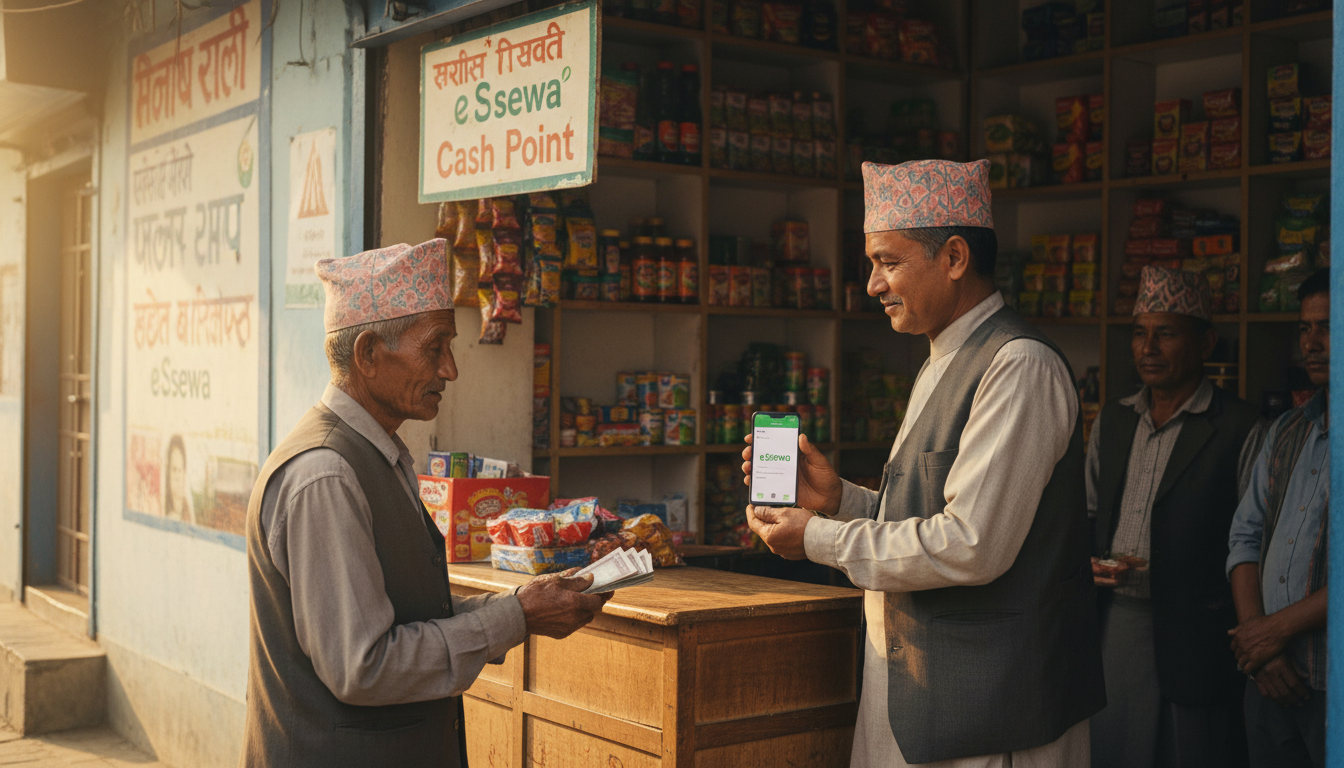
- Strategic Necessity: In a country with varying levels of digital literacy, the agent network acts as a bridge. A rural villager may not know how to use an app but trusts the local shopkeeper. By handing cash to the agent, the villager can pay bills or transfer money digitally.
- Economic Structure: Agents are incentivized through commissions. They earn a percentage on every bill payment, top-up, or money transfer they facilitate. This creates a distributed sales force that is self-motivated to acquire customers and drive transaction volume.
- Cash In/Cash Out: Agents also solve the “last mile” liquidity problem, allowing users to load cash into their wallets (Cash In) or withdraw physical cash (Cash Out) without needing a bank ATM.
2.4 Competitive Landscape and Market Position
As of 2025, eSewa maintains a dominant market share, estimated at nearly 80% of the digital wallet space. However, the landscape is becoming increasingly contested.
| Competitor | Market Strategy | Key Strengths |
|---|---|---|
| eSewa | First Mover/Ecosystem | Massive agent network (250k+), ubiquitous brand recognition, government integration. |
| Khalti | Youth/UI Focus | Superior User Experience (UI/UX), gamification, youth-centric marketing, high engagement events. |
| IME Pay | Remittance Integration | Leveraging the massive IME remittance network, strong financial backing, focus on cross-border flows. |
The Consolidation Threat: Reports of a potential merger between Khalti and IME Pay (to form “IME Khalti”) present a significant strategic threat. Such a merger would combine IME’s financial muscle and remittance network with Khalti’s technological agility and youth appeal, potentially creating a competitor capable of challenging eSewa’s hegemony.
| Transaction Type | Daily Limit (Verified) | Monthly Limit (Verified) | Transaction Limit (Per Txn) |
|---|---|---|---|
| Wallet to Wallet | Rs. 50,000 | Rs. 500,000 | Rs. 25,000 |
| Wallet to Bank | Rs. 200,000 | Rs. 1,000,000 | Rs. 100,000 |
| Bank to Wallet | Rs. 200,000 | Rs. 1,000,000 | Rs. 100,000 |
| Mobile/QR Pay | Rs. 300,000 | No Limit | – |
Source: Nepal Rastra Bank Directives & eSewa Updates
Chapter 3: Marketing Strategy and Market Analysis
3.1 The Marketing Mix (4 Ps) of eSewa
3.1.1 Product Strategy: The Super App Ambition
eSewa has transitioned from a niche product (mobile recharge) to a “Super App” aiming to encompass every aspect of a user’s digital life. The product strategy focuses on stickiness. By integrating high-frequency use cases (top-up, commute) with low-frequency, high-value use cases (insurance, taxes, flight booking), eSewa ensures it remains relevant throughout the customer lifecycle. New features like “Personal Finance Manager” and “Payment Calendar” are designed to move the product from a transactional tool to a financial management hub.
3.1.2 Pricing Strategy: Penetration and Value
eSewa employs a freemium and commission-based pricing strategy.
- User Pricing: Registration is free. Most utility payments are free to the user, lowering the barrier to entry. eSewa absorbs the cost or charges the biller.
- Surcharges: For convenience-heavy features like transferring money to a bank account, a small fee is charged (Rs. 10-20), which users are willing to pay to avoid the opportunity cost of visiting a bank physically.
- Merchant Pricing: The primary revenue comes from the Transaction Discount Rate (TDR) charged to merchants, which varies by industry (e.g., lower for utilities, higher for e-commerce).
3.1.3 Place Strategy: Omnipresence
The concept of “Place” in eSewa’s marketing is hybrid.
- Digital Presence: The app is available on both iOS and Android, ensuring coverage of the smartphone market.
- Physical Presence: The brand’s visibility is aggressively maintained through its “Zone of Trust.” The green eSewa signage is ubiquitous across Nepal, visible at over 150,000 merchant outlets and agent shops. This physical visibility serves as constant outdoor advertising, reinforcing trust and brand recall even for non-users.
3.1.4 Promotion Strategy: Gamification and Festivals
eSewa’s promotional strategy is heavily tied to the cultural calendar of Nepal.
- Festive Campaigns: During Dashain and Tihar, the biggest festivals in Nepal, eSewa launches massive campaigns like “Maha Utsav.” These campaigns feature high-value sweepstakes (e.g., Nammi electric cars, iPhones) to incentivize transaction volume during peak spending periods.
- Travel Incentives: To capture the travel market, campaigns like “Travel Ticketing” offer 100% cashback or tangible goods (suitcases), directly competing with traditional travel agents by adding value beyond just the ticket.
- Referral Programs: The “Refer and Earn” program turns users into marketers. By compensating users for successfully onboarding friends, eSewa lowers its Customer Acquisition Cost (CAC) while leveraging the trust inherent in peer recommendations.
3.2 Online-to-Offline (O2O) Integration
eSewa’s marketing success lies in its ability to bridge the online and offline worlds.
- Influencer Collaboration: Recognizing that younger demographics are shifting to competitors like Khalti, eSewa has ramped up collaborations with social media influencers to modernize its image.
- Social Commerce Support: A acknowledging the rise of informal businesses on Facebook and Instagram, eSewa provides specific tools for social sellers to accept payments securely via links or QR codes. This taps into the “unorganized” retail sector, bringing them into the digital fold.
3.3 Consumer Sentiment and Challenges
Despite its dominance, eSewa faces significant headwinds in consumer perception and experience.
- Trust and Reliability Issues: Analysis of user reviews on platforms like Trustpilot and Google Play reveals recurring themes of frustration. Users frequently cite server downtime during peak loads, transactions where money is deducted but not credited (“pending” status), and a perceived lack of responsiveness from customer support. The generic, automated responses to specific grievances have exacerbated user dissatisfaction.
- The NRN Friction: Non-Resident Nepalis (NRNs) represent a wealthy and influential user segment. However, many report being blocked from using the app abroad or facing difficulties in loading funds, which alienates a key demographic capable of driving high-value remittance flows.
- KYC Fatigue: The mandatory Know Your Customer (KYC) verification, enforced by stringent NRB regulations, is a major friction point.
Users report high rejection rates due to minor discrepancies in document uploads or photo clarity. This “compliance friction” often leads to user churn during the onboarding phase.
SWOT Analysis
Table 3.1: SWOT Analysis of eSewa
- Strengths
- First Mover Advantage: Synonymous with “digital payment” in Nepal.
- Network Effect: Largest agent (250k+) and merchant network.
- Ecosystem Integration: Deep ties with F1Soft, Fonepay, and eSewa Money Transfer.
- Regulatory Compliance: ISO 27001 certified and fully licensed by NRB.
- Weaknesses
- Customer Support: Slow and generic dispute resolution process.
- Technical Stability: Server outages during high-traffic events.
- KYC Friction: High rejection rates alienate new users.
- UI/UX: Perceived as less modern/intuitive compared to youth-focused competitors like Khalti.
- Opportunities
- Cross-Border Payments: Integration with India’s UPI opens a massive market for tourism and trade.
- Lending (Easy Loan): Monetizing data through AI-driven credit scoring.
- Rural Expansion: Deepening penetration in unbanked federal provinces.
- Threats
- Market Consolidation: Potential merger of Khalti and IME Pay.
- Regulatory Caps: NRB transaction limits reduce utility for high-value users.
- Cybersecurity: Increasing sophistication of phishing and fraud attacks targeting users.
Technical Analysis
Technology Stack and Architecture
eSewa’s ability to process millions of transactions relies on a robust and evolving technology stack.
Core Backend and Migration
Historically, the financial sector in Nepal has relied heavily on Java due to its type safety, stability, and concurrency management, which are critical for financial ledgers. eSewa’s legacy core is likely built on Java. However, the landscape is shifting towards a polyglot architecture.
- Modernization: Recruitment patterns indicate a move towards Node.js and Python. Node.js is likely used for the API gateway and notification services due to its non-blocking I/O capabilities, which are essential for handling high concurrency during events like “Maha Utsav.” Python is increasingly used for the data analytics pipeline, powering the AI/ML models for credit scoring and fraud detection.
- Database Strategy:
- RDBMS: For the core ledger (money in/money out), ACID compliance is non-negotiable. eSewa likely utilizes enterprise-grade RDBMS (like Oracle or MSSQL, common in F1Soft products) or robust open-source options like PostgreSQL to ensure data integrity.
- NoSQL: Job descriptions reference Cassandra. This suggests a hybrid data strategy where Cassandra handles massive write-heavy workloads such as transaction logs, audit trails, and user activity streams, ensuring high availability and partition tolerance.
Mobile and Frontend Development
- Native Development: The Android app is built using Kotlin and Java, while the iOS app uses Swift and Objective-C. This ensures high performance and access to native device features like biometrics.
- Cross-Platform Future: Recent vacancies for Flutter developers signal a strategic shift. Adopting Flutter would allow eSewa to maintain a single codebase for both iOS and Android, accelerating feature deployment and reducing maintenance overhead for the UI layer.
Security Infrastructure and Compliance
For a platform handling public funds, security is the existential mandate.
- ISO Certification: eSewa is ISO 27001:2013 certified. This certification validates that the company has implemented a systematic Information Security Management System (ISMS), covering everything from physical server security to employee access protocols.
- Encryption and Data Protection:
- Data at Rest: Sensitive user data and transaction logs are encrypted using 128-bit AES encryption.
- Data in Transit: All communication between the app/web and the server is secured via SSL/TLS protocols, preventing man-in-the-middle attacks.
- Authentication Mechanisms:
- MPIN: A mandatory 4-digit Mobile PIN is required for every transaction, ensuring that phone theft does not immediately lead to fund theft.
- Biometrics: Integration with fingerprint and Face ID adds a layer of convenience without sacrificing security.
- 2FA: Two-Factor Authentication is triggered for logins from new devices or suspicious locations.
- API Security: The merchant API utilizes HMAC-SHA256 signature verification. This cryptographic technique ensures that the transaction payload (e.g., amount, merchant ID) has not been tampered with during transit. If the generated signature does not match the received signature, the transaction is instantly rejected.
Artificial Intelligence and Fraud Detection
As transaction volumes grow, manual oversight becomes impossible. eSewa has integrated AI to manage risk and enhance service.
- AI-Driven Credit Scoring: The “Easy Loan” feature relies on an AI decision engine. In the absence of a robust national credit bureau, the engine analyzes alternative data: transaction frequency, bill payment consistency, and agent revenue patterns. This allows eSewa to assign a risk score and disburse loans instantly without collateral.
- Fraud Detection Systems: Machine Learning models are deployed for anomaly detection. These systems monitor transactions in real-time for patterns indicative of fraud, such as sudden high-value transfers at odd hours or logins from geographically impossible locations.
- Virtual Assistant (eVA): eSewa has deployed “eVA,” an AI chatbot, to handle Level 1 customer support. While currently handling basic queries, the goal is to offload routine tasks like password resets and transaction status checks, freeing human agents for complex disputes.
Interoperability and API Ecosystem
eSewa’s technical strategy embraces the “Platform” approach, encouraging third-party integration.
- ePay API: The platform provides a robust API for merchants. It supports standard callback mechanisms (Success/Failure URLs), allowing e-commerce sites to automate order fulfillment immediately upon payment confirmation.
- SDK Availability: To lower the integration barrier, eSewa provides Software Development Kits (SDKs) for popular languages like PHP and Python. This “developer-first” approach has been crucial in building its vast merchant network.
Conclusion and Strategic Recommendations
Synthesis of Findings
The analysis of eSewa presents a compelling narrative of how fintech can serve as critical infrastructure in a developing nation. By identifying the gap between internet connectivity and banking accessibility, eSewa successfully built a digital layer over Nepal’s cash economy. Its success was not merely technological but logistical—the deployment of 250,000 agents to bridge the digital divide was a masterstroke of localized strategy.
eSewa has evolved from a simple recharge app into a comprehensive financial ecosystem. It has successfully integrated itself into the daily lives of citizens (utility payments), the operations of businesses (QR payments), and the functioning of the state (tax collection). However, the analysis also uncovers significant vulnerabilities. The platform is grappling with the “tech debt” of its rapid growth, manifested in server instability and customer support bottlenecks. Furthermore, the regulatory environment is tightening, and competitors are consolidating, threatening eSewa’s long-standing monopoly.
Future Outlook
- The Cross-Border Opportunity: The integration with India’s UPI network represents the next frontier of growth. With millions of Indian tourists visiting Nepal annually, enabling them to pay via their native apps (PhonePe, Google Pay) through the Fonepay/eSewa network could generate transaction volumes that dwarf domestic utility payments.
- The Shift to Financial Intermediation: As transaction fees (TDR) come under competitive pressure, eSewa’s future profitability lies in financial products like “Easy Loan.” Moving from a payments company to a lending institution (leveraging data rather than deposits) will be the key to sustaining high margins.
- Regulatory Headwinds: The Nepal Rastra Bank’s imposition of transaction limits aims to push high-value transactions back to formal banking channels. eSewa must adapt by focusing on high-volume, low-value transactions or by deepening its integration with banks to offer seamless “bank-grade” transfers that comply with these caps.
Strategic Recommendations
Based on the analysis, the following recommendations are proposed for eSewa:
- Revolutionize Customer Support: The current “generic response” model is a major churn driver. eSewa should invest in a hybrid support model where AI handles triage, but complex financial disputes are immediately routed to empowered human agents. Implementing a transparent “ticket tracking” system for users would rebuild trust.
- Infrastructure Resilience: To mitigate the “server down” reputation during festivals, eSewa must invest in auto-scaling cloud infrastructure (using hybrid cloud models if data sovereignty laws permit) to handle burst traffic during campaigns like “Maha Utsav.”
- Modernize UI/UX for the Next Generation: To counter the threat from Khalti, eSewa needs a design overhaul. The app should offer a “Lite” mode for older/rural users (focusing on simplicity) and a “Pro” mode for digital natives (focusing on analytics, dark mode, and speed).
- Lobby for Tiered KYC: The current “one size fits all” KYC is a growth bottleneck.
eSewa should work with the NRB to implement “Tiered KYC,” where low-value users can onboard with minimal friction (e.g., just a phone number) and only require full document verification for higher transaction limits.
In conclusion, eSewa has successfully laid the digital rails for Nepal’s economy. The challenge for the next decade is to upgrade these rails to high-speed functionality while ensuring that the passengers—its millions of users—feel safe, valued, and empowered.