


Bhoj Deals Case Study: E-commerce Evolution in Nepal
CHAPTER 1: Introduction and Methodology
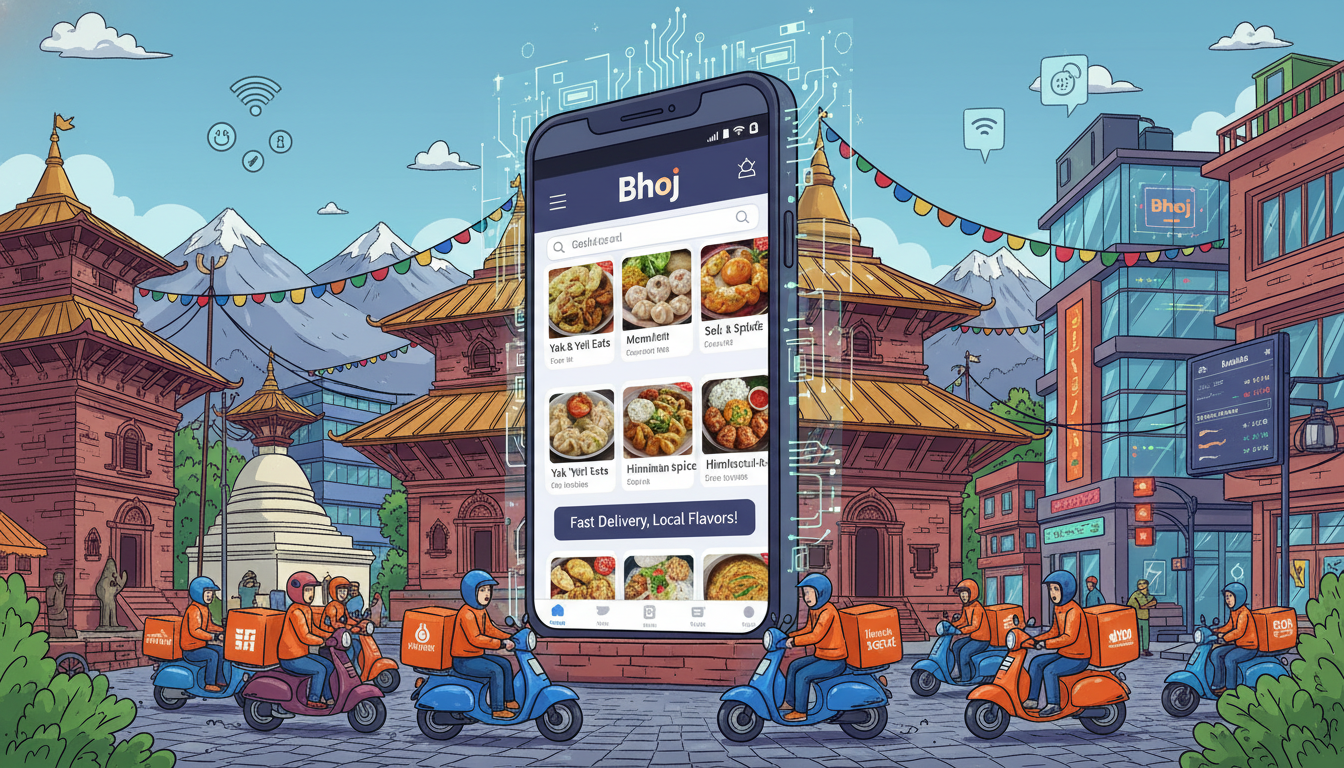
1.1 Background of the Study
The global digital economy has witnessed a paradigm shift over the last decade, transitioning from static web interfaces to dynamic, mobile-first ecosystems that integrate commerce, logistics, and finance. This evolution, often categorized under the umbrella of Electronic Commerce (E-commerce), has redefined the traditional boundaries of time and space in business transactions. In the context of developing economies, this transition is not merely a change in medium but a fundamental restructuring of market access and consumer behavior.
1.1.1 Global and Local Trends in E-commerce
Globally, the e-commerce sector is currently characterized by the convergence of “Super Apps,” hyper-local logistics, and Artificial Intelligence (AI) driven personalization. The market is moving beyond simple B2C (Business-to-Consumer) transactions toward complex O2O (Online-to-Offline) models where digital platforms drive physical footfall or facilitate instant delivery services. The post-pandemic era has further accelerated the demand for “Quick Commerce” (Q-commerce), where delivery times are measured in minutes rather than days.
In Nepal, the trajectory of e-commerce adoption mirrors these global trends but is shaped by unique local constraints and opportunities. Historically, the Nepalese market relied heavily on cash transactions and physical bargaining. However, the proliferation of affordable smartphones and the reduction in mobile data costs have catalyzed a digital revolution. The COVID-19 pandemic served as a critical inflection point for the Nepalese market. Lockdowns and social distancing measures forced a behavioral shift, compelling consumers who were previously skeptical of online transactions to adopt digital platforms for essential goods, groceries, and prepared food. This period marked the transition of e-commerce in Nepal from a luxury convenience to an operational necessity.
1.1.2 E-commerce in Nepal
The current e-commerce landscape in Nepal is vibrant and fiercely competitive, particularly in the food technology (Food Tech) sector. The market is segmented into global giants with limited direct presence and homegrown pioneers who have adapted global best practices to local realities. Major players such as Foodmandu, Pathao Food, and Bhoj (formerly BhojDeals) dominate the urban centers, specifically the Kathmandu Valley.
While precise market share data remains opaque in the private sector, industry analysis suggests that the food delivery market in Nepal is expanding rapidly, driven by a growing middle class with disposable income and a scarcity of time. The regulatory environment is also maturing; the introduction of the E-Commerce Bill 2081 signifies the government’s intent to formalize this sector, establishing clear guidelines for consumer protection, data privacy, and platform liability. Within this dynamic environment, Bhoj has positioned itself not just as a logistics provider, but as a comprehensive “foodie” ecosystem, blending delivery services with dining-out incentives.
1.2 Types of E-commerce
To contextualize Bhoj’s operations, it is essential to classify it within standard e-commerce frameworks. The platform operates a multifaceted model that defies a single categorization:
- Business-to-Consumer (B2C): This is the primary operational mode where Bhoj acts as an intermediary retailer. Individual consumers browse the platform to purchase food and groceries from listed businesses (B). While Bhoj does not own the inventory (food), it manages the transaction and fulfillment, effectively serving the consumer directly.
- Business-to-Business (B2B): Bhoj provides a critical service to restaurant partners. By listing on the platform, restaurants gain access to a digital storefront, marketing reach, and a logistics fleet they might otherwise lack. Bhoj acts as a service provider to these businesses, charging commissions and listing fees.
- Online-to-Offline (O2O): A distinguishing feature of Bhoj is its legacy “Deals” platform. Users claim a deal online via the app but consummate the transaction offline by physically visiting the restaurant to dine in. This drives digital traffic into physical locations, creating a symbiotic loop between the app and brick-and-mortar establishments.
- Hyperlocal Commerce: The platform connects buyers and sellers within restricted geographic zones (e.g., specific neighborhoods in Kathmandu or Butwal), focusing on speed and proximity.
1.3 Introduction to Group Members
This comprehensive case study is submitted by a group of BBM 7th Semester students specializing in E-commerce (IT 204). The team has divided the research responsibilities to cover technical analysis, marketing strategies, and operational logistics, ensuring a holistic review of the subject matter.
- Member A: Focus on Technical Infrastructure and UI/UX Analysis.
- Member B: Focus on Business Models, Logistics, and Operations.
- Member C: Focus on Marketing, Social Commerce, and Legal Frameworks.
1.4 Objectives of the Case Study
The primary objective of this report is to deconstruct the operational and strategic framework of Bhoj to understand its sustainability and growth potential within the Nepalese economy. Specific objectives include:
- Business Model Validation: To analyze how Bhoj generates revenue and maintains liquidity through its hybrid B2B/B2C model.
- Operational Auditing: To evaluate the efficiency of Bhoj’s logistics, vendor management, and fulfillment processes compared to competitors like Foodmandu and Pathao.
- Marketing Effectiveness: To assess the impact of digital marketing strategies, influencer collaborations, and the “Bhoj Wallet” loyalty program on customer retention.
- Technological Assessment: To critique the platform’s user interface, security protocols (SSL, Data Privacy), and integration with fintech partners like Khalti and eSewa.
- Strategic Forecasting: To identify the “Strengths, Weaknesses, Opportunities, and Threats” (SWOT) facing Bhoj in the context of emerging laws and technologies.
1.5 Scope and Limitations of the Study
Scope:
This study is confined to the analysis of “Bhoj” (formerly BhojDeals) as an e-commerce entity. It covers the platform’s mobile application (Android/iOS) and website operations. The geographical scope is limited to Bhoj’s operational areas: Kathmandu, Lalitpur, Bhaktapur, Butwal, and Bhairahawa. The thematic scope encompasses marketing, operations, finance (payment gateways), and legal compliance.
Limitations:
- Financial Opacity: As a privately held company, Bhoj does not publish audited financial statements. Revenue, profit margins, and valuation figures are estimates derived from secondary industry sources and competitor benchmarking.
- Data Bias: A significant portion of user reviews and data is concentrated in the Kathmandu Valley, potentially underrepresenting the user experience in expansion cities like Butwal.
- Dynamic Market Conditions: The e-commerce sector is volatile. Regulatory changes (e.g., changes to the VAT Act or ride-sharing bans) can alter the operating environment overnight, potentially rendering some analysis historical rather than predictive.
1.6 Research Methodology
The report utilizes a descriptive and analytical research design based primarily on secondary data, supplemented by platform simulation.
Secondary Data Collection: Comprehensive data was aggregated from diverse sources including:
- Corporate Disclosures: Official website data, privacy policies, and terms of service.
- App Store Intelligence: Version history, changelogs, and developer responses from Google Play and Apple App Store.
- Media and Press: Interviews with leadership (Niket Agrawal), press releases regarding partnerships (Khalti), and industry news.
- User Sentiment Data: Public reviews from social media, Reddit threads, and app store comments were analyzed to gauge Customer Satisfaction (CSAT).
Platform Testing (Simulation): The research team conducted a functional audit of the Bhoj app to map the user journey, testing features such as search filters, cart functionality, wallet integration, and zone-based restrictions.
CHAPTER 2: Overview of the Selected E-commerce Platform
2.1 Company Profile
Bhoj (incorporated as Backdrop Pty Ltd for its tech operations) serves as a pivotal case study in the resilience of Nepalese startups. Founded around 2014-2015, the company was established by Aditya Bajaj and is currently steered by Co-Founder and CEO Niket Agrawal.
Initially launched as BhojDeals, the company’s original value proposition was distinct from a delivery company; it functioned as a discovery and discount platform (similar to Groupon or initial Zomato models), where users could find restaurants and claim free deals for dining in. This “deal-centric” DNA allowed Bhoj to build strong B2B relationships with restaurants before pivoting to logistics.
As the market matured and competitor Foodmandu validated the delivery model, Bhoj expanded its scope. It rebranded simply to BHOJ, signifying a transition from a niche deal site to a holistic food super-app. Today, it stands as an unfunded (bootstrapped) entity competing against venture-backed rivals, a testament to its focus on unit economics and sustainable growth.
2.2 Key Features of the Platform
Bhoj’s feature set is designed to capture value at multiple points of the consumer’s food journey:
- On-Demand Food Delivery: This is the flagship feature. Users can order from over 700 restaurants.
The system uses geofencing to categorize restaurants as “Within Zone” (fast delivery, lower cost) or “Outside Zone” (higher delivery fees, longer wait times), managing customer expectations effectively.
- Dine-in Deals (Legacy Feature): Unlike UberEats or Foodmandu, Bhoj retains its roots by offering “Free Deals.” Users save a deal on the app, visit the restaurant, and show the phone screen to receive discounts (e.g., 10-25% off). This requires no upfront payment, lowering the friction for adoption.
- Bhoj Wallet: A closed-loop financial instrument embedded in the app. It facilitates refunds, holds cashback credits, and enables seamless payments. This feature is critical for increasing “stickiness”—if a user has Rs. 200 in their Bhoj Wallet, they are unlikely to order from a competitor.
- Social Proof Integration: The platform incorporates a robust review and rating system. Users can read detailed feedback and view scanned menus before ordering, which aids in decision-making and reduces “order anxiety”.
- Multi-City Support: The app’s architecture supports multi-city toggling, allowing it to service distinct markets like Kathmandu, Bhairahawa, and Butwal with localized content and pricing.
2.3 Products/Services Offered
Bhoj has diversified horizontally to mitigate the risks associated with relying solely on cooked food delivery.
- Restaurant Meals: The primary SKU (Stock Keeping Unit). Offerings range from budget-friendly “Momo” hubs to premium fine dining establishments.
- FMCG and Groceries: Accelerated by the COVID-19 pandemic, Bhoj expanded into delivering groceries, fresh vegetables, dairy, and frozen items. This connects the platform to daily household needs, increasing the frequency of app usage.
- Liquor and Beverages: The platform lists alcohol delivery (where legally permitted) and diverse beverage options, catering to the nightlife and social gathering segment.
- Logistics-as-a-Service (LaaS): For partner restaurants, Bhoj provides the fleet. This allows restaurants to focus on cooking while outsourcing the complex “last-mile” logistics to Bhoj’s rider network.
- Digital Real Estate: Bhoj sells visibility. Restaurants can pay or offer higher commissions to be featured in “Top Picks” or banner ads within the app, functioning as a digital marketing agency for the hospitality sector.
2.4 Buying and Selling Workflow
The platform facilitates a seamless handshake between two distinct user groups: the hungry consumer and the restaurant operator.
2.4.1 Customer Journey (Buying Process)
- Discovery & Authentication: The user launches the app and is authenticated via phone number (OTP). The app detects the user’s GPS location to serve relevant content.
- Selection: The interface presents a feed of restaurants. Users can filter by cuisine (Chinese, Indian, Newari), dietary preference (Veg/Non-Veg), or rating. The “Near Me” filter is particularly popular for reducing delivery times.
- Cart Management: Users select items, customize them (e.g., spice level), and add them to the cart. The cart validates the minimum order requirements (if any) and calculates delivery fees based on distance.
- Transaction: At checkout, the user selects a payment method. If choosing digital payment (Khalti/eSewa), the app redirects to the respective gateway via API. If COD is selected, the order is placed immediately.
- Post-Purchase: The user receives real-time status updates (Confirmed, Cooking, Dispatched). Upon delivery, the user is prompted to rate the food and the rider, closing the feedback loop.
2.4.2 Seller Onboarding (Selling Process)
- Acquisition: Restaurants can initiate partnership via the “Become a Partner” link on the website or through direct sales outreach. The entry barrier is kept low with a “simple process” promise.
- Verification & Digitization: Bhoj verifies the restaurant’s legitimacy (PAN registration, hygiene). The menu is then digitized—photographed and typed into the database.
- Order Fulfillment Console: Partners use a “Restaurant App” or web dashboard. When an order arrives, it rings on the device. The kitchen accepts the order, sets a preparation time, and prints the ticket.
- Handover: Once the food is ready, the restaurant marks it as “Ready.” The assigned Bhoj rider verifies the order ID and collects the package.
- Reconciliation: Bhoj aggregates the revenue collected by riders (for COD) and digital payments. It deducts the agreed commission (approx. 20%) and transfers the net balance to the restaurant’s bank account on a weekly or bi-weekly cycle.
2.5 Business Model
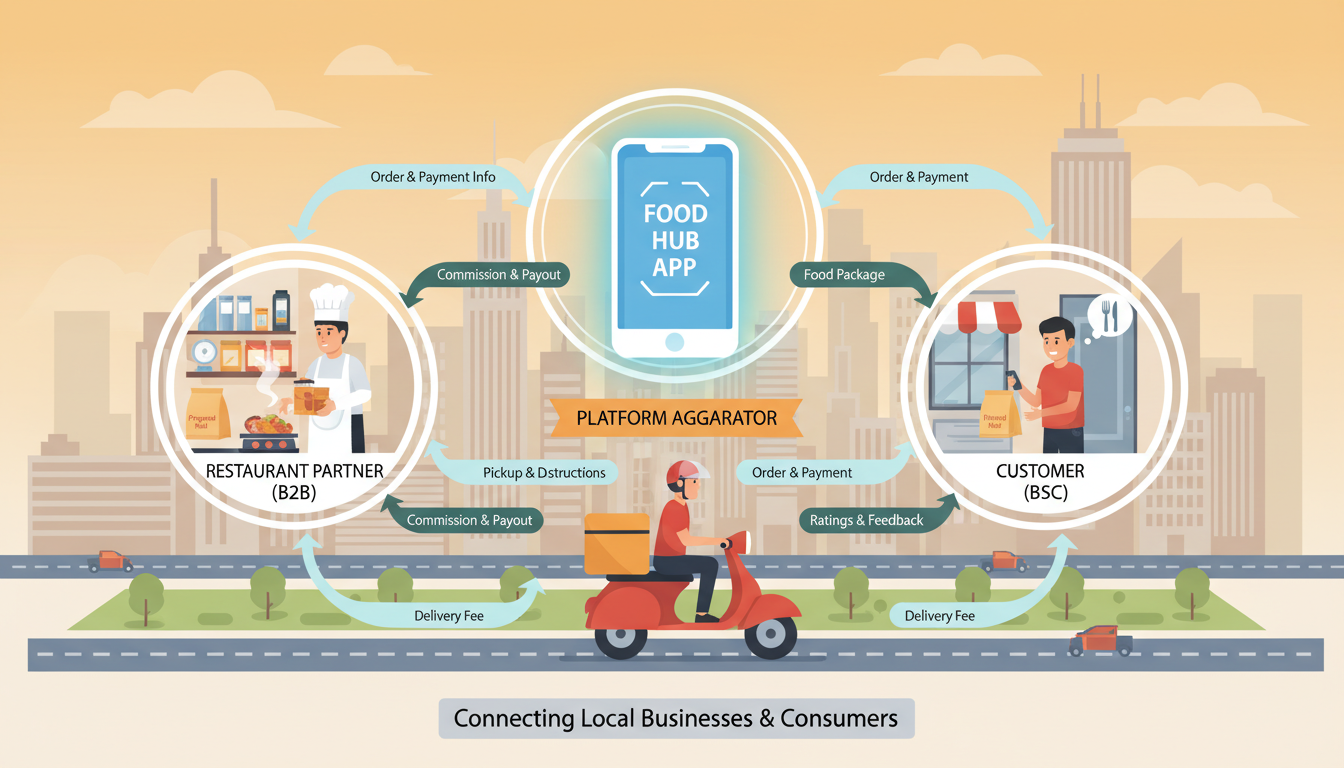
Bhoj employs a Hyperlocal Aggregator Model. Unlike a full-stack food delivery company that might own kitchens (Cloud Kitchens), Bhoj acts as the bridge between supply and demand.
2.5.1 B2C/B2B/Hybrid Analysis
Bhoj fits the Hybrid Marketplace definition:
- B2B Revenue: It charges restaurants a commission fee (Take Rate) on the Gross Merchandise Value (GMV) of every order. Additionally, it may charge onboarding fees or marketing fees for featured slots.
- B2C Revenue: It charges consumers a delivery fee. This fee structure is tiered:
- Orders < Rs. 500: Rs. 100 Delivery Charge.
- Orders Rs. 500 – Rs. 1000: Rs. 50 Delivery Charge.
- Orders > Rs. 1000: Free Delivery.
This pricing strategy incentivizes larger basket sizes, effectively increasing the commission revenue which subsidizes the logistics cost.
2.6 Network Infrastructure & Technology Stack
While specific architectural blueprints are proprietary, the functional requirements imply a sophisticated technology stack:
- Frontend: The mobile apps are likely built using native technologies (Swift for iOS, Kotlin for Android) or cross-platform frameworks like Flutter to ensure responsiveness. The web interface utilizes modern JavaScript frameworks (React or Vue.js) for dynamic content loading.
- Backend: A robust cloud infrastructure (AWS/Google Cloud) is required to handle high concurrency during lunch and dinner peaks.
- Database: Real-time databases (like Firebase or MongoDB) are essential for tracking rider location and order status updates instantaneously.
- Geolocation APIs: Extensive use of Google Maps Platform for geocoding addresses, calculating delivery radii, and optimizing rider routes.
2.7 Security Features and Policies
In the digital trust economy, security is paramount.
- Data Encryption: All data transmission between the app and servers is encrypted using SSL/TLS protocols (HTTPS), ensuring that personal details and order history are not intercepted.
- Payment Security: Bhoj acts as a merchant but does not store credit card details or banking passwords. It utilizes Tokenization via its payment partners (Khalti, eSewa), ensuring it remains out of scope for deep PCI-DSS compliance while maintaining security.
- Privacy Compliance: The privacy policy explicitly outlines data usage (name, email, phone) for service fulfillment. It also includes clauses for legal compliance, stating data may be shared if required by law or court order, reflecting adherence to local regulations.
2.8 Payment Gateways and Systems Used
Bhoj has aggressively modernized its payment stack to reduce reliance on Cash on Delivery (COD), which is operationally expensive and risky.
| Payment Method | Partner/Provider | Strategic Reason |
|---|---|---|
| Digital Wallet | Khalti | Strategic partnership offering exclusive cashback (e.g., “100% Cashback campaigns”). Drives user acquisition from Khalti’s user base. |
| Digital Wallet | eSewa | The market leader in Nepal. Integration allows users to redeem eSewa reward points for Bhoj vouchers, linking the two ecosystems. |
| Direct Banking | FonePay / ConnectIPS | Facilitates direct bank-to-merchant transfers for users who prefer using mobile banking apps over wallets. |
| International Cards | VISA / MasterCard | Enables the Nepalese diaspora (living abroad) to pay for food delivered to family in Nepal, opening a “Remittance-for-Goods” revenue channel. |
| Internal Wallet | Bhoj Wallet | A closed-loop system for refunds and cashback loyalty, keeping money within the Bhoj ecosystem. |
CHAPTER 3: Marketing and Customer Engagement
3.1 Digital Marketing Strategies
Bhoj operates in a “mobile-first” market. Consequently, its marketing strategy is almost entirely digital, focusing on capturing the user at the moment of intent (hunger).
3.1.1 Social Media Integration
Bhoj treats social media not just as a billboard, but as a two-way communication channel.
- Platform Diversity: Active presence on Facebook (mass market), Instagram (visual food appeal), and increasingly TikTok (viral trends).
- Content Strategy: The content mix includes high-resolution food photography (“Food Porn”), user-generated content (reposting customer stories), and meme marketing that resonates with the youth demographic.
- Engagement: The brand runs interactive contests (e.g., “Guess the Dish,” “Tag a Friend”) to drive organic reach. These posts often have high engagement rates, leveraging the social nature of food.
3.1.2 SEO/SEM Approaches
- Search Engine Optimization (SEO): The website structure is programmatic; it generates landing pages for specific cuisines and locations (e.g., “Best Biryani in Kathmandu”).
This allows Bhoj to capture high-intent traffic from Google Search.
- App Store Optimization (ASO): The app description is keyword-dense (“Food Delivery,” “Deals,” “Restaurants in Nepal”), ensuring it ranks highly when users search for generic food terms on the Play Store or App Store.
3.1.3 Content & Influencer Marketing
Influencer marketing has become a cornerstone of Bhoj’s strategy.
- Micro-Influencers: Rather than relying solely on expensive celebrities, Bhoj collaborates with “foodies” and local lifestyle bloggers. These influencers post authentic reviews and unboxing videos of Bhoj orders, which serves as high-trust social proof.
- Referral Marketing: The “BhojCode” system turns every customer into an influencer. By offering mutual benefits (Referrer gets credits, Referee gets a discount), Bhoj lowers its Customer Acquisition Cost (CAC) significantly.
3.2 Mobile and Location-Based Marketing Techniques
- Geo-Fenced Notifications: The app utilizes the user’s location to send hyper-relevant push notifications. A user in Butwal will not see an ad for a Kathmandu restaurant.
- Temporal Targeting: Notifications are timed to coincide with biological triggers—sending a “Biryani” prompt at 11:30 AM (lunch decision time) or a “Late Night Munchies” alert at 10:00 PM.
- App-Exclusive Offers: To drive app installs over website usage, Bhoj restricts certain “Free Deals” and tracking features to the mobile app, forcing users into the more engaging mobile ecosystem.
3.3 Social Commerce and Online Communities
Bhoj leverages the communal aspect of dining.
- Reviews as Content: The review section on the app is a form of social commerce. Users trust other users more than the restaurant’s own description. By facilitating this dialogue, Bhoj builds a community of trust.
- Cross-Promotions: Partnerships with brands like Khalti create a network effect, where communities from different sectors (Fintech + Food) merge for mutual benefit.
3.4 Advertising Campaigns and Communication Channels
- Performance Marketing: Bhoj invests in paid ads on Facebook and Google, likely using “retargeting” pixels. If a user views a restaurant but doesn’t order, they may see an ad for that restaurant later on social media.
- Offline Activation: While digital is primary, Bhoj has historically sponsored food festivals and local events to maintain brand visibility in the physical world.
3.5 Customer Retention and Loyalty Programs
Acquiring a customer is expensive; retaining them is profitable.
- The Bhoj Wallet Ecosystem: This is the most powerful retention tool. Cashback earned from orders is credited here. Since this “money” expires or is only usable on Bhoj, it creates a high switching cost. A user with Rs. 500 in their Bhoj Wallet is economically discouraged from ordering via Pathao Food.
- Gamification: The hunt for “Free Deals” adds a layer of excitement. Users check the app not just to order, but to see what offers are available, increasing Daily Active Users (DAU).
CHAPTER 4: Technical and Strategic Analysis
4.1 Website and App UI/UX Evaluation
The User Interface (UI) and User Experience (UX) of the Bhoj app have received mixed feedback, highlighting a disparity between functionality and aesthetics.
- Functional Strengths: The app excels in utility. Features like “Advanced Sort & Filter” and “Near Me” allow users to quickly parse through hundreds of options. The flow from cart to payment is generally linear and logical.
- Aesthetic and Stability Weaknesses: User reviews often describe the UI as “worn out” or a “cheap copy” of international apps, lacking the polish of competitors like Foodmandu. Critical UX failures include “Address Loops” (where the app repeatedly asks for location data) and occasional crashes during high load. The design language (fonts, colors) is perceived as dated by tech-savvy users.
4.2 SWOT Analysis
Strengths (Internal)
- Hybrid Value Proposition: Unique combination of Delivery + Dine-in Deals + Grocery differentiates it from pure logistics players.
- Geographic First-Mover: Strong presence in secondary cities (Butwal, Bhairahawa) where major competitors are slower to expand.
- Loyalty Lock-in: The closed-loop “Bhoj Wallet” effectively reduces customer churn.
- Fintech Integration: Deep partnerships with Khalti and eSewa for seamless payments.
Weaknesses (Internal)
- Technical Instability: Persistent reports of bugs, glitches, and a dated UI undermine user trust.
- Customer Support: Severe criticism regarding unresponsive support channels and barred phone lines.
- Bootstrapped Constraints: Lack of external VC funding limits the ability to burn cash on aggressive discounts compared to funded rivals like Pathao.
Opportunities (External)
- Market Expansion: Rising internet penetration in Tier-2/3 cities offers a massive untapped user base.
- Fintech Evolution: Integration of “Buy Now Pay Later” (BNPL) for food orders could increase average order value.
- AI & Automation: Implementing AI chatbots could solve the customer support crisis at scale.
Threats (External)
- Competitor Aggression: Pathao’s massive rider fleet and ride-sharing cross-subsidization pose a major threat to Bhoj’s logistics speed.
- Regulatory Tightening: The new E-commerce Bill imposes stricter liability on platforms for product quality, increasing compliance costs.
- Brain Drain: The migration of skilled youths (target demographic) abroad impacts both the labor force (riders) and the consumer base.
4.3 Mobile Commerce and Cross-Platform Features
Bhoj is a definitive example of m-commerce (Mobile Commerce).
- Location-Based Services (LBS): The entire business logic rests on GPS. It restricts orders to manageable radii to ensure food quality.
- Cross-Platform Strategy: While the mobile app is the primary interface, the web platform serves as an acquisition funnel. However, Bhoj actively degrades the web experience slightly (e.g., by making certain deals app-exclusive) to force users onto the app, where retention metrics are higher.
4.4 Use of EDI or Integration Tools
Bhoj utilizes modern API-driven integration rather than legacy EDI.
- Restaurant Panel APIs: These allow real-time inventory management. If a restaurant marks “Chicken Momo” as out of stock on their tablet, it instantly reflects on thousands of user devices.
- Third-Party Logistics (3PL): While Bhoj manages its fleet, the system likely integrates with mapping APIs to optimize routes dynamically based on traffic conditions.
4.5 Reviews, Ratings, and Customer Feedback Loop
The feedback loop is a critical operational dashboard.
- Public Ratings: These act as a quality control mechanism for restaurants. Establishments with consistently low ratings are likely delisted or deprioritized.
- The Service Gap: A critical finding is the disconnect in the feedback loop regarding Bhoj’s own service. While users can rate food, their complaints about the app’s service (late delivery, missing items) often go unanswered due to poor customer support infrastructure. This “deafness” to feedback is a strategic vulnerability.
4.6 Innovation, Trends, and Future Technologies
- Quick Commerce (Q-Commerce): The pivot to grocery delivery suggests a move toward Q-Commerce. Future innovation will likely focus on reducing delivery times from hours to minutes using “Dark Stores” (fulfillment centers).
- Artificial Intelligence: There is significant potential to use AI for personalization—moving from generic lists to “You ordered Pizza last Friday; here is a Burger offer for today.” Currently, Bhoj’s personalization seems limited to basic filters.
- Automation: Automated dispatch systems that assign riders based on AI predictions of traffic and prep time are becoming industry standards that Bhoj must adopt to stay competitive.
CHAPTER 5: Conclusion and Strategic Recommendations
5.1 Summary of Key Findings
The comprehensive analysis of Bhoj reveals a resilient, adaptable, and strategically astute player in the Nepalese e-commerce market.
- Strategic Differentiation: Bhoj has successfully avoided direct commoditization by maintaining its “Deals” and “Wallet” features, offering a unique value proposition beyond just “moving food from A to B.”
- Financial Prudence: As an unfunded entity, Bhoj has survived through smart partnerships (Khalti/eSewa) and a focus on revenue-generating features rather than just vanity metrics.
- Regional Vision: Its expansion into Butwal and Bhairahawa demonstrates a foresight to capture emerging markets while competitors fight over the saturated Kathmandu market.
- Operational Fragility: The platform’s Achilles’ heel is its technical stability and customer support. The recurring user complaints regarding “unresponsive support” and “app glitches” pose a severe risk to long-term brand equity.
5.2 Limitations of the Study
The study identified a gap in data regarding the supplier side of the equation. Little public information exists on how satisfied restaurant partners are with Bhoj’s commission rates (approx. 20%) and payment cycles. Additionally, the lack of access to proprietary financial data limits the ability to calculate the company’s true profitability or “Cash Burn” rate.
5.3 Strategic Suggestions and Recommendations
To secure its position and scale further, Bhoj should consider the following strategic pivots:
- Customer Support Automation: To address the critical weakness of “unresponsive support,” Bhoj must deploy an AI-powered Chatbot capable of handling Level 1 queries (Order Status, Refunds) instantly. This is a cost-effective solution to a labor-intensive problem.
UI/UX Modernization
A complete redesign of the app interface is necessary. The design should move toward a “clean,” minimalist aesthetic similar to global standards (UberEats/DoorDash) to improve perceived trustworthiness and usability.
Logistics Hybridization
To match Pathao’s delivery speed, Bhoj should explore a “Gig-Economy Hybrid Model,” allowing freelance riders to log in during peak hours to augment the core fleet.
Subscription Loyalty Model
Launching a subscription service (e.g., “Bhoj Pro“) that offers unlimited free delivery for a monthly fee would dramatically increase “Share of Wallet” and order frequency, locking users in against competitors.
Data Monetization
Bhoj sits on a goldmine of consumer food data. It can monetize this by selling “Market Insights” to restaurants—telling a pizza place exactly which neighborhoods are searching for pizza but have no supply.
Potential for Expansion or Innovation
- Cloud Kitchens: Bhoj is perfectly positioned to launch “Cloud Kitchens” (delivery-only restaurants) in data-proven high-demand areas. This would allow them to capture the full margin (food + delivery) rather than just commissions.
- Fintech Expansion: The Bhoj Wallet could be expanded into a broader lifestyle wallet, allowing users to pay for utilities or movies, effectively turning Bhoj into a Super App.
- Tourism Integration: Given Nepal’s tourism industry, Bhoj could curate “Food Tours” or “Tourist Dining Passes,” integrating its “Deals” feature with the travel sector.