

Hamrobazaar Case Study: Nepal E-commerce Strategic Analysis

CHAPTER 1: Introduction and Methodology
1.1 Background of the Study
The advent of the internet has catalyzed a global economic paradigm shift, transitioning traditional brick-and-mortar commerce into a dynamic digital ecosystem. Electronic Commerce, or e-commerce, has evolved from a novel method of exchanging business documents to a pervasive commercial infrastructure that underpins the modern global economy. In the context of the academic curriculum for IT 204: E-Commerce, this report serves as a practical exploration of the theoretical concepts regarding business models, infrastructure, security, and marketing strategies.
1.1.1 Global and Local Trends in E-commerce
Globally, the e-commerce landscape has matured into a multi-trillion-dollar industry characterized by distinct operational models. The Western markets, led by pioneers like Amazon and eBay, have established a dichotomy between inventory-led retail (B2C) and peer-to-peer exchange (C2C). We are currently witnessing the “Third Wave” of e-commerce, which is defined by the integration of social commerce, ubiquitous mobile access, and the blurring of lines between content and commerce. Trends such as “Buy Now, Pay Later” (BNPL), artificial intelligence-driven personalization, and hyper-local logistics are reshaping consumer expectations.

In contrast, the South Asian market operates on a different trajectory. It is characterized by a “mobile-first” adoption curve, where millions of users have skipped the desktop internet phase entirely. The region faces unique challenges, including low credit card penetration, a reliance on cash-on-delivery (COD), and infrastructural bottlenecks. However, the rise of digital wallets and regulatory frameworks is rapidly formalizing this sector.
1.1.2 E-commerce in Nepal
Nepal’s digital economy is at a critical inflection point. With internet penetration exceeding 18.24 million users and a rapidly growing smartphone user base, the foundational infrastructure for e-commerce is robust. Historically, the Nepalese market was fragmented and informal. Early adopters used social media platforms like Facebook groups to trade goods, lacking a dedicated, structured marketplace.
The current landscape is dominated by two primary models: the managed marketplace (e.g., Daraz, owned by Alibaba) which mimics the Amazon model of warehousing and logistics control, and the open classifieds marketplace (e.g., Hamrobazaar). The latter aligns with the C2C model, facilitating direct interaction between buyers and sellers without the platform acting as a merchant of record. This report focuses on Hamrobazaar.com, a platform that has become synonymous with the secondary market in Nepal, effectively digitizing the country’s informal economy. The enactment of the E-commerce Act further signals the maturation of this sector, moving it from a “wild west” environment to a regulated industry.
1.2 Types of E-commerce
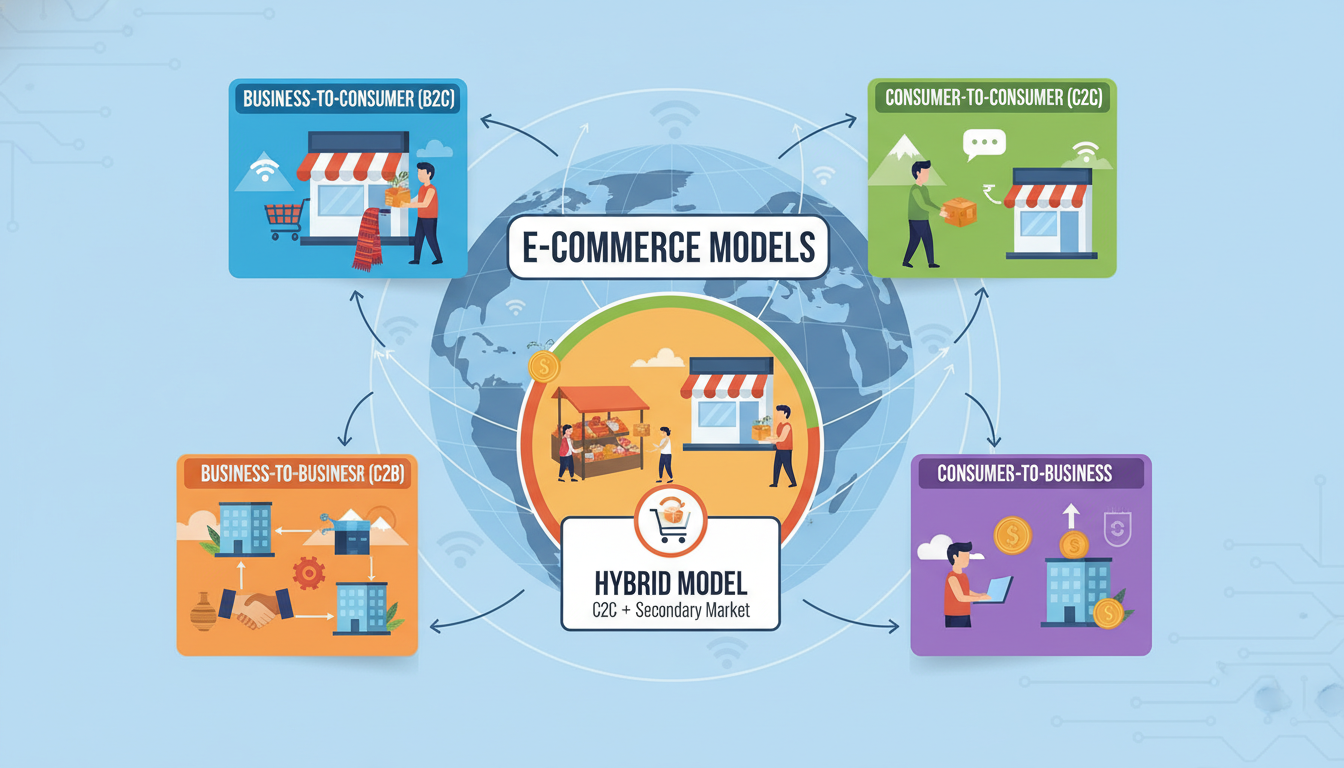
To contextualize the analysis of Hamrobazaar, it is necessary to define the prevailing e-commerce models as outlined in the course curriculum:
- Business-to-Consumer (B2C): This is the retail model where businesses sell products directly to individual consumers. In Nepal, platforms like Sastodeal and Daraz exemplify this, managing inventory or vetting suppliers strictly.
- Consumer-to-Consumer (C2C): This model facilitates commerce between private individuals. It is often characterized by the sale of used or second-hand goods. Hamrobazaar was founded on this premise, allowing users to liquidate underutilized assets.
- Business-to-Business (B2B): This involves transactions between companies, such as manufacturers selling to wholesalers. While less visible to the public, this forms the backbone of the supply chain.
- Consumer-to-Business (C2B): A model where individuals sell goods or services to businesses, often seen in freelance marketplaces.
- Hybrid Model: An increasingly common strategy where platforms blend models. Hamrobazaar, for instance, has evolved from a pure C2C platform to a Hybrid Marketplace that hosts verified businesses (B2C) alongside individual sellers, integrated with third-party logistics.
1.3 Introduction to Group Members
This case study is submitted as part of the partial fulfillment of the requirements for the Bachelor of Business Administration (BBA) 6th Semester. The research team comprises students dedicated to exploring the intersection of technology and commerce. The group has leveraged diverse skill sets, including financial analysis, digital marketing assessment, and technical architecture review, to compile this comprehensive report.
1.4 Objectives of the Case Study
The primary objective of this report is to provide an in-depth, expert-level analysis of Hamrobazaar.com, aligning with the learning outcomes of the IT 204 course. The specific objectives are:
- Business Model Analysis: To dissect Hamrobazaar’s transition from a founder-led classifieds site to a corporate-backed hybrid marketplace and evaluate its sustainability.
- Strategic Evaluation: To analyze the platform’s marketing strategies, particularly its response to social commerce threats like Facebook Marketplace and Instagram Shops.
- Technological Assessment: To review the platform’s infrastructure, security protocols, and integration of innovative financial tools like “Hamro BNPL” (Buy Now, Pay Later).
- Regulatory Compliance: To assess the platform’s adherence to the newly implemented E-commerce Act and its implications for data privacy and consumer protection.
- Future Outlook: To provide strategic recommendations for the platform to maintain market dominance in an evolving digital landscape.
1.5 Scope and Limitations of the Study
Scope: The scope of this study is comprehensive, covering the operational timeline of Hamrobazaar from its inception to the post-2021 acquisition era. It encompasses:
- Marketing: Digital campaigns, SEO, and brand positioning.
- Operations: Logistics integration (Baato), seller verification, and customer support.
- Finance: Revenue streams, including advertising and fintech commissions.
- Legal: Compliance with Nepalese cyber law and consumer protection statutes.
Limitations:
- Financial Opacity: As a private limited company, Hamrobazaar does not disclose detailed financial statements. Revenue and profitability are inferred from business model analysis and industry benchmarks rather than audited reports.
- Dynamic Regulatory Environment: The E-commerce Act is in the early stages of enforcement. Its long-term impact on C2C liability remains a developing subject.
- User Sentiment Data: Analysis of customer satisfaction is derived from public forums (Reddit, App Store reviews) which may disproportionately reflect extreme positive or negative experiences.
1.6 Research Methodology
This report utilizes a mixed-method research approach to ensure a holistic analysis:
- Secondary Data Collection: A rigorous review of existing literature was conducted. This included industry white papers, news articles regarding the MNS Investments acquisition, interviews with CEO Rohit Tiwari, and legal texts of the E-commerce Act.
- Platform Testing & Observation: The research team conducted direct testing of the Hamrobazaar web and mobile applications. This involved mapping the user journey for both buyers and sellers, analyzing the “Hamro BNPL” application flow, and evaluating the “Baato” logistics integration.
- Digital Footprint Analysis: Tools and public data were used to assess the platform’s SEO performance, keyword dominance, and social media engagement strategies compared to competitors.
- Comparative Analysis: The platform was benchmarked against global standards (e.g., eBay, OLX) and local competitors (Daraz, Facebook Marketplace) to identify relative strengths and weaknesses.
CHAPTER 2: Overview of the Selected E-commerce Platform
2.1 Company Profile
Hamrobazaar.com is Nepal’s premier online classifieds marketplace, serving as a critical infrastructure for the country’s secondary economy.
- Origins and Founding: The platform was established in the mid-2000s by Prabal Saakha. In its nascent stage, it was described as a “pocket website”—a passion project designed to solve a simple problem: the lack of a centralized venue for buying and selling used goods in Nepal. For over a decade, it operated with a minimalist, utility-focused interface and a strictly “free-to-use” philosophy. This strategy allowed it to aggregate massive liquidity and user trust, effectively monopolizing the classifieds niche before international competitors could enter.
- The 2021 Acquisition: A pivotal moment in the company’s history occurred in March 2021, when MNS Investments, a leading Nepalese conglomerate with interests in media and technology, acquired Hamrobazaar. This marked the transition from a “hobbyist” operation to a strategic corporate asset.
- Leadership and Vision: Post-acquisition, Rohit Tiwari, a seasoned entrepreneur and co-founder of Foodmario, was appointed as CEO. His mandate was to modernize the legacy tech stack, introduce monetization channels, and professionalize the user experience while retaining the platform’s core democratic value: free listings for the average citizen.
- Scale: The platform commands significant traffic, with reports indicating approximately 800,000 unique monthly visitors and over 2 million daily page views. The average user retention time is notably high at 12-13 minutes, reflecting the engaging “treasure hunt” nature of the platform.
2.2 Key Features of the Platform
Hamrobazaar has evolved its feature set to address the specific friction points of the Nepalese market:
- Classifieds Engine: The core feature allows users to post advertisements across diverse categories (Auto, Real Estate, Electronics) with detailed descriptions and images.
Crucially, this service remains free for standard users, ensuring a low barrier to entry.
-
Hamro BNPL (Buy Now, Pay Later): In a market with low credit card adoption, Hamrobazaar partnered with Foneloan to introduce an integrated EMI solution. This allows users to purchase high-value items via instant digital loans approved through mobile banking apps, a first for a classifieds site in Nepal.
-
In-App Messaging: To address privacy concerns and reducing the risk of harassment, the platform introduced a real-time chat feature in its 2.0 update. This allows buyers and sellers to negotiate without exchanging personal phone numbers initially.
-
Smart Location Filters: Recognizing the logistical challenges of Nepal, the platform utilizes geolocation to prioritize hyper-local listings, enabling users to find goods available within their immediate vicinity (e.g., “5km radius”).
2.3 Products/Services Offered
Hamrobazaar operates as a horizontal marketplace, meaning it services a wide breadth of categories rather than focusing on a single vertical.
| Category | Description & Examples |
|---|---|
| Automobiles | A high-volume category featuring motorcycles, scooters, and cars. It serves as a primary liquidity venue for the secondary vehicle market. |
| Real Estate | Listings for land, houses for sale, and rental apartments. This section functions as a lead generator for brokers and landlords. |
| Electronics | Mobile phones, laptops, and cameras. This category sees the highest velocity of trade and is the primary target for the BNPL feature. |
| Home & Lifestyle | Furniture, appliances, and clothing. This supports the “circular economy” by extending the lifecycle of household goods. |
| Services & Jobs | Listings for plumbers, electricians, tutors, and job vacancies, moving the platform towards a “services marketplace.” |
Historically dominated by used goods (C2C), the platform has aggressively onboarded businesses (B2C), now featuring brand-new inventory from official distributors and SMEs.
2.4 Buying and Selling Workflow
The platform functions as a venue rather than a merchant, meaning the workflow is decentralized.
2.4.1 Customer Journey (Buying Process)
-
Search and Discovery: The user enters the site via the mobile app or web. They utilize search keywords (e.g., “iPhone 13”) or browse categories. Advanced filters allow sorting by price, condition (New/Used), and location.
-
Evaluation: The user reviews product images, descriptions, and the seller’s profile. The “Speak Comment” feature allows public questioning of the seller, providing a layer of social verification.
-
Negotiation: Unlike fixed-price retail, negotiation is expected. The buyer contacts the seller via phone, SMS, or the in-app chat to haggle over the price.
-
Transaction:
-
C2C: The buyer and seller agree to meet in a public location. The buyer inspects the item physically. Payment is made via cash or P2P transfer (eSewa/Khalti).
-
B2C: For verified sellers, the buyer may opt for delivery services integrated via Baato.
-
-
Feedback: The user may report the ad if it was a scam, contributing to platform moderation.
2.4.2 Seller Onboarding (Selling Process)
-
Registration & Verification: To reduce anonymity, sellers must register using a mobile number verified via OTP. This ties the account to a real identity.
-
Ad Creation: The seller uploads images (critical for trust), sets a price, writes a description, and tags the location.
-
Moderation: The ad is submitted for review. Automated systems check for prohibited content before it goes live.
-
Management: Sellers use a dashboard to manage listings, mark items as “Sold” (to stop calls), or “Boost” ads for higher visibility using paid credits.
2.5 Business Model
2.5.1 B2C/B2B/Hybrid Analysis
Hamrobazaar operates on a Hybrid Model that layers B2C monetization on top of a C2C foundation.
-
The Foundation (C2C): This component functions as a traffic magnet. By offering free listings to individuals, the platform ensures a massive inventory and high user engagement. This segment is not directly monetized through transaction fees but monetized through advertising impressions.
-
The Growth Engine (B2C): Businesses (official stores, grey market retailers) use Hamrobazaar as a sales channel. These “Verified Sellers” are the target for premium services.
-
The Revenue Model:
-
Advertising: Display ads (Google AdSense) and direct corporate sponsorships (banner ads for banks, ISPs) generate the bulk of revenue from the high traffic volume.
-
Freemium Listings: While basic posting is free, “Booster” options (Featured Ads, Top of Search) function as a paid service for sellers needing urgency.
-
Fintech Commissions: The platform likely earns origination fees or commissions from the loans processed via the “Hamro BNPL” service.
-
2.6 Network Infrastructure & Technology Stack
The platform’s infrastructure has undergone a significant overhaul known as “Hamrobazaar 2.0” under the new management.
-
Frontend: The web interface has transitioned to a modern, responsive framework (likely React or similar) to support dynamic content and faster loading on mobile connections.
-
Mobile Architecture: Native applications for iOS and Android leverage device features like GPS for location filtering and camera integration for ad posting.
-
Backend & Scalability: To handle 2 million daily views, the backend utilizes cloud infrastructure capable of high concurrency. The database must manage millions of active and archived listings with complex search queries.
-
API Integrations: The platform has moved from a walled garden to an open ecosystem, integrating external APIs for Logistics (Baato) and Finance (Foneloan/F1Soft), creating a connected digital service mesh.
2.7 Security Features and Policies
Security is the primary challenge for any open marketplace. Hamrobazaar employs several layers of defense:
-
Data Security: The platform utilizes SSL (Secure Socket Layer) encryption to protect user data in transit, ensuring that login credentials and messages cannot be intercepted.
-
Identity Verification: The mandatory OTP (One-Time Password) verification for mobile numbers acts as a deterrent against throwaway accounts. In cases of fraud, this allows the platform to provide law enforcement with a trace to the perpetrator.
-
Privacy Protection: The in-app chat system allows users to communicate without revealing their private phone numbers, mitigating the risk of harassment or data harvesting.
-
Policy Compliance: The platform’s privacy policy explicitly states that data is collected for service improvement and marketing but is not sold to third parties without consent, aligning with standard data protection norms.
2.8 Payment Gateways and Systems Used
Hamrobazaar employs a bifurcated payment strategy:
-
Decentralized/Cash-Based: For the majority of C2C transactions, the platform does not process payments. It acts purely as an information broker. Buyers and sellers settle transactions offline using Cash or via P2P transfers using eSewa, Khalti, or ConnectIPS. The platform discourages advance payments to unknown sellers to prevent fraud.
-
Integrated Fintech (Hamro BNPL): For verified B2C transactions, the platform has integrated a sophisticated Buy Now, Pay Later system.
-
Mechanism: A buyer selects a product and scans a QR code using their mobile banking app (supported by partner banks like Kumari Bank, NIMB).
-
Credit Assessment: The bank’s algorithm instantly analyzes the user’s transaction history and salary inflows to approve a loan.
-
Settlement: If approved, the bank pays the seller immediately, and the buyer repays the bank in EMIs. This is a cashless, paperless system that significantly reduces friction for high-ticket items.
-
CHAPTER 3: Marketing and Customer Engagement
3.1 Digital Marketing Strategies
Hamrobazaar’s marketing strategy has shifted from passive organic growth to active, content-driven engagement. This evolution is necessary to defend its market share against aggressive social commerce platforms.
3.1.1 Social Media Integration
The platform maintains a robust presence on major social networks, utilizing them not just for broadcasting but for community engagement.
-
Facebook: With a massive follower base, the Facebook page is used to highlight “Featured Ads,” share safety tips, and run contests. It serves as a secondary customer support channel.
-
Trend Jacking: The marketing team employs “Trend Jacking,” a strategy of identifying viral trends on TikTok or Instagram and immediately highlighting relevant products available on Hamrobazaar. For instance, if a specific vintage camera becomes a trend, Hamrobazaar promotes listings of that camera to capture the wave of interest.
3.1.2 SEO/SEM Approaches
Search Engine Optimization (SEO) is the backbone of Hamrobazaar’s acquisition strategy.
-
Long-Tail Dominance: Because the site is composed of thousands of user-generated ads with specific product names (e.g., “Second hand iPhone 12 Pro Max 256GB Gold”), it naturally captures highly specific, high-intent search queries.
-
Local SEO: The site ranks highly for “Nepal” specific keywords (e.g., “Bike price in Nepal,” “Rent in Kathmandu”), effectively blocking competitors from the top search results.
3.1.3 Content & Influencer Marketing
Recognizing the power of social proof, Hamrobazaar has begun collaborating with influencers.
-
Thrift Culture: Influencers create content focused on “thrifting” or “budget setups,” showcasing how they furnished a room or built a PC using deals found on Hamrobazaar. This narrative reframes “used goods” as “smart, sustainable choices,” appealing to the younger, eco-conscious demographic.
3.2 Mobile and Location-Based Marketing Techniques
-
App-Centric Push: Marketing efforts are heavily focused on driving app installations.
Once installed, the app uses push notifications to alert users about price drops on “watched” items or new listings in their saved categories.
Geolocation: The platform’s intrinsic design is location-based. By defaulting search results to the user’s current city, it ensures relevance. This hyper-local focus is a key differentiator against global platforms that may not have granular location data for Nepal.
3.3 Social Commerce and Online Communities
Hamrobazaar operates in a competitive environment defined by Social Commerce.
- The Threat: Facebook Marketplace and Instagram Shops allow users to buy and sell within their existing social feeds. These platforms leverage the “Real Identity” trust of a social profile, which is a significant advantage over anonymous classifieds.
- Hamrobazaar’s Response: To counter this, Hamrobazaar fosters its own community feeling through features like public “Speak Comments.” This allows the community to police itself—users can publicly warn others if a price seems suspicious or ask technical questions that reveal the seller’s legitimacy.
3.4 Advertising Campaigns and Communication Channels
- Seasonal Campaigns: In Nepal, the festival season (Dashain/Tihar) is the peak consumption period. Hamrobazaar executes targeted campaigns such as “Upgrade for Dashain”.
- Strategy: The campaign encourages users to sell their old electronics or furniture to generate cash (liquidity) for purchasing new festival items.
- Fintech Synergy: In 2024, the “Hamro BNPL” launch was synchronized with Dashain, offering “0% Interest” deals to capture high-ticket spending that might otherwise go to physical retail stores.
- Channels: The platform utilizes a mix of digital channels (Google Ads, Social Media) and traditional channels (partnerships with banks) to reach its audience.
3.5 Customer Retention and Loyalty Programs
- Retention Metrics: The platform boasts an impressive average retention time of 12-13 minutes per user. This “stickiness” is driven by the diverse inventory and the psychological reward of finding a bargain.
- Loyalty: While there is no formal “points system,” the platform builds loyalty through utility. The “Watchlist” feature allows users to track prices, keeping them engaged over weeks.
- Challenges: Retention is threatened by UI/UX friction. Long-time users have expressed dissatisfaction with the ad-heavy design of the new app, which could lead to churn if not addressed.
CHAPTER 4: Technical and Strategic Analysis
4.1 Website and App UI/UX Evaluation
The transition from the legacy interface to “Hamrobazaar 2.0” represents a strategic trade-off between modernization and usability.
- Visual Design: The new interface supports high-resolution images and a card-based layout, which is visually superior for browsing.
- User Experience (UX): However, user feedback suggests significant friction. The aggressive placement of banner ads—necessary for revenue—often obscures content and disrupts the browsing flow. Users on forums like Reddit have described the app as “cluttered” compared to the utilitarian simplicity of the old version. The “Search” functionality has also been criticized for returning irrelevant results, indicating a need for better indexing algorithms.
4.2 SWOT Analysis
Strengths
- Market Leadership: Unrivaled brand recall and traffic volume (2M+ daily views) in Nepal.
- Inventory Depth: The largest database of used goods, creating a “winner takes all” network effect.
- Fintech Innovation: First-mover advantage with Hamro BNPL integration.
- Operational Efficiency: Asset-light model with no inventory costs.
Weaknesses
- Trust Deficit: Persistent reputation issues related to scams and fraud inherent in C2C.
- UI/UX Friction: Negative sentiment regarding ad density and app performance.
- Revenue Vulnerability: Heavy reliance on advertising revenue makes it susceptible to ad-blockers.
- Lack of Transaction Control: Inability to secure C2C payments.
Opportunities
- Escrow Services: Launching a “Hamro Pay” escrow service to secure transactions and earn fees.
- Tiered Membership: Charging professional sellers for “Storefront” analytics and branding tools.
- Regional Expansion: Leveraging mobile penetration to grow in Tier-2 and Tier-3 cities.
- Data Monetization: Selling pricing trends and market insights to brands and researchers.
Threats
- Regulatory Compliance: The E-commerce Act 2081 imposes liabilities that are difficult to enforce in a C2C model.
- Global Giants: Facebook Marketplace offers a frictionless, ad-free alternative integrated into daily social use.
- Vertical Competitors: Specialized sites (e.g., for Real Estate or Jobs) could erode specific category shares.
4.3 Mobile Commerce and Cross-Platform Features
Hamrobazaar effectively employs an m-commerce strategy.
- Mobile-First: Recognizing that most Nepalis access the internet via mobile data, the platform prioritizes the app experience.
- Cross-Platform Sync: User accounts sync seamlessly between web and mobile. A user can start browsing on a desktop at work and continue on the mobile app during their commute.
- Device Integration: The app deeply integrates with the phone’s ecosystem, allowing for one-tap calling to sellers and direct sharing of listings to WhatsApp or Messenger.
4.4 Use of EDI or Integration Tools
While traditional EDI (Electronic Data Interchange) is less relevant for a C2C platform, Hamrobazaar utilizes modern API (Application Programming Interface) integrations.
- Baato API: This integration connects the platform to a logistics network. When a seller receives an order, the API can potentially trigger a pickup request, calculating shipping costs in real-time based on the user’s geolocation.
- Banking APIs: The connection with F1Soft (Foneloan) requires secure API tunnels to query bank databases for credit scoring without exposing sensitive banking data to Hamrobazaar directly.
4.5 Reviews, Ratings, and Customer Feedback Loop
- Seller Ratings: The platform currently lacks a robust, verified review system for C2C sellers, which is a major gap compared to eBay. Trust relies on “gut feeling” and phone conversations.
- Feedback Loop: User feedback is primarily collected through app store reviews and social media. The company’s response to the 2.0 backlash—acknowledging issues but maintaining the strategic direction——shows a tension between user desires (ad-free simplicity) and business needs (revenue generation).
4.6 Innovation, Trends, and Future Technologies
- Artificial Intelligence (AI): Current use is likely limited to basic spam filtering. Future potential includes AI-driven Image Recognition (auto-categorizing products based on photos) and Price Prediction Models to help sellers set realistic prices.
- Big Data: The platform sits on a goldmine of data regarding the secondary market value of goods in Nepal. This data could be used to generate “Blue Book” style pricing guides for cars and phones.
CHAPTER 5: Conclusion and Strategic Recommendations
5.1 Summary of Key Findings
Hamrobazaar.com serves as a definitive case study of a local platform adapting to global e-commerce trends while navigating unique regional constraints.
- Strategic Pivot: It has successfully transitioned from a hobbyist “pocket website” to a diversified digital ecosystem, integrating fintech (BNPL) and logistics (Baato) to create a moat against competitors.
- Market Resilience: Despite the entry of global giants and the ubiquity of social media marketplaces, Hamrobazaar has retained its dominance through deep inventory liquidity and brand heritage.
- The Trust Barrier: The platform’s greatest challenge remains the lack of transaction security in C2C trades, which leaves users vulnerable to fraud and limits the platform’s ability to monetize transactions directly.
5.2 Limitations of the Study
During the course of this research, it became evident that the lack of public financial data limits the ability to assess the profitability of the new business model. Furthermore, the E-commerce Act 2081 is so new that its enforcement mechanisms are not yet fully tested in the courts, making legal assessments speculative.
5.3 Strategic Suggestions and Recommendations
To secure its future and align with the maturing market, Hamrobazaar should consider the following:
- Implement Escrow Services (“Hamro Secure Pay”): The most critical recommendation is to bridge the trust gap. An escrow service would hold the buyer’s payment until the product is verified.
- Unit 4 Context: This directly addresses “Security Threats” and “Payment Systems.”
- Benefit: It eliminates advance-payment scams and provides a new revenue stream via transaction fees (e.g., 2% of sale value).
- Tiered Verification System: To professionalize the platform without alienating casual users:
- Silver (Verified ID): KYC verification via Nagarik App.
- Gold (Business): PAN/VAT verified with access to “Storefront” analytics.
- Unit 2 Context: This refines the “Business Model” by segmenting B2C and C2C users effectively.
- Community Dispute Resolution: Implement a “Reputation Score” for sellers based on successful transactions and verified reviews. Allow users to upload “Video Evidence” of product condition to dispute claims.
- Content-Driven Commerce: Expand the “Trend Jacking” strategy by launching a native “Discover” feed within the app—a TikTok-style stream of video listings (e.g., “Car walkarounds,” “Gadget reviews”) to increase engagement and time-on-site.
5.4 Potential for Expansion or Innovation
- Services Marketplace: The “Services” category is underutilized. There is immense potential in organizing the fragmented market for plumbers, electricians, and movers, verifying them, and managing bookings (similar to Urban Company).
- Regional Expansion: Using the mobile-first strategy to penetrate rural Nepal, where access to goods is limited.
Hamrobazaar could become the primary “virtual mall” for remote districts, aided by the Baato logistics network.
In conclusion, Hamrobazaar is well-positioned to evolve from a classifieds site into a “Super App” for commerce in Nepal. By solving the trust equation through technology and regulation, it can unlock the full value of the digital economy.