


Sovereign Host: Direct Booking Strategies Beyond Airbnb
The Sovereign Host: Strategic Diversification and the Architecture of Direct Distribution in the 2025 Short-Term Rental Market

The short-term rental industry has entered a period of fundamental structural realignment. As of 2025, the “platform paradox”—where Online Travel Agencies (OTAs) provide essential volume while simultaneously commoditizing the service provider—has reached a critical mass. Professional operators are increasingly recognizing that platform dependence is not merely a cost of doing business but a systemic risk to long-term growth and business valuation. The emergence of the “Sovereign Host” model represents a shift from passive listing management to active hospitality brand building, leveraging a sophisticated technical stack that prioritizes direct guest relationships, data ownership, and diversified demand capture.
The economic impetus for this transition is clear: OTA commissions, often totaling 15% to 20% of gross revenue, represent a significant leakage of profit that could otherwise be reinvested into property maintenance, guest experience, or local marketing. Furthermore, the restrictive communication policies of platforms like Airbnb and Booking.com prevent the collection of first-party data, effectively “renting” the guest to the host for a single stay rather than allowing for the cultivation of lifetime value. To counter these challenges, the 2025 marketing framework focuses on four pillars of independence: high-performance direct booking engines, Google ecosystem optimization, conversational commerce via WhatsApp, and systematic loyalty architecture.
The Digital Storefront: Engineering the High-Conversion Direct Booking Engine
The foundation of independence is the direct booking website. In 2025, the market has bifurcated into general-purpose website builders and high-performance, industry-specific platforms. The technical requirements for these sites have shifted; aesthetic appeal is now secondary to performance metrics such as page load speed, mobile responsiveness, and the frictionless nature of the booking funnel. Research suggests that as page load times increase from 1 to 5 seconds, the probability of a bounce increases by 90%, making technical optimization a primary driver of conversion rate optimization (CRO).
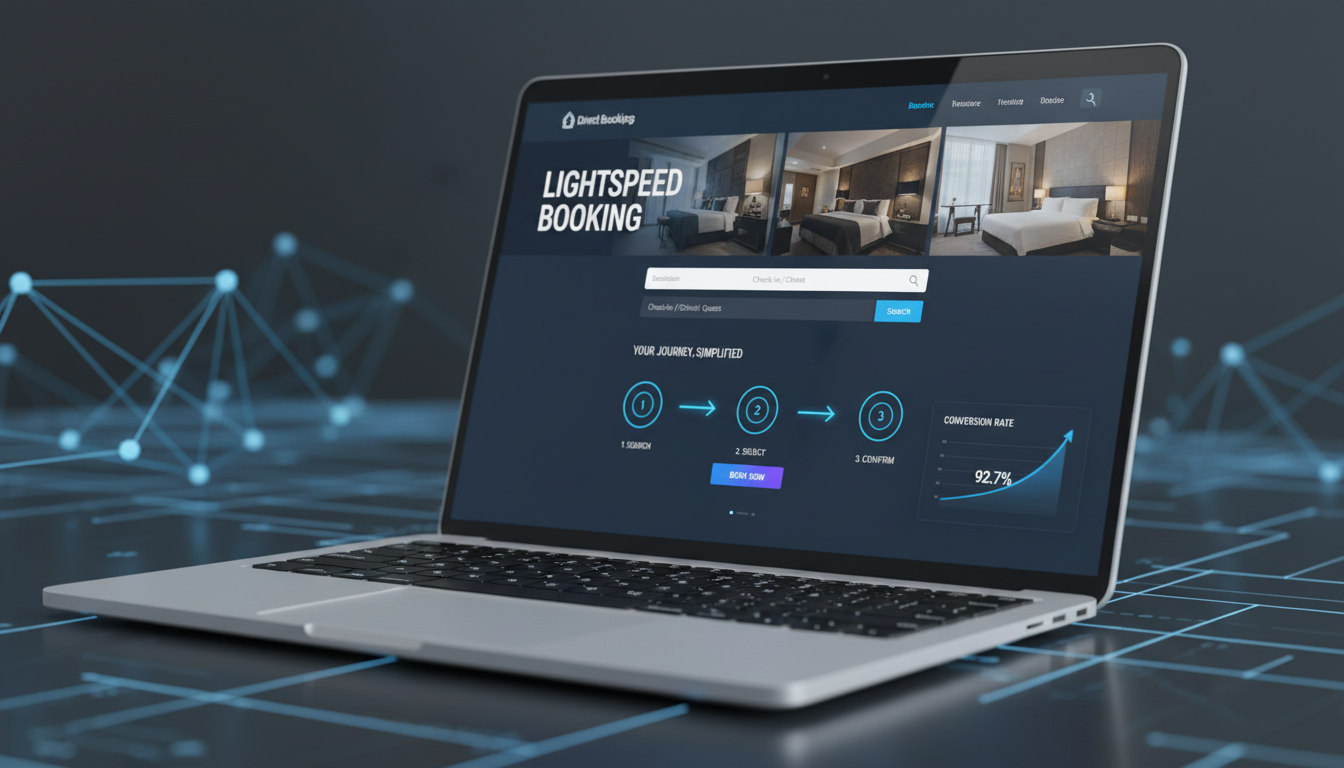
Comparative Analysis of Direct Booking Platforms and Website Builders
| Platform | Best For | Technical Advantage | Setup Time | Starting Price |
|---|---|---|---|---|
| CraftedStays | Scaling portfolios (5-50 units) | Sub-2s load times; 4.4x speed improvement | 25 Minutes | $89.99/mo |
| Wix | Individual owners/resorts | Advanced SEO tools and template flexibility | 2-4 Days | $17.00/mo |
| Lodgify | Mid-market growth | Integrated channel manager and payment processing | 2-3 Days | $12.00+ |
| Hostfully | Professional managers | Enterprise-level software integrations (100+) | 1 Hour (Free sites) | $117.00/mo |
| Squarespace | Visual branding/Luxury | High-end visual storytelling templates | 2-4 Days | $16.00/mo |
| IONOS | Budget-conscious hosts | AI-powered building and affordable hosting | 1-2 Days | $1.00/mo |
| Zeevou | Multi-brand managers | Automated guest vetting and multi-city management | 2-5 Days | Custom |
| Floorspace | WordPress enthusiasts | Full ownership and PMS-agnostic connection | 2-4 Weeks | Affordable |
| Carrd | Simple landing pages | Minimalist, single-page responsiveness | <1 Hour | Free / $19/yr (Pro) |
The performance data highlights a critical second-order insight: the choice of platform is often a trade-off between customization and speed. While agency-built custom sites or complex WordPress installations offer total design control, they frequently suffer from slower load times (3.8-5.2 seconds) compared to purpose-built platforms like CraftedStays (1.2-1.8 seconds). For operators in 2025, the “speed-to-booking” metric is the most critical KPI; a faster site directly correlates with a 40-70% improvement in conversion rates over standard PMS-provided sites.
The Role of Simple Landing Pages in Lean Marketing
For hosts managing a single property or testing a new market, the complexity of a full-scale website can be a deterrent. The emergence of minimalist landing page builders like Carrd and Onepage.io has provided a low-friction entry point into direct bookings. These tools are particularly effective for “Link in Bio” social media strategies, where the goal is to provide a single, mobile-optimized call to action (CTA).
A minimalist landing page for a vacation rental typically prioritizes:
- A Hero Section: High-resolution imagery with a bold value proposition (e.g., “The Most Private Cabin in the Blue Ridge Mountains”).
- Frictionless Booking: A direct integration with a payment widget like Stripe or PayPal, or a “Book Now” button that opens a WhatsApp chat for manual reservation.
- Trust Signals: Prominent placement of guest testimonials and “Verified Host” badges.
- Mobile-Forward Navigation: Ensuring that tap targets are large enough for thumb-based navigation and that form fields support auto-fill features.
The shift toward these “micro-sites” reflects a broader trend in 2025: the fragmentation of the web into niche, high-intent landing pages that cater to specific demographics, such as remote workers seeking reliable Wi-Fi or pet owners looking for fenced yards.
The Google Frontier: Navigating Maps, Metasearch, and Verification
In 2025, Google has effectively transitioned from a general search engine into a specialized metasearch aggregator for the travel industry. For short-term rental operators, Google represents the most efficient channel for capturing high-intent traffic without the 15% “OTA tax”. Success on this frontier requires a dual approach: optimizing the Google Business Profile (GBP) for local maps visibility and integrating property data into Google Vacation Rentals (GVR).
Google Vacation Rentals (GVR) Mechanics
GVR operates as a metasearch engine, pulling data from various sources to display listings directly within Google Search, Travel, and Maps. Unlike an OTA, Google does not process the booking itself. Instead, it directs the user to the host’s direct booking site or a partner OTA.
The GVR ecosystem offers three primary paths for integration:
- Connected Partner OTA: Listing via Airbnb or Vrbo allows the property to appear on Google, but the booking remains subject to OTA commissions.
- Connectivity Partner (PMS): Using a Google-certified integration partner like Hostaway, Lodgify, or iGMS allows for direct, commission-free bookings where the user is sent directly to the host’s website.
- Direct XML Integration: Reserved for large-scale managers with over 5,000 units and dedicated technical teams.
For the professional host, the “Official Site” badge is the ultimate objective. This badge increases perceived trust and ensures the operator retains full control over the guest relationship and payment processing.
Google Business Profile: The local SEO Powerhouse
The Google Business Profile (GBP) is the primary driver of visibility in the “Local 3-Pack” and Google Maps. In 2025, Google has significantly tightened its verification protocols to eliminate “ghost listings” and spam.
The 2025 Verification Workflow and Requirements
Verification is increasingly performed through live or recorded video walkthroughs. Failure to provide consistent proof of physical existence and management often results in immediate profile suspension.
| Verification Pillar | Required Evidence | Strategic Implication |
|---|---|---|
| Physical Existence | Exterior shots of street signs, landmarks, and building address. | Google prioritizes businesses with a unique, permanent location. |
| Proof of Management | Recording the act of unlocking the door (key/keypad); filming the staff room or storage. | Demonstrates that the business is actively managed on-site. |
| Operational Proof | Utility bills, tax registrations, or insurance documents matching the GBP name and address. | Eliminates virtual offices and P.O. boxes from the map. |
| Brand Integrity | Permanent signage matching the GBP name exactly; no keyword stuffing. | Using “Best Beach House” as a name instead of the legal brand name triggers suspension. |
The second-order impact of these strict guidelines is a massive reduction in search-result clutter. Hosts who successfully navigate the verification process benefit from reduced competition and higher rankings. Furthermore, the categorization of the business—distinguishing between a “Hotel” (requiring an on-site front desk) and a “Vacation Rental” (which may not)—is critical for unlocking specific GVR features like amenity filtering and official site links.
Aesthetic Authority: Instagram as a Visual Funnel
Instagram has evolved into a “top-of-funnel” discovery platform where travelers research the “vibe” and authenticity of a property before committing to a booking. In 2025, the focus has shifted from high-production photography to “authentic aesthetics” and community engagement.
The Visual Content Hierarchy
The successful Instagram strategy for vacation rentals in 2025 revolves around three content formats:
- Reels (Short-form Video): These are the primary driver of reach. Content should focus on “a day in the life” at the property, local “secret spots,” or fast-paced property tours utilizing trending audio.
- Stories and Highlights: Stories serve as a real-time engagement tool for Q&A, limited-time promotions, and behind-the-scenes glimpses. Highlights should be treated as a website navigation menu, with categories like “About Us,” “Guest Reviews,” “Local Eats,” and “Booking Info”.
Carousel Posts
Ideal for showcasing property features in detail or creating “Listicle” style guides (e.g., “5 Best Coffee Shops Near Our Cabin”).
Community Management and Conversion
Instagram is an interactive platform, not a static billboard. High engagement rates—measured by likes, comments, and shares—signal to the algorithm that the content is valuable, increasing its reach.
Engagement Strategy
| Implementation Tactic | ROI / Benefit |
|---|---|
| Prompt Response | Builds trust and prevents potential guests from moving to a competitor. |
| Reply to all DMs and comments within 30-60 minutes. | |
| User-Generated Content | Provides “Social Proof” and authentic testimonials that feel more trustworthy than ads. |
| Encourage guests to tag the property and repost their photos. | |
| Hashtag Strategy | Increases discoverability among travelers searching for specific destinations. |
| Mix niche tags (#CabinsInTheWoods) with local tags (#AshevilleTravel). | |
| Geo-Tagging | Surfaces content in location-based searches and “Explore” feeds. |
| Tag specific local landmarks and restaurants in all posts. |
A critical insight for 2025 is the “recency” factor in Instagram’s algorithm. Posting when the target audience is most active—typically early morning or late evening—is essential for maximizing organic reach. For hosts without a direct booking engine, the Instagram DM has become a viable booking channel, with tools like Gallabox or Setmore allowing for the integration of “Book Now” buttons and automated payment links directly within the chat window.
Conversational Commerce: WhatsApp Automation and the Guest Journey
WhatsApp has emerged as the dominant communication channel for short-term rentals in 2025, driven by its 98% open rate—a stark contrast to the 20% average seen in traditional email marketing. The integration of WhatsApp automation allows hosts to provide a 24/7 “AI Guest Concierge” that manages the entire guest journey from inquiry to post-stay review.
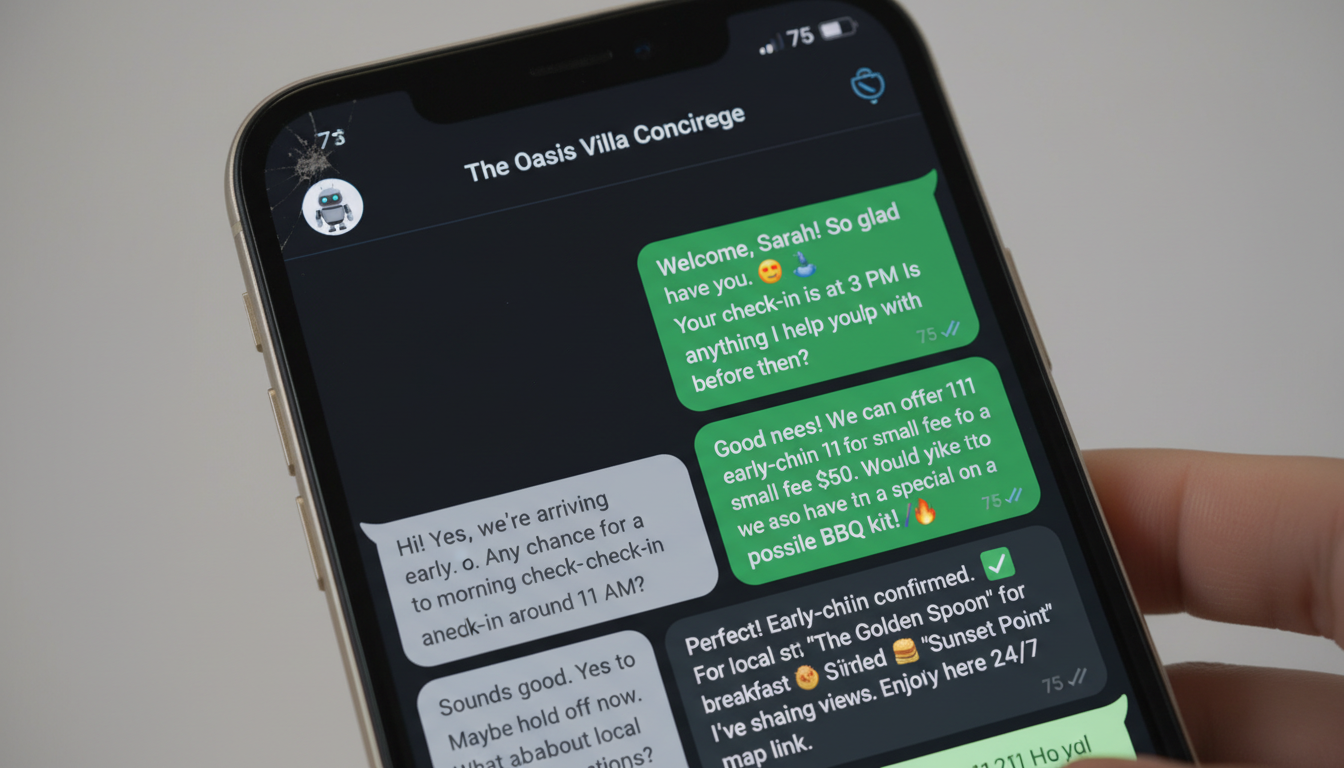
The Anatomy of the Automated Messaging Workflow
The guest journey is divided into specific “trigger points” where automated, personalized messages can be deployed to enhance the experience and drive revenue.
| Stage | Trigger Event | Content / Objective |
|---|---|---|
| Confirmation | Instant after booking | Send a warm welcome, booking details, and a link to the digital guidebook. |
| Pre-Arrival | 48-72h before check-in | Request digital ID, confirm arrival time, and offer early check-in as a paid upgrade. |
| Check-In | On arrival time | Provide smart lock codes and specific parking instructions. |
| Mid-Stay | 24h after arrival | “Just checking in! Is everything perfect?” A preemptive strike against negative reviews. |
| Check-Out | Morning of departure | Reminder of procedures (keys, trash) and a polite thank-you message. |
| Post-Stay | 24h after departure | Request for a review and a “Return Guest” discount code for direct booking. |
The use of AI-powered chatbots (e.g., Enso Connect, Conduit, HostBuddy) allows for the handling of 80% of repetitive guest questions—such as “What is the Wi-Fi password?” or “How do I turn on the hot tub?”—without staff intervention. These systems utilize a “multi-agent” architecture, where separate AI agents handle specific tasks like verifying property data, checking policies, and drafting responses to ensure high accuracy and tone consistency.
Upselling through Conversational Channels
WhatsApp is not just a service tool; it is a revenue driver. Automated “nudge” messages can be sent to guests who have abandoned a booking mid-way or to current guests offering mid-stay cleans, grocery delivery, or late check-outs. In 2024, data showed that these automated upsells generated an average of $147 in extra revenue per listing per month, with early check-ins and late check-outs being the primary drivers.
Reputation Sovereignty: Automated Review Capture and Aggregation
In the direct booking world, trust is the primary currency. Travelers are often hesitant to book on an independent website for fear of scams or poor quality. Review capture and aggregation strategies are the most effective way to neutralize this perceived risk.
The Review Management Ecosystem
As of 2025, professional hosts utilize automated platforms like Reva, Revyoos, and Birdeye to manage their reputation across the entire web.
- Review Aggregation: These tools pull reviews from Airbnb, Vrbo, Booking.com, and Google into a single “Master Feed”. This feed is then displayed as a widget on the direct booking site, providing immediate social proof.
- Reputation Ownership: By aggregating reviews, hosts “own” their reputation data. Even if an OTA account is suspended, the host retains a verifiable record of their historical performance.
- Sentiment Analysis: AI models analyze thousands of reviews to spot trends, such as recurring complaints about a specific housekeeper or praise for the property’s amenities, allowing for data-driven operational improvements.
- SEO Impact: Displaying verified reviews on a website improves search engine rankings through “Review Schema” markup, which signals to Google that the site is a trustworthy business.
The strategic use of review widgets has been shown to increase direct booking conversion rates by more than 40%, as the commission savings alone often offset the cost of the software.
The Loyalty Architecture: Converting One-Time Guests into Repeat Bookers
The “Holy Grail” of STR marketing is the repeat guest. Every repeat booking represents a zero-cost acquisition and a direct injection of pure profit. Converting an OTA guest into a direct booker requires a deliberate strategy of “branding the sht out of everything”.
Branding and In-Stay Incentives
The guest’s physical interaction with the property is the most effective time to plant the seeds of direct booking.
- Physical Branding: Using branded welcome signage, WiFi splash pages, and household items (mugs, tote bags, fridge magnets) to ensure the property name sticks in the guest’s memory.
- Unique WiFi Codes: Setting the WiFi password to “BookDirect” or the property’s URL acts as a subtle, repetitive marketing message throughout the stay.
- Branded Guidebooks: Tools like TouchStay or Hostfully Guidebooks allow hosts to provide local recommendations while reinforcing their brand identity.
The Re-Booking Funnel
| Retention Tactic | Mechanism | Impact |
|---|---|---|
| The “Stay Anniversary” | Automated email sent 10 months after the initial stay. | Re-engages the guest at the exact time they are likely to be planning their next trip. |
| Shareable Discounts | Providing a discount code that the guest can share with friends and family. | Turns one happy guest into a small network of potential direct visitors. |
| Exclusive Perks | Offering direct bookers flexible check-in/out or a welcome basket. | Provides a clear value proposition for bypassing the OTA. |
| WiFi Data Capture | Using tools like StayFi to capture guest emails via a WiFi captive portal. | Bypasses OTA data siloing, allowing for long-term email and SMS marketing. |
The underlying trend in 2025 is the shift toward “Emotional Hospitality.” Guests who feel a personal connection to a host or a specific property are far more likely to return. Little emotional touches—such as acknowledging a birthday or remembering a pet’s name—are what turn a one-off stay into a multi-year habit.
Market Dynamics: The ROI of the Multi-Channel Strategy
The transition to direct distribution is not merely a defensive move against OTAs; it is a proactive strategy for maximizing Revenue Per Available Rental (RevPAR). Data from the summer of 2025 indicates that the STR industry is thriving, with RevPAR increasing by 12.7% in some markets, driven by both higher occupancy and higher average daily rates (ADR).
Performance Metrics for 2025 (US Market)
| Metric | Growth (YoY) | Primary Driver |
|---|---|---|
| Occupancy Rate | +7.2% | Strong demand in urban and secondary metro markets. |
| Direct Bookings | +37.5% | Increased operator focus on independent branding. |
| RevPAR | +12.7% | Higher demand outpacing a slower increase in supply. |
| Booking Lead Time | -11% | Spontaneous travel trends requiring last-minute pricing strategies. |
| AI Adoption | +24% | Mainstream usage of AI for messaging and revenue management. |
The second-order implication of shorter booking windows (down 11-24% globally) is that hosts must be more agile with their pricing. Operators using dynamic pricing tools (e.g., PriceLabs, Beyond) are better positioned to capture last-minute demand and protect their margins during shoulder seasons.
The Financial Synthesis of Direct Booking
To understand the impact of direct distribution, consider the following RevPAR model using LaTeX notation for financial clarity:
$$RevPAR_{Direct} = (ADR_{Base} times Occupancy) - Operational_Costs$$$$RevPAR_{OTA} = (ADR_{Base} times Occupancy) - (Commission_{OTA} + Operational_Costs)$$Where the $Commission_{OTA}$ typically ranges from $0.15 times ADR$ to $0.20 times ADR$. By shifting even 30% of their volume to direct channels, a property manager can increase their net operating income (NOI) by thousands of dollars per property per year, which significantly increases the resale value of the property management business.
Synthesis: The Sovereign Host Manifesto
The evolution of the short-term rental market in 2025 has made one thing clear: the era of passive hosting is over.
The “Sovereign Host” is a business owner who understands that their property is a product, their reputation is an asset, and their guest data is the key to longevity.
By integrating high-speed website technology, rigorous Google Business Profile management, authentic Instagram storytelling, and automated WhatsApp workflows, operators can build a resilient “Sovereignty Stack.” This multi-channel approach allows for the benefits of OTA visibility without the risks of platform dependency. As the industry continues to mature, those who prioritize direct relationships and professional branding will not only survive the “platform wars” but will thrive as the leading hospitality brands of the next decade.