

Foodmandu Case Study: Pioneering Nepal’s Food Delivery E-commerce
Chapter 1: Introduction and Contextual Analysis
1.1 The Genesis of E-Commerce in Nepal
The digital landscape of Nepal in the early 2010s presents a sharp contrast to the hyper-connected ecosystem observed today. To understand the magnitude of Foodmandu’s achievement, one must first contextualize the environment into which it was born. In 2010, internet penetration in Nepal was minimal, smartphone usage was a luxury reserved for the elite, and the concept of “digital trust”—the willingness to transact with an invisible entity online—was virtually non-existent. The market was dominated by traditional brick-and-mortar commerce, and the restaurant industry relied entirely on foot traffic and landline-based reservations.
Into this analog world, Foodmandu emerged not merely as a company but as a category creator. It was the first company in Nepal to introduce the concept of on-demand food delivery, effectively digitizing the restaurant menu and creating a logistical bridge between the kitchen and the consumer’s doorstep. Unlike global markets where players like UberEats or DoorDash disrupted existing delivery networks, Foodmandu had to build the entire ecosystem from scratch. This involved convincing restaurants that internet orders were real, teaching customers that food could travel on a motorbike without spilling, and mapping a city that, for all intents and purposes, had no functional address system.
The significance of this case study lies in Foodmandu’s survival and growth through Nepal’s most turbulent decade. From its founding in 2010, the company navigated the severe load-shedding (power outages) era, the devastating 2015 earthquake, and the economic blockade that followed. While many startups folded under these pressures, Foodmandu adapted, cementing its status as a pioneer in the Nepalese e-commerce industry. Today, it serves as the primary benchmark for the sector, processing orders worth NPR 75 crore annually and employing a workforce that has grown from 4 to over 250.
1.2 Founder Profile: Mr. Manohar Adhikari
The entrepreneurial journey of Mr. Manohar Adhikari, the founder and Managing Director of Foodmandu, serves as a testament to resilience and the non-linear path of innovation in developing markets. Adhikari was not born into business aristocracy; he was raised in a simple family and faced the profound adversity of losing both parents at a young age.
His academic background includes a Bachelors and Masters in Business Studies from Tribhuvan University, providing the theoretical foundation for his ventures. However, his professional trajectory was anything but conventional. Adhikari began his career as a computer instructor, leveraging his passion for technology. Recognizing a stagnation in his career trajectory, he made a radical pivot to agriculture, spending six years in poultry farming.
Returning to the technology sector, Adhikari worked as a programmer for D2Hawkeye, a US-based software company with offices in Kathmandu. It was here, in the micro-moments of daily office life, that the idea for Foodmandu germinated. Adhikari often found himself working late, frustrated by the lack of quality food options near his Bishalnagar office. He realized that while Kathmandu had excellent restaurants, they were inaccessible to office workers constrained by time.
This personal pain point crystallized into a business idea: “A food delivery company would’ve been a blessing”. However, unlike the rash launches common in the startup world, Adhikari approached this with calculation. He spent three years working in his own software company to accumulate the capital and technical resources necessary to launch Foodmandu. On November 11, 2010, the company launched with just 4 employees and 10 partner restaurants. Adhikari’s leadership style is characterized by a “retention over acquisition” philosophy—he prioritized building a sustainable business model over burning cash for rapid expansion, a strategy validated by the company’s longevity.
1.3 Corporate Identity: Mission, Vision, and Objectives
Foodmandu effectively operates as a logistics and technology company disguised as a food service provider. Its core identity has evolved from a simple delivery service to a lifestyle enabler.
Mission:
The company’s mission is anchored in the concept of “delivering happiness.” By taking care of meals and daily essentials, Foodmandu aims to free up its customers’ time, allowing them to be fully present for life’s important moments. This is encapsulated in their recent brand campaign, “Life Ajhai Better” (Life is Even Better), which positions the service as a tool for lifestyle enhancement rather than just a utility.
Vision:
Foodmandu envisions itself as the premier digital marketplace in Nepal. While food remains the anchor, the vision has expanded to include a broader logistics network. This is evident in the launch of “Foodmandu OneMart” for groceries and “Foodmandu Fresh” for perishables, indicating a strategic shift towards becoming a comprehensive Quick Commerce (Q-Commerce) player.
Strategic Objectives:
- Geographical Expansion: To move beyond the Kathmandu Valley. The company has successfully launched in Pokhara, Butwal, and Chitwan, targeting the emerging middle class in Tier-2 cities.
- Market Dominance: To maintain its market leadership position (currently estimated as the largest player by revenue) against aggressive entrants like Pathao and Bhoj.
- Technological Integration: To transition from manual logistics management to AI-driven predictive logistics, utilizing data to optimize delivery routes and kitchen preparation times.
1.4 Evolution of the Service Portfolio
Foodmandu has systematically layered new services atop its core offering.
- 2010: Launched as a pure-play restaurant food delivery service.
- 2020: Introduction of “Foodmandu Fresh” and “OneMart” (groceries) in response to the COVID-19 pandemic, diversifying revenue streams beyond cooked meals.
- 2024-2025: Expansion into “Foodmandu Bar” (beverage delivery) and corporate catering solutions, leveraging B2B partnerships.
Chapter 2: Business Model, Revenue Architecture, and Operations
2.1 The Hyperlocal Marketplace Model
Foodmandu operates on a robust Aggregator Business Model. In this framework, the platform does not own the restaurants nor prepare the food (currently). Instead, it acts as the digital intermediary that connects three distinct stakeholders:
- The Consumer: Seeking convenience, variety, and reliability.
- The Merchant (Restaurant): Seeking incremental revenue, marketing visibility, and logistics outsourcing.
- The Courier (Rider): Seeking employment and income.
This model allows Foodmandu to scale without the capital expenditure of building kitchens. However, unlike pure aggregators (like early JustEat), Foodmandu is a Full-Stack Food Delivery service, meaning it manages its own fleet of riders rather than relying on the restaurants to deliver. This control over logistics is crucial for maintaining quality standards and delivery times in a chaotic city like Kathmandu.
2.2 Revenue Streams and Financial Mechanics
Understanding Foodmandu’s financial viability requires a deep dive into its revenue architecture. The company generates income through multiple diversified streams, reducing reliance on any single source.
Table 2.1: Foodmandu Revenue Stream Analysis
| Revenue Stream | Mechanism | Estimated Contribution | Insight |
|---|---|---|---|
| Merchant Commission | A percentage fee charged on the Gross Merchandise Value (GMV) of every order. | 20% – 22% | This is the primary revenue engine. Foodmandu commands the highest commission in the market (compared to 15% for smaller players) due to its superior order volume. |
| Delivery Fees | A variable fee paid by the customer based on distance. | Rs. 50 – Rs. 200+ | Used to subsidize rider costs. Pricing is dynamic: Rs. 20 for the first km, +Rs. 20/km thereafter. |
| Advertisement (In-App) | Fees for “Featured” listings, banner ads, and “Top Pick” placements. | Variable | High-margin revenue. Restaurants pay for visibility in a crowded marketplace. |
| Subscription Services | Premium memberships for customers (waived delivery fees) and B2B corporate accounts. | Growing share | Increases customer stickiness and Lifetime Value (LTV). |
| On-Boarding Fees | One-time registration fees for new restaurants. | Nominal | Covers the cost of photography, menu digitization, and tablet setup. |
Financial Performance:
In the fiscal year 2024/2025, Foodmandu reported an annual transaction value (GMV) of NPR 75 Crore ($5.6 Million USD approx). This represents a 40% year-over-year growth. The founder has publicly stated a target of crossing NPR 1 Billion in the subsequent year. While exact profitability figures are private, the high GMV and commission structure suggest a strong path to unit economic profitability, unlike many global peers that burn cash indefinitely.
2.3 Logistics and Fleet Management
The operational heart of Foodmandu is its fleet. In a city plagued by traffic congestion and unpaved roads, managing a delivery network is a complex logistical challenge.
Employment vs. Gig Model:
Unlike Pathao, which utilizes a pure “gig economy” model leveraging freelance bike taxis, Foodmandu operates a more structured fleet. The company employs over 200 riders, providing them with a sense of stability.
- Compensation: Riders earn between NPR 20,000 to NPR 70,000 monthly.
This salary is competitive for blue-collar work in Nepal, often exceeding entry-level corporate salaries.
- Benefits: Foodmandu invests in social security (SSF), festival allowances, and accident insurance for its riders. This “employee-centric” approach results in lower churn rates compared to gig-platforms, ensuring more experienced and reliable riders.
The “Last Mile” Challenge:
The most significant operational hurdle is the lack of a standardized address system in Kathmandu.
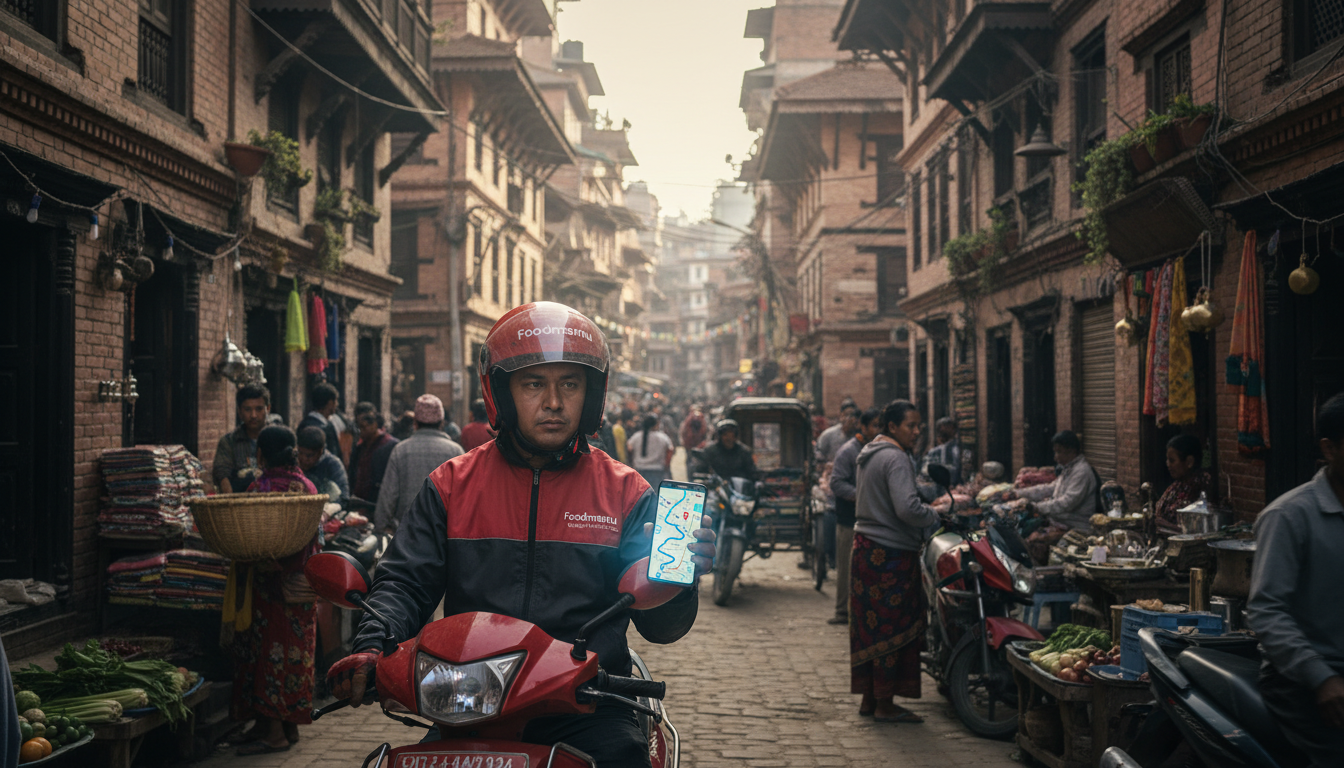
- Navigation: Delivery depends on “Landmark Navigation.” Customers provide instructions like “Near the white stupa, behind the yellow gate.”
- Communication: This necessitates high call volumes between rider and customer, increasing the time-per-delivery.
- Training: Riders undergo specific training to navigate these “streets with no names” and manage customer interactions professionally.
2.4 Restaurant Partner Ecosystem
Foodmandu has cultivated a network of over 800 partner restaurants, ranging from 5-star hotels to popular local eateries.
Onboarding Process:
The barrier to entry for restaurants is structured to ensure legality and quality.
- Verification: Restaurants must submit PAN/VAT registration and business licenses.
- Digitization: Foodmandu’s team visits the location to photograph dishes and digitize the menu.
- Technology Integration: Partners are equipped with the “Foodmandu Restro” app (often on a provided tablet) to receive orders in real-time.
- Contractual Agreement: A formal agreement locks in the commission rate (typically 20-22%) and service standards.
Chapter 3: Technology Infrastructure and Digital Strategy
3.1 The Tech Stack: Building for Scale
Foodmandu has evolved from a simple PHP-based website to a sophisticated, cloud-native technology platform capable of handling thousands of concurrent transactions. The engineering architecture is designed for scalability, security, and real-time data processing.
Backend and Cloud Infrastructure:
- Cloud Provider: The platform is hosted on Microsoft Azure. This enterprise-grade cloud solution allows Foodmandu to auto-scale its servers during peak demand (e.g., Friday nights or during the Online Food Festival).
- API Architecture: The core logic is built using Node.js, a runtime environment known for handling asynchronous, event-driven operations—perfect for the real-time nature of food delivery (order status updates, rider tracking). The system utilizes RESTful APIs documented via OpenAPI standards to ensure seamless communication between the consumer app, rider app, and restaurant portal.
- Database: Data persistence is managed via Microsoft SQL Server (MSSQL). This relational database stores complex transactional data, menu structures, and user profiles. The engineering team focuses heavily on query optimization to ensure that menu loads are instantaneous even for restaurants with hundreds of items.
| Component | Technology Used | Function |
|---|---|---|
| Backend Framework | Node.js | Handling API requests, real-time logic. |
| Cloud Hosting | Microsoft Azure | Scalability, hosting, deployment. |
| Database | MSSQL (SQL Server) | Structured data storage (Users, Orders). |
| Real-time Comms | WebSockets | Live rider tracking on the map. |
| Security | JWT (JSON Web Tokens) | Secure user and rider authentication. |
3.2 Mobile Application Ecosystem
The “Foodmandu” experience is actually the interplay of three distinct applications:
- Consumer App: Focuses on UI/UX, search algorithms, and personalized recommendations. It integrates payment gateways and live map tracking.
- Foodmandu Restro (Vendor App): A dashboard for restaurants. It allows owners to toggle item availability (86-ing items), view daily sales reports, and accept/reject incoming orders.
- Foodmandu Rider App: The logistics command center. It provides riders with optimized routes, order details, and an earnings wallet. It uses background geolocation services to feed position data back to the server.
3.3 The Mapping Dilemma: Google Maps vs. OpenStreetMap
A critical technological insight is Foodmandu’s approach to mapping. In developed markets, Google Maps API is the default. However, in Nepal, Google Maps often lacks granular data on pedestrian paths (Gallis) and specific local landmarks.
- OpenStreetMap (OSM) Integration: Research indicates a strong preference in the local tech sector for OSM. Foodmandu utilizes OSM data, which is community-maintained and often richer in local context than Google’s data. This allows for better routing in the labyrinthine alleys of old Kathmandu.
- Custom Geocoding: The tech team has developed logic to handle “fuzzy” locations, allowing users to drop pins and add textual context, effectively building a proprietary database of Kathmandu’s unstructured addresses.
3.4 Data Science and AI: The Future Frontier
Foodmandu is transitioning from a logistics company to a data company. With over a decade of order data, they possess unique insights into the culinary habits of Nepalis.
- Personalization: The platform is increasingly using Machine Learning algorithms to recommend restaurants based on a user’s past behavior (e.g., “You ordered Momos last Tuesday, would you like to try this new Momo place?”).
- Logistics Optimization: AI is being deployed to predict food preparation times and delivery ETAs more accurately. By analyzing historical data (e.g., “Restaurant X always takes 15 minutes longer on Fridays”), the system can adjust the promised delivery time dynamically, improving customer satisfaction.
3.5 Payment Gateways and Security
Foodmandu acts as a catalyst for the “Cash-Lite” economy.
- Integrations: The app supports all major digital wallets: eSewa, Khalti, IME Pay, and Fonepay. This broad integration is crucial for user acquisition.
- Security: To protect user trust, the system uses encryption and tokenization. Financial data is not stored on Foodmandu’s servers but is handled by the payment processors (PCI-DSS compliance).
Chapter 4: Marketing Strategy and Competitive Landscape
4.1 Marketing Strategy: Social Commerce and Gamification
Foodmandu’s marketing is not merely about buying ads; it is about community engineering. The company recognizes that its core demographic—urban millennials and Gen Z—are digital natives.
- Social Commerce: Foodmandu leverages Facebook, Instagram, and TikTok to drive direct conversions. They do not just post photos; they use “Shoppable” features and direct deep-links to specific restaurant menus. The brand voice is casual, witty, and highly localized, often using memes and trending topics to stay relevant.
- The Foodmandu Online Food Festival (FOFF): The FOFF is a masterclass in e-commerce gamification. It is an annual digital event that simulates a physical food festival.
- Mechanics: Users visit virtual “stalls” in the app to unlock exclusive deals.
- Gamification: The festival includes interactive games like “Shake and Win” and “Treasure Hunts.” In 2020, they introduced an Augmented Reality (AR) feature where users had to physically walk around the city to “catch” virtual vouchers, similar to Pokémon GO.
- Impact: This strategy drives massive engagement. Users open the app not just to order, but to play, significantly increasing Daily Active Users (DAU) and brand recall.
- Influencer Marketing: The company partners with food vloggers (e.g., Mr. Foodie Nepal) and lifestyle influencers. These partnerships provide social proof, crucial for a service that relies on trust regarding food hygiene and quality.
4.2 Competitive Analysis: The War for the Stomach
For nearly a decade, Foodmandu enjoyed a monopoly. However, the entry of international-style logistics players has transformed the market into a fierce battleground.
Primary Competitor: Pathao Food
Pathao, originally a ride-sharing company, entered the food market with a significant logistical advantage.
- Strengths: Pathao leverages its massive existing fleet of bike taxis for food delivery. This allows for faster dispatch times and lower operational costs.
- Pricing Strategy: Pathao often engages in predatory pricing, offering flat delivery fees (e.g., Rs. 15) and heavy discounts to capture market share.
- Comparison: While Foodmandu positions itself as a premium service with better restaurant curation and customer support, Pathao competes on speed and price.
Secondary Competitor: Bhoj (formerly BhojDeals)
- Strategy: Bhoj started as a deal/coupon site and pivoted to delivery. Their core value proposition remains “Value.”
- Differentiation: They offer free delivery on orders over NPR 1000, appealing to families and large groups.
They also have a strong presence in the “dining-out” coupon market.
| Feature | Foodmandu | Pathao Food | Bhoj |
|---|---|---|---|
| Core Strength | Brand Trust, Premium Partnerships | Logistics Speed, Low Price | Discounts & Deals |
| Fleet Model | Employed/Contracted (High Quality) | Gig/Freelance (High Volume) | Contracted |
| Commission Rate | ~20-22% | Variable | ~15-20% |
| Delivery Fee | Distance Based (Premium) | Often Subsidized (Low) | Threshold Free Delivery |
| Target Audience | Quality-conscious, Families | Price-sensitive, Youth | Deal-seekers |
4.3 SWOT Analysis
Strengths:
- First-Mover Advantage: Foodmandu is synonymous with food delivery in Nepal.
- Data Supremacy: 15 years of consumer data allows for better decision-making than newer entrants.
- Exclusive Partnerships: Many top-tier restaurants work exclusively with Foodmandu due to long-standing relationships.
Weaknesses:
- Cost Structure: The employed fleet model is more expensive than Pathao’s gig model.
- Tech Glitches: Users occasionally report app instability and payment failures compared to the slicker interface of Pathao.
- Geographic Concentration: Revenue is still heavily dependent on the Kathmandu Valley.
Opportunities:
- Cloud Kitchens: Foodmandu can use its data to launch “Dark Kitchens” in underserved neighborhoods, capturing 100% of the margin.
- Q-Commerce: Expanding “OneMart” to deliver groceries in under 30 minutes.
- Tier 2 Cities: The expansion into Butwal and Chitwan offers a “Blue Ocean” where competition is lower.
Threats:
- Price Wars: Competitors burning venture capital to subsidize delivery could make Foodmandu appear expensive.
- Brain Drain: The mass migration of Nepali youth (the core customer base) to Australia and the Middle East shrinks the total addressable market (TAM).
- Regulatory Tightening: New VAT rules and e-commerce liabilities increase the cost of doing business.
Chapter 5: Legal Framework, Challenges, and Future Outlook
5.1 The Evolving Legal Landscape: The E-Commerce Bill 2080
The operating environment for Foodmandu is shifting from unregulated to highly regulated. The introduction of the E-Commerce Bill 2080 (2025 Act) is a watershed moment.
Shift in Liability:
Previously, platforms could claim they were mere intermediaries, taking no responsibility for the food’s quality. The new Act changes this.
- Contractual Responsibility: The platform is now a party to the contract. If the food is not delivered or differs from the description, the consumer has the right to return/refund, and the platform acts as the guarantor.
- Grievance Redressal: Foodmandu is legally mandated to have a functional customer support and grievance handling mechanism. Failure to resolve issues can lead to fines.
- Transparency: The Act requires full disclosure of all costs, taxes, and delivery charges upfront, eliminating hidden fees.
Taxation Challenges:
The government has introduced Value Added Tax (VAT) on digital services.
- Impact: Foodmandu must pay VAT on its commission income. Furthermore, it must ensure its partner restaurants are VAT compliant. This raises the cost structure and puts upward pressure on menu prices, potentially dampening demand.
5.2 Persistent and Emerging Challenges
- Infrastructure Deficit:
The “Cost of Logistics” in Nepal is artificially high due to poor infrastructure.
- Road Conditions: Potholes and dust increase vehicle maintenance costs and reduce the lifespan of delivery bikes.
- Traffic: Unpredictable traffic jams in Kathmandu mean that delivery times can fluctuate wildly, leading to customer dissatisfaction.
- Address System:
The lack of a codified address system (e.g., Zip codes, house numbers) remains the single biggest drag on efficiency. Riders waste minutes on every order calling customers for “Last Mile” directions. This reduces the number of orders a rider can complete per hour, directly impacting unit economics.
- Talent Retention:
Finding and keeping skilled software engineers is difficult in Nepal, as many emigrate for better opportunities. This “Brain Drain” hampers Foodmandu’s ability to innovate at the same speed as global competitors.
5.3 Future Outlook: 2025 and Beyond
Foodmandu is at an inflection point. To survive the next decade, it must pivot from being a “Food Delivery Company” to a “Lifestyle Logistics Company.”
- The Rise of Quick Commerce (Q-Commerce):
The “OneMart” initiative is critical. As urban lives get busier, the demand for instant grocery delivery will outpace restaurant food delivery. Foodmandu is positioning itself to be the “Amazon Fresh” of Nepal.
- Vertical Integration (Cloud Kitchens):
Expect Foodmandu to launch its own food brands. By analyzing data, they know exactly what cuisines are missing in specific neighborhoods. Opening a “Dark Kitchen” (delivery only) allows them to control the entire value chain and increase margins from 20% to 50%.
- AI-First Operations:
The future will see the deployment of deep learning models to automate dispatch. Instead of human dispatchers, AI will route riders based on real-time traffic data, weather, and predicted kitchen load, shaving vital minutes off delivery times.
5.4 Conclusion
Foodmandu’s story is one of audacious hope. In a country where electricity was once scarce, building a digital empire required not just code, but courage. Mr. Manohar Adhikari did not just build a company; he built a habit. He taught a generation of Nepalis that they could trust a stranger to bring them dinner.
As the market matures, the challenges will shift from “educating the customer” to “beating the competition.” With the E-commerce Bill 2080 providing a legal safety net and the market expanding into Tier-2 cities, Foodmandu is well-positioned. However, its ability to maintain its crown will depend on how effectively it can leverage its data, transition to AI-driven logistics, and fend off the deep-pocketed competition of Pathao. Foodmandu is no longer just a startup; it is a critical pillar of Nepal’s modern service economy.