


Prithvi Narayan Shah’s Dibya Upadesh: Nepal’s Founding Counsel
The Divine Counsel: An Exhaustive Exegesis of Prithvi Narayan Shah’s Dibya Upadesh and the Foundation of the Nepali State
Abstract and Introduction
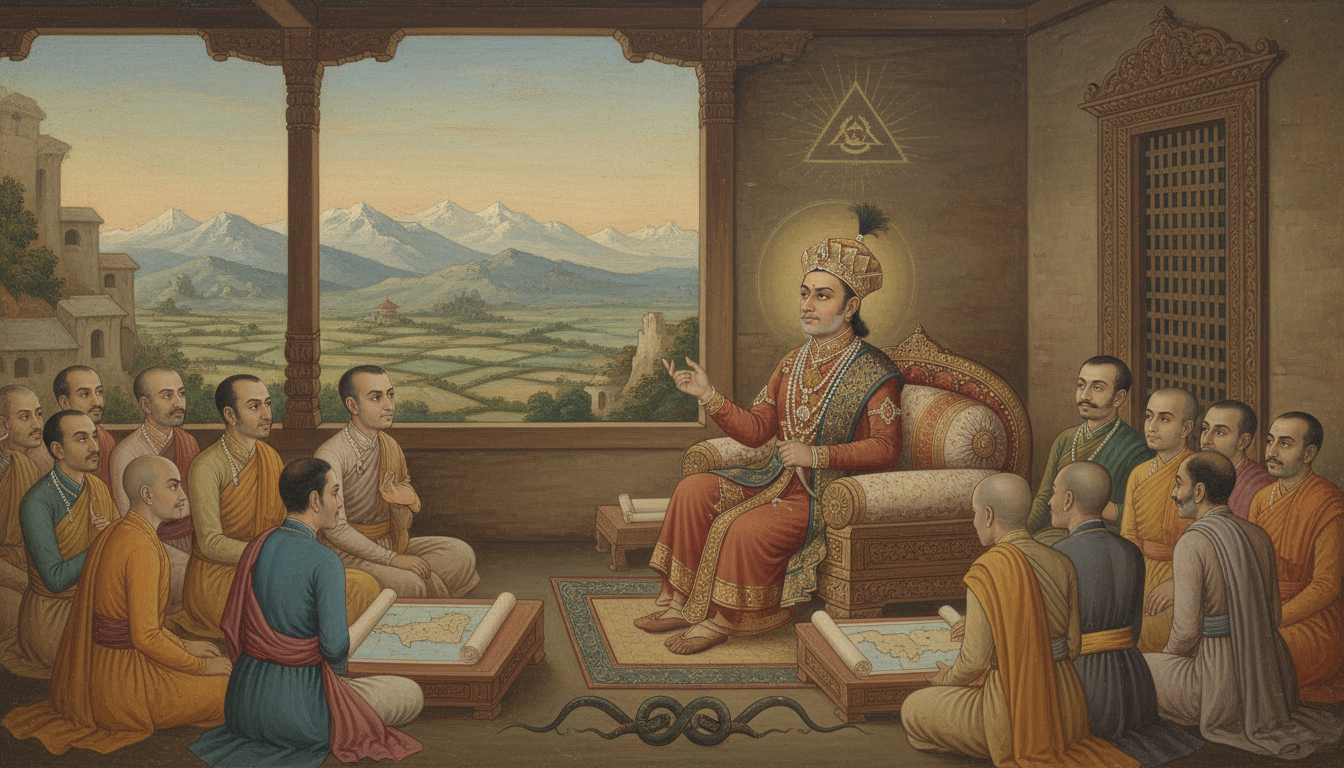
The Dibya Upadesh (Divine Counsel) stands as the seminal document of Nepali statecraft, a posthumous testament delivered by King Prithvi Narayan Shah (1723–1775) in the winter of his life at the Nuwakot Palace. It is not merely a collection of dying wishes or a monarch’s final edict; it is a sophisticated, multidimensional treatise on geopolitical survival, military strategy, economic nationalism, and social engineering. Delivered orally to his brothers, courtiers, and priests around 1774-75, the text encapsulates the strategic genius of a ruler who transformed a petty hill principality into a formidable Himalayan empire capable of withstanding the expansionist pressures of the Qing Dynasty in the north and the British East India Company in the south.
This report provides an exhaustive, expert-level analysis of the Dibya Upadesh, dissecting its historical context, its intricate policy directives, and its enduring legacy. It explores the doctrine of the “Yam between two boulders,” the socio-religious construction of “Asal Hindustan,” and the “Marwat” system of military social security. Through a rigorous examination of the text and supporting historical records, this document illuminates how Prithvi Narayan Shah’s insights continue to define the existential parameters of the modern Nepali state, offering a blueprint that has influenced centuries of foreign policy and domestic administration.
The analysis proceeds by first establishing the chaotic geopolitical landscape of the 18th-century Himalayas, then detailing the biography of the unifier to understand the experiences that shaped his worldview. Subsequently, it deconstructs the text of the Dibya Upadesh across four primary pillars: Foreign Policy (The Yam Theory), Economic Policy (Protectionism and Autarky), Military Strategy (The Gorkhali War Machine), and Social Governance (The Garden Metaphor).
Part I: The Himalayan Geopolitical Landscape (1700–1743)
1.1 The Fragmented Hill States
To comprehend the magnitude of Prithvi Narayan Shah’s achievement and the urgency of his counsel, one must first navigate the fractured political geography of the 18th-century central Himalayas. Prior to the rise of the House of Gorkha, the region was a patchwork of warring principalities, devoid of central authority and vulnerable to external predation.
The region was divided into three distinct geopolitical clusters:
- The Kathmandu Valley (Nepal Mandala): This fertile valley was the economic and cultural heart of the region, controlling the lucrative trans-Himalayan trade routes between India and Tibet. However, by the mid-18th century, it was politically fractured into three competing city-states ruled by Malla cousins: Kantipur (Kathmandu), Lalitpur (Patan), and Bhaktapur (Bhadgaon). Their ceaseless internecine bickering made them rich but militarily complacent prizes.
- The Chaubise Rajya (24 Principalities): Located in the Gandaki basin to the west of Gorkha, this confederacy included powerful states like Lamjung, Tanahu, and Palpa. These states were martial in nature, often allied by blood but divided by ambition. Lamjung, in particular, was the ancestral rival of Gorkha, ruled by a collateral branch of the Shah dynasty.
- The Baise Rajya (22 Principalities): Further west in the Karnali basin lay these rugged principalities, remote and economically poorer but fiercely independent.
Gorkha itself was a minor state within the Chaubise cluster, geographically disadvantaged with poor soil and no direct access to the trade wealth of the north or the agricultural riches of the Terai plains in the south. The genius of Prithvi Narayan Shah lay in his realization that this fragmentation was a “death sentence” in the face of the shifting continental tides.
1.2 The Twin Imperial Threats
The external environment was undergoing a cataclysmic shift that defined the paranoia and prudence found in the Dibya Upadesh.
The Southern Menace: The Rise of the British
To the south, the Mughal Empire was in a state of terminal decline. The power vacuum was being rapidly filled by the British East India Company (EIC). The Company’s victory at the Battle of Plassey in 1757 marked the transition of the British from traders to sovereigns of Bengal. Prithvi Narayan Shah, who had visited Benaras as a young prince, had witnessed the “Firangis” (foreigners) firsthand. He saw them not as benign merchants but as the vanguard of a military-industrial complex that entered with “the Bible and the sword”. He understood that the fragmented hill states, if left united, would be swallowed piecemeal by this expanding colonial behemoth. His unification project was, therefore, fundamentally a defensive consolidation—a preemptive strike to create a state large enough to resist colonization.
The Northern Dragon: The Qing Dynasty
To the north, the Qing Dynasty under the Qianlong Emperor (1735–1796) was at its zenith. The Chinese had asserted suzerainty over Tibet, installing Ambans (residents) in Lhasa. While less expansionist towards the south than the British were towards the north, the Qing presence meant that Nepal could not simply expand northward without consequence. The trade routes, vital for the economy, depended on Tibetan goodwill.
It is within this crucible of pressure—between the “Emperor of the South” and the “Emperor of the North”—that the strategic doctrine of the Dibya Upadesh was forged.
Part II: The Making of the Unifier
2.1 Early Life and Influences
Prithvi Narayan Shah was born in 1723 to King Nara Bhupal Shah and Queen Kaushalyavati. His upbringing was steeped in the martial traditions of the Gorkhali court and the religious tutelage of his mentors. The Dibya Upadesh reveals a man who was deeply reflective, willing to listen to elders, and possessed of an unshakable sense of destiny.
He explicitly recounts consulting his maternal uncle, Prince Udyot Sen of Palpa, regarding his ambition to conquer the Kathmandu Valley. This interaction is significant as it highlights the collaborative nature of his strategy. Udyot Sen advised him that the “Khas” clan would be the quickest to finish the task of conquering Nepal, a piece of sociological intelligence that shaped the composition of the Gorkhali army.
2.2 The Benaras Sojourn
One of the most critical, though less documented, periods of his life was his pilgrimage to Benaras (Varanasi). Ostensibly a religious journey, it was effectively an intelligence and procurement mission. In Benaras, he observed the weaponry and drill of the East India Company’s troops. He witnessed the decline of local Indian rulers and the ruthless efficiency of the British.
It was here that he acquired the “firelocks” (flintlock muskets) and realized the necessity of modernizing the Gorkhali army. The Dibya Upadesh reflects this technical awareness, with instructions on maintaining localized munitions factories to avoid dependence on foreign supply chains.
2.3 The First Failure and Strategic Pivot
His first attempt to capture Nuwakot, the strategic gateway to the Kathmandu Valley, ended in failure under his father’s reign. This defeat taught him the value of preparation and patience. When he ascended the throne in 1743, he did not rush. He spent years securing his rear by signing a treaty with Lamjung (the “Brahmin’s knot” alliance) to ensure Gorkha would not be attacked from the west while campaigning in the east.
This strategic patience is codified in the Dibya Upadesh: “The old man dies, his words die with him… pass on to your children.” He viewed the unification not as a single campaign but as a multi-generational project.
Part III: The Textual History of the Dibya Upadesh
3.1 Delivery and Rediscovery
The Dibya Upadesh was not written by the King’s own hand but was delivered orally to a gathering of his brothers (Bahadur Shah, etc.), courtiers (Pandes, Basnyats), and priests at the Nuwakot Palace shortly before his death in January 1775. The text is structured as a stream-of-consciousness monologue, utilizing the rough, earthy dialect of Khas Bhasha (old Nepali) rather than the polished Sanskrit of the court elites.
For nearly two centuries, the text remained obscure, preserved in manuscripts within the royal archives and the traditions of the nobility. It was “rediscovered” and brought to public light in the 1950s by the historian Yogi Naraharinath and the royal historian Baburam Acharya.
3.2 Authenticity and Historiography
The publication of the text in 1952 coincided with the restoration of the Shah monarchy’s power after the fall of the Rana oligarchy. This timing has led some modern scholars to question whether the text was embellished to serve the nationalist agenda of King Mahendra. However, the internal evidence—the archaic linguistic forms, the specific references to 18th-century individuals, and the tactical details of the period—strongly supports its authenticity.
The text serves as a “Nationalist Gospel,” used by the Panchayat regime to construct a unified Nepali identity. Yet, reading it strictly as propaganda does a disservice to its sophisticated content. It is a pragmatic manual for survival, comparable to Kautilya’s Arthashastra or Machiavelli’s Prince, but tailored to the specific topography of the Himalayas.
Part IV: The Doctrine of the Yam: Foreign Policy Strategy
4.1 “A Yam Between Two Boulders”
The most enduring metaphor of the Dibya Upadesh is the description of Nepal as “Dui dhunga bich ko tarul” (A yam between two boulders). This imagery is not merely poetic; it is a concise geopolitical thesis.
A yam is a tuber that grows underground; it is soft, organic, and vulnerable. Boulders are hard, immovable, and crushing.
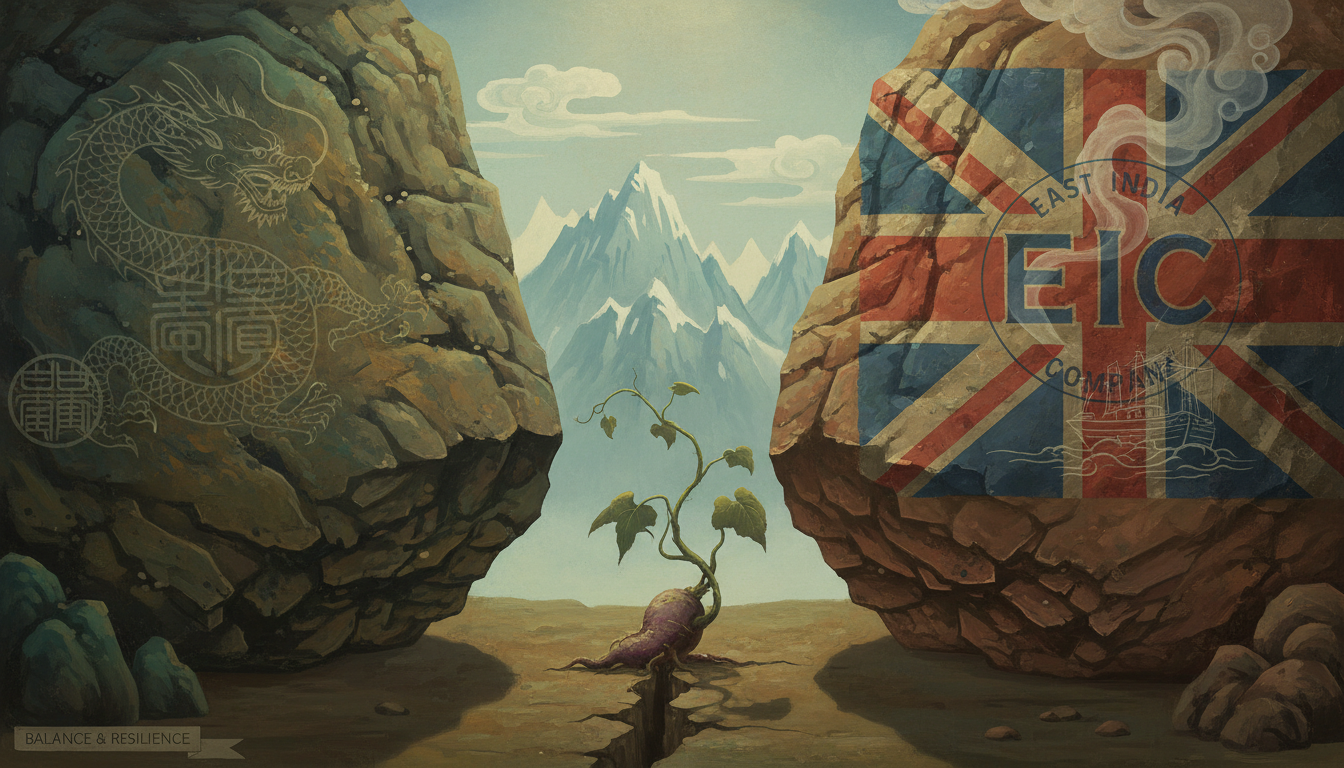
The metaphor dictates a policy of defensive survivalism:
- Immutability of Geography: Nepal cannot change its location. It is permanently wedged between the Chinese boulder and the Indian boulder.
- Growth Strategy: A yam grows by finding the soft earth between the rocks. It does not push the rocks apart (which is impossible) nor does it grow too fast lest it be crushed.
- Neutrality: To align with one boulder against the other is suicide. The state must maintain equidistance.
4.2 The Northern Strategy: Caution and Commerce
Prithvi Narayan Shah advises maintaining a “great friendship” (badi mitrata) with the Emperor of the North (China). He recognized China as a distant but potent counterweight to the immediate threat from the south. However, he was careful not to become a vassal.
The primary friction with the north was economic. The Dibya Upadesh details the currency dispute with Tibet. The Malla kings had enriched themselves by minting debased silver coins for the Tibetan market. The Tibetans, realizing the fraud, demanded the Gorkhalis exchange the bad coins for pure ones at face value.
Prithvi Narayan Shah’s stance in the Dibya Upadesh is one of economic rectification but fiscal caution. He expresses a desire to “strike pure coins” to restore national honor and creditworthiness. He understood that the debased currency was a strategic liability that could provoke a war with Tibet (which indeed happened later in 1792), disrupting the vital salt-grain trade.
4.3 The Southern Strategy: The Fortress Doctrine
The attitude toward the south is markedly different. The “Emperor of the Southern Seas” (the British) is described with deep suspicion. The Dibya Upadesh outlines a policy of isolationism and fortification.
Directives on the Southern Border:
- “Do not let the merchants climb up.” Prithvi Narayan Shah explicitly banned foreign merchants from entering the hills beyond the fort of Godhparsa (near modern Birgunj). He argued that foreign merchants would drain the country’s wealth (“they will make the people bankrupt”) and serve as spies.
- Fortification: He ordered the construction of “iron doors” at the passes and the placement of cannons in ambush positions. This was an early form of “Anti-Access/Area Denial” (A2/AD) strategy, using the terrain to negate the British advantage in open-field warfare.
This “Fortress Nepal” policy successfully insulated the country from the economic imperialism that subjugated the rest of South Asia. While Indian states were collapsing under the debt and political intrigue of the East India Company, Nepal remained an impenetrable citadel.
Part V: Asal Hindustan: The Cultural and Social Project
5.1 The “True Land of Hindus”
In a bold ideological maneuver, Prithvi Narayan Shah declared his newly unified kingdom to be Asal Hindustan (“The True/Real Land of Hindus”). This was not just religious piety; it was political branding.
By the 18th century, the Gangetic plains (Mughlana) were perceived by orthodox Hindus as having been “polluted” by centuries of Islamic rule (Mughals) and the encroaching Christian power (British). By claiming the title of Asal Hindustan, the Shah King achieved two strategic goals:
- Sanctuary Status: He positioned Nepal as the last refuge of the Sanatan Dharma, attracting high-caste Hindus, ascetics, and traders fleeing the turmoil in the plains. This provided the state with demographic and intellectual capital.
- differentiation: It created a stark “Us vs. Them” psychological barrier. The people of the hills were taught to view the south not just as a political enemy but as a cultural other. This spiritual fortification was as important as the physical forts.
5.2 The Garden Metaphor: Social Engineering
“Mera sana dukhale arjyako muluk hoina, sabai jaatko phulbari ho” (This is not a kingdom acquired by my little pain; it is a garden of all castes).
This famous aphorism is often misinterpreted as a modern pluralist statement. In reality, it describes a hierarchical but inclusive feudal order. The “Garden” contains “four varnas and thirty-six jats”.
- The Four Varnas: The classical Hindu division (Brahmin, Kshatriya, Vaishya, Shudra).
- The Thirty-Six Jats: The various occupational castes and ethnic tribes (Magars, Gurungs, Newars, etc.) that made up the kingdom.
The Dibya Upadesh instructs that every caste must stay in its lane and perform its dharma. The King is the gardener who tends to this diversity, ensuring that no single plant (clan) overshadows the others. He recognized the distinct value of each group: the Khas and Thakuris for leadership, the Magars and Gurungs for fighting, the Newars for commerce and art, and the Brahmins for legitimacy and counsel.
This “Garden” theory allowed for the integration of non-Hindu tribal groups into the Hindu state structure without demanding immediate total assimilation, creating a syncretic but stratified society.
Part VI: The Gorkhali War Machine: Military and Administrative Innovations
6.1 The Marwat System: A Feudal Social Security
One of the most revolutionary aspects of Prithvi Narayan Shah’s rule, detailed in the Dibya Upadesh, was the Marwat system.
- Definition: Marwat (derived from marna, to die) was a land tenure policy ensuring that if a soldier died in battle, his land grants were not confiscated by the state but were passed to his family.
- Mechanism: The widow and children retained the land to sustain themselves. Once the sons came of age, they were given preference for recruitment into the army.
- Impact: This solved the perennial problem of morale. A Gorkhali soldier fought with the ferocity of a man who knew his death would not condemn his family to starvation. It created a hereditary military caste deeply loyal to the Shah crown. “If the King has wisdom, the best soldiers will come,” the Upadesh notes.
6.2 The Pajani System and Meritocracy
The Dibya Upadesh is fiercely meritocratic regarding military command. Prithvi Narayan Shah instituted the Pajani (annual review), where every official, from the lowest soldier to the highest Kaji, was evaluated.
- Instruction: “Do not appoint a commander just because he is a relative. Appoint one who has been tested in four or five battles”.
- Rotation: He advised rotating the key posts among the aristocratic families to prevent entrenched power centers. “If soldiers and courtiers are given to pleasure, my sword will strike in all directions”. He demanded a spartan, battle-hardened elite.
6.3 The Tharghar Aristocracy
The administration was built upon the Tharghar (Six Houses), the six clans that had assisted the Shah dynasty since their early days in Gorkha. The Dibya Upadesh lists them as Pande, Aryal, Pantha, Rana, Khanal, and Bohara.
However, the text also reflects the King’s political agility. He integrated the Basnyat family into this elite circle due to the military prowess of commanders like Shivaram Singh Basnyat. He explicitly mentions, “Now I will make ties between the Pandes and the Basnyats,” using matrimonial alliances to bind these rival warlord families to the throne and to each other, creating a unified ruling class.
Part VII: Economic Nationalism: The Closed Economy
7.1 Protectionism and Industry
The Dibya Upadesh outlines a strictly protectionist economic policy. Prithvi Narayan Shah was an 18th-century mercantilist who believed that the wealth of a nation depended on its accumulation of precious metals and self-sufficiency.
- Textiles: He observed that the drain of wealth to the British occurred primarily through the purchase of fine fabrics. He commanded his people to wear Chyanga Panga (rough homespun cloth). “We won three cities… by wearing Chyanga Panga”. He advised sending samples of foreign cloth to local weavers to learn how to reproduce them—an early form of industrial espionage and import substitution.
- Trade Balance: He encouraged the export of forest products (timber, herbs, elephants) to the south to earn hard currency (Company Rupees) but insisted that the transactions happen at the border, preventing the integration of the Nepali market into the colonial economy.
7.2 Corruption and Justice
“Ghuss line ra dine duwai rastra ka shatru hun” (Both the bribe taker and the bribe giver are enemies of the nation).
This directive is central to his governance model. He equated corruption with treason. He instructed that the money collected from judicial fines should not go to the royal palace treasury but should be used for religious works or public goods. This was to remove the perverse incentive for the King or judges to desire more crime/litigation to increase revenue. He advocated for the confiscation of property of corrupt officials, establishing a zero-tolerance policy that, while difficult to enforce, set the moral standard for the state.
Part VIII: Detailed Historical Contextualization of Specific Events
8.1 The Battle for Kirtipur and the “Nose Cutting”
While the Dibya Upadesh focuses on high strategy, it is underpinned by the bloody realities of the unification wars, particularly the siege of Kirtipur. The text’s emphasis on “persistence” and “forts” stems from the trauma of Kirtipur, where the King’s favorite commander, Kalu Pande, was killed in the first assault.
The eventual conquest of Kirtipur in 1766 was followed by the infamous incident where the noses and lips of the town’s male inhabitants were allegedly cut off as punishment for their resistance. While the Dibya Upadesh does not explicitly boast of this (it focuses on the result of the conquest), the ruthlessness underlying the “Garden” metaphor is evident.
8.2 The Blockade Strategy
The King’s instruction to “strike with the sword” if courtiers became soft reflects this hard-edged pragmatism.
The conquest of the Kathmandu Valley was achieved not just by assault but by a strangulating economic blockade—a strategy derived from the “Yam” theory (controlling the spaces between). By conquering Nuwakot (trade route to Tibet) and Makwanpur (trade route to India), Prithvi Narayan Shah choked the Malla cities. The Dibya Upadesh validates this indirect approach, emphasizing the control of strategic choke points (Godhparsa, forts) over impulsive frontal assaults.
Part IX: Legacy, Relevance, and Critique
9.1 The Panchayat Appropriation
During the Panchayat era (1960–1990), King Mahendra aggressively utilized the Dibya Upadesh to legitimize his autocratic rule. The “Yam” theory was adapted into a non-aligned foreign policy, successfully balancing India and China to extract aid from both. The “Garden” metaphor was used to promote a unitary Nepali nationalism based on the Shah crown, the Nepali language, and Hinduism, often at the expense of ethnic diversity.
9.2 Modern Critiques
In the post-2006 republican era, the Dibya Upadesh has faced scrutiny. Indigenous (Janajati) scholars argue that the “Asal Hindustan” project was a form of internal colonization that suppressed local languages and religions in favor of a Khas-Arya hegemony. They contend that the “Garden” was not a celebration of diversity but a mechanism of control.
9.3 Enduring Strategic Wisdom
Despite these critiques, the geopolitical and economic insights of the text remain startlingly relevant.
- The New Yam: As the rivalry between India and China intensifies (BRI vs. Indo-Pacific), Nepali policymakers still cite the Dibya Upadesh to justify neutrality.
- Economic Dependency: With Nepal’s massive trade deficit with India, the King’s warning against “foreign merchants” and the call for self-sufficiency resonate with modern calls for economic nationalism.
Part X: Conclusion
The Dibya Upadesh is a unique document in the annals of South Asian history. It is a rare voice from the hills—a strategic doctrine that is indigenous, pragmatic, and remarkably prescient. Prithvi Narayan Shah did not merely leave behind a kingdom; he left behind an operating system for its survival.
The counsel reveals a ruler who was acutely aware of the fragility of his creation. He knew that a small, mountainous state could only survive by being useful to its neighbors without being subservient, by being martial without being reckless, and by being unified without being uniform. Whether viewed as the “Father of the Nation” or a feudal conqueror, Prithvi Narayan Shah’s Dibya Upadesh remains the indispensable key to understanding the soul and survival of Nepal.
Appendices: Data and Comparative Tables
Table 1: The Six “Tharghar” Aristocratic Families and Their Roles
| Family Name | Traditional Role in Gorkha Administration | Key Historical Figures mentioned or implied |
|---|---|---|
| Pande | Military Command, Foreign Affairs (China/Tibet) | Kalu Pande (Commander-in-Chief), Damodar Pande |
| Basnyat | Military Command, Administration | Shivaram Singh Basnyat, Abhiman Singh Basnyat |
| Aryal | Astrology (Jaisi), Diplomacy, Rituals | Dharmaraj Aryal |
| Pantha | Administration, Diplomacy | – |
| Rana | Military (Magar division), Administration | – |
| Khanal | Priestly duties, Advisors | – |
| Bohara | Military, Administration | – |
Note: The Basnyat family was a later addition to the original 6 Tharghars, integrated by PNS to solidify military alliances.
Table 2: Economic Directives in Dibya Upadesh vs. Strategic Intent
| Policy Directive | Quote from Dibya Upadesh | Strategic Rationale |
|---|---|---|
| Trade Ban | “Do not let the foreign merchants climb above Godhparsa.” | Prevent capital flight and British intelligence gathering. |
| Textiles | “Wear homespun Chyanga Panga.” | Import substitution; destroy the market for British goods. |
| Currency | “I will strike pure coins.” | Restore credibility with Tibet; assert sovereign right to minting. |
| Corruption | “Giver and taker are both enemies.” | Protect the treasury and maintain judicial legitimacy. |
| Export | Sell herbs, timber, elephants to the South. | Accumulate hard currency (Company Rupees) for arms. |
Table 3: The “Yam” Geopolitical Strategy Matrix
| Vector | Actor | Strategy | Goal |
|---|---|---|---|
| North | China / Tibet | “Maintain a great friendship” | Secure trade (salt/wool); use as counterweight to South. |
| South | British India | “Be vigilant; build forts” | Deter invasion; prevent economic domination. |
| Internal | Diverse Castes | “Garden of all castes” | Internal cohesion prevents external subversion. |
Table 4: Key Land Tenure Systems in the Unification Era
| System | Description | Strategic Purpose |
|---|---|---|
| Raiband | State ownership of land (Raikar). | Primary source of tax revenue. |
| Jagir | Land assigned to employees in lieu of salary. | Reduced need for cash; tied bureaucracy to land. |
| Birta | Tax-free land grants (usually to Brahmins). | Gained religious legitimacy; PNS was cautious with this. |
| Marwat | Land grants to families of fallen soldiers. | Social security; ensured extreme military loyalty. |
| Kipat | Communal land tenure (Kirat region). | Integrated the Kirat tribes without alienating them. |
End of Report.
