

Nepal: State vs. Nation – Power, Identity, Transformation
Introduction: The Conceptual Fissure Between State and Nation
The political history of Nepal is fundamentally a history of the tension between two distinct constructs: the State (Rajya) and the Nation (Rashtra). While often used interchangeably in casual discourse, in the Nepali context, they represent divergent historical trajectories, sociological realities, and political projects. The Nepali state, consolidated in the mid-18th century through the Gorkha conquests, predates the Nepali nation by nearly two centuries. The state was established as a military-administrative apparatus designed for territorial control, revenue extraction, and the preservation of sovereignty against external imperial threats. In contrast, the Nepali nation—understood as a psychological bond of shared identity and belonging among the diverse peoples inhabiting that territory—has been a belated, contested, and often exclusionary project.

The central thesis of Nepal’s modern political turbulence is that the State has historically been monopolized by a specific cultural coalition (the hill high-caste Hindu elite, or Khas-Arya), while the Nation is empirically a mosaic of over 125 caste and ethnic groups, multiple languages, and distinct civilizations (Indic, Tibeto-Burman, Indigenous). The “State-Building” process—focused on centralization, homogenization, and the monopoly of violence—has frequently come into direct conflict with “Nation-Building,” which, in a diverse society, requires the recognition of plurality, the devolution of power, and the accommodation of difference.
This report provides an exhaustive analysis of this dichotomy. It traces the evolution of the Nepali polity from the “Empire of Gorkha” to the “Federal Democratic Republic,” examining how successive regimes have attempted to bridge the gap between state and nation—often by force—and how marginalized groups have mobilized to redefine the nation in their own image. It further analyzes the contemporary dynamics of 2024-2025, where constitutional amendment debates, province naming conflicts, and coalition politics continue to reflect this unresolved struggle.
Theoretical Frameworks: The Nepali Context
To understand the specificities of the Nepal case, one must distinguish between the “Nation-State” model imported from Europe and the indigenous concepts of polity that preceded it.
The Concept of Muluk (Possession) vs. Desh (Country)
Historical anthropological analysis suggests that prior to the mid-20th century, the Nepali state was not viewed by its rulers as a “nation” in the modern sense. Instead, it was conceptualized as a Muluk—a possession or estate of the King. The relationship between the ruler (Shah) and the territory was proprietary. The inhabitants were subjects (praja) bound by duty to the crown, not citizens with rights.
- Ritual Authority: The King’s authority was legitimized not by popular will but by ritual status as the protector of Dharma and the incarnation of Vishnu.
- Tenurial Sovereignty: The state’s primary interface with the “nation” was through the land tenure system (Raikar, Birta, Jagir), where loyalty was extracted in exchange for the right to till the land.
The Shift to Modern Nationalism
The transition from Muluk to Rashtra (Nation) began tentatively in the 1950s but was aggressively engineered during the Panchayat era. This state-led nationalism was “Mahendra-ite” nationalism—a project to create a “Nepali” identity that was essentially a mirror image of the ruling Hill Hindu culture.
- Gellner’s Theory Application: As predicted by Ernest Gellner, the Nepali state attempted to impose a “high culture” (Nepali language, Daura-Suruwal dress, Hindu ethos) on the diverse “low cultures” to create a homogenized industrial-compatible society, although Nepal lacked the industrial base.
- Anderson’s Imagined Community: The “imagined community” of Nepal was constructed through the print capitalism of Gorkhapatra (state media), the national education system, and the unified administrative grid, excluding those who did not fit the “Hill Hindu” mold (e.g., Madhesis, Janajatis).
The Gorkha Empire (1768–1846): State-Building as Conquest
The foundation of the modern Nepali state lies in the unification campaign led by King Prithvi Narayan Shah of Gorkha.
The Military State
Prithvi Narayan Shah’s conquest of the Kathmandu Valley and subsequent expansion east to the Teesta and west to the Sutlej was a remarkable feat of state-building. The primary driver was not “national unification” in a romantic sense, but the consolidation of economic resources (trade routes to Tibet) and the creation of a defensible perimeter against the rising British East India Company.
- Structure: The Gorkhali state was a “military-fiscal state.” Its institutions were designed to mobilize manpower for war (jhara labor) and extract agricultural surplus.
- The “Garden” Metaphor: In his Dibya Upadesh, Prithvi Narayan Shah famously described Nepal as a “garden of four varnas and thirty-six castes”. While often cited as evidence of inclusive nation-building, in practice, this was a recognition of social stratification rather than equality. The state maintained a strict hierarchy where the conquering Gorkhalis (Khas) held political power, and other groups were integrated as subjects/taxpayers.
The Asal Hindustan (True Land of Hindus)
Faced with the British conquest of India, the Gorkhali state defined itself ideologically as Asal Hindustan—the “pure” land of Hindus, in contrast to a Mughal/British-contaminated India. This strategic identity choice inextricably linked the Nepali state to Hinduism, laying the groundwork for the exclusion of Buddhist, animist, and Muslim populations from the core definitions of “national” identity.
The Rana Oligarchy (1846–1951): The Codification of Inequality
Following the Kot Massacre of 1846, Jung Bahadur Rana seized power, reducing the Shah monarch to a figurehead. The Rana period represents a century of stagnation in “nation-building” but a significant era for the legal structuring of the state.
The Muluki Ain of 1854: A Constitution of Exclusion
The most defining act of the Rana state was the promulgation of the Muluki Ain (Civil Code) of 1854. This was the first attempt to bring the entire diverse population of the state under a single legal framework.
- Hierarchy: The code classified all subjects into a single caste hierarchy:
- Tagadhari (Wearers of the Holy Cord): Bahun, Thakuri, Chhetri (The Ruling Class).
- Matwali (Alcohol Drinkers):
- Non-Enslavable: Magar, Gurung, Rai, Limbu (Indigenous groups).
- Enslavable: Bhote, Tharu, and others.
- Pani Nachalne (Impure but touchable): Muslims, Europeans.
- Pani Nachalne (Untouchable): Dalits (Kami, Damai, Sarki).
- State-Building Impact: This code legally integrated the disparate tribes into the Hindu state structure. However, it did so by stripping them of their own customary laws and imposing the Hindu purity/pollution ideology. The state effectively told Indigenous groups: “You are part of this nation only insofar as you accept your (lower) place in our hierarchy”.
State as Private Property
The Ranas treated the state revenue as their private income. There was no distinction between the treasury and the Prime Minister’s purse. This extractive nature meant there was zero investment in “nation-building” infrastructure like schools or roads, which might have fostered a shared consciousness. The “nation” remained fragmented villages, isolated from the center and each other.
The Panchayat Era (1960–1990): The Monolithic Nation
The brief democratic interlude ended when King Mahendra dissolved parliament, arresting Prime Minister B.P. Koirala. He introduced the Panchayat system, claiming parliamentary democracy was “alien” and Nepal needed a system “suited to its soil”.
Engineering the “Nepali”
The Panchayat era was the most aggressive period of nation-building in Nepal’s history. The state deployed its full resources to construct a singular national identity to counter regional fragmentation and the influence of Indian political culture.
- One King, One Language, One Dress (Ek Raja, Ek Bhesh, Ek Bhasa): This slogan became the state ideology.
- Language: The “New Education System Plan” made Nepali the sole medium of instruction. Indigenous languages were removed from the curriculum, leading to a generational loss of mother tongues among Magars, Gurungs, and Tharus.
- Dress: The Daura Suruwal (hill dress) was mandated for official use. Madhesis wearing Dhoti-Kurta were often barred from entering government offices like Singha Durbar, physically alienating them from the state.
- Religion: The 1962 Constitution declared Nepal the “only Hindu Kingdom in the world,” merging the monarch’s divinity with the state’s sovereignty.
The “Development” (Bikas) Discourse
The Panchayat state legitimized itself through Bikas (Development). It expanded the bureaucracy into the hinterlands. However, this expansion was essentially a colonization of the periphery by the center. The administrators, teachers, and police officers sent to the Terai or the high mountains were overwhelmingly Hill Brahmins and Chhetris. For the local populace, the “State” looked like a specific ethnic group.
- Internal Colonization of the Terai: The state encouraged hill migration to the Terai (through deforestation schemes) to “Nepalize” the region and dilute the Madhesi demographic, which was viewed with suspicion as a “fifth column” of India.
The Democratic Era and the Identity Explosion (1990–2006)
The People’s Movement (Jana Andolan I) of 1990 restored multiparty democracy.
However, the 1990 Constitution, while democratic, maintained the core definitions of the traditional nation: it remained a Hindu Kingdom with Nepali as the language of the state.
6.1 The Failure of Majoritarian Democracy
The 1990s revealed that “democracy” (voting rights) did not equate to “inclusion” (state access).
- The Bahun-Chhetri Grip: Despite multiparty competition, the leadership of all major parties (Congress, UML) remained dominated by Hill High Castes. Between 1990 and 2002, over 60% of all executive appointments went to Bahun-Chhetris, who made up only ~30% of the population.
- The Janajati Awakening: In the vacuum of representation, ethnic organizations (like the Nepal Federation of Indigenous Nationalities – NEFIN) began to mobilize, arguing that the 1990 constitution was merely an “improved version” of the Panchayat state that still ignored their identity.
6.2 The Maoist Insurgency: Weaponizing Identity
The CPN (Maoist) insurgency was the catalyst that shattered the unitary state. The Maoists diagnosed the Nepali state as “semi-feudal and semi-colonial” and identified ethnic oppression as a primary contradiction alongside class.
- Ethnic Federalism: The Maoists proposed dividing Nepal into autonomous regions based on ethnicity (e.g., Magarat, Tamsaling, Tharuwan). This validated the demands of marginalized groups and linked the concept of “state restructuring” irrevocably with “identity”. By promising self-rule, the Maoists recruited heavily from the Magar, Tharu, and Dalit communities, effectively forming an army of the “excluded nation” against the “exclusionary state”.
7. The Federal Republic (2006–2015): The Struggle for the Constitution
The Comprehensive Peace Agreement and the Interim Constitution marked the end of the Hindu Monarchy. However, the transition to a federal republic was violent and contested.
7.1 The Madhes Movements (2007, 2008)
When the Interim Constitution was first promulgated in 2007, it remained silent on federalism. The Madhesi population, fearing a return to the unitary status quo, launched the Madhes Andolan.
- Significance: This was the first time the “Terai” stood up as a distinct political bloc against Kathmandu. The movement burnt the Interim Constitution and blocked the highways.
- Outcome: The state was forced to amend the constitution to declare Nepal a “Federal Democratic Republic” and accept the principle of samaveshi (inclusion) and proportional representation.
- The “Other” Nationalism: The Madhes movement challenged the hill-centric definition of nationalism. It asserted that one could be a loyal Nepali while wearing a Dhoti and speaking Hindi/Maithili. It demanded “Civic Nationalism” (loyalty to the constitution) over “Cultural Nationalism” (loyalty to hill symbols).
7.2 The First Constituent Assembly (CA-I) Debates
The CA-I failed because the “State” (represented by NC/UML) and the “Nation” (represented by Maoists/Madhesis/Janajatis) could not agree on the map.
- Identity vs. Viability: The Identity bloc demanded 14 provinces named after ethnic groups (e.g., Limbuwan, Newa, Tamsaling). The Traditional bloc argued this would disintegrate the nation and proposed 7 provinces based on geography (river systems).
- State Restructuring Committee: The CA’s own committee recommended an identity-based 14-province model, which the traditional elite rejected as “ethnic federalism,” fearing it would lead to conflict and the marginalization of Brahmins/Chhetris in those regions.
8. The 2015 Constitution: Compromise and Conflict
The 2015 Constitution was promulgated under the shadow of the devastating Gorkha Earthquake. The major parties (NC, UML, Maoists) argued that the disaster necessitated a “fast-track” constitution to stabilize the state.
8.1 Redefining the Nation (Article 3)
The Constitution fundamentally redefined the nation. Article 3: “Having multi-ethnic, multi-lingual, multi-religious, multi-cultural characteristics with common aspirations, people living in diverse geographical regions… and being committed to and united by a bond of allegiance to national independence… are collectively referred to as the nation.” Article 4: “Nepal is an independent, indivisible, sovereign, secular, inclusive, democratic, socialism-oriented, federal democratic republican state.” This marked the legal death of the “Hindu Kingdom.” However, the definition of “secular” was qualified by an explanation that it meant “protection of religion and culture being practiced since ancient times” (Sanatan), which critics argued was a covert protection of Hinduism.
8.2 The Blockade and the Madhesi Rejection
While the hills celebrated the constitution (Deepawali), the Madhes burned it (Black Day). The 7-province model split the Madhesi vote bank and resource base.
- The 2015 Blockade: For five months, the Madhes-based parties blocked the India-Nepal border points. The state framed this as an Indian blockade violated Nepal’s sovereignty, successfully rallying “Hill Nationalism” against the Madhesis. The crisis deepened the emotional rift between the Kathmandu state and the Madhesi nation.
- Amendments: Under pressure, the First Amendment was passed to ensure constituency delineation based primarily on population (benefiting the populous Terai) and ensuring proportional inclusion, but it failed to satisfy the core demand for provincial boundary revision.
9. Federalism in Practice (2015–2024): The Naming Battles
In a federal system, the naming of provinces is a potent symbolic act of nation-building. It signals whose history and identity the state recognizes. The naming process in Nepal has revealed the resilience of the traditional power structure.
9.1 The Pattern of Geographic Naming
Despite the “identity” movements, the Provincial Assemblies (dominated by NC and UML) have systematically rejected ethnic names in favor of geographic ones (Rivers/Directions).
- Province 3: Named Bagmati (River) – rejecting “Newa-Tamsaling” despite the region being the homeland of Newars and Tamangs.
- Province 4: Named Gandaki (River) – rejecting “Tamuwan” (Gurung homeland).
- Province 6: Named Karnali (River).
- Province 7: Named Sudurpaschim (Far-West).
The only exception was Province 2, which named itself Madhes Province in Jan 2022. This was a victory for identity politics, but it also ghettoized the “identity” issue to a single province, leaving the rest of the country under “geographic” (i.e., statist) nomenclature.
9.2 The “Koshi” Flashpoint
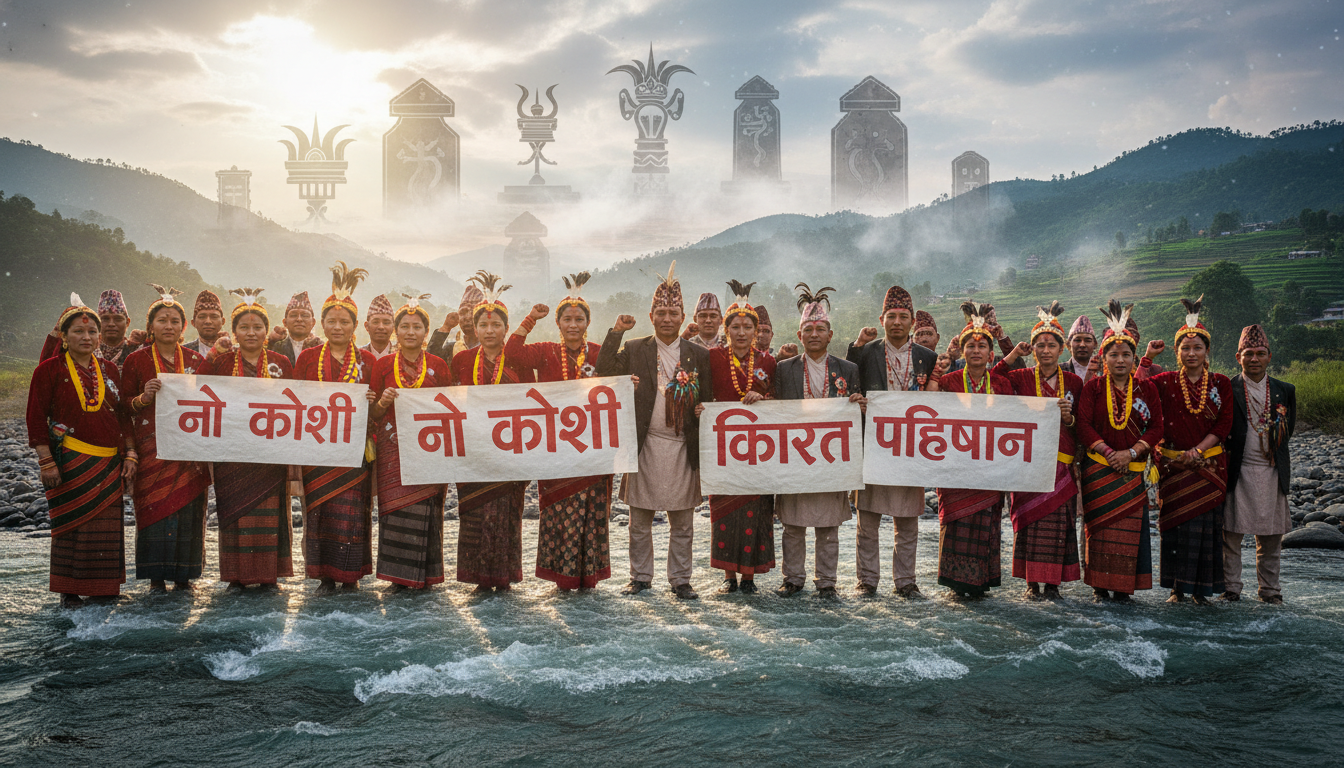
The conflict peaked in Province 1 (Eastern Nepal), the homeland of the Kirat people (Rai, Limbu).
- The Decision: On March 1, 2023, the assembly named the province “Koshi” (after the river), bypassing proposals for “Kirat” or “Limbuwan”.
- The Backlash: The “No Koshi” movement erupted. Indigenous activists argued that naming the province “Koshi” was a continuation of the Panchayat era’s erasure of indigenous history. The river name “Koshi” is derived from Hindu mythology (Kaushiki), whereas the land has been known as the Kirat domain since antiquity.
- State Violence: The protests turned violent. On March 19, 2023, protestor Padam Limbu ‘Lajehang’ was injured by police and later died, becoming a martyr for the identity movement.
- Current Status: The conflict remains unresolved. The provincial government has been unstable, and the identity movement has boycotted government functionaries. The “Koshi” name has become a symbol of the State’s refusal to accommodate the Nation’s diversity.
| Province | Final Name | Date | Identity Demands (Rejected) | Conflict Level |
|---|---|---|---|---|
| 1 | Koshi | Mar 2023 | Kirat, Limbuwan, Sagarmatha | High (Violent Protests) |
| 2 | Madhes | Jan 2022 | Mithila, Bhojpura | Low (Resolved) |
| 3 | Bagmati | Jan 2020 | Newa, Tamsaling | Moderate (Simmering) |
| 4 | Gandaki | July 2018 | Tamuwan | Low |
| 5 | Lumbini | Oct 2020 | Tharuhat | Moderate |
| 6 | Karnali | Feb 2018 | Khasan | Low |
| 7 | Sudurpaschim | Sep 2018 | Khaptad | Low |
10. The Bureaucratic and Military State: Persistence of Exclusion
While the political layer of the state (Parliament) has become more diverse due to Proportional Representation (PR), the “Permanent Government”—the Civil Service, Army, and Judiciary—remains largely resistant to change.
10.1 The Civil Service: The “Bahun-Chhetri” Core
The Civil Service is the steel frame of the Nepali state. Despite the introduction of a reservation system (45% of seats allocated to clusters: Women, Janajati, Madhesi, Dalit, Disabled, Backward Region) in 2007, the dominance of the Khas-Arya group persists in the “Open Competition” (55%) and leadership positions.
- Statistical Reality (2023/24):
- Khas-Arya: Constitute ~31% of the population but hold ~63.5% of civil service posts.
- Madhesi: Constitute ~32% of the population but hold only ~15.4% of posts.
- Dalits: Constitute ~13% of the population but hold only ~2.5% of posts.
- Mechanism of Exclusion: The Public Service Commission (PSC) exams are conducted in high-level Nepali and English. The cultural capital required to pass these exams (knowledge of Hindu administrative history, Nepali literary fluency) heavily favors the Hill High Castes. The “State” speaks a language that the “Nation” (especially in the Madhes and non-Nepali speaking hills) struggles to master.
10.2 The Nepal Army: Democratizing the Gorkhalis?
The Nepal Army (NA) was historically the King’s Army. Post-2006, it was brought under civilian control. A major challenge was the integration of former Maoist combatants (who were largely Janajati/Tharu). While ~1,400 combatants were integrated, the officer corps remains dominated by Chhetris and Thakuris (the traditional warrior castes).
- Inclusion Policy: The NA introduced quotas in 2012 (Rule 5 of Army Service Rule).
However, cultural integration is slow. The army’s ethos remains deeply rooted in Hindu martial traditions (e.g., the prominence of Fulpati and Dashain rituals), which alienates non-Hindu soldiers.
10.3 The Judiciary: The Last Bastion
The judiciary is perhaps the least inclusive organ of the state. As of 2023, the vast majority of Supreme Court and High Court judges are Hill Brahmins.
- Impact on Nation-Building: This lack of diversity affects trust. When the Supreme Court rules on issues like the “Koshi” name or citizenship, marginalized groups often perceive the verdict as biased by the “Khas-Arya mindset” of the bench, rather than neutral constitutional interpretation.
11. Contemporary Political Dynamics : The Regression Risk
The years 2024 and 2025 have seen a significant shift in Nepali politics, characterized by a backlash against the fluid political instability of the federal era.
11.1 The NC-UML Coalition (July 2024)
In a dramatic realignment, the two largest traditional parties, Nepali Congress (Sher Bahadur Deuba) and CPN-UML (K.P. Sharma Oli), formed a coalition government in July 2024, ousting the Maoist Center.
- The 7-Point Agreement: The bedrock of this coalition is a 7-point agreement. While publicly focused on “stability,” the unwritten but widely understood core agenda is Constitutional Amendment.
11.2 The Threat to Proportional Representation (PR)
The coalition argues that the current electoral system (60% First-Past-The-Post, 40% PR) makes it impossible for any single party to get a majority, leading to perpetual instability (hung parliaments).
- The Proposal: There are strong indications that the amendment aims to remove or significantly downgrade the PR system, or shift PR to the National Assembly (Upper House) only.
- Implications for the Nation: The PR system is the only constitutional mechanism that guarantees representation for Dalits and smaller minorities who cannot win in direct elections due to lack of resources and social capital. Removing PR would likely restore the absolute dominance of the Khas-Arya elite in the Lower House. This potential rollback is viewed by Janajatis and Madhesis as a coup by the “State” against the “Nation’s” diversity.
11.3 The Rise of “Gen-Z” and the RSP
The emergence of the Rastriya Swatantra Party (RSP) and independent candidates (e.g., Balen Shah) represents a new dimension. This urban, youth-driven movement prioritizes “delivery” (garbage collection, corruption control) over “identity” (federalism, ethnicity).
- Tension: While this seems like a move towards a post-ethnic civic nation, critics argue that this “delivery discourse” often ignores systemic exclusion. The RSP leadership is itself overwhelmingly Khas-Arya. The “Gen Z” anger is directed at the incompetence of the Old State, but it does not necessarily embrace the agenda of the Excluded Nation.
12. Geopolitics and Nationalism: The Map as Identity
In the absence of internal cohesion, the Nepali state relies heavily on external threats to generate “national” unity.
12.1 The 2020 Map and “Limpiyadhura Nationalism”
In May 2020, India opened a road through Lipulekh, territory claimed by Nepal. The K.P. Oli government responded by publishing a new political map incorporating Limpiyadhura, Kalapani, and Lipulekh.
- Consensus: The constitutional amendment to update the map passed unanimously. Even the Madhesi parties, usually critical of the “hill state,” voted for it to prove their patriotism.
- Analysis: This event demonstrated that “Territorial Nationalism” remains the most potent unifier in Nepal. It allowed the State to project strength and paper over internal cracks. The map became a sacred symbol of the nation, printed on school textbooks and coins, reinforcing the state’s narrative that the primary threat to the nation is external (India), not internal (inequality).
12.2 The “Yam” vs. The “Bridge”
Prithvi Narayan Shah described Nepal as a “Yam between two boulders” (India and China), implying a defensive posture. Modern discourse attempts to reframe Nepal as a “vibrant bridge” (Transit State). However, the state’s inability to manage geopolitical rivalry (e.g., the BRI vs. MCC debate) reflects its internal weakness. A fractured nation is vulnerable to external manipulation.
13. Sociocultural Dimensions: Language and Heritage
13.1 Language Politics: The Unfinished Business
The 2015 Constitution grants provinces the right to choose official languages. The Language Commission (2021 Report) recommended 11 languages for official status.
- Status: Implementation is stalled. While the Madhes Province uses Maithili/Bhojpuri, Koshi province has yet to fully implement Limbu/Maithili.
- The “English” Factor: Interestingly, the real threat to Nepali (the state language) and Indigenous languages (the national languages) is the massive surge in English-medium education. Private schools, sought after by all classes for economic mobility, are creating a new “English-speaking nation” disconnected from the “Vernacular State“.
13.2 Rastriya Bibhuti (National Heroes)
The list of Rastriya Bibhuti (National Heroes) is a state tool to define the national pantheon.
- Composition: Of the 18 heroes, the majority are Hill High Caste males or Royals (King Janak, Prithvi Narayan Shah, Bhanubhakta, King Tribhuvan).
- Tokenism: Recent additions like Pasang Lhamu Sherpa (Janajati), Falgunanda (Kirat saint), and Jaya Prithvi Bahadur Singh (Humanist) attempt to broaden the list. However, there is a glaring absence of Madhesi figures (beyond ancient King Janak/Sita) or Dalit heroes, reflecting the state’s continued reluctance to fully embrace the history of the margins.
14. Conclusion: State-Building and Nation-Building at a Crossroads
The history of Nepal is the story of a state searching for a nation. For 250 years, the state tried to create a nation through force, assimilation, and law (Muluki Ain, Panchayat). This project failed, leading to the explosions of 1990, 2006, and 2015.
Today, Nepal stands at a critical juncture.
- The Structural Gap: The transition to a Federal Democratic Republic has created the form of an inclusive nation-state, but the substance of the state machinery (bureaucracy, army, judiciary) remains captured by the old elite.
- The New Conflict: The “Koshi” protests and the NC-UML constitutional amendment plans signal a potential counter-revolution. The traditional elite, feeling that federalism has gone too far or is “too expensive,” seeks to recentralize power. This risks reigniting the identity conflicts that the 2015 constitution sought to manage.
- The Path Forward: True nation-building in Nepal cannot be achieved by erasing difference (the Panchayat model) or by fragmenting into ethnic enclaves (the radical identity model). It requires a “Multi-National State” approach—where the state acknowledges that it governs not one single “Nepali culture,” but a federation of diverse cultures, all of whom have an equal stake in the state’s prosperity.
Unless the Nepali state can evolve from being a “Possession of the Few” to a “Commonwealth of the Many,” the dialectic of State vs. Nation will remain the primary engine of instability in the Himalayas.
15. Statistical Appendix
Table 2: Demographics vs. State Representation (2023/24)
| Social Cluster | Population % (2021 Census) | Civil Service % | Army Officer Corps % (Est.) | Judiciary % (Est.) |
|---|---|---|---|---|
| Khas-Arya | 31.2% | 63.5% | >65% | >80% |
| Janajati (Hill) | 22.3% | 15% | 15% | <5% |
| Janajati (Terai) | 8.5% | 4.5% | <2% | <1% |
| Madhesi Caste | 15% | 10% | <2% | <5% |
| Dalit | 13.2% | 2.5% | <1% | <1% |
| Muslim | 4.4% | 0.6% | <0.5% | <0.5% |
Table 3: Evolution of the Constitutional Definition of “Nation”
| Constitution | Definition of State | Definition of Nation | Key Exclusion |
|---|---|---|---|
| 1962 (Panchayat) | Hindu Kingdom, Monarchy vested with Sovereignty. | United by loyalty to King. | Non-Hindus, Non-Nepali speakers. |
| 1990 | Multi-ethnic, Multi-lingual, Hindu Kingdom. | People bound by national independence. | Secularists, Republicans. |
| 2007 (Interim) | Secular, Federal Republic (post-amendment). | Diversity acknowledged. | Madhesis (initially ignored federalism). |
| 2015 | Socialism-oriented, Federal Democratic Republic. | Multi-ethnic, Multi-lingual, Multi-cultural (Art 3). | Women (Citizenship), Madhesis (Boundaries). |