


Foolproof Digital Marketing Strategy Framework: 2025 Blueprint
Executive Strategic Overview
The digital marketing landscape of 2025 is characterized by a paradox of accessibility and complexity. While tools for reaching audiences have never been more democratized, the fragmentation of attention, the opacity of algorithmic decision-making, and the rigorous demands of privacy-first data governance have erected formidable barriers to entry for sustainable growth. A “foolproof” strategy in this environment is not a static set of tactics but a dynamic, self-correcting ecosystem that integrates technical infrastructure, creative resonance, and rigorous data architecture.

This report provides an exhaustive analysis of the strategic frameworks, technical requirements, and execution methodologies necessary to build a resilient digital marketing engine. Moving beyond the superficial application of “hacks,” this analysis anchors digital activity in robust planning models like RACE and SOSTAC®, ensuring that every tactical deployment—from automated email sequences to AI-driven paid media—serves a unified business objective. We will dissect the causal relationships between technical SEO performance and conversion rates, the interplay between community engagement and customer lifetime value, and the critical shift from session-based analytics to event-based intelligence under Google Analytics 4.
Phase I: Strategic Architecture and Planning Methodologies
The primary cause of digital marketing failure is not a lack of effort but a lack of structural cohesion. Organizations frequently deploy tactics in isolation—running ads without optimized landing pages or generating leads without nurturing sequences—resulting in resource leakage. To counter this, we must adopt a lifecycle-based planning architecture.
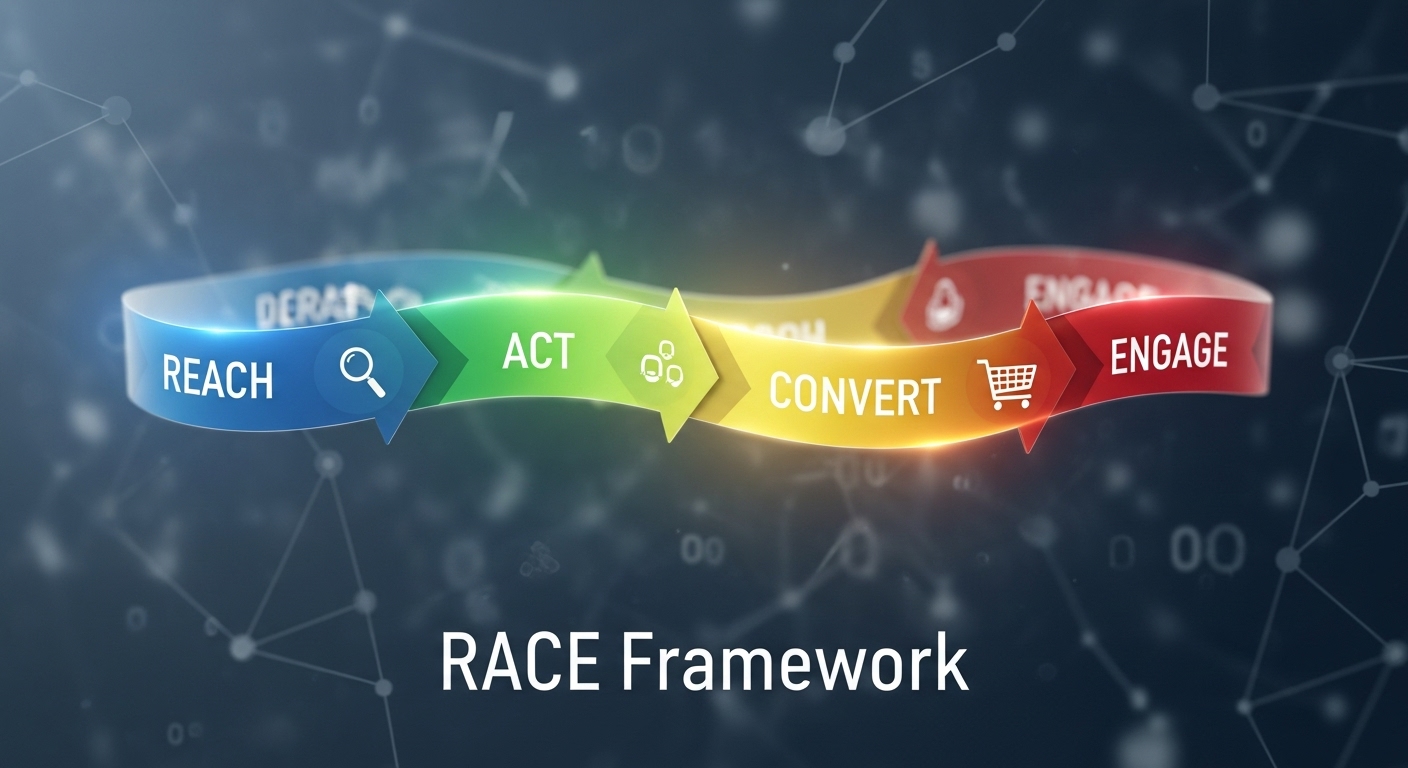
The RACE Framework: Structuring the Customer Lifecycle
The RACE Framework (Reach, Act, Convert, Engage) serves as the governing logic for the entire digital strategy. Unlike traditional linear funnels, RACE acknowledges the cyclical nature of modern consumer behavior, where post-purchase engagement is as critical as initial acquisition.
The Strategic Imperative of “Plan”
Before the cycle begins, the “Plan” phase establishes the digital transformation agenda. This is where the governance of the strategy is defined, ensuring that digital communications are not merely additive but integrative with business goals. In 2025, this planning phase must account for the integration of online and offline channels, ensuring that data flows seamlessly between physical touchpoints and digital data lakes, creating a unified customer view.
-
Reach: Building awareness and driving qualified traffic to web presence. Operational KPI Focus: Impressions, Share of Voice, Cost Per Mille (CPM).
-
Act (Interact): Persuading visitors to take the initial low-friction interaction. Operational KPI Focus: Lead Volume, Bounce Rate (inverse), Pages/Session.
-
Convert: Commercial capitalization; turning prospects into paying customers. Operational KPI Focus: Conversion Rate (CVR), Average Order Value (AOV).
-
Engage: Building long-term loyalty, advocacy, and repeat purchase behavior. Operational KPI Focus: Customer Lifetime Value , Churn Rate, Net Promoter Score (NPS).
The nuance often missed in the “Act” stage is the distinction between a visitor and a lead. “Act” is about interaction—generating the initial permission to market, whether through a whitepaper download, a webinar registration, or a newsletter sign-up. This stage bridges the gap between anonymous traffic and identifiable prospects, requiring a distinct content strategy separate from the hard-sell focus of the “Convert” stage.
The SOSTAC® Planning System
While RACE provides the “what,” the SOSTAC® model (Situation, Objectives, Strategy, Tactics, Action, Control) provides the “how.” This model enforces a discipline that prevents the premature selection of tactics before the strategic context is understood.
Situation Analysis: The Bedrock of Strategy
The first step, Situation Analysis, demands a rigorous audit of the current reality. This involves more than a cursory glance at sales figures; it requires a deep forensic analysis of the “5 Cs”—Company, Customers, Competitors, Collaborators, and Climate. In the 2025 context, this includes a specific review of digital maturity: Is the technical stack capable of handling server-side tracking? Are first-party data collection mechanisms compliant with GDPR and CCPA?
Objectives and the Control Feedback Loop
The “Control” phase of SOSTAC® is often treated as an afterthought, yet it is the mechanism that makes the strategy “foolproof.” By defining clear metrics during the Objectives phase (Where do we want to be?), the Control phase (Did we get there?) becomes a diagnostic tool rather than just a scoreboard. This circular relationship ensures that if a tactic fails, the organization can diagnose whether the failure was in execution (Action), channel selection (Strategy), or an unrealistic target (Objectives).
Phase II: Situational Intelligence and Market Positioning
A strategy built on assumptions is fragile. Robust digital marketing requires deep situational intelligence, specifically regarding the competitive landscape and the psychological profile of the target audience.
Advanced Competitor Analysis Frameworks
Competitor analysis in 2025 must transcend simple observation of ad copy. It requires a structural dissection of the competitor’s digital ecosystem. This involves “reverse engineering” their success to understand their resource allocation and strategic priorities.
-
Traffic Source Decomposition: Analyzing the ratio of organic vs. paid traffic for competitors reveals their dependency on ad spend versus brand equity.
-
Backlink Forensics: Identifying the specific domains linking to competitors allows for the replication of their digital PR strategy. Tools that analyze link velocity can indicate whether a competitor is engaging in an aggressive aggressive SEO campaign or resting on historical authority.
-
Content Gap Analysis: Identifying topics where competitors have established authority versus areas they have neglected provides a blueprint for “Blue Ocean” content strategies—areas of high demand but low competitive density.
Psychographic Profiling and Buyer Personas
The era of broad demographic targeting is ending. The precision of modern digital strategy relies on Buyer Personas—semi-fictional archetypes that represent the ideal customer. These profiles must be built on a synthesis of quantitative data (transaction logs, web analytics) and qualitative insight (customer interviews, survey data).
The “Anti-Persona”
Equally important is the definition of the “Anti-Persona”—the individual who looks like a customer but drains resources without delivering value. For a B2B software company, this might be “Student Steve,” who downloads content for research but has no budget authority. Explicitly defining these negative segments allows paid media teams to utilize exclusion lists effectively, saving significant budget.
Jobs-to-be-Done (JTBD) Mapping
Integrating the Jobs-to-be-Done framework into persona development shifts the focus from “who they are” to “what they are trying to achieve.” A persona might look like “Marketing Manager Mary,” but her JTBD is “Prove ROI to the CFO to secure next year’s budget.” This insight fundamentally changes the messaging strategy from listing product features to highlighting reporting capabilities and cost-efficiency.
Phase III: Technical Infrastructure and Core Web Vitals
In the 2025 ecosystem, marketing and engineering are inextricably linked. A website is no longer just a digital brochure; it is a software application that must perform with speed and stability. Search engines, particularly Google, have evolved to penalize poor technical performance severely.
The 2025 Technical SEO Architecture
Technical SEO provides the foundation upon which all content and acquisition strategies rest. If search engine bots cannot crawl and index the site efficiently, no amount of creative brilliance will yield results.
Mobile-First Indexing and Responsiveness
With mobile traffic consistently surpassing desktop, Google utilizes mobile-first indexing. This means the mobile version of the site is the primary version used for ranking. A responsive design is non-negotiable.
-
Touch Target Optimization: Buttons and interactive elements must be sized appropriately for thumbs (minimum 44×44 pixels), preventing “ghost clicks” and user frustration.
-
Viewport Configuration: The site must automatically adapt content to the width of the device, ensuring no horizontal scrolling is required, which is a significant negative ranking signal.
Core Web Vitals and Page Experience
Core Web Vitals (CWV) are a set of metrics Google uses to measure real-world user experience.
-
Largest Contentful Paint (LCP): Measures loading performance. The main content must load within 2.5 seconds. This requires optimizing server response times and using efficient image formats like WebP.
-
Cumulative Layout Shift (CLS): Measures visual stability. Elements should not jump around as the page loads. This is often caused by images without defined dimensions or dynamically injected ads. Stability is crucial for user trust.
-
First Input Delay (FID) / Interaction to Next Paint (INP): Measures interactivity. The site must respond immediately to user taps. Minimizing main-thread JavaScript execution is key here.
Structural Data and Schema Markup
To stand out in search results, websites must speak the language of search engines: Schema Markup.
By wrapping content in structured data code, businesses can help Google understand the context of the information—identifying a string of numbers as a price, or a block of text as a review. This enables “Rich Snippets” (star ratings, prices, event dates) to appear directly in search results, which can increase Click-Through Rates (CTR) by up to 30%.
Conversion Rate Optimization (CRO) and UX Design
Once traffic lands on the site, the user experience (UX) determines whether it converts. CRO is the systematic process of increasing the percentage of visitors who take a desired action.
Landing Page Heuristics
High-converting landing pages adhere to specific psychological and design principles.
- The “Blink Test”: Users form an opinion in 0.05 seconds. The value proposition must be immediately visible above the fold.
- Message Match: The headline on the landing page must mirror the copy of the ad that drove the click. Discrepancies here cause cognitive dissonance and immediate bounce.
- Directional Cues: Visual design elements (arrows, lines of sight) should guide the user’s eye toward the Call to Action (CTA).
- Removal of Navigation: Dedicated landing pages should have no global navigation menu. The user should have only two choices: convert or close the window. This “tunnel vision” design prevents leaks in the funnel.
Phase IV: The Data & Analytics Engine (GA4)
As we navigate the post-cookie era, data governance becomes a competitive advantage. The shift to Google Analytics 4 (GA4) represents a fundamental change in how user behavior is measured, moving from a session-based model to an event-based model.
Event-Based Measurement Strategy
In GA4, everything is an event. This requires a strategic mapping of business objectives to specific digital interactions.
E-Commerce Event Architecture
For online retailers, the standard e-commerce events provide a granular view of the shopping funnel. Implementing these allows for the visualization of drop-off points at each stage of the transaction.
| Event Name | Trigger Definition | Strategic Insight Gained |
|---|---|---|
| view_item | User views product details. | Measures product interest and page appeal. |
| add_to_cart | User adds item to cart. | Indicates intent; drop-off here suggests price/info friction. |
| view_cart | User reviews the cart. | Validates intent; drop-off suggests “sticker shock” or shipping cost issues. |
| begin_checkout | User clicks checkout. | Commitment step; critical for funnel optimization. |
| add_payment_info | User enters CC details. | High intent; technical failures here are catastrophic. |
| purchase | Transaction complete. | Revenue realization; used for ROAS calculation. |
Lead Generation Event Architecture
For B2B or service-based businesses, the funnel is longer and often offline. GA4 accommodates this through events that track the progression of lead quality.
| Event Name | Trigger Definition | Strategic Insight Gained |
|---|---|---|
| generate_lead | Form submission (contact/demo). | Top-of-funnel volume metric. |
| working_lead | Sales rep contacts lead. | Operational efficiency metric. |
| qualify_lead | Lead meets ideal customer profile. | Marketing quality metric. |
| close_convert_lead | Lead becomes a paying client. | Ultimate ROI metric; connects marketing to revenue. |
Privacy and First-Party Data
With third-party cookies deprecating, businesses must rely on first-party data. This involves implementing “Consent Mode” to respect user privacy choices while modeling data for users who opt out of tracking. Furthermore, server-side tagging (sending data from the server rather than the browser) is becoming the gold standard for data accuracy and privacy compliance.
Phase V: Acquisition and Reach Strategies
The “Reach” phase focuses on filling the top of the funnel. In 2025, this requires a hybrid approach that leverages the compounding returns of organic search and the immediate scalability of programmatic paid media.
The New Era of SEO: Information Gain and Topic Clusters
Search engines are evolving into “Answer Engines,” driven by Large Language Models (LLMs). To rank, content must provide unique value, known as “Information Gain”.
The Topic Cluster Model
Ranking for single keywords is an outdated strategy. The modern approach uses Topic Clusters:
- Pillar Page: A comprehensive guide covering a broad topic (e.g., “Digital Marketing”).
- Cluster Content: Sub-pages exploring specific facets (e.g., “SEO,” “PPC,” “Email Marketing”) in depth.
- Hyperlinking: Rigorous internal linking connects these pages, signaling to search engines that the site possesses deep topical authority.
Information Gain
To bypass AI-generated content that simply summarizes existing knowledge, brands must inject original research, expert quotes, and unique data into their content. This “human” element is what algorithms are increasingly trained to reward.
Paid Media: Automation and Creative Strategy
Paid media platforms like Meta (Facebook/Instagram) and Google Ads have shifted toward extreme automation.
Automation: PMax and Advantage+
- Google Performance Max (PMax): This campaign type accesses all Google inventory (YouTube, Search, Gmail, Maps) from a single campaign. Success relies on providing high-quality assets (images, video, text) and letting the AI optimize placement.
- Meta Advantage+ Shopping Campaigns (ASC): Similar to PMax, this uses machine learning to automate audience targeting and ad delivery. It has been shown to reduce Cost Per Acquisition (CPA) by up to 32% by dynamically serving the right creative to the right user.
The Creative Variable
In an automated world, targeting controls are limited. Therefore, creative is the new targeting. If you want to target dog owners, you don’t select “Dog Interest” in the settings; you feature a dog in the video ad. The algorithm will naturally serve the ad to users who engage with that visual. Testing diverse formats (static, carousel, short-form video) is essential to finding what resonates.
The Virtuous Activity Cycle
Budgets should not be static. The “Virtuous Activity Cycle” strategy involves fluidly moving budget between platforms based on real-time performance. If TikTok CPMs drop, budget flows there; if Google search volume spikes, budget shifts back. This agility maximizes the efficiency of total ad spend.
Phase VI: Engagement, Community, and Lead Nurturing
Once a user is acquired, the “Act” phase focuses on deepening the relationship. This is where community building and content nurturing play a pivotal role.
Community Engineering: The Moat of 2025
Building a brand community creates a defensible “moat” around the business. A thriving community reduces support costs (peer-to-peer help) and increases retention.
Engagement Tactics for Community Growth
Building a community requires proactive management, not just setting up a forum.
- Seed Content Strategy: Community managers must overcome the “empty room” syndrome by posting “Seed Content”—questions, polls, or provocative statements—that encourage members to respond. This leverages the “90-9-1” rule, encouraging the 90% of lurkers to become active.
- AMA (Ask Me Anything) Sessions: Regularly scheduling experts or leadership for live Q&A sessions drives spikes in engagement and provides exclusive value to members. The scarcity and timeliness of these events drive attendance.
- Company Corner: Creating a dedicated space for different departments (e.g., Product, Support, Marketing) to interact with customers humanizes the brand and makes users feel like insiders.
- Rituals (e.g., Coffee Talk Friday): Establishing recurring, low-stakes threads for social interaction helps members bond with each other, not just the brand. This horizontal connection is the glue of a sticky community.
Content Nurturing and the User Journey
Content must be mapped to the user’s psychological state.
- Top of Funnel: “Problem Aware” content (e.g., “Why is my conversion rate low?”) educates the user.
- Middle of Funnel: “Solution Aware” content (e.g., “The ultimate guide to CRO tools”) helps them evaluate options.
- Bottom of Funnel: “Product Aware” content (e.g., “Case Study: How Company X doubled sales with our tool”) provides the social proof needed to close.
Phase VII: Conversion Mechanics and Sales Enablement
The “Convert” phase is where the commercial transaction occurs. For e-commerce, this is the checkout flow; for B2B, it is the sales handover.
Reducing Friction
Friction is the enemy of conversion. Every extra form field, every second of load time, and every unclear navigation element reduces the probability of a sale.
- Checkout Optimization: Guest checkout options are mandatory. Forcing account creation is a primary cause of cart abandonment.
- Trust Signals: Security badges (Norton, McAfee) and payment icons (PayPal, Apple Pay) near the credit card field reduce anxiety.
Sales Enablement for B2B
For lead-based businesses, the “Convert” stage involves the seamless transfer of data from marketing to sales. Implementing “Lead Scoring” (assigning points based on user behavior, e.g., +10 for visiting pricing page, +5 for opening email) ensures that sales teams prioritize the hottest prospects.
Phase VIII: Retention, Loyalty, and Lifecycle Automation
The “Engage” phase focuses on the most profitable activity: retaining existing customers. Increasing retention by just 5% can increase profits by 25-95%.
The Welcome Email Sequence
The moment a user subscribes is when their attention is highest. A structured welcome sequence is critical for setting the tone.
- Email 1 (Immediate): The “Delivery” email. Delivers the promised lead magnet or discount code.
- Subject line must be clear: “Here is your [Asset Name].”
- Email 2 (Day 2): The “Indoctrination” email. Introduces the brand’s mission and values. “Why we started.”
- Email 3 (Day 4): The “Discovery” email. Highlights best-selling products or key resources. “Where to start.”
- Email 4 (Day 7): The “Soft Ask.” A gentle nudge toward a purchase or deeper engagement, often accompanied by social proof.
Abandoned Cart Recovery Protocol
Recovering lost revenue is the lowest-hanging fruit in digital marketing. The strategy must be multi-channel.
- Trigger: User adds item to cart but does not complete purchase within 60 minutes.
- Step 1 (1 Hour): Email: “Did life get in the way?” A helpful, service-oriented reminder. No discount yet.
- Step 2 (24 Hours): Email: “Your cart is expiring.” Introduces scarcity.
- Step 3 (24 Hours + 5 min): SMS (if consented): “Quick heads up—low stock on your items. Secure them here: [Link].” SMS has a 98% open rate and drives urgency.
- Step 4 (48 Hours): Email: “Final Call + 10% Off.” The discount is the “break glass” option to secure the sale.
Loyalty Programs and Advocacy
Loyalty programs must offer more than just discounts; they must offer status. Tiers (Bronze, Silver, Gold) gamify the experience. “Experiential Rewards” (early access to sales, exclusive webinars) often drive higher engagement than simple cash-back offers.
Conclusion: The Integrated Growth Engine
The digital marketing strategy of 2025 is not a collection of isolated hacks; it is an integrated growth engine. It begins with the structural discipline of RACE and SOSTAC®, grounds itself in the technical realities of Core Web Vitals and GA4 event data, and expresses itself through the dual engines of automated paid acquisition and organic community building.
The organizations that win in 2025 will be those that recognize the causal links between these disparate elements—understanding that site speed influences ad costs, that community engagement drives SEO authority, and that data privacy compliance builds the trust necessary for conversion. By systematically implementing this framework, businesses move from “random acts of marketing” to a predictable, scalable, and “foolproof” system for market dominance.