


Data-Driven Teaching Decisions: Improve Student Outcomes
Executive Summary
The transition from the traditional “chalkboard” era of instruction—characterized by intuition, ephemeral feedback, and summative judgment—to the “dashboard” era represents a fundamental paradigm shift in education. This transformation is not merely technological but pedagogical, requiring a move from assessment of learning (autopsy data) to assessment for learning (biopsy data). While modern educational institutions are increasingly “data-rich,” possessing vast repositories of student information ranging from standardized test scores to login metadata, they often remain “information-poor” due to a critical lack of data literacy among educators and the absence of effective feedback loops.
Table of Contents
- Executive Summary
- The Educational Data Landscape: A Paradigm Shift
- ↳ The Data-Rich, Information-Poor Paradox
- ↳ The Evolution of Instructional Tools
- ↳ The Moral and Strategic Imperative
- Theoretical Frameworks: Assessment for Learning
- ↳ Autopsy vs. Biopsy: The Temporal Value of Data
- ↳ The Feedback Loop Mechanism
- ↳ The “CIA” of Differentiation
- The Human Element: Bridging the Data Literacy Gap
- ↳ Anatomy of the Literacy Gap
- ↳ Frameworks for Capacity Building
- ↳ Collaborative Inquiry and PLCs
- Learning Analytics: Metrics that Matter
- ↳ Product vs. Process Metrics
- ↳ Proxy Variables and the “Whole Child”
- ↳ The Ethics of Predictive Analytics
- Designing the Feedback Loop: Rubrics as Data Instruments
- ↳ The Architecture of Analytic Rubrics
- ↳ Designing for Longitudinal Tracking
- ↳ 5.3 The Role of Student Self-Assessment
- 6. Dashboard Architecture: Visualizing for Action
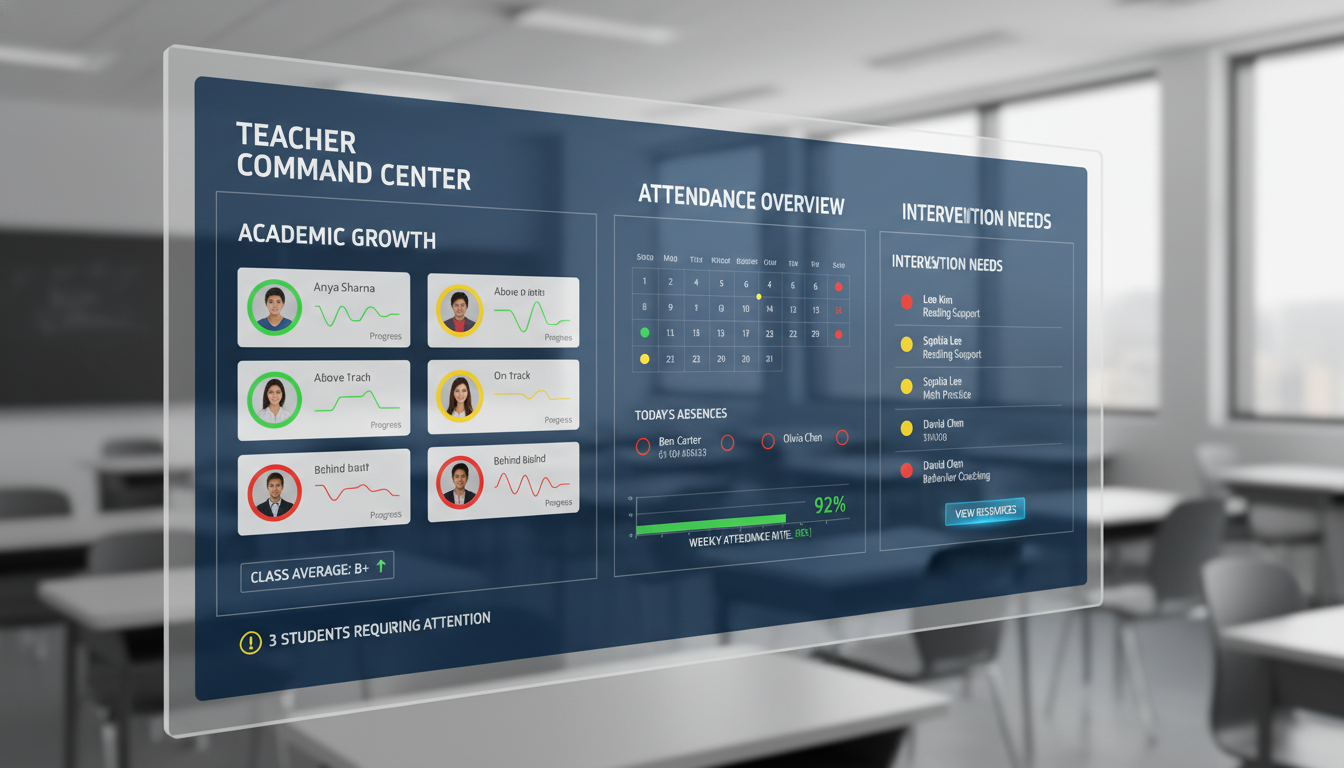
- ↳ 6.1 Design Principles: Glanceability and Simplicity
- ↳ 6.2 Best Practices for Action-Oriented Dashboards
- ↳ 6.3 Low-Tech vs. High-Tech Solutions
- 7. The Role of Artificial Intelligence: Closing the Loop
- ↳ 7.1 AI as a Rubric Designer
- ↳ 7.2 AI for Automated Feedback
- ↳ 7.3 Pattern Recognition and Differentiation
- 8. Case Studies and Implementation Scenarios
- ↳ 8.1 Scenario A: The “Monday Morning” Triage
- ↳ 8.2 Scenario B: Longitudinal Tracking of Critical Thinking
- ↳ 8.3 Scenario C: Student-Led Data Conferences
- 9. Conclusion: The Future of the Dashboard
- Appendix: Practical Toolkit
- ↳ Checklist for Dashboard Design
- ↳ Template: The “Data Dialogue” Protocol
- ↳ Key Resources for Further Learning
This report provides an exhaustive analysis of the ecosystems, frameworks, and methodologies required to operationalize data for instructional improvement. It posits that the missing link in student achievement is not the quantity of data but the velocity and quality of the feedback loop. By leveraging learning analytics, designing precise analytic rubrics, and utilizing action-oriented dashboards, educators can visualize the learning process in real-time. Furthermore, the report explores the emerging role of Artificial Intelligence (AI) in automating these processes, allowing for personalized interventions at scale. The analysis concludes that sustainable improvement requires a dual investment: technological infrastructure that adheres to principles of glanceability and modularity, and human capital investment to bridge the data literacy gap, transforming teachers into data-informed instructional designers.

The Educational Data Landscape: A Paradigm Shift
The historical trajectory of teaching has long been defined by the isolation of the classroom. For generations, the “chalkboard” served as the primary technology of instruction—a medium that was flexible and immediate, yet transient. Information written on a chalkboard disappeared with the swipe of an eraser, leaving no digital trace and providing no longitudinal data. Decisions made in this environment were largely intuitive, based on a teacher’s “gut feeling” or the visual cues of nodding heads in a lecture hall. Today, that landscape is being radically re-engineered by the influx of data, creating a new imperative for Data-Driven Decision Making.
The Data-Rich, Information-Poor Paradox
In the current era, schools generate terabytes of data annually. Student Information Systems (SIS) track demographics, attendance, and discipline; Learning Management Systems (LMS) log every click, submission, and forum post; and assessment platforms generate streams of proficiency data. Yet, despite this deluge, a paradox persists: schools are data-rich but information-poor.
The core of this paradox lies in the disconnect between data collection and instructional application. Data is often siloed in disparate systems that do not communicate, or it is presented in aggregate formats that obscure individual student needs. A principal might know that 40% of the third grade is failing reading, but the classroom teacher may not know why specific students are struggling or which specific phonemic awareness skills are lacking. This gap highlights the distinction between “data” (raw numbers) and “information” (contextualized patterns useful for decision-making).

DDDM in education is defined as the systematic collection and analysis of information to guide decisions that improve student outcomes. It is not a singular event but a continuous cycle of inquiry. When effective, it optimizes resource allocation, allowing schools to direct interventions to students with the highest need rather than applying a “one-size-fits-all” approach. However, the realization of these benefits is contingent upon the availability of timely, relevant, and actionable data—qualities often missing from traditional reporting structures.
The Evolution of Instructional Tools
The tools of the trade have evolved from the mimeograph machine to the predictive algorithm. In the past, data collection was manual and laborious—grading paper tests, calculating averages by hand, and storing records in physical filing cabinets. This high friction meant that deep analysis was rare. A teacher might analyze a final exam, but the “data” arrived too late to influence instruction for those students.
Today, technology has lowered the friction of data collection to near zero. Automated grading, digital exit tickets, and AI-driven insights allow for “real-time” data analysis. This shift has moved the bottleneck from collection to interpretation. The modern educator is no longer a scavenger for information but a curator, tasked with filtering out noise to find the signal in a sea of metrics. This evolution demands a new set of professional competencies, specifically in data literacy, which remains a significant gap in teacher preparation programs.
The Moral and Strategic Imperative
The push for data-driven instruction is driven by both moral and strategic imperatives. Strategically, data allows for the optimization of limited educational resources. Morally, it serves as an instrument of equity. Without data, instructional decisions are often influenced by implicit biases regarding race, gender, or socioeconomic status. Data, when used responsibly, cuts through these biases, revealing the “invisible” students who may be quietly failing or the high-potential students who are disengaged due to a lack of challenge.
Furthermore, the legal landscape, including mandates like the Every Student Succeeds Act (ESSA) and the Individuals with Disabilities Education Act (IDEA), increasingly requires the use of evidence-based interventions and progress monitoring. The shift to the dashboard is not merely a technological trend; it is a compliance requirement and an ethical necessity to ensure that every student’s learning trajectory is visible, monitored, and supported.
Theoretical Frameworks: Assessment for Learning
To navigate the shift to data-driven instruction, one must distinguish between the varying purposes of assessment. The most critical distinction in the “chalkboard to dashboard” transition is the move from summative assessment (Assessment of Learning) to formative assessment (Assessment for Learning).
Autopsy vs. Biopsy: The Temporal Value of Data
Traditional educational models have relied heavily on Assessment of Learning—summative evaluations administered at the end of a unit, semester, or year. These assessments act as “autopsies”: they determine the cause of failure after the instructional event has concluded. While necessary for certification and accountability, autopsy data is useless for the student who has already failed; it provides no opportunity for correction or growth.
In contrast, Assessment for Learning serves as a “biopsy.” It is diagnostic, frequent, and occurs during the learning process. Formative assessment provides a health check on student understanding while there is still time to intervene.
- Formative Data: Includes low-stakes quizzes, exit tickets, observation protocols, and draft reviews. It answers the question, “What does the student need right now?”.
- Summative Data: Includes final exams and standardized tests. It answers the question, “What did the student achieve?”.
Research confirms that data-driven instruction based on formative assessment has a high effect size on student achievement because it allows for “mid-course corrections”. Teachers can adjust pacing, reteach concepts, or group students for immediate intervention based on live data rather than waiting for end-of-term reports.
The Feedback Loop Mechanism
The mechanism that powers formative assessment is the feedback loop. A feedback loop is an iterative process where outputs of a system (student performance) are circled back and used as inputs for the next operation (instruction). In a classroom context, an open loop (where data is collected but not used) is functionally useless. Closing the loop is the defining characteristic of effective data use.
| Stage | Description | Teacher Action (Data-Driven) | Student Action (Meta-Cognitive) |
|---|---|---|---|
| 1. Clarify Goals | Establishing “Where am I going?” | Defining success criteria and learning targets clearly in the dashboard/rubric. | Understanding the standard to be met. |
| 2. Elicit Evidence | Determining “Where am I now?” | Administering a formative task (e.g., digital quiz, concept map). | Performing the task to demonstrate current understanding. |
| 3. Analyze Gap | Identifying the distance between current status and the goal. | Using analytics to spot misconceptions (e.g., “50% of class missed Question 3”). | Reviewing auto-generated feedback or peer review. |
| 4. Instructional Response | Closing the gap. | Modifying the next lesson; grouping students for triage; providing specific resources. | engaging in revision, re-practice, or extension activities. |
Effective feedback loops transform assessment from a monologue (teacher grades student) into a dialogue (teacher and student analyze data together). This collaborative approach fosters self-regulated learning, where students eventually learn to monitor their own data streams—a skill essential for lifelong learning.
The “CIA” of Differentiation
A practical framework for applying this theory is the “CIA” model: Content, Instruction, and Assessment. Data must be “chunked” into these three categories to be manageable.
- Content Data: Analysis of the materials. Are the texts too complex? Are the digital resources being accessed? Teachers track resource usage to ensure alignment with student needs.
- Instruction Data: Analysis of pedagogy.
How much “teacher talk” vs. “student talk” occurred? Which strategies (e.g., Socratic seminar vs. direct instruction) yielded better quiz results?
- Assessment Data: The measurement of outcomes. By triangulating these three data sources, teachers can identify why learning happened (or didn’t). For instance, if assessment scores are low (Assessment Data) but resource usage is high (Content Data), the fault may lie in the delivery method (Instruction Data).
The Human Element: Bridging the Data Literacy Gap
While the theoretical benefits of data are clear, the practical application is stalled by a human capital crisis: the data literacy gap. Data literacy—the ability to read, understand, create, and communicate data as information—is frequently cited as a “missing skill” in the teaching workforce.
Anatomy of the Literacy Gap
The gap exists because teacher preparation programs have historically focused on pedagogy, content knowledge, and classroom management, with little emphasis on data science or statistical analysis. Consequently, when teachers are presented with complex dashboards or spreadsheet reports, they often struggle to interpret them correctly.
Key manifestations of the literacy gap include:
- Analysis Paralysis: Being overwhelmed by the volume of data and unable to distinguish between “noise” (daily fluctuations) and “signal” (long-term trends).
- Misinterpretation of Visuals: Misreading growth charts or conflating correlation with causation (e.g., assuming low attendance caused low grades without considering external variables like health or housing instability).
- Compliance over Inquiry: Viewing data entry as a bureaucratic hurdle (feeding the system) rather than an instructional tool (feeding the learning).
This gap creates a dependency on “data specialists” or administrators to interpret results, slowing down the feedback loop. For data to be truly transformative, it must be democratized; every teacher must be a data analyst for their own classroom.
Frameworks for Capacity Building
To close this gap, schools must implement structured professional development (PD) that goes beyond software training to focus on decision-making logic. Several evidence-based frameworks exist to guide this process.
The Data Wise Improvement Process
Developed at Harvard, the Data Wise process provides a roadmap for collaborative data inquiry. It emphasizes that data work is cultural work.
- Prepare: Build assessment literacy and create a safe culture where data is used for improvement, not judgment.
- Inquire: Dig into data to identify a specific learner-centered problem (e.g., “Our students struggle with multi-step word problems”).
- Act: Develop an action plan, implement it, and assess its impact.
The PDSA Cycle
The Plan-Do-Study-Act (PDSA) cycle is another rigorous framework adopted from industry for educational contexts.
- Plan: Teachers hypothesize that a specific change (e.g., using graphic organizers) will improve a specific metric (e.g., essay organization scores).
- Do: Implement the change on a small scale.
- Study: Analyze the data. Did the metric improve?
- Act: Adopt the change, adapt it, or abandon it based on evidence.
This scientific method approach empowers teachers to treat their classroom as a laboratory, fostering a professional identity of “teacher-researcher”.
Collaborative Inquiry and PLCs
Data literacy is best developed in community. Professional Learning Communities (PLCs) serve as the incubator for these skills. In effective PLCs, data analysis is protocol-driven to ensure objectivity.
- The Data Dialogue Protocol: A structured conversation where teachers first predict what the data will show (surfacing bias), then observe the data factually (without inference), then infer causes, and finally plan interventions.
- Vertical Alignment: Teachers from different grade levels meet to analyze data “vertically,” tracking student cohorts as they move from grade to grade to ensure skills transfer.
By embedding data literacy into the weekly rhythm of school life through PLCs, schools can shift the culture from one of “data compliance” to “data curiosity”.
Learning Analytics: Metrics that Matter
Moving beyond the human element, we must examine the nature of the data being analyzed. Learning Analytics (LA) is the measurement, collection, analysis, and reporting of data about learners and their contexts. In the transition to digital learning environments, the granularity of this data has exploded.
Product vs. Process Metrics
A critical distinction in learning analytics is between product and process metrics.
- Product Metrics: These measure the outcome of learning. Examples include final grades, standardized test scores, and project deliverables. While important, they are lagging indicators.
- Process Metrics: These measure the behaviors of learning. Examples include time on task, revision history, number of logins, library access frequency, and discussion forum participation.
Research suggests that process metrics are often better predictors of student success and retention than product metrics. For example, a student who submits an assignment three days early and revises it twice (high process engagement) is on a different trajectory than a student who submits a first draft at 11:59 PM, even if both receive the same grade. The former exhibits “self-regulated learning” behaviors that predict long-term resilience. Teachers using dashboards should prioritize these process metrics to identify “at-risk” students before they fail a major assessment.
Proxy Variables and the “Whole Child”
Since we cannot directly measure internal cognitive states or emotional well-being, learning analytics relies on proxy variables—observable data points that stand in for unobservable traits.
| Unobservable Trait | Proxy Metric (Observable Data) | Interpretation/Action |
|---|---|---|
| Engagement | Login Frequency (Regularity) & Recency. | Low frequency indicates disengagement. “It has been 4 days since the last login.” |
| Grit / Persistence | Number of attempts on a formative quiz. | Multiple attempts indicate a willingness to learn from failure. |
| Social Connection | Number of replies to peers in forums. | Isolation in digital spaces can predict dropout. |
| Well-being/Stability | Attendance rates & Punctuality. | Chronic absenteeism is often a proxy for external instability (health, housing). |
| Prior Knowledge | Baseline assessment scores. | Used to calculate “distance traveled” or growth. |
Understanding these proxies allows teachers to construct a “Whole Child” view. For instance, chronic absenteeism (missing >10% of school) is a powerful proxy for future academic decline. Research shows that missing just three days in the month prior to a test can lower scores by 0.3 to 0.6 standard deviations. By tracking these proxies, educators can intervene based on behavioral shifts rather than waiting for academic failure.
The Ethics of Predictive Analytics
As analytics become more predictive (forecasting future performance), ethical considerations arise. “Early Warning Systems” use algorithms to flag students at risk of dropping out based on historical patterns. While powerful, these systems carry the risk of “algorithmic bias” or self-fulfilling prophecies. If a dashboard flags a student as “At Risk” in Red, the teacher might unconsciously lower their expectations for that student. It is vital that teachers understand that analytics are probabilistic, not deterministic. They are tools for support, not labeling.
Designing the Feedback Loop: Rubrics as Data Instruments
To feed the dashboard, teachers need high-quality data. While digital systems collect behavioral data automatically, the assessment of complex work (essays, projects, presentations) requires a human sensor. The Rubric is the instrument that converts qualitative observation into quantitative data.
The Architecture of Analytic Rubrics
For data analytics, Analytic Rubrics are superior to Holistic Rubrics.
- Holistic Rubrics assign a single score to the entire product (e.g., “Excellent – 4”). This provides a summary but no granular data on why the work was excellent.
- Analytic Rubrics break the task down into distinct criteria (e.g., Thesis, Evidence, Organization), scoring each independently.
Why this matters for data: An analytic rubric generates a multi-dimensional dataset. Instead of just knowing a student got a “B,” the teacher knows the student is a “Level 4 in Evidence” but a “Level 2 in Organization.” This granularity enables targeted instruction. If the dashboard shows that 80% of the class is “Level 2 in Organization,” the teacher knows exactly what to teach on Monday.
Designing for Longitudinal Tracking
To track growth over time, rubrics must be designed longitudinally. Instead of creating a new rubric for every assignment, teachers should design “Mastery Rubrics” or “Developmental Rubrics” that span a semester or year.
Step-by-Step Design for Longitudinal Rubrics:
- Define the Constructs: Identify the core skills that will be assessed repeatedly (e.g., “Critical Thinking,” “Communication”).
- Establish a Fixed Scale: Use a consistent scale (e.g., Novice, Apprentice, Practitioner, Expert) rather than changing point values for every task.
- Write Descriptors of Growth: Describe what the skill looks like at each level.
- Novice: “Identifies the main idea.”
- Expert: “Evaluates the validity of the main idea and compares it to alternative viewpoints”.
- Map Assignments to the Rubric: Assignment A might assess Criteria 1 and 2; Assignment B might assess Criteria 2 and 3.
Visualize the Trajectory: By plotting the scores for “Criteria 2” across multiple assignments, the teacher can visualize a “growth curve” for that specific skill.
5.3 The Role of Student Self-Assessment
Rubrics are also tools for student data literacy. When students use the rubric to self-assess before submission, they engage in the feedback loop directly. Comparing their self-assessed data point with the teacher’s data point provides a powerful moment for metacognitive reflection (“I thought I was a 4, but I was a 2 because I forgot citations”).
6. Dashboard Architecture: Visualizing for Action
Once data is collected via learning analytics and rubrics, it must be presented to the teacher. The design of the Teacher Dashboard is critical. A poorly designed dashboard increases cognitive load and leads to disuse; a well-designed dashboard enables “glanceability” and immediate action.
6.1 Design Principles: Glanceability and Simplicity
Teachers act in a high-velocity environment. They do not have time to decode complex visualizations during a class. Therefore, dashboards must adhere to the principle of Glanceability: the ability to convey the status of the system in moments.
- Traffic Lighting: Use Red/Yellow/Green indicators to show status instantly. Red draws attention to immediate needs (e.g., absenteeism, failing grades).
- Sparklines: Small in-cell line graphs that show trends (e.g., last 5 quiz scores) allow teachers to distinguish between a student who is consistently low (flat line) and one who is plummeting (downward slope).
- Modularity: Group data into logical modules (e.g., “Attendance Module,” “Academic Growth Module”) so teachers can focus on one aspect at a time.
6.2 Best Practices for Action-Oriented Dashboards
A dashboard should not just report news; it should drive action. The “Three Best Practices” framework suggests:
- Design for a Specific Meeting: Don’t build a “dashboard for everything.” Build a “Monday Morning Attendance Dashboard” or a “Quarterly Review Dashboard.” The context dictates the data.
- Design for a Specific Action: Every metric should prompt a question. If attendance is Red, the action is “Call Home.” If Math Growth is Red, the action is “Assign Intervention.”
- Design to Talk About Students: While aggregate data (class average) is interesting, teachers teach individuals. The dashboard must allow drilling down from the aggregate to the individual student list.
6.3 Low-Tech vs. High-Tech Solutions
The DIY Dashboard (Google Sheets):
- Setup: One tab for raw data entry (rubric scores), one tab for the “Dashboard.”
- Functions: Use VLOOKUP or QUERY functions to pull data for a specific student into a “Student Profile” view.
- Visuals: Use Conditional Formatting to auto-color cells based on proficiency levels.
Enterprise Solutions:
Platforms like Panorama Student Success or PowerBI offer robust integration with SIS data. These platforms excel at pulling “hard” data (attendance, suspension) but often lag in integrating the “soft” formative data (rubric scores on daily work) that teachers value most. The ideal ecosystem often involves a hybrid: enterprise systems for macro-trends and teacher-managed sheets for micro-instructional decisions.
7. The Role of Artificial Intelligence: Closing the Loop
The emergence of Generative AI (GenAI) in 2024-2025 has introduced a powerful new agent into the data ecosystem. AI helps solve the “time” problem in data-driven instruction by automating analysis and content generation.
7.1 AI as a Rubric Designer
Creating high-quality analytic rubrics is time-consuming. GenAI tools (like ChatGPT or Eduaide.AI) can function as instructional design partners.
- Workflow: A teacher inputs the assignment prompt and learning standards. The AI generates a draft analytic rubric with specific descriptors for each performance level.
- Refinement: The teacher can ask the AI to “adjust the language for 5th-grade reading level” or “add a criterion for ‘Use of Scientific Vocabulary’,” significantly accelerating the preparation phase of assessment.
7.2 AI for Automated Feedback
Closing the feedback loop—providing timely, specific comments to 30+ students—is the teacher’s greatest bottleneck. AI tools now offer “Human-in-the-Loop” grading assistance.
- Mechanism: The student submits a draft. The AI analyzes it against the rubric and provides preliminary feedback on structure, grammar, and evidence use.
- Teacher Control: The teacher reviews the AI’s suggestions, edits them for tone and accuracy, and releases them to the student. This can reduce grading time by 50% while increasing the volume of feedback students receive.
7.3 Pattern Recognition and Differentiation
AI excels at pattern recognition. A teacher can feed anonymized results from a quiz into an LLM and ask: “Identify the top three misconceptions in this dataset and suggest a re-teaching strategy for each.” The AI can instantly group students based on error types and generate differentiated lesson plans for each group—a task that would take a human teacher hours.
8. Case Studies and Implementation Scenarios
To illustrate the practical application of these frameworks, we examine three implementation scenarios.
8.1 Scenario A: The “Monday Morning” Triage
Context: A middle school math teacher with 150 students.
Challenge: Managing diverse learning needs with limited time.
Solution: The teacher utilizes a “Monday Morning Dashboard”.
- Data Source: Weekly digital exit tickets (formative) and attendance data (proxy for engagement).
- The Meeting: During her 20-minute planning period, she opens the dashboard. It highlights 12 students in “Red” for the previous week’s concept (Ratios).
- The Action: She groups these 12 students. Drilling down, she sees 8 failed due to calculation errors (Process Metric) and 4 due to conceptual misunderstanding.
- The Intervention: She assigns the 8 students a calculation practice module (AI-tutor) and pulls the 4 students for a small-group re-teaching session.
- Result: The feedback loop is closed within 24 hours.
8.2 Scenario B: Longitudinal Tracking of Critical Thinking
Context: A high school humanities department.
Challenge: “Critical Thinking” is a school goal, but no one knows how to measure it.
Solution: The team designs a longitudinal analytic rubric.
- Design: They agree on a 4-point scale for “Evidence Analysis.”
- Implementation: Every essay in History and English uses this specific rubric row.
- Visualization: They use a visualization tool to plot “Evidence Analysis” scores over time for the 9th-grade cohort.
- Insight: The data reveals a “sophomore slump”—scores plateau in 10th grade.
- Action: The department revises the 10th-grade curriculum to introduce more complex primary sources, challenging the students to break through the plateau.
8.3 Scenario C: Student-Led Data Conferences
Context: An elementary school focused on student agency.
Challenge: Students are passive recipients of grades.
Solution: Data Narratives.
- Method: Teachers provide students with simplified versions of their own growth charts.
- Activity: Students analyze their charts. “I see my reading speed went up, but my comprehension stayed the same.”
- Goal Setting: Students set their own goals for the next quarter based on the data.
- Outcome: The “black box” of grading is opened. Students understand the connection between their effort (process) and their data (product).
9. Conclusion: The Future of the Dashboard
The journey from the chalkboard to the dashboard is a journey toward professionalization and precision. It does not replace the teacher; rather, it augments the teacher’s capacity to care. By offloading the memory-intensive task of tracking hundreds of data points to a digital system, the teacher is freed to focus on the high-value tasks: relationship building, mentorship, and creative instructional design.
However, technology alone is not the panacea. The success of this transition relies on the human operator. Schools must invest heavily in data literacy training, ensuring that teachers are not just consumers of data but confident analysts. They must foster cultures of inquiry where data is safe to discuss. And they must ensure that the goal remains always the same: not to produce better data, but to produce better learning.
As we look to the future, the integration of predictive analytics and generative AI promises to make these dashboards even more prescient, potentially identifying learning struggles before the student is even aware of them. The challenge will be to wield this power with ethics and empathy, ensuring that the dashboard remains a tool for opening doors, not closing them.
Appendix: Practical Toolkit
Checklist for Dashboard Design
- Metric Selection: Have you limited the dashboard to 3-5 key metrics per view? (Simplicity).
- Actionability: Does every metric lead to an obvious next step? (Action-Orientation).
- Drill-Down: Can you click from the class view to the student view? (Student-Centricity).
- Visual Clarity: Are you using sparklines and traffic lighting? (Glanceability).
Template: The “Data Dialogue” Protocol
- Phase 1: Predictions (5 mins): “Based on our instruction, what do we expect the data to show?”.
- Phase 2: Visual Observation (10 mins): “I see that…” (No interpretations allowed).
- Phase 3: Inference (10 mins): “I think this is happening because…” (Triangulate with other data).
- Phase 4: Pedagogical Action (15 mins): “Therefore, next week I will…”.
Key Resources for Further Learning
- Data Wise Project (Harvard): For frameworks on collaborative inquiry.
- Institute of Education Sciences (IES): For practice guides on data use.
- Society for Learning Analytics Research (SoLAR): For technical deep dives into learning analytics.