


Digital Cooperatives Global South: Scaling Hurdles & Insights
Introduction and Problem Statement

Across the Global South, digitally enabled cooperatives, collective platforms, and solidarity-oriented initiatives are a frequently proposed alternative to extractive platform capitalism. The narrative suggests that by owning the platform, workers can reclaim value, ensure data sovereignty, and democratize governance. Yet, a significant gap exists between this “platform cooperativism” discourse and the on-the-ground reality in developing economies.
In contexts like Nepal, many such initiatives are launched with high enthusiasm, policy interest, and donor support, only to remain informal, stall at early pilot stages, or fail to scale despite clear market demand. While the literature often celebrates successful case studies or critiques the giants of the gig economy, there is a “survival bias” in current research. We know very little about the “stalled” initiatives—ventures that possess cooperative intent and digital tools but fail to achieve institutional durability.
This research posits that the failure to scale is not merely a lack of funding or technical code, but a friction between imported digital logics and local informal governance structures. Specifically, it investigates how “skills training” and educational intermediaries often act as shadow governance structures, holding these collectives together in the absence of formal legal frameworks.
Research Questions
This project is driven by a primary inquiry into the “missing middle” of the digital solidarity economy.
Primary Question:
Why do digitally mediated cooperative and collective initiatives in Nepal struggle to scale, sustain participation, or formalize democratic governance, even when digital platforms and basic AI-driven tools are readily available?
Sub-questions:
- The Role of Intermediaries: How do skills training institutions and educational hubs function as “informal governance layers” within digital cooperatives, effectively replacing or delaying formal democratic structures?
- Organizational Tensions: What specific organizational tensions emerge when “platform logic” (efficiency, algorithmic management, scale) collides with “cooperative principles” (consensus, member voice, slowness) in a resource-constrained environment?
- The Invisible Role of AI: Where do data-driven and algorithmic systems shape decision-making implicitly? Even if an initiative does not market itself as “AI-first,” how are commonly available digital tools, including basic AI-enabled systems (e.g., auto-allocation of tasks), altering the labor dynamics and perceived autonomy of the members?
Context and Motivation
Nepal provides a critical, under-examined empirical site for this research. It represents a specific archetype of the Global South digital economy:
- High Digital Penetration, Low Institutional Trust: While internet access is widespread, formal trust in digital payment systems and legal contract enforcement remains low.
- The “Skill-Mediated” Economy: In Nepal, the path to digital labor almost always passes through private training centers. These centers often morph into informal agencies or collectives, yet they are rarely recognized as such in cooperative literature.
- The “Stalled” Phenomenon: The researcher’s sustained engagement with digital education networks and small enterprise ecosystems in Nepal reveals a recurring pattern: cooperative intent is common, but institutional durability is rare.
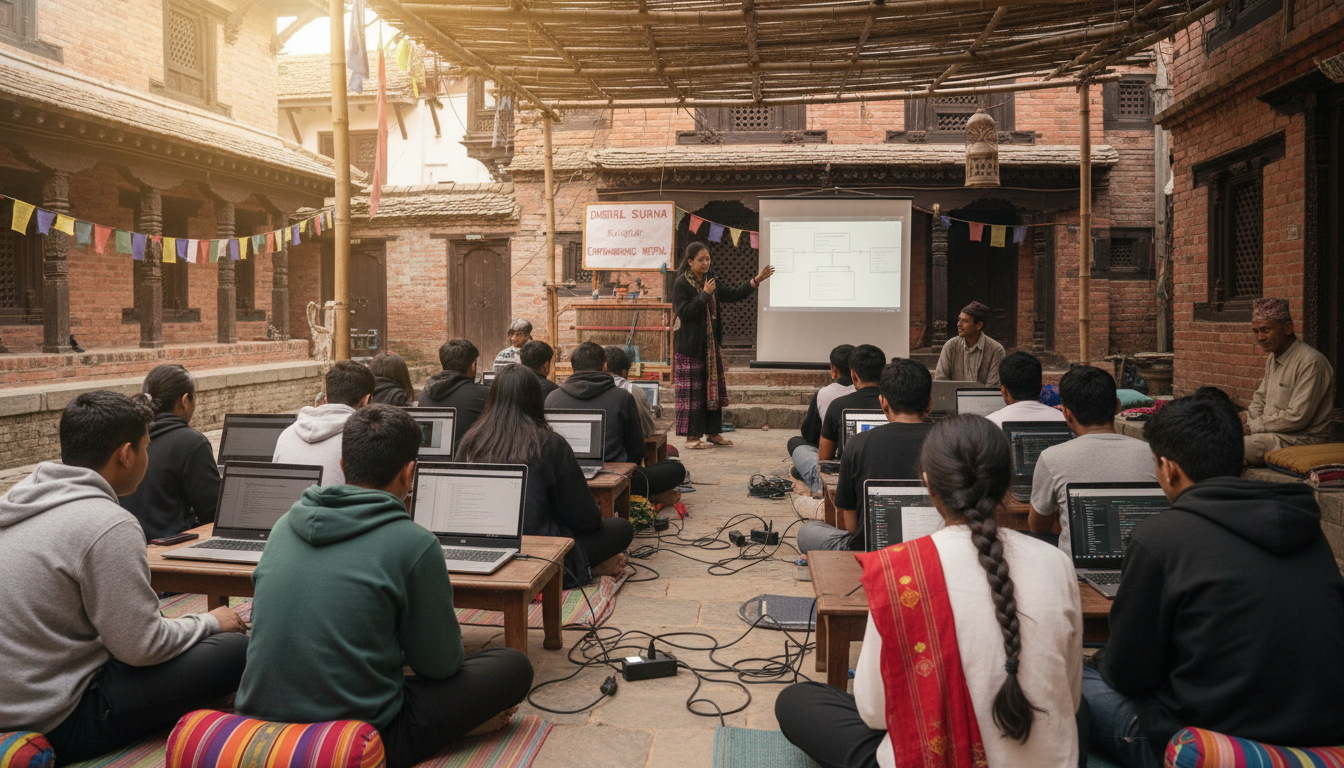
By focusing on stalled and informal cases rather than success stories alone, this research seeks to generate practical insights into the conditions under which such initiatives can survive and stabilize in similar Global South contexts.
Theoretical Framework
To analyze these dynamics, the research will draw on two key theoretical areas:
- Institutional Isomorphism & Logic: Understanding how these initiatives struggle to conform to the “standard” models of Western cooperatives while navigating local informal norms.
- Sociotechnical Systems Theory: This lens allows us to view the “stalling” not as a failure of technology, but as a misalignment between the technical design and the social reality of the workers.
These frameworks are used pragmatically, as analytical lenses rather than as abstract models, allowing empirical cases to remain central to the analysis.
Empirical Focus and Case Selection
The study moves beyond general surveys to a deep-dive analysis of two to three specific initiatives. The selection criteria prioritize “instructional friction”—cases that have attempted to organize but hit a ceiling.
Proposed Case Archetypes:
- The “Training-Turned-Coop”: A collective of freelancers (e.g., graphic designers or writers) that emerged from a training center. These groups often share work and profits but lack a legal cooperative charter.
- The “Paused” Platform”: An app-based service (e.g., local delivery or home services) that attempted a worker-owned model but has paused operations due to governance disputes or scaling inability.
- The Semi-Formal Collective: A group using low-code/no-code tools or shared social media channels to coordinate labor democratically, operating entirely outside the formal business registry.
Rationale: These cases allow for a comparative analysis across organizational forms (formal vs. informal) and varying degrees of platform reliance.
Methodology
The research adopts a qualitative, case-based approach grounded in embedded practitioner research.
Data Collection:
- Semi-Structured Interviews (n=15-20): In-depth discussions with organizers, cooperative members, dormant participants, trainers, and platform developers.
- Artifact Analysis: A review of “governance artifacts,” including WhatsApp group rules, platform terms of service, meeting minutes (if available), and training curricula.
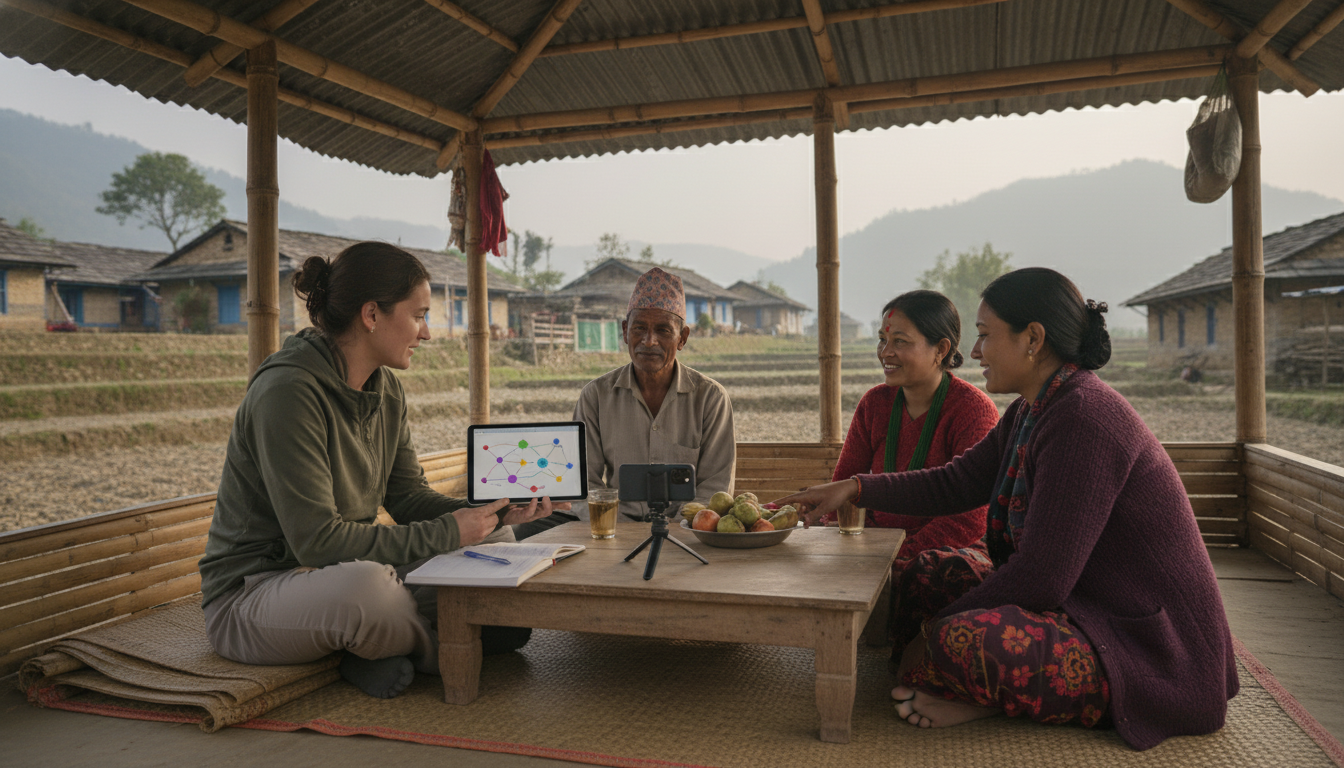
- UX/UI Walkthroughs: Observing how members interact with the digital tools used for coordination to identify friction points where technology discourages democratic participation.
Reflexivity:
The researcher acknowledges their proximity to the field as a practitioner in digital education. This “insider” status is an asset for access but requires rigorous reflexivity. The study will employ a “critical friend” approach—validating findings with participants to ensure the analysis reflects their lived reality, not just the researcher’s assumptions.
Timeline:
- Months 1–3 (Preparation): Finalize case selection, obtain ethical consent, conduct literature review on “institutional voids” in the Global South.
- Months 4–6 (Fieldwork): Conduct interviews, site visits, and digital ethnography of platform interactions.
- Months 7–9 (Analysis): Coding of data, identifying themes (e.g., “The Burden of Consensus,” “The Hidden Manager”), and drafting the comparative analysis.
- Months 10–12 (Dissemination): Finalizing the paper, producing the policy brief, and preparing conference presentations.
Relevance to ICDE & PCC Priorities
- Decolonial Research Approaches: It refuses to transplant Euro-centric definitions of “cooperativism” onto Nepal, instead looking at how solidarity looks from the ground up.
- Analyzing Failure/Stagnation: It answers the call for rigorous empirical analysis of why models fail, which is crucial for the “viability” metrics of the movement.
- Solidarity AI: By examining how basic algorithms impact informal groups, it contributes to the emerging debate on how AI can either serve or suppress worker autonomy in non-corporate settings.
While grounded in Nepal, the findings are expected to resonate across similar skill-mediated and informal digital labor ecosystems in South and Southeast Asia.
Expected Outputs and Public Engagement
Academic Output:
- An 8,000 to 10,000-word research paper suitable for publication as an ICDE working paper or in a journal such as New Media & Society.
Practitioner Tools:
- “The Stalled State Diagnostic“: A practical checklist for cooperative organizers to identify if they are falling into the “informality trap.”
- Policy Brief: A short document for Nepali policymakers and development agencies (e.g., ILO, UNDP) on how to support digital cooperatives beyond just providing seed funding.
- Conference Presentation: A session at the Platform Cooperativism Consortium Conference (Bangkok) focusing on “Governance via Education: The Role of Training Centers in the Gig Economy.”
Contribution
This research bridges the gap between digital optimism and institutional reality. By centering stalled, informal, and skill-mediated initiatives, it provides a grounded explanation for why solidarity-oriented projects struggle to move from intent to institution. It suggests that in the Global South, education is the proxy for governance, and understanding this link is key to creating sustainable platform cooperatives.
