


Nepali Elections: Microtargeting, Voter Segmentation & Digital Strategy
The Transformation of Political Communication in the Himalayas
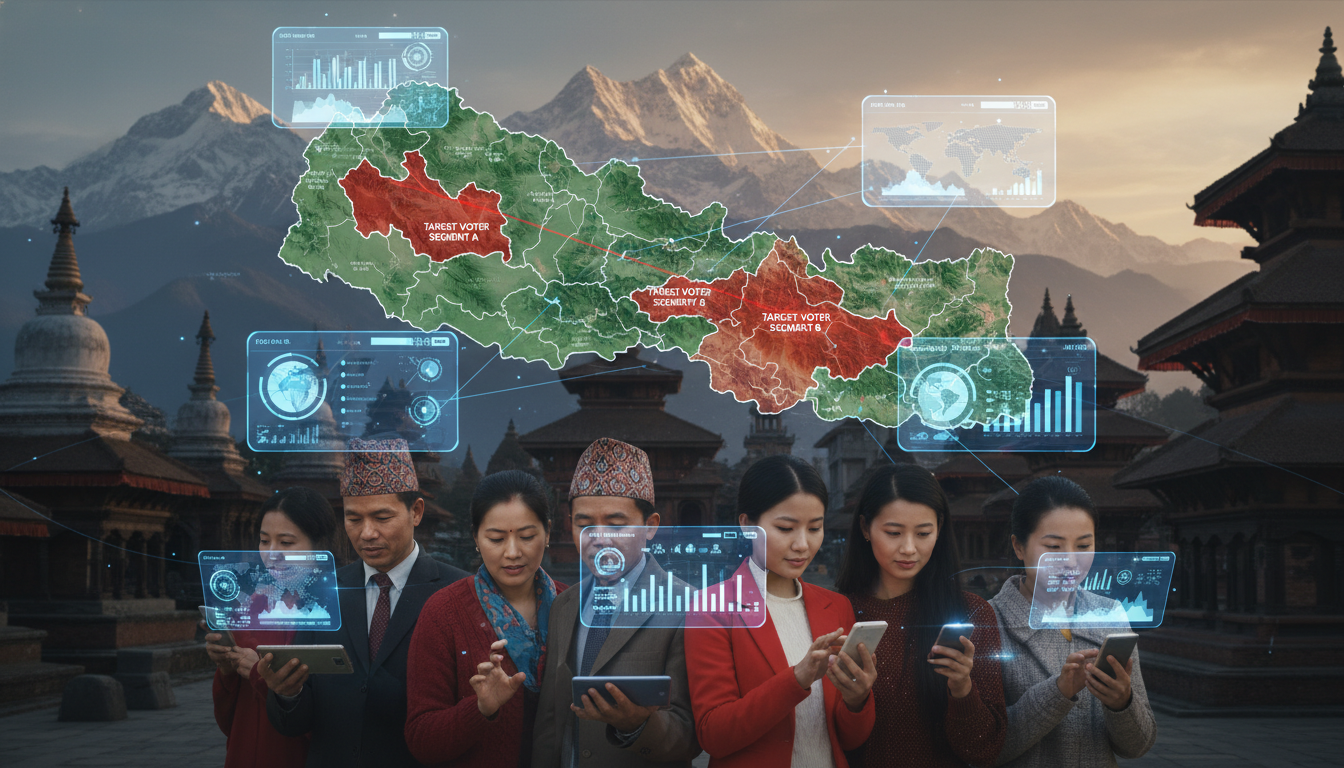
The electoral landscape of Nepal has undergone a seismic shift in the post-federalism era, moving from a model of mass rallies and door-to-door campaigning to a sophisticated, data-driven ecosystem of microtargeting and digital segmentation. As the nation approaches the snap parliamentary elections scheduled for March 5, 2026, the convergence of open-access voter data, high mobile penetration, and an unregulated social media environment has fundamentally altered the mechanics of voter mobilization. This transformation is not merely technological but deeply sociological, interacting with Nepal’s complex fabric of caste, ethnicity, geography, and the burgeoning youth demographic to create new fault lines in the democratic process.
The Post-2017 Digital Paradigm
The implementation of the 2015 Constitution and the subsequent 2017 elections marked the beginning of Nepal’s federal experiment, but the 2022 general elections and the 2025 Gen Z protests signaled the arrival of the “algorithmic era” in Nepali politics. Traditional gatekeepers of information—print media and broadcast television—have ceded dominance to decentralized digital platforms. In 2022, the electoral success of the Rastriya Swatantra Party (RSP) and independent candidates like Balen Shah demonstrated that digital dominance could translate into legislative power, bypassing the formidable grassroots machinery of established parties like the Nepali Congress (NC) and the CPN-UML.
The digital infrastructure underpinning this shift is robust. While the 2021 census indicated that 38% of households had fixed internet connections, mobile internet penetration is significantly higher, effectively bridging the digital divide in the Terai and mid-hill regions. This ubiquity of connectivity has allowed political actors to shift their focus from broad-spectrum broadcasting to “narrowcasting”—the delivery of tailored messages to specific segments of the electorate based on their digital and demographic profiles.
The Strategic Imperative for 2026
The context for the upcoming 2026 elections is volatile. The “Gen Z Protests” of September 2025, triggered by a government ban on social media platforms, resulted in the fall of the previous administration and the scheduling of snap polls. This sequence of events has cemented the internet not just as a campaign tool, but as a central battlefield of political legitimacy. Political parties are no longer just competing for votes; they are competing for attention in an attention economy defined by algorithmic sorting. Consequently, the sophistication of voter segmentation has increased exponentially. Strategies have evolved from simple age-based targeting to complex psychographic profiling, leveraging data fusion techniques that merge public voter rolls with private behavioral data to predict voting intent at the individual level.
The Data Infrastructure: The Foundation of Microtargeting
In many mature democracies, high-quality voter data is a proprietary asset, guarded by privacy laws and high costs. In Nepal, the foundational dataset for microtargeting is a state-provided public good, creating a unique environment where the barrier to entry for data-driven campaigning is paradoxically low, yet the risks of misuse are exceptionally high.
The Election Commission’s Biometric and Demographic Database
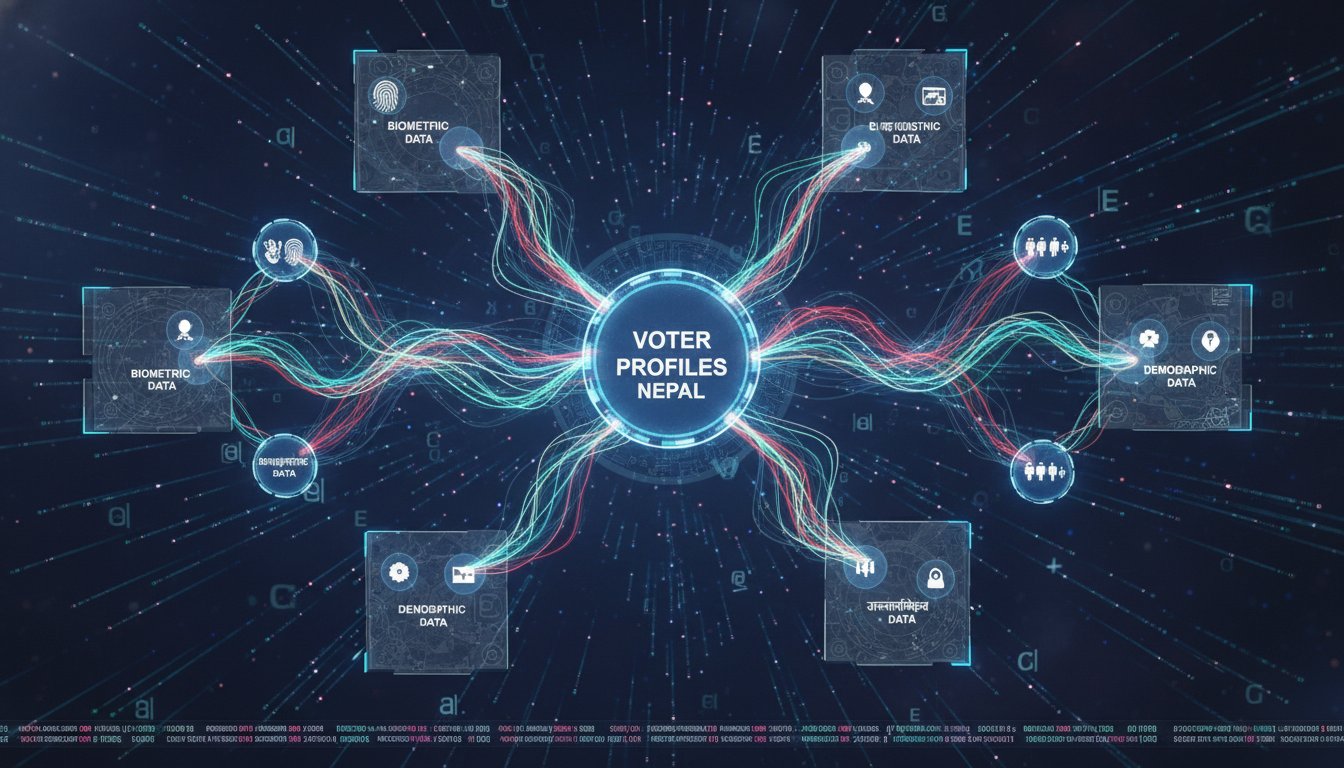
The Election Commission of Nepal (ECN) hosts one of the largest biometric databases in South Asia, containing the detailed profiles of over 17.7 million registered voters. While the collection of this data—including thumbprints and photographs—was intended to ensure election integrity and prevent voter fraud, the management and dissemination of the alphanumeric components of this database have inadvertently fueled the microtargeting industry.
The Electoral Rolls Rules, 2012 mandate transparency, requiring the ECN to make voter lists accessible. However, the granularity of the data provided is extensive. The publicly available voter list contains Personally Identifiable Information (PII) including the voter’s full name, age, gender, permanent address (down to the ward and tole level), voting station, and the names of their spouse, father, and mother. This level of detail allows for precise familial and household profiling. For a political strategist, knowing a voter’s family structure allows for targeted messaging: a household with elderly parents might receive messaging about senior citizen allowances, while a young couple in the same house receives messaging about job creation.
The Economics of Data Access
For the 2026 elections, the ECN has formalized the commercial access to this data, establishing a pricing structure that effectively democratizes access to high-fidelity voter intelligence. Political parties can acquire the entire national voter list—containing millions of records—for a fee of NPR 10,000 (approximately USD 75). Access to district-level data is priced similarly, while constituency-specific lists are available for NPR 3,000.
This low cost has profound implications for the electoral playing field. In other jurisdictions, building a voter file of this magnitude would cost millions of dollars, favoring well-funded incumbents. In Nepal, independent candidates and new parties can access the same foundational data as the ruling coalition for the price of a modest dinner. The ECN delivers this data electronically via hard drives or pen drives, stripping out the biometric photos to protect privacy, but leaving the demographic skeleton intact.
Data Fusion and the Grey Market
The raw voter list, while valuable, lacks the critical “last mile” connector: the mobile phone number. However, the ECN data acts as a primary key (via the Voter ID or unique name/location combinations) that allows political operatives to merge disparate datasets.
The Telecom Intersection
Nepal’s mobile SIM registration process requires citizenship identification, which is intrinsically linked to voter eligibility. While direct access to telecom databases is illegal, political parties often leverage informal networks within the telecom sector or utilize data harvested from previous membership drives to map mobile numbers to voter IDs. By cross-referencing the name and address from the ECN list with contact lists obtained from “missed call” campaigns or party apps, strategists create enriched voter profiles. This “data fusion” enables the delivery of unsolicited SMS and WhatsApp messages, a tactic that was prevalent in the 2022 elections and is expected to intensify in 2026.
App-Based Harvesting
The rise of political mobile applications represents a more formalized method of data enrichment. The Rastriya Swatantra Party (RSP) and CPN-UML have deployed mobile apps that serve dual purposes: party management and data collection. The RSP app, for instance, encourages supporters to register as members, collecting their location, contacts, and digital behavioral data. The privacy policy of such apps often allows for data usage to “provide personalized experiences,” a euphemism for political targeting. This voluntary surrender of data by supporters allows the party to identify “strongholds” and “swing zones” with high precision, mapping their digital support base against the physical voter rolls.
The Digital Divide and Platform Hierarchy
Understanding the data infrastructure also requires analyzing the platforms where targeting occurs.
- Facebook: Remains the “public square” of Nepali politics. It is the primary venue for official party communications, long-form manifestos, and paid advertising. Its user base covers the widest demographic spread.
- TikTok: The engine of viral mobilization. Before the temporary bans and subsequent restrictions, TikTok was the primary source of information for the under-30 demographic. Its content graph algorithm allows political messages to break out of follower networks and reach new audiences rapidly, making it crucial for candidate discovery.
- Dark Social (WhatsApp/Viber): The “hidden” layer of the campaign. Parties organize voters into neighborhood-level groups (e.g., “Ward 4 Youth Club”). Content circulated here is unmonitored by the ECN and often contains the most aggressive or polarizing messaging.
Geographic Microtargeting: From the Terai to the Himalayas
Geography in Nepal is not merely a physical setting; it determines the economic reality, cultural context, and information consumption habits of the voter. Effective microtargeting strategies in Nepal are deeply spatial, utilizing the hierarchical administrative structure of Province, District, Constituency, and Ward.
Ward-Level Granularity
The “Ward” is the atomic unit of Nepali politics. Winning a parliamentary seat often depends on aggregating margins from specific wards.
The availability of ward-level voter lists allows candidates to conduct “digital neighborhood watches.” In the 2022 elections, parties utilized “phygital” (physical + digital) strategies at the ward level. A Ward Committee member would receive the digital voter list for their specific area. They would then manually annotate this list, marking households as “loyal,” “opposition,” or “swing.” This annotated data would then feed into the central campaign strategy. If Ward 5 is identified as a swing area, the central “Cyber Army” targets voters in that specific geolocation with localized content—for example, ads promising to fix a specific road or water supply issue relevant only to that ward.
The Regional Divide: Terai vs.
Hills
Targeting strategies bifurcate sharply between the ecological belts.
The Madhesh (Terai) Strategy
The southern plains are densely populated and politically distinct. Here, the “ground game” remains dominant, but digital targeting is used to amplify on-ground narratives.
- Language and Medium: Messaging in the Terai often utilizes Maithili, Bhojpuri, or Tharu languages alongside Nepali. Due to varying literacy rates, video content (TikTok/YouTube) and voice-based communication (robocalls) are more effective than text-heavy Facebook posts.
- Cross-Border Dynamics: The proximity to India influences targeting. Narratives regarding citizenship rights, cross-border trade, and the Madhesh movement are microtargeted to specific ethnic clusters. For instance, voters in border constituencies might receive messaging emphasizing the candidate’s stance on border security or customs facilitation, distinct from the messaging sent to voters in the northern part of the same district.
The Urban Valley Strategy (Kathmandu/Pokhara)
In urban centers, the electorate is highly connected and deeply cynical about traditional campaigning.
- Issue-Location Matching: This strategy was pioneered by Balen Shah in 2022. His campaign used data to identify specific municipal failures—such as uncollected garbage in a particular Tole—and then targeted residents of that Tole with content showing him engaging with the issue. This created a perception of hyper-responsiveness.
- Digital Town Halls: Candidates in urban areas utilize Facebook Live and Zoom to conduct “digital town halls,” bypassing the need for physical rallies which can cause traffic congestion—a major grievance for urban voters. This respects the urban voter’s time and presents the candidate as “modern”.
The Remote Frontier
In the mountainous constituencies of Karnali or Sudurpaschim, digital connectivity is improving but intermittent. Here, the “influencer” model shifts from digital celebrities to local community leaders. Microtargeting involves identifying these key opinion leaders (teachers, local business owners) and engaging them via WhatsApp or direct phone calls, providing them with digital content to share offline via Bluetooth or during community gatherings. The “digital” campaign here effectively relies on a “human router” system.
Demographic Segmentation: The Anatomy of the Electorate
Demographic targeting in Nepal slices the electorate by age, gender, and the complex, often unspoken, variable of caste/ethnicity.
The Youth Bulge and “Gen Z” Politics
The most critical demographic shift in recent years is the dominance of the youth vote. In the 2022 election, 41% of registered voters were between the ages of 21 and 40. By 2026, this cohort, bolstered by the newly eligible Gen Z voters who led the 2025 protests, will be the decisive voting bloc.

The “No, Not Again” Campaign
The “No, Not Again” campaign of 2022 serves as a foundational case study in negative demographic targeting. It was an organic, decentralized online movement that targeted the “under-40” demographic with a singular message: the rejection of the “old guard” leadership (Sher Bahadur Deuba, K.P. Oli, Pushpa Kamal Dahal) who had rotated in power for decades.
- Mechanism: The campaign utilized meme culture and visual markers (a red “X” over the photos of elderly leaders). It did not necessarily promote a specific alternative but focused on demobilizing support for established parties among youth.
- Targeting: The content was algorithmically optimized for younger users on TikTok and Instagram, platforms where the “old guard” had little presence or credibility. The Election Commission’s attempt to ban this campaign only fueled its virality, invoking the “Streisand Effect” and framing the campaign as a free speech issue, which further resonated with the youth demographic.
The 2025 Radicalization
The 2025 protests marked the maturation of this demographic into a coherent political identity. Triggered by the government’s ban on social media platforms, the youth mobilized using tools like Discord and Telegram—platforms that were effectively invisible to the government’s monitoring apparatus.
- Segmentation: Political strategists now segment this group not just as “youth” but as “The Resistance.” Messaging to this group focuses on digital rights, anti-corruption, and a complete overhaul of the political system. The “Youths Against Corruption” discord channel acted as a digital parliament, even conducting straw polls for interim leadership, demonstrating a level of digital civic engagement that traditional parties struggle to comprehend.
Gendered Segmentation: Empowerment and Exclusion
Women constitute approximately 49% of the electorate, yet their digital experience is markedly different from men’s.
Targeting Women Voters
Parties utilize specific narratives to target female voters. These often revolve around micro-finance, maternal health, and representation. The ECN’s pilot of “accessible polling stations” in 2022 was heavily marketed to women and persons with disabilities, using targeted video content to demonstrate the ease of voting.
Gendered Disinformation and Harassment
Conversely, women candidates and politically active women are the primary targets of negative microtargeting. “Cyber armies” deploy gendered disinformation—sexualized slander, deepfakes, and character assassination—to delegitimize female opponents.
- Strategic Silence: Research indicates that this harassment functions as a strategy of exclusion. Many women journalists and politicians engage in self-censorship or withdraw from platforms like Twitter to avoid abuse, effectively silencing their voices in the digital public sphere.
- Case Studies: Women politicians have reported instances where their photos were manipulated (shallowfakes) to suggest immorality, a tactic designed to alienate conservative voters in their constituencies.
Caste and Ethnicity: The Silent Algorithm
While the Nepali constitution prohibits discrimination based on caste, political strategy is deeply entrenched in it. Since digital platforms like Meta do not allow for explicit targeting by “Caste,” strategists use proxies.
- Surname Inference: The public availability of full names in the voter list allows parties to infer caste and ethnicity with high accuracy. A “Jha” or “Yadav” is identified as Madhesi; a “Gurung” or “Magar” as Janajati.
- Micro-Narratives:
- Khas Arya: Targeted with narratives regarding national unity, stability, and the protection of Hindu cultural identity.
- Janajati: Targeted with narratives regarding proportional representation, identity politics, and cultural preservation.
- Dalit: Targeted with narratives regarding anti-discrimination and land rights.
These narratives are often contradictory. A party might run a “Pro-Hindu State” ad targeting Khas Arya voters in the hills while simultaneously running a “Secular/Inclusive” ad targeting Janajati voters in the east. This “dog-whistle” targeting is facilitated by the privacy of the news feed—Voter A never sees the ad shown to Voter B.
Issue-Based Segmentation and Narrative Warfare
Beyond fixed demographics, modern microtargeting focuses on psychographics: the voters’ fears, hopes, and trigger points.
The Corruption Axis
Corruption has emerged as the single most potent segmentation variable, largely driven by the rise of the Rastriya Swatantra Party (RSP).
- The “Clean” vs. “Corrupt” Binary: The RSP segments the electorate into those who benefit from the “syndicate” (party cadres) and those who are victims of it (everyone else). Their targeting focuses on the “victims,” using data-heavy infographics (“receipts”) that expose financial scandals.
- The “Bell” Phenomenon: The RSP’s election symbol, the Bell, became a viral meme representing a “wake-up call.” This symbolism was propagated through algorithmic riding—creating content that naturally generates high engagement (shares/comments) to bypass the need for paid promotion.
- Counter-Targeting: The hacking of the RSP website by “GenZRisingNepal” in late 2025 illustrates the volatility of this segment. The hackers used the “corruption” narrative against the RSP leadership itself, accusing them of hypocrisy regarding cooperative frauds. This indicates that the “Anti-Corruption” segment is not loyal to a party but to the issue; they will turn on any actor seen as violating the integrity standard.
The Geopolitical Wedge
Nepal’s strategic position between India and China is weaponized in digital campaigns.
- The “Nationalist” Voter: Voters who engage with content critical of Indian border interference or the US-funded MCC compact are segmented into a “Nationalist” bucket. They are targeted with content framing the opposition as “foreign agents.”
- Disinformation Narratives: During the 2025 protests, narratives were circulated claiming the unrest was “foreign instigated” (similar to events in Bangladesh), a tactic designed to consolidate the nationalist vote by triggering fears of lost sovereignty.
The “Remittance” Segment
With a massive diaspora population, the economy of migration is a key political issue.
- Targeting the Diaspora: Although they cannot vote from abroad, the diaspora exerts immense influence on their families back home. Parties maintain active overseas chapters (e.g., Pravasi Nepali Manch). They target migrant workers in the Gulf, Malaysia, and the West with content emphasizing “returning home” or “protecting the family left behind.”
- The Influence Loop: A migrant worker in Qatar is targeted with a Facebook post detailing a local infrastructure failure in his home village. He then calls his family in that village, urging them to vote against the incumbent. This “remittance influence” effectively outsources the campaign to the diaspora.
The Machinery of Influence: Strategies and Tools
The execution of these segmentation strategies relies on a complex machinery of human and algorithmic agents.
“Cyber Armies” and Organized Trolling
Major political parties have institutionalized their digital wings, often referred to as “Cyber Armies.”
- CPN-UML’s “Cyber Circle”: Formerly the “IT Army,” this group operates as a disciplined, hierarchical organization. It is tasked with disseminating party narratives and “swarming” opposition content. If an opposition leader posts a critique, the Cyber Circle mobilizes hundreds of comments to drown out the message and report the post for community standards violations.
- Nepali Congress’s “NC WIN”: The “Wide Information Network” was established to counter communist dominance in the digital sphere. It focuses on projecting the party’s historical legacy and democratic credentials, though it often struggles with the agility of its younger rivals.
The Rise of Political Apps
The 2022 and 2026 election cycles have seen the deployment of dedicated political apps.
- RSP App: This app is a cornerstone of the RSP’s strategy. It gamifies political participation, allowing users to register as members, donate, and access party news. Crucially, it collects user data—including location and contacts—allowing the party to build a “heatmap” of support independent of the ECN rolls. The app’s privacy policy, while claiming to protect data, allows for usage to improve “user experience,” a broad clause that covers targeted mobilization.
- CPN-UML App: Similar in function, this app integrates with the party’s massive cadre base, digitizing the membership renewal process and allowing the central leadership to push notifications directly to the pockets of grassroots workers.
Unsolicited Messaging (SMS/Email)
The convergence of voter lists and mobile data has normalized the use of unsolicited direct messaging.
- Bulk SMS: Candidates purchase bulk SMS packages targeted by location. A voter in Kathmandu-4 might receive a text saying, “Vote for Candidate X to solve the Melamchi water crisis.”
- Privacy Violation: This tactic is widely criticized as invasive. Unlike social media ads, which can be scrolled past, SMS invades the personal notification tray. During the 2022 election, the volume of spam led to significant voter fatigue and anger, yet the low cost and high read rate make it an irresistible tool for candidates.
Ethical Limits and the Regulatory Vacuum
The rapid evolution of microtargeting has outpaced the legal and ethical frameworks of Nepal.
The Privacy Crisis
The fundamental ethical failure lies in the public exposure of voter data.
- Safety Risks: The availability of addresses and family details on the ECN website poses tangible risks to victims of domestic violence, stalking, and marginalized individuals. Civil society organizations have argued that this violates the constitutional right to privacy, but the ECN maintains that transparency of the electoral roll takes precedence.
- State Surveillance: The reported acquisition of Pegasus spyware by state agencies introduces a darker dimension. The fear is that the detailed voter profiles created for campaigning could be repurposed for state surveillance of dissidents, journalists, and opposition leaders.
The ECN’s Code of Conduct 2082
For the upcoming March 2026 elections, the ECN has introduced a rigorous Code of Conduct to address these digital challenges.
- Ban on Foreign Ads: The Code prohibits the use of sponsored (paid) advertisements on foreign social media platforms like Facebook, TikTok, and X. This is intended to curb the influence of money in politics and prevent foreign interference. However, enforcing this is technically challenging, as payments can be routed through third-party agencies or personal accounts.
- AI and Deepfakes: The Code explicitly bans the use of Artificial Intelligence to create misleading content. This targets the growing threat of deepfakes and “shallowfakes” (manipulated audio/video).
- Enforcement Reality: While the rules are strict, the ECN’s capacity to monitor the “dark social” (encrypted apps) and the sheer volume of content is limited. The reliance on platform cooperation (Meta, TikTok) is a bottleneck, as these companies often have slow response times for content takedowns in smaller markets like Nepal.
The Disinformation “Infodemic”
Microtargeting creates echo chambers where disinformation can thrive unchecked.
- Shallowfakes: The most prevalent form of manipulation is not high-tech AI, but simple video editing—slowing down a video to make a leader appear drunk or cropping a quote to reverse its meaning. These are cheap to produce and spread virally on TikTok.
- Verification Gap: While fact-checking initiatives like Nepal Check and South Asia Check exist, they are outgunned by the volume of false content. The “truth” often arrives days after the lie has already influenced voter sentiment.
Case Studies in Digital Campaigning
Balen Shah: The Independent Blueprint
Balen Shah’s victory in Kathmandu was a masterclass in independent microtargeting.
- The Strategy: Lacking a party machine, Shah built a “digital machine.” He utilized a network of volunteers who dominated the comment sections of major news portals.
- Content Strategy: He avoided high-level political ideology. Instead, he focused on “engineering solutions” to urban problems. His content was visual, short, and highly shareable. He utilized “influencer marketing,” getting endorsements from non-political figures (artists, rappers) to reach the apolitical youth demographic.
- Impact: His win proved that digital microtargeting could overcome the “party vote” in urban centers, creating a blueprint for the 2026 independents.
The Gen Z Uprising
The 2025 protests demonstrated the mobilizing power of the “digital underground.”
- The Catalyst: The government’s attempt to ban social media platforms backfired, radicalizing a generation that views internet access as a fundamental right.
- The Toolset: Denied access to Facebook, the movement migrated to VPNs and encrypted apps. They used these tools not just for communication but for democratic organization—voting on leadership and strategy in real-time. This “digital democracy” stood in stark contrast to the opaque, top-down decision-making of the traditional parties.
Future Outlook: The 2026 Election and Beyond
As Nepal heads toward the polls in March 2026, the era of analog politics is definitively over. The election will be fought on the screens of smartphones as much as on the streets.
The Persistence of Microtargeting
Despite the ECN’s bans, microtargeting will likely evolve rather than disappear. Parties will shift from “paid ads” to “organic amplification” via Cyber Armies. They will move from public posts to private WhatsApp groups. The use of data fusion to link voter IDs to mobile numbers will continue in the grey market.
The Risk of Polarization
The ultimate consequence of microtargeting is polarization. When voters are segmented and fed only the information that aligns with their existing biases, the shared public reality fractures. The “No, Not Again” campaign and the “Cyber Circle” attacks are symptoms of this fracturing.
The Need for a Digital Rights Framework
The current situation is unsustainable. Nepal urgently needs a comprehensive Data Protection Act that regulates the use of personal data in politics. The “open data” policy of the ECN must be balanced against the privacy rights of citizens. Without these safeguards, the democratization of data access risks becoming the democratization of surveillance and manipulation.
The 2026 election will be a test case for whether Nepal’s democracy can survive its digital transformation. It will determine whether these tools empower the citizen to hold the state accountable, or empower the state and political elites to manipulate the citizen with unprecedented precision.
Age
- Gen Z: Anti-establishment
- Youth: Employment
- Elderly: Stability/Pension
Migration
- Resident: “Ground game”
- Diaspora (Migrant Workers): “Influence the family”
Ideology
- Anti-Corruption: “Receipts” of scams
- Nationalist: Sovereignty narratives
- Identity-Based
Gender
- Male: Generic
- Female: Safety/Microfinance
- Female (Opponent): Harassment
