

Digital Politics Nepal: Social Media Ads & Election Strategy
Introduction: The Intersection of Federalism and Digital Connectivity
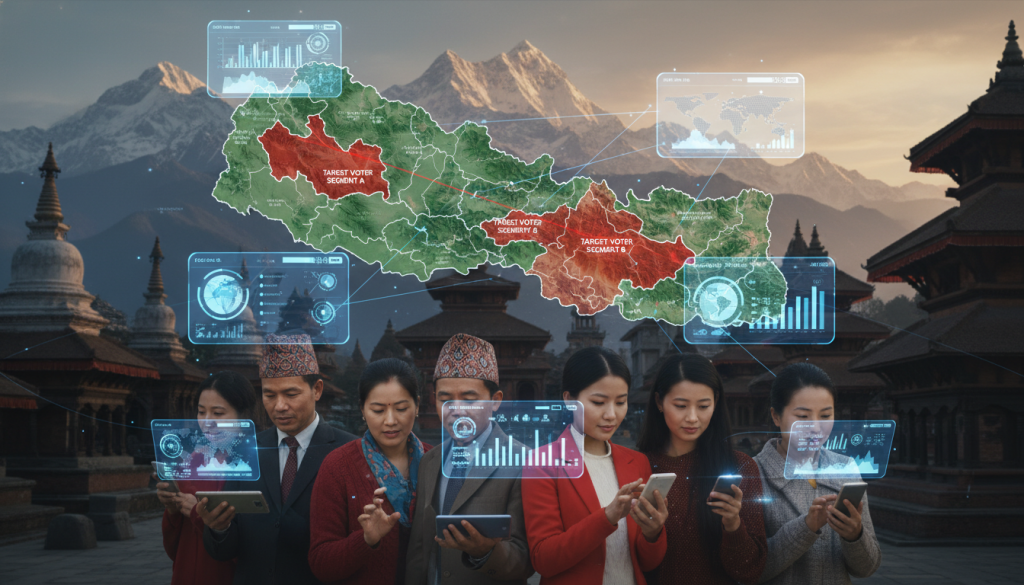
The political evolution of Nepal, marked by the promulgation of the Constitution in 2015 and the subsequent transition to a federal democratic republic, has coincided with a seismic shift in the nation’s information architecture. The transition from a centralized, analog governance model to a federalized system comprising 753 local units has been mirrored by the decentralization of public discourse through digital platforms. As the country prepares for the inevitable operational complexities of the upcoming 2027 general elections, the role of social media—specifically paid political advertising—has transcended its initial status as a supplementary campaign tool to become the central nervous system of electoral strategy.
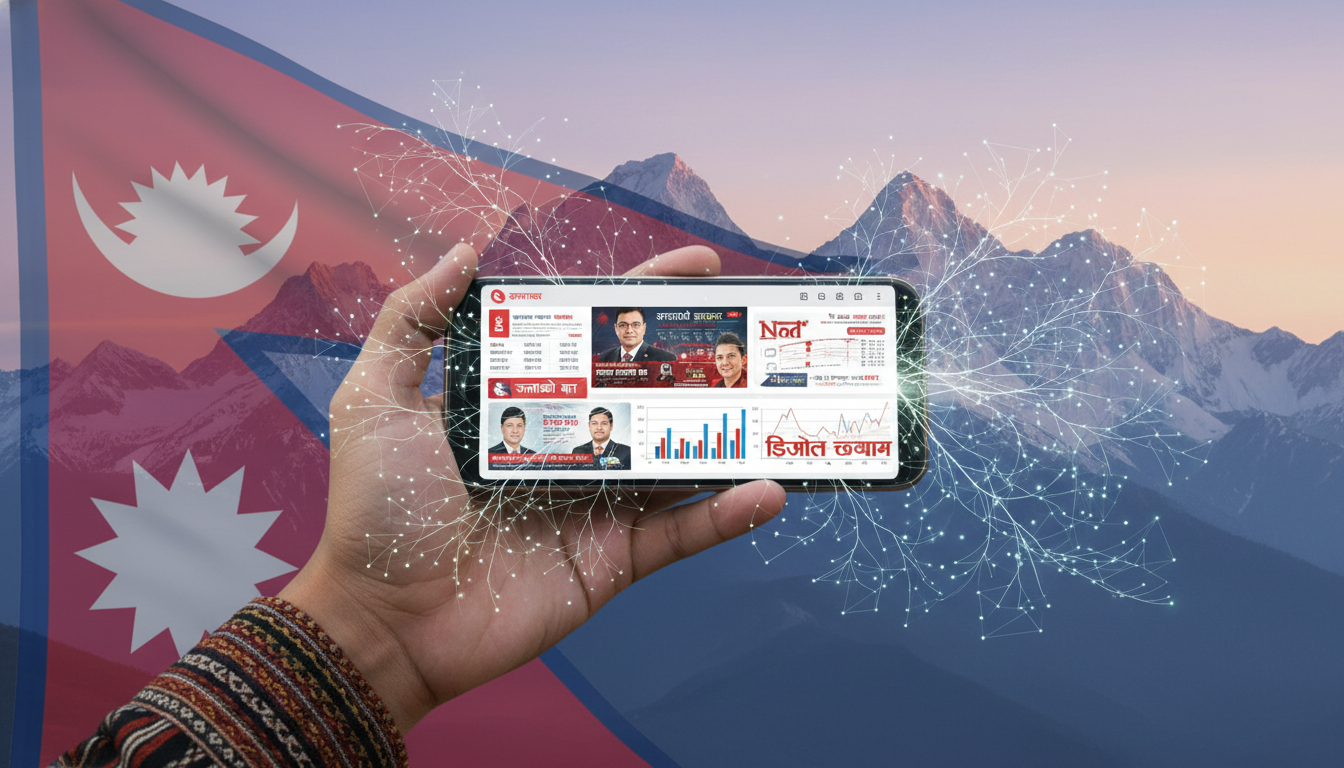
This report provides an exhaustive analysis of the political advertising landscape in Nepal. It dissects the intricate friction between the rigid, geography-bound regulatory frameworks established by the Election Commission of Nepal (ECN) and the fluid, borderless algorithms of Silicon Valley giants. By examining the specific verification requirements of Meta and Google, the volatile regulatory history of TikTok, and the budgetary behaviors of Nepali political actors, this document aims to serve as a foundational text for understanding the mechanics of digital democracy in the Himalayas.
The analysis is grounded in the reality that Nepal represents a unique “petri dish” for digital politics. With a digital penetration rate that effectively covers the entire voting-age population, yet a regulatory capacity that struggles with enforcement, the country exemplifies the challenges of maintaining information integrity in the Global South. The emergence of “negative partisanship,” driven by algorithmic amplification, and the weaponization of the “silence period” are not merely technical glitches but fundamental challenges to the democratic process defined by the 2015 Constitution.
The Digital Electorate: Demographics, Behavior, and Market Dynamics
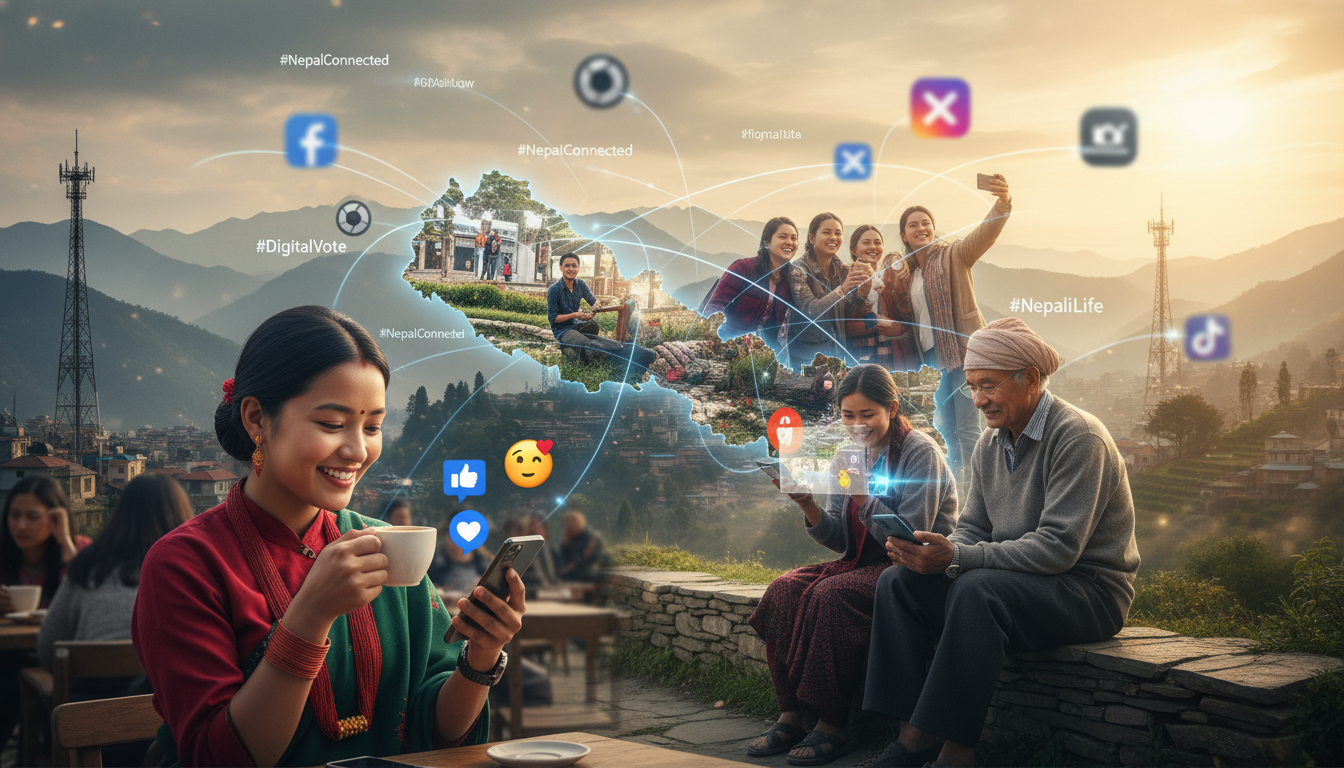
To understand the efficacy of political advertising in Nepal, one must first map the digital terrain. The electorate is no longer defined solely by geography—districts, constituencies, or wards—but by digital affinities and platform behaviors. The data suggests a rapid consolidation of the public sphere onto a few proprietary platforms, creating a “Facebook Nation” where the algorithm acts as the primary gatekeeper of political reality.
The Ubiquity of Connectivity
As of early 2025, Nepal’s digital infrastructure supports a robust user base that aligns closely with the voting demographic. Data from ad planning tools indicates that there are approximately 14.3 million social media users aged 18 and above in Nepal. When juxtaposed against the total eligible voting population, this figure suggests a near-total saturation of the urban and semi-urban electorate, and significant penetration into rural areas facilitated by the proliferation of affordable mobile data and smartphones.
The implication for political advertisers is profound: “Digital” is no longer a niche channel for reaching youth; it is the mass media of contemporary Nepal. The reach of traditional print media and even broadcast television is increasingly fragmented, whereas social platforms offer an aggregated audience that rivals the population of the entire country.
Platform Dominance and Stratification
The market share of social media platforms in Nepal dictates where political budgets are allocated. The ecosystem is heavily skewed toward Meta, creating a near-monopoly on paid political communication.
Table 1: Social Media Platform Market Share and Demographic Profile in Nepal (December 2025)
| Platform | Market Share | User Base (Est.) | Gender Skew | Strategic Political Function |
|---|---|---|---|---|
| 89.18% | 14.3 Million | 56% Male / 44% Female | The Primary Utility. Used for mass mobilization, official party manifestos, and local community organizing. It is the “town square.” | |
| 5.21% | ~1.5 Million | Heavy Male Skew | The Elite Echo Chamber. Used for narrative setting among journalists, diplomats, and the political class. High influence, low voter reach. | |
| YouTube | 4.02% | High (Video consumption) | Balanced | The Broadcast Network. Long-form interviews, speeches, and “explainer” videos. Critical for literacy-challenged demographics. |
| 0.52% | 3.9 Million | Youth / Urban Skew | The Lifestyle Filter. Soft power projection for younger candidates. Focus on aesthetics over policy. | |
| 0.86% | 1.5 Million | 71.6% Male | The Donor Network. Professional networking used to target high-net-worth individuals and policy professionals. | |
| TikTok | N/A (Organic Dominance) | High | Balanced / Youth Skew | The Viral Engine. Short-form video for emotional resonance and “soundbite” politics. Subject to high regulatory volatility. |
Facebook as Critical Infrastructure:
With nearly 90% market share, Facebook is the operational backbone of Nepali politics. For a candidate in a rural municipality, a Facebook Page is more valuable than a physical office. The platform’s demographic skew toward men (56.4%) presents a structural challenge for gender-inclusive campaigning. Political strategists must employ specific gender-segmented ad sets to ensure their message reaches female voters, who are often less visible in the public comment sections but remain a critical voting bloc.
The Resurrection and Regulation of TikTok:
The trajectory of TikTok in Nepal offers a critical case study in state sovereignty vs. platform power. Banned in November 2023 for “disrupting social harmony”, the platform was unbanned in August 2024 after complying with government registration requirements. By 2025, TikTok had re-established itself as a dominant force. However, its role in paid advertising remains distinct from Meta. While Meta allows direct placement of political ads (subject to verification), TikTok’s global policy generally restricts political ads. Consequently, Nepali politicians utilize TikTok primarily for organic reach or through “Grey Market” influencer campaigns, where popular creators are paid to promote candidates without utilizing the formal ad interface.
The Economics of Attention: CPM and CPC Analysis
Nepal remains one of the most cost-efficient advertising markets in the world. This low barrier to entry has democratized political speech, allowing independent candidates to compete with well-funded parties, but it has also led to a “Tragedy of the Commons” scenario where the electorate is bombarded with high-frequency messaging.
Cost Dynamics:
- Cost Per Click (CPC): The average CPC on Facebook in Nepal ranges from NPR 5 to NPR 40 ($0.04 – $0.30 USD). In comparison, Google Ads average around $0.64 USD.
- Cost Per Mille (CPM): The cost to reach 1,000 people on Facebook fluctuates between NPR 80 and NPR 500 ($0.60 – $3.75 USD).
Strategic Implications of Low CPM:
- Saturation Capability: A budget of NPR 100,000 (approx. $750 USD) can generate anywhere from 200,000 to 1 million impressions. For a local Ward Chairperson candidate, whose constituency might only contain 5,000 voters, this budget allows for a “saturation strategy” where every voter sees the candidate’s content dozens of times.
- The “Spam” Effect: The cheapness of impressions encourages quantity over quality. Candidates often choose to “boost” every post rather than strategically targeting specific messages. This contributes significantly to voter fatigue and ad blindness.
- Cross-Border Arbitrage: The disparity in ad costs means that diaspora funding (remittances) goes significantly further in Nepal than in the host countries. A Nepali worker in Qatar or Malaysia can fund a significant portion of a local campaign with a fraction of their monthly income, amplifying the political influence of the diaspora.
The Regulatory Architecture: The Election Commission of Nepal (ECN)
The governance of political advertising in Nepal is defined by the Election Code of Conduct (CoC), a legal instrument designed for a physical world that is increasingly struggling to contain a digital reality. The ECN, constitutionally mandated to conduct free and fair elections, has found itself in a perpetual game of catch-up with technological advancements.
The Election Code of Conduct (CoC)
The CoC acts as the supreme regulatory guideline during election periods. It imposes strict behavioral norms, financial caps, and temporal restrictions on campaigning.
Key Provisions Affecting Digital Advertising:
- Expenditure Ceilings: The ECN sets specific spending limits based on the tier of the election. For the 2022 local elections, the expenditure limit for a Mayoral candidate in a Metropolitan City was capped at NPR 750,000. This cap is comprehensive, meant to cover staff, rallies, print materials, and digital advertising.
- Prohibition on Misinformation: The CoC explicitly forbids the dissemination of “false, misleading, or hate-speech” content via social media. This provision empowers the ECN to request takedowns.
- The “Silence Period”: Perhaps the most contentious regulation, the ECN enforces a silence period commencing 48 hours before polling begins. During this window, all physical campaigning must cease, and the “posting” of new content on social media is prohibited.
The “Silence Period” Paradox:
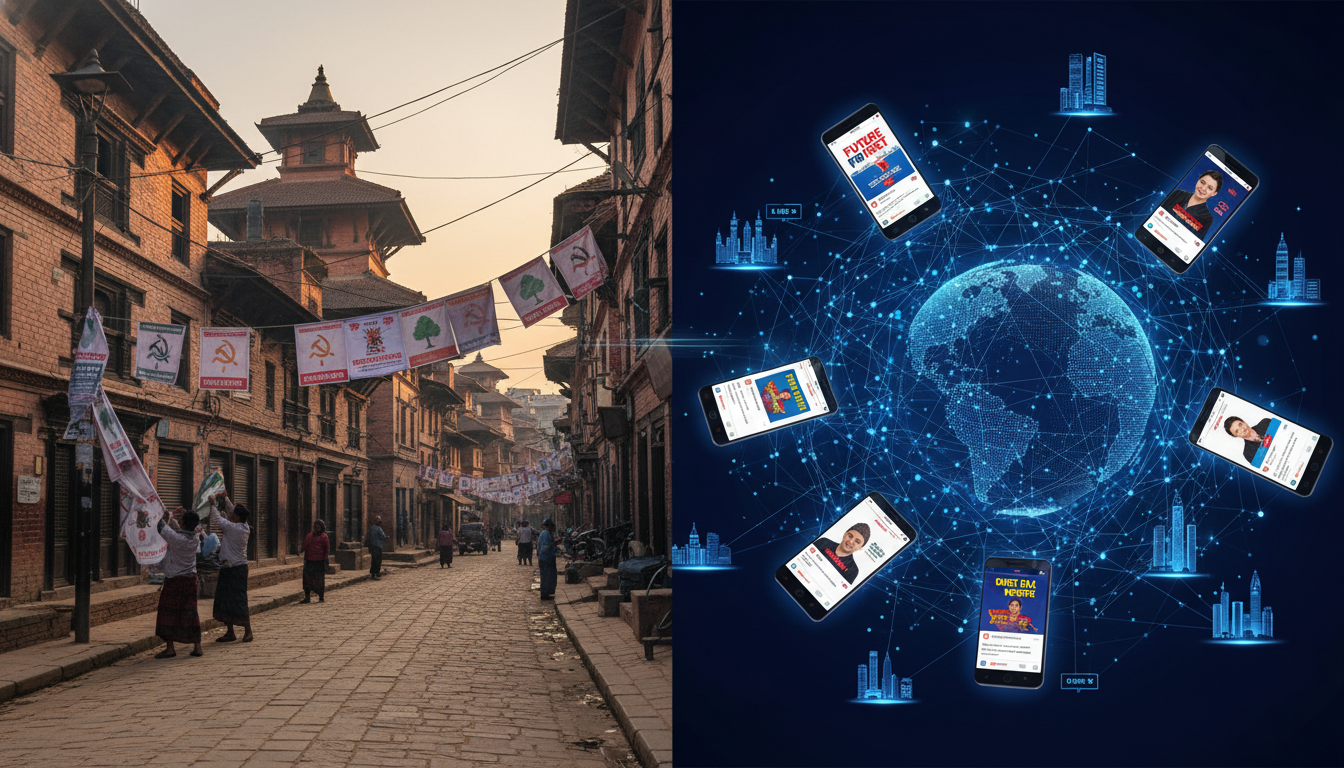
In the analog era, the silence period meant removing physical banners and stopping rallies. In the digital era, the interpretation is ambiguous. While candidates are barred from posting new content, the algorithms do not stop serving content that was posted days earlier or that is currently being “boosted” by third parties.
Furthermore, the global nature of the internet means that supporters in the US, UK, or Australia—who are outside the ECN’s jurisdiction—often ramp up their activity during the silence period, effectively nullifying the domestic ban.
Surveillance and Enforcement: The Role of the State
Recognizing the limitations of voluntary compliance, the ECN has increasingly turned to surveillance technologies and inter-agency cooperation to enforce the CoC.
Militarization of Monitoring:
For the election cycles leading into 2026/2027, the ECN has formalized a collaboration with the Nepalese Army and the Nepal Telecommunication Authority (NTA) to monitor the digital sphere. This involves the deployment of “cyber teams” equipped with algorithms to detect Code of Conduct violations in real-time.
-
The Mechanism: The monitoring apparatus scans for keywords related to hate speech, anti-national sentiment, and silence period violations.
-
The Implication: The involvement of the military in domestic election monitoring raises significant questions regarding civil-military relations and the potential for overreach. While the stated goal is “election security”, the capacity for this infrastructure to be used for political suppression is a concern for civil society groups.
Platform Liaison:
The ECN has established direct communication channels with Meta (Facebook) and TikTok to expedite “takedown” requests. The government’s leverage was demonstrated by the 2023-2024 TikTok ban; platforms are now acutely aware that non-compliance with ECN directives can result in a total market lockout. This has made platforms more responsive to ECN requests, effectively outsourcing censorship to the tech giants.
The Enforcement Gap: “Shadow Spending”
Despite these measures, the enforcement of expenditure limits remains the ECN’s Achilles’ heel. The decentralized nature of digital ad buying allows for massive “shadow spending” that never appears in official reports.
-
The Agency Loophole: Candidates often funnel cash to digital marketing agencies, who then run ads from their own Business Manager accounts. Since the agency is a private service provider, its internal accounts are not subject to the same scrutiny as the candidate’s bank account.
-
Third-Party Proxies: “Shadow Pages”—unofficial fan pages, meme pages, or “News” aggregators—run negative campaigns or boosterism without officially declaring ties to the candidate.
-
Underreporting: Studies of the 2017 and 2022 elections revealed that over 50% of candidates exceeded legal spending limits, with 90% underreporting their expenses. The disconnect between the official limit (e.g., NPR 750,000 for a Metro Mayor) and the actual market cost of a competitive campaign (often in the millions) makes non-compliance a systemic necessity rather than an aberration.
Platform-Specific Policies: The Verification Gauntlet
For a political advertiser in Nepal, complying with the ECN is only half the battle. The other half involves navigating the complex, often opaque “Election Integrity” policies of Silicon Valley platforms. Both Meta and Google have instituted global verification regimes that apply to Nepal, often creating significant operational hurdles for local actors.
Google Ads: The Strict Verification Regime
Google’s policy for “Political Content” is binary: verify or be blocked. The platform bifurcates advertisers into “Organizations” and “Individuals,” with stringent documentation requirements for each.
Verification Requirements for Nepal:
-
Identity Matching: The most common point of failure for Nepali advertisers is the requirement that the name on the Payments Profile must exactly match the name on the submitted documents. In the chaotic structure of Nepali political parties, where ad accounts might be created by a junior IT staffer using a personal Gmail but paid for by a party credit card, this mismatch frequently leads to verification failures.
-
Accepted Documents:
- Organizations: Certificate of Incorporation, VAT/PAN registration certificate, or an extract from the commercial register.
- Individuals: A valid Nepal government-issued photo ID. Crucially, Google accepts the Election Commission Voter ID card, bridging the digital ID with the political franchise. Other accepted IDs include Passports, Citizenship Certificates, and Driver’s Licenses.
-
Image Quality: Google enforces strict technical standards: color images, no photocopies, and clear lighting. This automated rejection of low-quality scans is a frequent hurdle for rural advertisers with limited digitization capabilities.
Transparency and Restrictions:
Google maintains an Ads Transparency Center where verified political ads are publicly viewable. Furthermore, Google’s systems are configured to respect local “Silence Periods”. If the ECN mandates a blackout, Google may programmatically pause ads targeting Nepal during that window, offering a layer of automated compliance that protects advertisers from inadvertent legal exposure.
Meta (Facebook/Instagram): The “Social Issues” Matrix
Meta’s policy is broader and more complex, categorized under “Social Issues, Elections, or Politics.” This captures not just candidate promotion but also NGO advocacy, issue-based campaigning, and “Get Out The Vote” efforts.
The Authorization Workflow:
-
Identity Confirmation: The administrator of the Facebook Page running the ads must confirm their identity using a government-issued ID (Passport or Citizenship).
-
Residency Requirement: The administrator must be physically located in the country where the ads are running (Nepal). This is designed to prevent foreign interference (e.g., the Russian interference model). However, this creates a bottleneck for the Nepali diaspora who wish to run ads for their home districts; they must find a proxy in Nepal to serve as the admin.
-
“Paid for by” Disclaimer: Every political ad must carry a disclaimer stating the funding source. Failure to include this results in immediate ad rejection.
The Meta Ad Library:
The Ad Library is the primary mechanism for transparency on Facebook and Instagram.
-
Data Retention: Meta archives political ads for seven years. This allows researchers to analyze campaigns retrospectively.
-
Granularity: The library provides data on spend ranges (e.g., NPR 10,000 – 50,000), impression ranges, and demographic targeting (Age, Gender, Location).
-
Blind Spots: While the library is a powerful tool, it relies on the advertiser self-declaring the ad as political. If a candidate runs a “boosted post” about a local festival without checking the political box, and the AI fails to flag it, the ad bypasses the archive completely. This “false negative” rate is a significant gap in transparency. Additionally, the library has been criticized for API bugs that hinder bulk data analysis.
The TikTok Anomaly: From Ban to “Influencer” Politics
TikTok’s relationship with the Nepali state is unique. Following the government’s ban in late 2023 and subsequent unbanning in August 2024, the platform operates under heightened scrutiny.
The Policy Divergence:
Unlike Meta and Google, TikTok generally prohibits paid political ads on its platform globally. However, this has not stopped political promotion.
-
The “Grey Market”: Political parties circumvent the ad ban by paying influencers to create organic content. A popular TikTok creator might release a skit or a dance video featuring a candidate’s jingle. Since this is technically “organic” content (even if paid for under the table), it bypasses TikTok’s ad review systems.
-
Viral Loops: The strategy on TikTok is not “reach” (paid views) but “virality” (organic shares). Parties invest in “IT Cells” dedicated to clipping candidate speeches into 15-second emotional highlights designed to trigger the algorithm’s recommendation engine.
-
Compliance Office: TikTok’s establishment of a liaison office in Nepal means that while paid ads are absent, the government has a direct line to request the removal of “organic” content that violates the Code of Conduct, making TikTok a heavily policed space for political speech.
Budget Allocation Strategies: The Economics of Influence
The allocation of campaign funds in Nepal has shifted dramatically. The traditional “Masala” budget (tea, snacks, fuel for motorcycles) is increasingly being diverted to the “Data” budget (boosting, video production, influencer payments).
Strategic Archetypes
Based on expenditure trends from the 2022 elections and current market dynamics, three distinct budget allocation models have emerged:
-
The “Air War” Model (Legacy Parties – UML, Nepali Congress)
- Digital Share: 15-20% of total budget.
- Focus: Brand maintenance and base mobilization.
- Tactic: High-volume “Brand Awareness” campaigns managed by central party offices or large Kathmandu-based agencies. The CPN-UML, for example, spent an estimated NPR 40 million on central publicity in 2022.
- Content: Professionally produced music videos, high-resolution graphics of mass rallies, and manifesto highlights.
-
The “Insurgent” Model (Rastriya Swatantra Party – RSP / Balen Shah)
- Digital Share: 60-80% of total budget.
- Focus: Conversion and disruption.
- Tactic: Heavily reliant on “Cyber Circles” and volunteer networks. The strategy leverages the “organic multiplier” effect—using small ad spends to seed content that then spreads virally on TikTok and Facebook Groups.
- Content: Raw, authentic “selfie-style” videos, anti-establishment memes, and rapid response to news events. This model proved decisive in the 2022 elections, allowing newcomers to bypass traditional media gatekeepers.
- 3.
The “Hyper-Local” Model (Ward Chairs / Rural Mayors)
- Digital Share: <10% (Ad-hoc spending).
- Focus: Community visibility.
- Tactic: Using personal Facebook profiles to live-stream rallies and boosting specific posts using personal credit cards or remittance money sent by relatives abroad.
- Content: Photos of local infrastructure projects (roads, taps) and attendance at weddings/funerals.
5.2 The Diaspora Factor: Remittance Politics
The influence of the Nepali diaspora cannot be overstated. With personal remittances accounting for 33.06% of GDP, the economic lifeline of the country is also a political lifeline.
- Funding: Diaspora chapters (e.g., Overseas Nepali Forum, Nepali Janasamparka Samiti) act as major fundraisers.
- Direct Spending: Instead of sending cash, diaspora members often pay for ads directly using foreign credit cards. A supporter in Sydney can target ads to their home village in Jhapa. This spending is invisible to the ECN and constitutes a significant portion of the Shadow Budget.
6. Campaign Performance: Optimization and Fatigue
In the high-frequency, low-cost environment of Nepali social media, the challenge is not just reaching the voter, but retaining their attention without inducing hostility.
6.1 Message Fatigue and the “Hide Ad” Metric
The low CPM encourages advertisers to bid for maximum impressions. However, this often leads to frequency saturation.
- The Phenomenon: A voter in a contested urban constituency might see the same ad for a Mayoral candidate 20 to 30 times a day.
- Psychological Impact: High frequency initially builds recognition, but quickly crosses a threshold into annoyance. Sentiment analysis suggests that after a frequency of 4-5 impressions per week, the Hide Ad and Report Ad rates spike.
- Negative Partisanship: Oversaturation can drive voters toward the opposition purely out of spite. The No Not Again campaign in 2022 capitalized on this fatigue, using the ubiquity of established leaders’ faces as a visual motif for their own negative campaigning.
6.2 Frequency Control Strategies
Sophisticated campaign managers are now implementing technical controls to mitigate fatigue:
- Frequency Capping: Using Meta’s automated rules to limit impressions to 1 or 2 per user per day.
- Creative Rotation: Instead of showing the same static image, campaigns rotate between 5-10 variations (video, carousel, static) to keep the visual stimulus fresh while delivering the same core message.
- Dayparting: Running ads only during peak engagement hours (morning and evening) rather than 24/7, to align with user behavior patterns.
6.3 Targeting and Exclusion
The granularity of targeting in Nepal has improved significantly.
- Geo-Fencing: Advertisers can target specific municipalities (Palikas). In rural areas where GPS data is less precise, Radius Targeting around key market centers (Bazaars) is used as a proxy for population density.
- Exclusion Lists: To save budget, campaigns use exclusion lists to prevent ads from showing to users who are already “converted” (e.g., people who already like the page) or “hostile” (people who like the opposition’s page). This ensures the budget is focused on the persuadable swing voter.
7. Transparency, Accountability, and the Black Box
While platforms provide tools like the Ad Library, the reality of political advertising in Nepal remains opaque due to structural loopholes and the Agency Problem.
7.1 The Agency Problem
A significant portion of political spending is funneled through digital marketing agencies.
- The Mechanism: A candidate pays an agency NPR 1 million in cash. The agency runs ads worth NPR 1 million from its own Business Manager account.
- The Transparency Gap: In the Meta Ad Library, the “Paid for by” disclaimer reads “Digital Solutions Nepal” or “Media Hub Pvt Ltd” rather than “Candidate X.” This masks the true source of funding. Voters see an ad paid for by a generic company, unaware it is a proxy for a specific political interest.
- Audit Blindness: Since the agency is a private business, its accounts are harder for the ECN to audit compared to the candidate’s personal accounts. This allows candidates to effectively launder their campaign spending through commercial entities.
7.2 Data Privacy and Voter Profiling
Political parties are increasingly building their own parallel voter databases.
- Data Harvesting: Parties use Surveys and Petitions on social media—often disguised as engagement bait (e.g., “Vote for your favorite idol”)—to harvest phone numbers and emails.
- Cross-Referencing: This data is cross-referenced with the public voter list to create Digital Voter Files.
- The Regulatory Void: Nepal lacks a comprehensive Data Protection Act that specifically regulates political micro-targeting. The misuse of personal data for political profiling is rampant and currently unchecked.
8. Conclusion: The Future of the Digital Ballot
As Nepal looks toward the 2027 general elections, the ecosystem of political advertising stands at a critical juncture. The “Digital” is no longer an add-on; it is the arena itself. The 2022 elections were an experiment; 2027 will be the maturity phase.
The primary tension remains the mismatch between the ECN’s analog controls and the digital reality. The Silence Period is a relic that punishes honest actors while rewarding those who use proxies and offshore funding. The expenditure limits are unrealistically low, forcing candidates into the shadows of the Agency Loophole.
Key Trends to Watch:
- AI and Synthetic Media: The 2027 election will likely be Nepal’s first AI Election. The use of generative AI to create deepfakes or localized avatars of candidates speaking in multiple dialects (Maithili, Bhojpuri, Tamang) will challenge the ECN’s monitoring capabilities to their breaking point.
- Regulatory Modernization: There is an urgent need for the ECN to move from “bans” to “audits.” Mandating API access to platform data and regulating the agencies rather than just the candidates is the only path to true transparency.
- Platform Sovereignty: The government’s willingness to ban TikTok shows that it views platform regulation as a matter of national sovereignty. We can expect tighter registration requirements and potentially a “Digital Services Tax” applied to political ads in the future.
In conclusion, political advertising in Nepal has democratized access to the electorate but has also introduced systemic risks regarding privacy, transparency, and information integrity. The ballot box in the Himalayas is now inextricably linked to the server farms of Silicon Valley.
9. Appendix: Technical Reference Data
9.1 Verification Document Checklist (Nepal)
Table 2: Platform-Specific Verification Requirements
Platform: Google
Required Document for Organization: Certificate of Incorporation / VAT / PAN
Required Document for Individual: Passport / National ID / Voter ID
Critical Compliance Note: Name must match payment profile exactly. Mismatch = Rejection.
Platform: Meta
Required Document for Organization: Notarized Business Registration
Required Document for Individual: Passport / Citizenship Certificate
Critical Compliance Note: Admin must be resident in Nepal. VPNs do not work for verification.
Platform: TikTok
Required Document for Organization: Company Registration (if running ads)
Required Document for Individual: N/A (Organic focus)
Critical Compliance Note: Platform requires government registration. Organic influencer content is the primary vector.
9.2 Ad Cost Benchmarks (2025 Estimates)
Table 3: Comparative Ad Costs
Metric: CPM (Facebook)
Range (NPR): 80 – 500
USD Equivalent (Approx): $0.60 – $3.75
Context: Varies by seasonality (higher near elections). ~15x cheaper than Western markets.
Metric: CPC (Facebook)
Range (NPR): 5 – 40
USD Equivalent (Approx): $0.04 – $0.30
Context: Extremely cost-efficient for mass reach. Allows saturation strategies.
9.3 Key Regulatory Timelines
- Campaign Period: Ends 48 hours before polling.
- Silence Period: 48 hours pre-polling (Zero ads allowed). Automated enforcement by Google; Manual/Report-based enforcement by Meta.
- Financial Reporting: Candidates must submit expenditure reports within 35 days of election results (often delayed/ignored).
- Ad Archive Retention: Meta retains political ads for 7 years. Google transparency data varies by region availability.