


Nepal Digital Infrastructure: Crisis of Reliability, Not Access
The Fragility of Connection: Infrastructure, Access, and the Reliability Crisis in Nepal’s Digital Transformation
Executive Summary: The Illusion of Saturation
In the contemporary discourse of global development, connectivity is frequently positioned as the great equalizer—a digital panacea capable of overcoming the formidable barriers of geography, caste, and economic stratification. For Nepal, a landlocked nation defined by its extreme topography and complex federal structure, the narrative of “digital transformation” has been embraced with fervent optimism by policymakers, international donors, and the private sector alike. Superficially, the statistics appear to validate this enthusiasm. Official reports from the Nepal Telecommunications Authority (NTA) boast tele-densities exceeding 100% and broadband penetration rates that ostensibly rival developed nations. The “Digital Nepal Framework” (DNF) envisions a seamless integration of technology into governance, agriculture, and healthcare, projecting an image of a nation rapidly ascending the digital maturity curve.
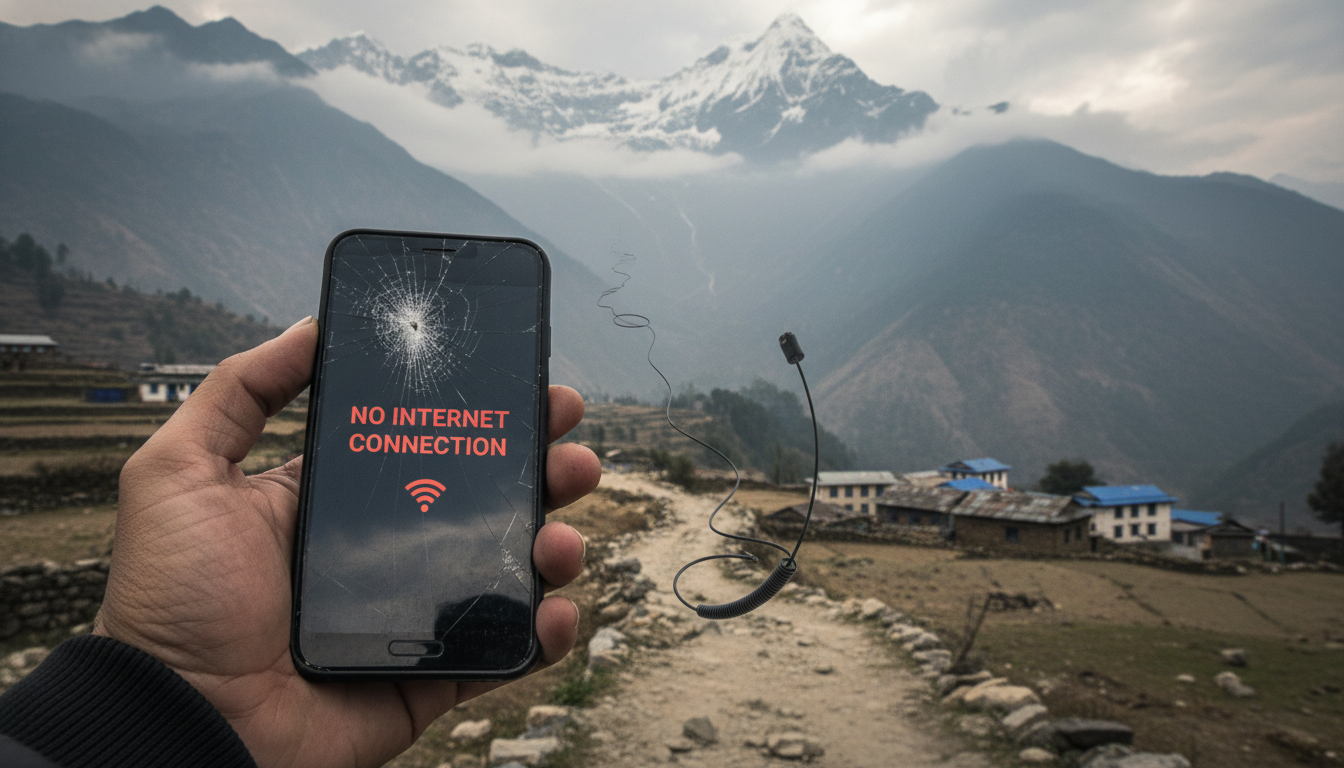
However, a rigorous, forensic examination of the underlying infrastructure reveals a far more precarious reality. The central thesis of this report is that Nepal’s digital ecosystem is suffering from a crisis not of access, but of reliability. The user query posits a fundamental axiom: “No adoption survives unstable systems.” This axiom is currently being tested—and frequently validated—across Nepal’s digital landscape. While the fiber optic cables have reached the district headquarters, and 4G signals illuminate the screens of smartphones in remote valleys, the utility of these connections is compromised by systemic fragility.
When a rural farmer’s digital payment fails due to a micro-outage at a solar-powered base station; when a government server hosting critical National ID data crashes for weeks due to lack of redundancy; when a school computer lab, funded by millions in aid, sits gathering dust because no technician is available to replace a simple power supply—these are not merely technical glitches. They are structural failures that erode the foundational trust required for a digital economy to function.
This report offers an exhaustive analysis of these failure points. Drawing upon disparate data sources—from NTA Management Information System (MIS) reports and World Bank project audits to independent field studies on telecenter sustainability—we dissect the chasm between the “connected” urban centers of the Kathmandu Valley and the “digitally isolated” hinterlands of Karnali. We scrutinize the geopolitical and regulatory bottlenecks stalling the rollout of 5G and Low Earth Orbit (LEO) satellite services. We analyze the hidden “maintenance tax” that has rendered past initiatives like One Laptop Per Child (OLPC) ineffective.
Ultimately, this document serves as a corrective to the prevailing optimism. It argues that without a radical pivot from “deployment” to “resilience”—from counting SIM cards to measuring uptime—Nepal’s digital revolution risks becoming a hollow modernization, where the infrastructure exists but the service is too unreliable to drive genuine socio-economic change.
1. The Statistical Mirage: Deconstructing Connectivity Data
To understand the fragility of Nepal’s digital infrastructure, one must first dismantle the statistical artifacts that govern public policy. There is a profound dissonance between the supply-side data provided by regulators and the demand-side reality experienced by citizens.
1.1 The Penetration Paradox: 144% vs. 39%
As of early 2024, the Nepal Telecommunications Authority (NTA) released its Management Information System (MIS) report, presenting a broadband penetration rate of 144.56%. To the uninitiated observer, this figure suggests a market that has reached saturation, where every citizen is not only connected but hyper-connected. The breakdown includes a voice service teledensity of 119.26% and a broadband data service density of 135.90%.
However, these figures are misleading indicators of digital inclusion. They represent the number of active subscriptions (SIM cards) divided by the population, not the number of unique human beings with functional internet access.
The Multi-SIM Phenomenon: The “144%” figure is inflated by the rampant practice of multi-SIM ownership. In Nepal, consumers frequently hold SIM cards from multiple operators (typically Nepal Telecom and Ncell) simultaneously. This behavior is not driven by affluence, but by infrastructural insecurity.
- Network Patchiness: A user in a rural district may find that Nepal Telecom (NTC) works in the market square, while Ncell provides better coverage at their home on the ridge. To ensure continuous connectivity, they must maintain subscriptions to both.
- Tariff Arbitrage: Users switch between carriers to capitalize on fluctuating data bonuses and voice pack offers, treating connectivity as a commodity to be traded rather than a utility to be relied upon.
- Redundancy by Necessity: The high penetration rate is, paradoxically, a symptom of low network reliability. If a single network were robust and ubiquitous, the average user would have no need for redundant subscriptions.

The Real Numbers: When we turn to the Nepal Living Standards Survey (NLSS) 2022/23, which measures household access rather than SIM sales, the illusion of saturation evaporates. The NLSS data reveals that the actual internet penetration rate stands at approximately 39.7% to 49.6% of households. This discrepancy—between 144% and 40%—represents the “statistical void” where policy fails. Government infrastructure targets are often based on the inflated NTA numbers, leading to a complacency that ignores the nearly 50% of the population that remains offline.
| Metric | NTA MIS Report | NLSS / DataReportal | Implication |
|---|---|---|---|
| Broadband Penetration | 144.56% | ~39.7% – 49.6% | Massive overestimation of digital inclusion hampers targeted intervention. |
| Voice Teledensity | 119.26% | ~120% | Voice connectivity is ubiquitous; data connectivity is not. |
| Mobile Connections | ~42.78 Million | 37.47 Million | Discrepancy suggests millions of inactive or “zombie” SIMs. |
| Urban Connectivity | Not Disaggregated | 79.3% | Shows deep concentration of resources in cities. |
| Rural Connectivity | Not Disaggregated | 17.4% | The “real” Nepal remains largely offline. |
1.2 The Device Ecosystem: Mobile-Only, Not Mobile-First
The nature of access is just as critical as the existence of access. Nepal’s digital landscape is overwhelmingly mobile-centric. Data indicates that 96% of internet users access the web via mobile devices. Smartphone ownership stands at 78% of the population aged 10 and over, significantly outpacing computer ownership.
While the smartphone revolution has democratized communication, it has created a “consumption-biased” digital ecosystem.
- The Productivity Ceiling: A smartphone is an excellent device for consuming information (social media, news, video) and performing simple transactions (digital wallets). However, it is a poor tool for high-value digital labor (coding, graphic design, complex data analysis) or deep educational engagement.
- The “Thumb” Economy: The reliance on mobile interfaces limits the user interface complexity that developers can deploy for government services (e-governance). Complex forms, tax filings, and detailed grant applications are notoriously difficult to navigate on a 5-inch screen, leading to high abandonment rates for digital public services.
- Educational Deficits: Students attempting to learn computer science or digital literacy skills on a smartphone face significant pedagogical barriers compared to those with access to a keyboard and mouse. The “mobile-only” reality reinforces a class divide where the urban elite use laptops to create the digital economy, while the rural poor use smartphones to consume it.
1.3 Broadband Composition: The Fiber vs. Wireless Divide
The composition of broadband services further highlights the fragility. Fixed broadband (wired, fiber optics) accounts for a relatively small fraction of the total penetration compared to mobile broadband. While FTTH (Fiber to the Home) is expanding rapidly in urban centers—with Nepal Telecom reaching 77 districts and private ISPs like WorldLink securing international financing for expansion —it remains tethered to the electrical grid and physical poles.
Mobile broadband (3G/4G), which serves the majority, is inherently less stable. It is susceptible to congestion, weather interference, and signal attenuation in Nepal’s mountainous terrain. The reliance on wireless for the “last mile” in rural areas means that the most vulnerable populations are served by the most volatile technology.
2. The Physical Layer: Optical Backbones and International Gateways
The stability of any digital system is determined by its weakest physical link. For Nepal, a landlocked nation sandwiched between two giants, the physical layer of the internet is a complex geopolitical and engineering challenge.
2.1 The “Chicken Neck” Dependency and Southern Routes
Historically, Nepal’s internet connectivity was entirely dependent on bandwidth imported from India. Fiber optic cables entered Nepal through border points at Bhairahawa, Birgunj, and Biratnagar, connecting to the Indian networks of Tata Communications, Airtel, and BSNL. These cables then traversed the “Chicken Neck” (Siliguri Corridor) to reach undersea cable landing stations in Mumbai and Chennai.
Vulnerabilities of the Southern Route:
- Monopoly Pricing: For decades, the lack of competition allowed Indian upstream providers to dictate bandwidth prices, keeping costs high for Nepali ISPs and consumers.
- Physical Vulnerability: The terrestrial routes through India and the Nepali Terai are prone to flooding during the monsoon.
Furthermore, road expansion projects in both countries frequently lead to accidental fiber cuts (“backhoe fade”), causing blackouts.
- Single Point of Failure: While there are multiple entry points, they all eventually funnel into the same global undersea cables departing from India. A failure at the Mumbai landing station impacts the entirety of Nepal’s traffic.
2.2 The Northern Alternative: The Chinese Link
In a strategic move to establish redundancy and break the Indian monopoly, Nepal activated optical fiber links with China via the Rasuwagadhi border point. This project was hailed as a milestone in “digital sovereignty,” theoretically allowing Nepal to route traffic through China Telecom and China Unicom to reach servers in East Asia and the US West Coast.
The “Cold Standby” Reality:
While the Chinese route exists, it functions more as a “cold standby” than a robust active load balancer due to extreme environmental factors:
- The Himalayan Barrier: Laying and maintaining fiber across the Tibetan Plateau and the Himalayas involves engineering at 4,000+ meters. Avalanches, glacial lake outburst floods (GLOFs), and landslides are constant threats.
- Repair Latency: When a fiber cut occurs on the Chinese side (as happened due to an avalanche during the initial rollout), repair crews face life-threatening conditions. Reports indicate that repair work has been suspended for weeks due to altitude sickness among workers.
- Latency Physics: For traffic destined for Europe or the Middle East, routing through China and then across Russia or the Pacific can introduce higher latency than the direct Indian route. Thus, while it provides political and commercial leverage, its technical utility as a seamless failover is constrained by geography.
2.3 Global Volatility: The Red Sea Cable Cuts
The fragility of Nepal’s connection was starkly illustrated in 2024/2025 by events thousands of miles away. The severing of critical undersea cables in the Red Sea (SMW4, IMEWE, EIG) due to geopolitical conflict and maritime traffic caused significant disruptions to internet traffic across South Asia.
The Ripple Effect in Nepal:
- Latency Spikes: Although Nepal is landlocked, its data packets must traverse these undersea highways to reach servers in Europe (e.g., London financial hubs). The rerouting of traffic via the Cape of Good Hope or trans-Pacific routes increased latency (ping).
- Banking & Fintech Impact: High latency is not just an annoyance for gamers; it breaks the “handshake” protocols of secure banking transactions. When latency exceeds certain thresholds, transaction requests time out. For a rural user in Nepal trying to send a remittance via a mobile wallet on a 3G connection, the added global latency can cause the transaction to fail, reinforcing the distrust in digital financial services.
- Cached vs. Live Content: While 73% of the top 1000 websites are now cached locally in Nepal, minimizing the impact for passive consumption, “live” data—video calls, enterprise VPNs, and real-time financial trading—suffered degradation. This bifurcation means entertainment remained stable while productivity suffered.
3. The Power-Digital Nexus: The Primary Antagonist
If fiber optics are the veins of the digital body, electricity is the blood. The most critical insight from the research is that Nepal’s “internet problem” is, at its core, an “energy problem.” The instability of the power grid is the single largest cause of technical unreliability in the telecommunications sector.
3.1 The Physics of Downtime
Base Transceiver Stations (BTS)—the cell towers that broadcast 4G signals—are energy-intensive infrastructure. They require a constant, “clean” power supply. In rural Nepal, the national grid is plagued by “transient faults,” brownouts, and voltage fluctuations.
The Cascade of Failure:
- Grid Instability: A storm trips a substation in a remote district. The grid goes down.
- Battery Limitations: Most rural BTS towers are equipped with battery backups (Lead-Acid or Lithium-Ion). However, these batteries are often degraded due to improper charging cycles caused by the erratic grid. A battery rated for 8 hours might only last 2 hours in practice.
- Generator Logistics: Once batteries die, a diesel generator (DG) must kick in. However, fueling these generators in roadless areas requires porters to carry fuel cans on foot. This is logistically expensive and slow.
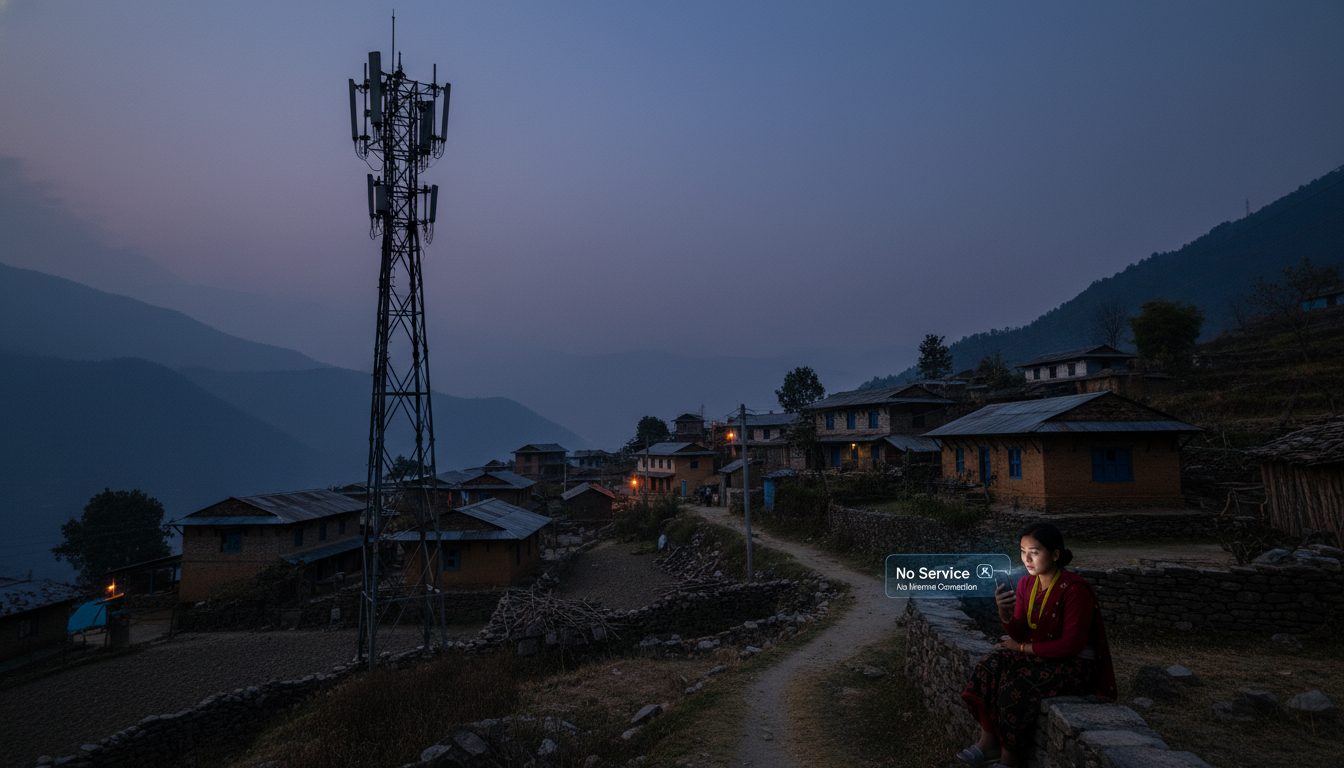
- The “Coverage Hole”: When the power fails, the tower goes dark. The network topology changes instantly. A user who had 4 bars of signal suddenly has “No Service.”
- Service Interruption: This intermittency is fatal for adoption. If a health post cannot upload patient data because the tower is down every afternoon during load shedding, the staff stops using the digital system entirely and reverts to paper.
3.2 The Scale of the Problem
The Nepal Telecommunications Authority (NTA) and major operators like Nepal Telecom have explicitly identified power outages as a primary cause of network failure. In the 2024 flood season, widespread internet disruptions were attributed not to fiber cuts, but to the destruction of power supplies feeding the telecom infrastructure.
Economic Implications for ISPs: To mitigate this, ISPs and Telcos must invest heavily in power redundancy—solar hybrid systems, larger battery banks, and generators. This “energy tax” increases the CAPEX and OPEX of rural deployment significantly. A tower in Kathmandu might cost $X to operate; the same tower in Karnali costs $3X due to energy logistics, yet generates 1/10th of the revenue. This economic inversion explains the reluctance of private operators to expand aggressively into rural areas without government subsidy.
3.3 Natural Disasters as Infrastructure Stress Tests
Nepal’s geography makes it prone to earthquakes, floods, and landslides. These events act as stress tests for digital infrastructure.
- The 2024 Floods: Damaged power grids and severed fiber links, isolating districts like Surkhet and Solukhumbu.
- Resilience Failures: The lack of geo-redundant power backup meant that when the grid failed, the communication network followed shortly after. In disaster management, the first 24 hours are critical. The failure of the telecom network during these windows hampers rescue operations, proving that “unstable systems” can have lethal consequences.
4. The Urban-Rural Chasm: Two Nepals
The aggregate statistics hide a stark bifurcation. There is a “Digital Kathmandu” and an “Analog Karnali.” This divide is structural, geographic, and economic.
4.1 Quantifying the Divide
The disparity is not subtle; it is overwhelming.
- Urban Internet Penetration: 79.3%.
- Rural Internet Penetration: 17.4%.
- Bagmati Province (Capital Region): 59.8% household access.
- Karnali Province (Remote West): 14.0% household access.
- Poverty Correlation: Only 9.5% of households below the poverty line have internet access.
Table 4.1: The Geography of Exclusion
| Region | Connectivity Status | Infrastructure Reality |
|---|---|---|
| Kathmandu Valley | High Saturation (FTTH, 4G) | Competitive ISP market. High speeds (200Mbps+). Redundant power. |
| Terai (Plains) | Moderate to High | Good 4G coverage. Fiber rollout is easier due to flat terrain. Frequent cuts due to road construction. |
| Hilly Region | Low to Moderate | Reliance on wireless backhaul. Spotty 4G. High cost of deployment. |
| Mountain (Himalaya) | Extremely Low | “Digital Islands” connected by VSAT or long-range Wi-Fi. Frequent multi-day outages. |
4.2 The Economics of Rural Connectivity (The “Market Failure”)
The reason for this divide is a classic market failure. The cost to deploy fiber in the mountains is exponentially higher than in the plains, while the customer base is sparse and has low purchasing power.
- Cost of Access: While data prices in Nepal are globally competitive (~$0.43/GB), this represents 2.05% of the average monthly income for a low-consumption basket. For a subsistence farmer, this is a prohibitive luxury.
- The RTDF Failure: To address this, the government established the Rural Telecommunications Development Fund (RTDF), collecting a 2% levy from ISPs to fund rural expansion. However, the utilization of this fund has been abysmal. Projects like the “Information Highway” were stalled for seven years due to legal disputes and bureaucratic inertia. The government has allocated $50 million, but deployment is glacial.
4.3 Grassroots Solutions vs. Scalability
In the vacuum left by the state and private sector, civil society has attempted to step in. The Nepal Wireless Networking Project, led by Mahabir Pun, famously used long-range Wi-Fi to connect villages in the Annapurna range.
- Success: Demonstrated that connectivity is possible in extreme terrain using off-the-shelf technology.
- Limitation: These projects often rely on the charisma and drive of individual leaders (“champion model”). Scaling this to a national level requires institutional structures, not just individual heroism. When the champion moves on, or when equipment ages, these networks often degrade due to lack of a sustainable maintenance model.
5. The Wireless Frontier: 4G Saturation and the 5G Stalemate
While fiber struggles to climb the mountains, wireless technologies promise to leapfrog them. However, the transition from 4G to 5G in Nepal is currently paralyzed.
5.1 4G: The Workhorse of the Economy
4G LTE is the backbone of Nepal’s digital economy. With 88% population coverage, it is the primary means of access for the masses.
- Spectrum Refarming: The NTA has adopted “technology neutrality” in the 1800 MHz and 1900 MHz bands, allowing operators to repurpose 2G/3G spectrum for 4G.
This is a crucial policy win, increasing capacity without requiring new physical towers.
- Congestion: Despite coverage, the quality of 4G is degrading in urban centers due to congestion. Speeds drop significantly during peak evening hours (8 PM – 10 PM) as the network struggles to handle the video streaming load (TikTok/YouTube).
5.2 The 5G Impasse
While the world races toward 5G, Nepal is stuck in neutral. The NTA has prepared the framework, but the rollout is delayed.
- The Cost Barrier: Operators estimate nationwide 5G deployment would cost Rs 50–60 billion.
- The Revenue Void: Operators like Nepal Telecom argue that the “business case” for 5G is weak. The current ARPU (Average Revenue Per User) is too low to justify the investment. 5G’s primary benefits (low latency for IoT, industrial automation) have few takers in Nepal’s current industrial landscape. Consumers just want faster video, which 4G can ostensibly provide if optimized.
- The “Chicken and Egg” Problem: Without 5G, advanced digital industries (smart cities, remote surgery) cannot develop. But without those industries, there is no revenue to pay for 5G. The government’s refusal to waive spectrum fees exacerbates this deadlock.
6. The Satellite Disruption: Starlink and Geopolitics
The most tantalizing solution for Nepal’s geography is Low Earth Orbit (LEO) satellite internet, epitomized by Starlink. Technically, LEO constellations can deliver high-speed, low-latency internet to any point in the Himalayas without laying a single meter of fiber.
6.1 The Regulatory Blockade
Despite Starlink sending a delegation to Nepal and expressing keen interest, the service remains unlicensed. The barriers are legal and geopolitical, not technical.
- Ownership Laws: Nepal’s telecommunications laws generally favor joint ventures with local equity participation. SpaceX typically operates as a wholly-owned subsidiary to protect its technology and control.
- Currency Outflow: Policymakers fear that subscription fees (paid in USD) will drain foreign currency reserves, mirroring concerns in Pakistan.
- Lawful Interception (The “Spying” Fear): This is the most significant hurdle. Security agencies in Nepal (and neighboring India and China) are deeply uncomfortable with a US-controlled satellite network beaming internet directly to users, bypassing the national gateways where the government conducts “lawful interception” (monitoring).
- Scenario: If a user in a sensitive border region connects to Starlink, their data goes from the dish to the satellite to a ground station (likely in Japan or Australia), bypassing Kathmandu entirely. This loss of “data sovereignty” is unacceptable to the security establishment.
Until Nepal formulates a specific policy for LEO satellites—perhaps mandating a local ground station gateway—this revolutionary technology will remain illegal, forcing rural Nepal to wait for fiber that may never come.
7. Technical Support Systems: The “Right to Repair” Void
Infrastructure is not just hardware; it is the human capacity to keep that hardware running. The research reveals a catastrophic failure in technical support systems, particularly in rural areas.
7.1 The “Break-Fix” Cycle of Doom
In urban centers, a broken laptop or router can be fixed within hours. In rural Nepal, a hardware failure is often terminal.
- The School Lab Graveyard: Government schools across Nepal have received grants to establish computer labs. However, field studies show that many of these labs become “technology graveyards”.
- Cause: Dust, humidity, and voltage spikes damage equipment.
- Failure Mode: Schools lack the budget (O&M funds) and access to technicians. A computer with a blown $10 power supply will sit broken for years because there is no one in the village who knows how to fix it, and sending it to the city is too expensive.
- Telecenter Collapse: The government launched telecenters in 2004 to provide community access. Most have failed. The reasons are consistent: when the printer jammed or the router reset, the center closed down because the “manager” was an administrator, not a technician.
7.2 Human Capital Flight
The “technician drain” mirrors the “brain drain.” Skilled hardware technicians migrate to Kathmandu or abroad (Malaysia, Gulf) for better wages. This leaves rural municipalities with a severe shortage of technical labor.
- Local Government Capacity: The 753 local units are mandated to hire IT officers. While this is a policy success on paper, the reality is that these officers are often overwhelmed with data entry tasks and lack the specialized skills to manage complex network infrastructure. Retention is a major challenge; once trained, they leave for better opportunities.
8. The Legacy of Failure: One Laptop Per Child (OLPC)
The failure of the One Laptop Per Child (OLPC) program in Nepal serves as a definitive case study in why “dropping hardware” without “building ecosystems” fails.
8.1 Anatomy of a Failure
Nepal was a pilot country for the OLPC XO-1 laptop. The vision was to leapfrog development by giving every child a rugged computer.
- Hardware Issues: The laptops were slow, the screens were small, and the “mesh networking” feature (designed to allow laptops to talk to each other without a router) was buggy.
- Pedagogical Disconnect: Teachers were not trained to integrate the devices into the curriculum. The laptop became a distraction rather than a tool.
- The Maintenance Void: When screens broke or chargers were lost, there was no supply chain for replacements. The project assumed the hardware was indestructible; it was not.
The Lesson: The Total Cost of Ownership (TCO) of digital infrastructure is not the purchase price. It is the lifecycle cost—training, repair, electricity, and upgrades. The OLPC project ignored the lifecycle, and thus, the adoption did not survive the system’s instability.
9. The Logic Layer: E-Governance and Data Integrity
Finally, we must address the reliability of the government’s own digital platforms. If the state cannot maintain its systems, it cannot expect citizens to adopt them.
9.1 The National ID (NID) Crisis
The National Identity Card (NID) is the cornerstone of the Digital Nepal Framework. Yet, in 2024/2025, the system faced severe disruptions.
- The Crash: Technical upgrades and lack of server capacity caused the NID management system to go offline.
- The Impact: Since the government made NID mandatory for opening bank accounts and obtaining passports, the system crash effectively paralyzed these sectors. Citizens could not bank or travel.
- Insight: Centralizing identity into a single digital system creates a “single point of failure.” Without massive redundancy and load balancing, a server crash becomes a national crisis.
9.2 Disaster Recovery and Data Security
The civil unrest and fires in 2025 exposed the fragility of government data centers.
- The Fire: The Department of Transport Management (DoTM) lost servers and physical archives to fire. This resulted in the potential loss of vehicle registration data.
- The Success Story: In contrast, the Integrated Data Management Centre at the National Information Technology Centre (NITC) survived due to backup systems. This proves that resilience is possible, but it is unevenly distributed across agencies.
- Cyber Hygiene: High-profile hacks of the Passport Department and National Vigilance Center were attributed to basic negligence (expired SSL certificates, unpatched software). This is a failure of “governance hygiene,” not just technology.
10. Conclusion: From Access to Resilience
The evidence amassed in this report points to a singular, inescapable conclusion: Nepal has largely succeeded in the first phase of the digital revolution—Access. It is now failing in the second phase—Reliability.
The 144% penetration rate is a statistical shroud masking a fragile ecosystem. The adoption of digital services is stalling not because people cannot connect, but because they cannot trust the connection. A farmer will not switch to digital payments if the network fails 20% of the time. A citizen will not rely on a digital ID if the server is down for weeks.
Strategic Imperatives for the Future:
- Redefine “Success”: Policymakers must stop celebrating “coverage” and start measuring “uptime.” Service Level Agreements (SLAs) with strict penalties for downtime must be enforced for all ISPs receiving RTDF subsidies.
- Solve the Energy Equation: Digital policy is energy policy. The government must mandate and subsidize solar-hybrid power systems for all rural telecom infrastructure to decouple connectivity from the national grid.
- The “Maintenance” Economy: Donors and government grants must allocate at least 30-40% of funds to Operations & Maintenance (O&M) and technical training, rather than spending 100% on hardware procurement. A “Rural Technician Corps” should be established to create local jobs in repair and maintenance.
- Regulatory Courage: The government must navigate the geopolitical tightrope to license LEO satellite operators (like Starlink) with appropriate security safeguards. Holding the geography hostage to terrestrial fiber economics is a losing strategy.
- Data Sovereignty with Redundancy: Critical government datasets (NID, Land Records) must be backed up in geo-redundant data centers (e.g., one in Kathmandu, one in Hetauda) with “hot standby” capability to ensure zero downtime during disasters.
Only by addressing these structural, physical, and human vulnerabilities can Nepal transition from a nation of “digital islands” to a truly resilient digital economy. The path forward is not about more cables; it is about more stability.