

Assessment Impact: Curriculum, Teaching & Washback Effect
The Theoretical and Historical Architecture of Assessment
The Genesis of Measurement-Driven Instruction
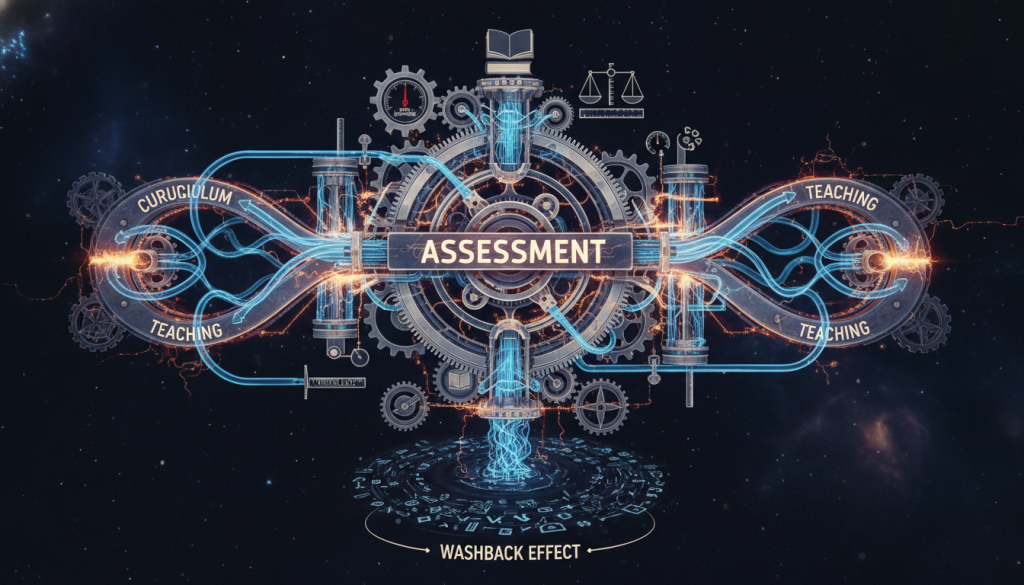
The architecture of modern education is fundamentally shaped by the mechanism of assessment. While curriculum defines the intended trajectory of learning, assessment acts as the regulatory gatekeeper that determines the actual path taken by students and teachers alike. This phenomenon, widely categorized in applied linguistics and educational theory as the “washback effect” (or backwash), refers to the profound influence that testing exerts on teaching and learning methodologies. It operates on the axiomatic truth that within institutionalized schooling, “what is assessed becomes what is valued, which becomes what is taught“.
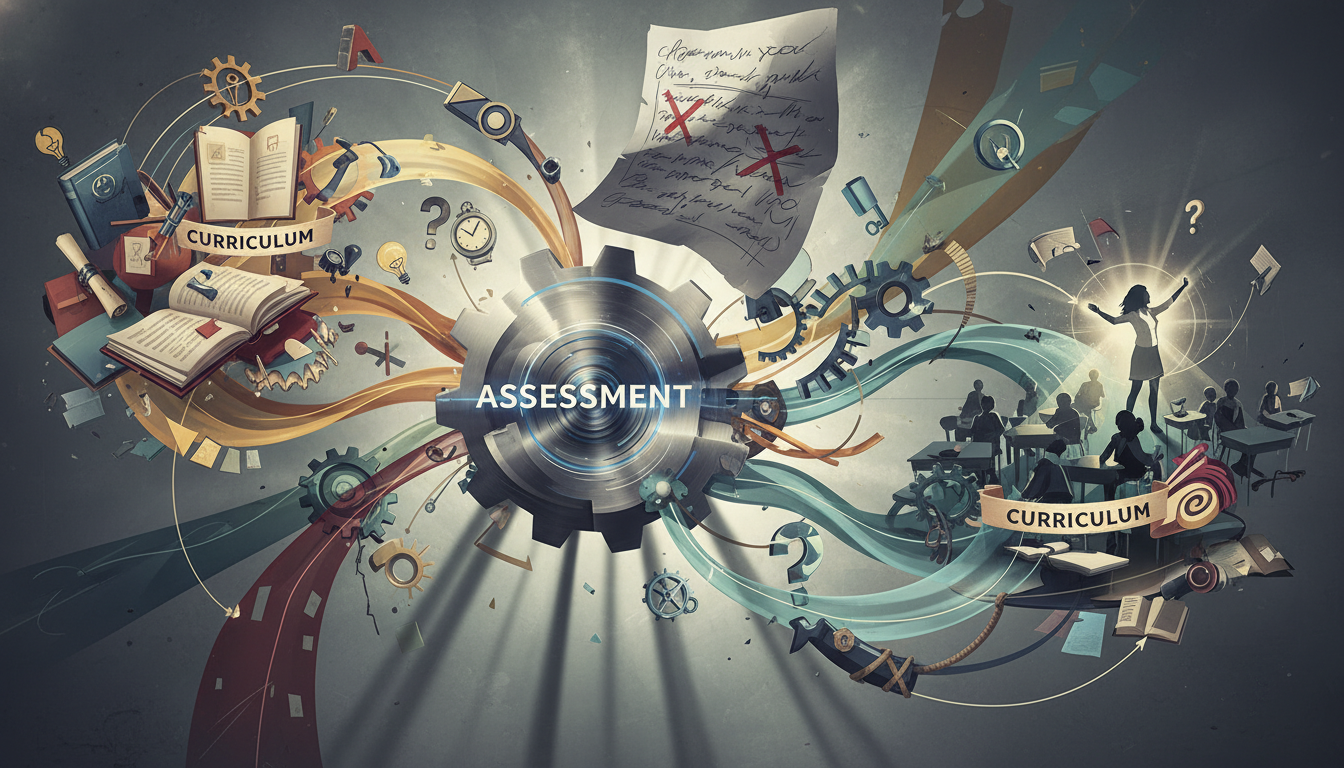
Washback is not merely a side effect of testing; it is often the explicit policy intent. Educational reformers frequently utilize “measurement-driven instruction” as a lever to force curriculum change, operating under the assumption that high-stakes tests will compel teachers to align their instruction with specific standards. However, this alignment is rarely linear or purely beneficial. The literature distinguishes between positive washback—where a test encourages beneficial teaching practices, such as the introduction of oral proficiency exams prompting increased time dedicated to speaking skills—and negative washback, where the format of the test constrains the instructional repertoire, reducing complex cognitive domains to multiple-choice surrogates.
Alderson and Wall provided the seminal definition, noting that washback compels “teachers and students to do things they would not necessarily otherwise do because of the test“. This definition underscores the coercive nature of assessment. It creates a divergence between the intended curriculum (what policymakers design) and the implemented curriculum (what actually occurs in the classroom). Messick expanded this theoretical framework to include “consequential validity,” arguing that the social consequences of testing—including its impact on teaching practices—are integral to the validity of the test itself. If an assessment system degrades the quality of instruction by promoting rote memorization over critical thinking, the test itself lacks consequential validity, regardless of its statistical reliability.
Campbell’s Law and the Corruption of Indicators
To understand the systemic distortions observed in high-stakes testing environments, one must engage with Campbell’s Law, a sociological principle that has become the cornerstone of critiques regarding educational accountability. Developed by social scientist Donald T. Campbell, the law states: “The more any quantitative social indicator is used for social decision-making, the more subject it will be to corruption pressures and the more apt it will be to distort and corrupt the social processes it is intended to monitor“.
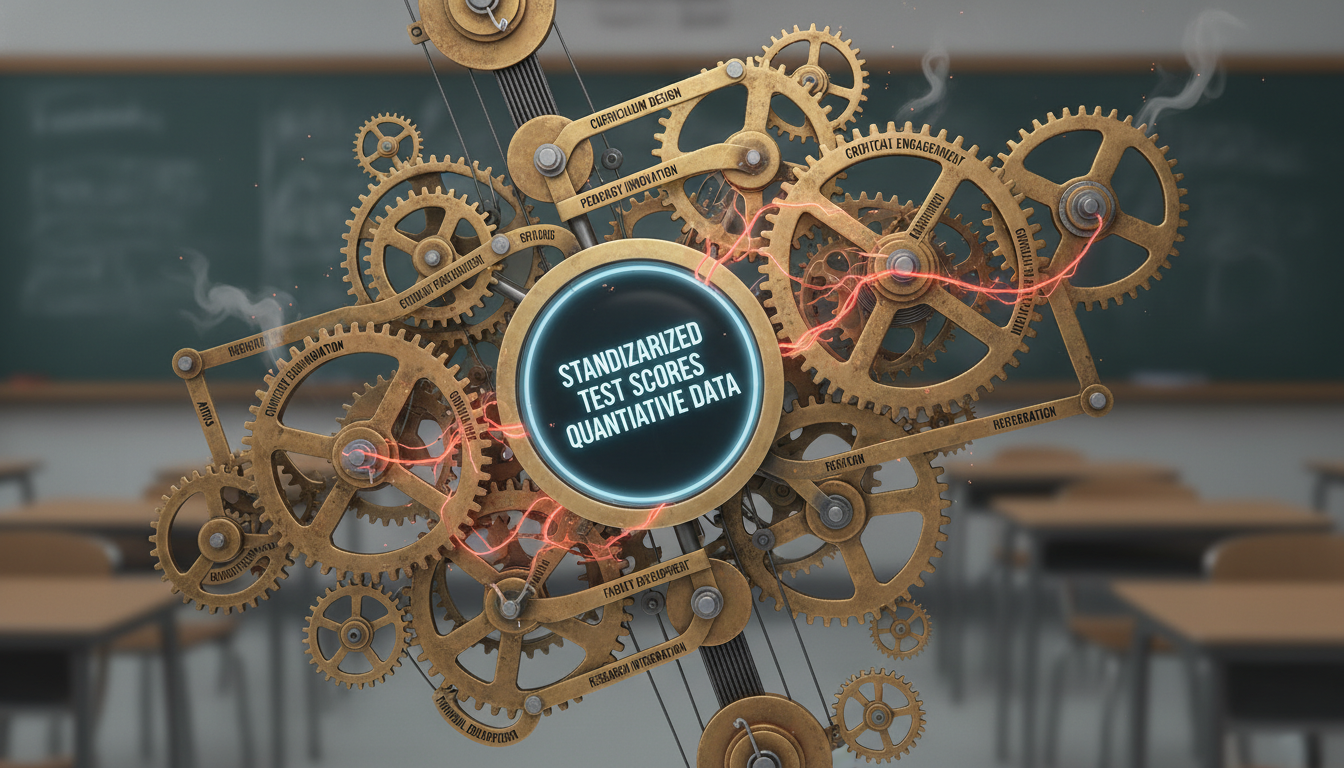
In the context of education, Campbell’s Law elucidates why assessment systems frequently degrade into “gaming” behaviors. When test scores are elevated from a measure of student learning to the primary goal of the educational apparatus—determining funding, school closure, or teacher employment—they lose their value as indicators. The pressure to meet quantitative targets leads to a corruption of the educational process itself. This manifests in distinct pathologies:
- Curricular Narrowing: The systematic elimination of non-tested subjects such as art, music, and social studies to maximize time for tested subjects like reading and mathematics.
- Teaching to the Test: The realignment of instruction toward test-taking strategies and item formats rather than the underlying domain of knowledge. For example, writing instruction may be reduced to editing multiple-choice grammar items because that is how the skill is measured.
- Data Fabrication: In extreme iterations, the existential pressure of high-stakes accountability leads to the manipulation of data or outright cheating by educators who feel their professional survival depends on the metrics.
This phenomenon is closely related to Goodhart’s Law (“When a measure becomes a target, it ceases to be a good measure“) and the “Cobra Effect,” where incentives produce unintended negative consequences. The application of business efficiency models to education, aiming to increase “productivity” through rigorous measurement, often fails to account for the complexity of human learning, leading to a system where the indicator (the test score) is conflated with the construct (student learning).
The Ontological Divergence: Testing vs. Assessment
A critical distinction in this analysis is the divergence between “testing” and “assessment.” While often used interchangeably in policy discourse, they represent fundamentally different epistemological approaches to evaluating student capability.
- Testing is characterized as a formal, standardized snapshot of performance. It relies on exact procedures for administration and scoring, prioritizing reliability (consistency across populations) over validity (accuracy of the specific construct).
- Assessment, conversely, is defined as a comprehensive collection of information about what students know and can do. It encompasses a broader array of evidences—observations, portfolios, projects, and interactions—collected over time and across authentic contexts.
The tension in modern education largely stems from the systemic over-reliance on testing as the sole proxy for assessment. While testing offers efficiency, scalability, and comparability, it lacks the nuance to capture the “day-to-day activities that can also be authentic and engaging demonstrations of students’ abilities“. This reductionism is not merely a methodological preference but a policy choice that prioritizes data that is easy to aggregate over data that is instructionally useful.
The Pedagogy of Pressure: High-Stakes Testing and Curricular Narrowing
The Mechanics of Curricular Reductionism
The most extensively documented consequence of high-stakes testing regimes is curricular narrowing. Research indicates that when significant consequences—such as school funding, teacher retention, or student graduation—are attached to test results, the curriculum contracts to fit the boundaries of the assessment. Au’s qualitative synthesis of 49 studies found a robust causal link between high-stakes testing and the fragmentation of knowledge, where content is broken down into isolated facts likely to appear on examinations rather than integrated concepts.
This narrowing occurs in two primary dimensions:
- Subject Exclusion: Non-tested subjects are marginalized. Evidence suggests that science, social studies, the arts, and physical education are frequently removed from the daily schedule, particularly in elementary education, to create “blocks” for reading and math remediation.
- Pedagogical Reductionism: Within the tested subjects themselves, instruction shifts from inquiry-based or conceptual learning to teacher-centered, didactic methods focused on memorization and drill. This “drill and kill” pedagogy is adopted not because teachers believe it is effective for long-term learning, but because it is efficient for short-term test score maximization.
Paradoxically, this strategy often backfires. Berliner argues that students who lack background knowledge in science and social studies—subjects often cut to make room for reading drills—eventually struggle with reading comprehension because they lack the requisite world knowledge to understand complex texts. Thus, the “test preparation strategy” meant to improve scores may act as a depressant on actual literacy development in the long run.
The Psychological Toll on the Learning Environment
The imposition of exam-oriented systems creates a high-pressure environment that significantly impacts the psychological well-being of the educational ecosystem.
The Physiology of Stress and Performance
High-stakes testing is inextricably linked to increased test anxiety among students. Research utilizing physiological markers provides compelling evidence of this impact. Studies measuring cortisol levels indicate that large cortisol responses—either positive or negative—are associated with worse test performance. This phenomenon introduces a “stress bias,” making tests a less reliable indicator of student learning, as they measure the student’s ability to cope with acute stress as much as their content knowledge.
The “exam hell” environment creates a vicious cycle where anxiety leads to avoidance behaviors, which in turn leads to poor preparation and further anxiety. Furthermore, standardized exams possess a major blind spot: they fail to capture “soft skills” such as resilience, risk-taking, and persistence. Interestingly, high school grades, which often reflect these longitudinal behaviors, have been shown to be better predictors of college completion than standardized test scores, which are snapshots of performance under pressure.
Teacher Whiplash and Moral Injury
Teachers experience a phenomenon described as “whiplash” as they rush to rewrite curricula to align with rapidly changing testing mandates. This constant churning prevents educators from building meaningful relationships with students, as the focus shifts from the child to the data point. A study cited by Darling-Hammond revealed that 78% of teachers felt high-stakes testing negatively impacted school morale.
This environment leads to professional compromise. Teachers often feel forced to adopt instructional methods they know are developmentally inappropriate or pedagogically unsound to ensure their students—and by extension, their schools—survive the accountability regime.
This dissonance between professional ethics and mandated practice contributes to teacher burnout and attrition.

2.3 Inequality and the “At-Risk” Marginalization
The narrowing of the curriculum disproportionately affects poor and minority children. Schools serving these populations are often under the most intense pressure to raise scores to meet adequate yearly progress (AYP) benchmarks. Consequently, the curriculum in these schools is more strictly aligned with the test than the curricula in wealthier, higher-performing schools.
While affluent students often continue to receive a broad, rich curriculum that includes arts, advanced sciences, and civics, disadvantaged students are frequently relegated to a steady diet of test prep and remediation. This creates a “knowledge gap” where low-income students have less of the requisite knowledge to learn more in future subject areas, perpetuating cycles of academic struggle. The system effectively denies the most vulnerable students the very type of engaging, high-quality education that could close the achievement gap.
3. Global Divergence: A Comparative Analysis of Assessment Systems
3.1 The “Exam Hell” Archetype: South Korea and East Asian Contexts
South Korea represents the archetype of an exam-oriented system. The education system relies heavily on standardized testing, culminating in the College Scholastic Ability Test (CSAT). This single high-stakes event plays a deterministic role in a student’s future academic and career prospects, functioning as the sole gateway to prestigious universities and, by extension, social status.
- Instructional Impact: The high stakes of the CSAT drive a teacher-centered instructional model emphasizing rote memorization and large class sizes to maximize efficiency in information transfer.
- The Shadow Education System: The pressure is so intense that it fuels a massive private tuition industry (“hagwons”). Parents engage in an “arms race” of resources to ensure their children can navigate the exams, creating significant socioeconomic inequity.
- Consequences: While South Korea produces high academic achievement in terms of PISA rankings, it comes at the expense of student mental health and “deep learning.” The system is rigid, with strict discipline and high pressure starting from junior classes, often suppressing independent thinking and creativity.
3.2 The Trust-Based Counterpoint: Finland
Finland offers a stark contrast to the East Asian model, famously eliminating the “teaching to the test” phenomenon by largely removing the high-stakes test itself from the K-12 experience (with the exception of the matriculation exam at the end of upper secondary school).
- Professional Autonomy: Finnish teachers possess a high degree of autonomy and are trusted as professionals to design curriculum and assessment. They are not subjected to census-based annual testing for accountability purposes.
- Assessment Philosophy: The focus is on formative assessment and providing feedback to support student learning rather than for accountability or ranking.
- Outcomes: Finland consistently ranks high in international comparisons despite—or perhaps because of—its lack of standardized testing. This absence of pressure creates room for student-centered teaching methods, collaboration, and critical thinking. The Finnish model suggests that high standards do not require high-stakes testing mechanisms to be maintained.
3.3 The Reformist Pivot: Singapore’s “Learn for Life” Movement
Singapore, traditionally known for its rigorous, high-stakes system similar to South Korea, is currently undergoing a significant transformation under the “Learn for Life” movement. This represents a deliberate, top-down policy shift away from an over-emphasis on academic results toward holistic development.
- Structural Reforms:
- Removal of Mid-Year Exams: The Ministry of Education is progressively removing mid-year examinations for Junior Colleges and Millennia Institutes to reduce testing load and free up curriculum time for deeper learning.
- Full Subject-Based Banding (SBB): The system is moving away from rigid streaming (tracking) to allow students to take subjects at different levels (G1, G2, G3) based on their specific strengths, rather than being locked into a single academic track.
- Lowering Stakes: Subjects like Project Work are moving to a Pass/Fail grading basis to encourage risk-taking and reduce the anxiety associated with grading every aspect of performance.
- Goal: The reforms aim to shift the focus from “access” to “quality,” fostering adaptive capacity and lifelong learning skills rather than mere test performance.
- Cultural Inertia: Despite these structural changes, the “culture” of testing remains strong. Parents, conditioned by the previous system, sometimes resist these changes, filling the void left by reduced exams with private tuition to gauge their children’s progress. This highlights a critical lesson: changing assessment policy does not immediately change assessment culture or parental anxiety.
Table 1: Comparative Analysis of Assessment Frameworks
| Framework | Core Philosophy | Assessment Mechanism | Accountability Model | Key Benefit | Key Challenge |
|---|---|---|---|---|---|
| Standardized National Systems (e.g., US NCLB/ESSA) | Standardization, Efficiency, Comparability. | Multiple-choice & short answer high-stakes exams. | Top-down; punitive (funding/employment linked to scores). | High reliability; easy data comparison across demographics. | Curricular narrowing; high stress; negative washback. |
| International Baccalaureate (IB) | Holistic, Inquiry-Based, Global. | Mixed: External exams + Internal Assessment (IA) (projects, orals). | Moderation: Teacher grades are checked by external examiners. | Deep learning; validity; focus on critical thinking. | Cost; perceived elitism; rigorous teacher training required. |
| NY Performance Standards Consortium | Practitioner-led; Depth over Breadth. | PBATs: Essays, experiments, and higher-order tasks. | External Audit: Rubrics reviewed by external experts/professors. | High college persistence; teacher professionalism. | Scalability; requires state waivers. |
| NH PACE | Local Accountability; Competency-Based. | Reduced standardized testing; Local performance tasks. | “Guardrails”: Peer review of district assessments. | Reduces over-testing; integrates assessment into instruction. | Complexity of implementation; reliability across districts. |
| Finland | Trust; Professionalism; Equity. | Teacher-designed classroom assessment. (Matriculation exam at end of HS only). | Trust-based; sample-based national monitoring (no census testing). | High teacher morale; broad curriculum. | Difficult to replicate without high teacher status/training. |
| High Tech High | Project-Based Learning (PBL). | Digital Portfolios; Public Exhibitions of Learning. | Portfolio quality; College acceptance rates. | Student agency; real-world connection. | Non-traditional metrics confuse some colleges/parents. |
4. Structural Flexibility: Alternative Curriculum Frameworks
4.1 The International Baccalaureate (IB): Concept over Content
The IB framework operates independently of national systems, offering a “concept-based” approach rather than a content-checklist approach. It is distinct in its specific focus on developing “independently of government and national systems,” which allows it to prioritize critical thinking and global contexts over local political mandates.
- Assessment Structure: The IB Diploma Programme (DP) utilizes a hybrid assessment model. While it retains external examinations, a significant portion of a student’s grade is derived from Internal Assessments (IA). These are oral presentations, field work, artistic performances, and laboratory reports that are marked by the classroom teacher and then “moderated” by external IB examiners to ensure consistency.
- Core Components: The framework includes mandatory core elements that force curricular breadth:
- Theory of Knowledge (TOK): A course entirely focused on critical thinking and epistemological questions (“How do we know what we know?”), assessed through an exhibition and an essay.
- CAS (Creativity, Activity, Service): A non-graded requirement that forces students to engage in experiential learning outside the classroom, ensuring the curriculum cannot be narrowed solely to academic text.
- Flexibility: The IB allows teachers to choose specific texts or case studies within broad conceptual topics, providing curricular flexibility within a rigid assessment framework.
4.2 The New York Performance Standards Consortium: A Public School Waiver Model
The NY Consortium represents a radical departure from standardized testing within a public school system. Comprising 38 public high schools, the Consortium has secured a waiver from the state’s Regents exams (except for the English Language Arts exam). This waiver allows them to bypass the standardized tests that drive instruction in other New York schools.
- The PBAT System: Instead of standardized tests, students must complete Performance-Based Assessment Tasks (PBATs) to graduate. These include:
- Analytic Essays on Literature: Requiring literary analysis and argumentation.
- Social Studies Research Papers: Requiring original research and defense of a thesis.
- Original Science Experiments: Requiring the application of the scientific method to a student-designed problem.
Higher-Level Mathematics: Requiring the narrative explanation of mathematical problem-solving processes.
- External Assessment: To ensure validity and combat the accusation of “subjectivity,” the Consortium employs an external assessment system. Student oral defenses and papers are evaluated by external experts, including college professors and teachers from other schools, using common rubrics.
- Outcomes: The Consortium demonstrates that a public system can operate effectively without high-stakes testing. Data suggests these schools have higher graduation rates for specific demographics and higher college persistence rates, attributed to the curriculum’s focus on writing, revision, and oral defense—skills highly valued in higher education.
4.3 New Hampshire’s PACE (Performance Assessment of Competency Education)
PACE is a pioneering accountability strategy approved by the U.S. Department of Education that reduces standardized testing by replacing it with locally developed common performance assessments. It represents a “competency-based” approach to state accountability.
- Reduced Testing: In PACE districts, students take the state standardized test (Smarter Balanced) only once in elementary (grade 3), middle (grade 8), and high school (grade 11) to serve as an external audit.
- Local Performance Tasks: In the intervening years (grades 4, 5, 6, 7, 9, 10), accountability is determined by teacher-created, competency-based performance tasks. These assessments are integrated into the curriculum, meaning the assessment is the learning activity.
- Quality Control: To ensure that a “proficient” score in one district means the same as in another, PACE utilizes a rigorous peer review process. Districts submit their tasks and student work for “calibration” sessions where teachers from different districts score work together to align their standards.
- Impact: This system eliminates “over-testing” because the assessments used for accountability are the same ones embedded in daily instruction, effectively merging the “intended” and “assessed” curriculum. Research indicates small positive effects on achievement and significant benefits in “deeper learning” capabilities.
4.4 Curriculum for Wales: Progression Steps and “What Matters”
Wales has engaged in a comprehensive reform to replace key stages with a “continuum of learning,” moving away from the rigid grade-level expectations that characterize the English National Curriculum.
- Statements of What Matters: The curriculum is organized around 27 “Statements of What Matters” across six Areas of Learning and Experience (AoLEs).
- Progression Steps: Instead of grades, learners move through “Progression Steps” at their own pace. These steps are reference points (at ages 5, 8, 11, 14, and 16) but are not treated as “cliffs” or high-stakes testing gates.
- Assessment Purpose: The primary purpose of assessment is legally redefined as supporting “learner progression” rather than school accountability. This legislative shift aims to break the link between assessment data and school ranking, thereby reducing the negative washback that causes teaching to the test.
- Holistic Integration: It emphasizes the “four purposes” of education (e.g., ambitious, capable learners; healthy, confident individuals), integrating health, well-being, and cross-curricular skills into the assessment framework.
4.5 Competency-Based Education (CBE) and the Mastery Transcript
Competency-Based Education (CBE) represents a structural shift from “time-based” education (Carnegie units) to “mastery-based” education. In CBE, students progress only upon demonstrating mastery of specific skills or knowledge, regardless of how long it takes.
The Mastery Transcript Consortium (MTC)
The MTC is a network of schools attempting to reinvent the high school transcript to support CBE and remove the “grade” as the primary signal of value.
- The Problem: Traditional transcripts (A-F grades) do not capture skills, collaboration, or interdisciplinary capabilities. They reduce complex learning to a single number (GPA).
- The Solution: The Mastery Transcript visualizes a student’s “competency wheel” rather than a list of courses. Credits are awarded for “mastery” of specific skills (e.g., “Analytical Writing,” “Quantitative Reasoning”), supported by a clickable digital portfolio of evidence.
- Impact: This allows college admissions officers to drill down into actual student work, providing a more transparent view of student capability than a GPA. It creates an incentive structure where “learning” is the goal, not “grade accumulation,” thereby reducing the “gaming” of grades.
Implementation Challenges of CBE
While theoretically robust, CBE faces significant implementation hurdles:
- Technology Barriers: Most Student Information Systems (SIS) are built on the “course” and “semester” model. They cannot easily handle “non-term” or self-paced financial aid calendars or grading structures.
- Assessment Difficulty: Designing rigorous, valid assessments for competencies is more difficult than writing multiple-choice tests. Teachers often lack the training to create high-quality performance assessments.
- Resource Intensity: Individualized pacing requires significant resources. There is a risk that without proper support, CBE can devolve into students working in isolation on computers, lacking the social construction of knowledge.
5. The Digital Frontier: Aligning Technology and Assessment
Technology is not merely a delivery mechanism for tests; it is reshaping the ontology of assessment itself. The alignment between technology and assessment is moving from “digitized traditional tests” to “stealth,” “adaptive,” and “generative” models.
5.1 Stealth Assessment: Blurring the Lines
Pioneered by Valerie Shute, stealth assessment embeds evaluation deeply within the learning process, often using digital games or immersive environments to measure competencies that are difficult to capture on paper.
- Mechanism: As students interact with a game (e.g., solving physics puzzles in Physics Playground), the system analyzes their log data—clicks, timing, sequence of actions, and tool usage—to infer their competency levels in real-time using Bayesian network modeling.
- Blurring Boundaries: This approach blurs the distinction between learning and assessment. The assessment is invisible to the student, removing the anxiety associated with “stopping to take a test” and reducing the threat of negative washback.
- Feedback Loops: It provides immediate, adaptive feedback. If a student struggles, the game adjusts difficulty or provides a hint, keeping the learner in the “zone of proximal development”. This contrasts sharply with traditional tests where feedback is delayed by weeks or months, rendering it instructionally useless.
5.2 Assessing Collaborative Problem Solving (CPS)
Traditional exams are inherently individualistic, yet the modern workplace demands collaboration. The OECD’s PISA 2015 assessment introduced a groundbreaking framework for Collaborative Problem Solving (CPS), attempting to measure social skills via technology.
- The Challenge: Assessing collaboration is difficult because group dynamics are messy. If a group fails, is it the individual’s fault or the group’s?.
- The Solution (Human-Agent Interaction): PISA used “computer agents” (simulated team members) to interact with the student. This standardized the collaboration context. The student interacted with agents who were programmed to be “helpful,” “lazy,” or “dominant,” and the system scored how the student navigated these social dynamics to achieve shared goals.
- Matrix of Skills: The framework assesses specific skills such as “establishing and maintaining shared understanding,” “taking appropriate action,” and “maintaining team organization”. This allows for the measurement of “soft skills” at a large scale, although critics argue that interacting with a chatbot is not a perfect proxy for human collaboration.
5.3 Digital Portfolios and Multimodal Composition
Digital portfolios allow for the assessment of “process” alongside “product,” accommodating the “multimodal” nature of modern communication.
- High Tech High Model: At High Tech High, digital portfolios are the central assessment mechanism. Students curate work samples, reflections, and resumes on platforms like Weebly or Wix. The rubric for these portfolios assesses not just the final artifact, but the “learning journey,” reflection, and technical proficiency.
- Validity of Portfolios: Research suggests digital portfolios promote greater self-regulation and reflection than standardized testing. They allow for “multimodal” assessment—evaluating students on their ability to combine text, image, audio, and design, which are essential 21st-century literacies.
- Rubric Design: Effective assessment of these projects requires new types of rubrics that evaluate “substance,” “process management,” and “habits of mind” rather than just correct answers.
5.4 The AI Revolution: Automated Scoring and Interactive Tutors
The integration of Generative AI (GenAI) into education is poised to disrupt the “teaching to the test” paradigm more radically than any policy reform.
- The Obsolescence of Standardized Output: With the advent of Large Language Models (LLMs) like ChatGPT, the traditional essay or short-answer test is increasingly vulnerable to automation. This forces a shift from assessing “outputs” (the essay) to assessing “process” (how the thinking developed).
- Automated Essay Scoring (AES): AI models are achieving high reliability in scoring essays, with correlations to human raters often exceeding 0.80. While currently used mostly for low-stakes feedback to save teacher time, the technology is approaching the threshold for high-stakes use.
This could allow for the massive scaling of writing assessments, moving away from multiple-choice testing.
- LLM-Based Interactive Tutors: The future model involves AI acting as an oral examiner. The AI asks a question, the student responds, and the AI follows up with probing questions to test the depth of understanding. This mimics the Socratic method and the “viva voce” (oral exam) but at scale. Recent studies suggest AI agents can act as effective peer assessors, providing feedback that improves student performance by up to 30% compared to traditional methods.
The Human Element: Teacher Agency, Resistance, and Subversive Pedagogy
Creative Insubordination
Rochelle Gutiérrez and others describe “creative insubordination” as the practice where teachers subvert mandates to advocate for their students. This is not resistance for its own sake, but a principled stance taken when compliance would harm students.
- Strategies: This might involve “closing the door” to teach non-tested subjects, reinterpreting standards to include social justice topics, or giving students answers to test prep questions so they can focus on the reasoning behind the error rather than the pressure of the grade.
- Motivation: Teachers who use creative insubordination often do so to protect marginalized students from the “deficit views” inherent in standardized testing data. They prioritize the “mirror test“—the ability to look at oneself and know they are doing right by the student, even if it violates a district mandate.
“Gaming” as a Survival Strategy
Referencing Campbell’s Law, teachers also engage in “gaming” strategies that are less about subversion and more about survival.
- Triage: Teachers may focus disproportionate attention on “bubble kids“—students who are just below the passing threshold—while ignoring those far below or far above. This occurs because moving the bubble kids yields the highest “value-added” metric for the school ratings.
- Resistance and Capitulation: Teachers often oscillate between resistance (critiquing the test) and capitulation (teaching to it) because their livelihoods depend on the results.
Student Voice and Resistance
Students are not passive recipients of assessment policies. They frequently express dissatisfaction with standardized testing, viewing it as irrelevant to their future success.
- Project-Based Preference: Students in project-based learning (PBL) environments often report higher engagement and self-efficacy. They perceive projects as “authentic measures” of ability compared to the “memorize and regurgitate” model of testing.
- Mental Health: The student pushback is often rooted in the psychological toll of the exam culture. In high-performing districts, students are increasingly vocal about the stress-performance curve and the lack of “soft skill” valuation.
- Agency: Research shows that involving students in the assessment process—giving them a voice in rubric design or assessment timing—significantly increases engagement and reduces absenteeism.
Conclusion: Decoupling Accountability from Standardization
The evidence presented in this report elucidates a clear structural conflict in modern education: the misalignment between the demands of the 21st-century economy (which prizes collaboration, creativity, and adaptability) and the legacy architecture of assessment (which prizes standardization, individual retention, and efficiency).
The “washback effect” ensures that as long as high-stakes standardized tests remain the primary currency of educational value, the curriculum will remain constrained. “Teaching to the test” is not a failure of teacher professionalism; it is a rational response to the incentive structures designed by policymakers.
However, the emergence of flexible frameworks like the NY Consortium, the operational success of the IB, and the technological capabilities of stealth assessment and AI provide a roadmap for decoupling accountability from standardization. The shift is moving from “Assessment of Learning” (summative, high-stakes, past-oriented) to “Assessment for Learning” (formative, adaptive, future-oriented).
Successful systemic change requires three synchronized elements:
- Policy Flexibility: Waivers and frameworks that allow for performance-based assessment (as seen in NH PACE and NY Consortium).
- Technological Infrastructure: Tools that can manage complex, multimodal data (digital portfolios, MTC transcripts) and automate the labor-intensive parts of personalization (AI).
- Professional Trust: A return to trusting teacher judgment, validated through moderation and peer review, rather than relying solely on external vendor-created metrics.
Without these shifts, Campbell’s Law will continue to operate: the more we pressure the test scores, the less those scores will actually mean. The future of assessment lies not in better tests, but in better systems that value the complexity of human learning.