


Airbnb/Booking Listing Optimization: 2025 Search Strategies
Strategic Listing Optimization: Algorithmic Search Paradigms for Short-Term Rental Platforms in 2025
The Digital Transformation of Short-Term Rental Search Ecosystems
The short-term rental (STR) industry has moved beyond its origins as a peer-to-peer sharing marketplace, evolving into a sophisticated, data-driven sector where search engine optimization (SEO) is the primary determinant of commercial viability. In 2025, platforms such as Airbnb and Booking.com function as advanced search engines that utilize complex machine learning models to match travelers with accommodations. The shift from basic keyword matching to predictive behavioral modeling marks a new era for property managers and hosts. Understanding these platforms as search engines requires a deep dive into the mechanics of their internal ranking algorithms, which now evaluate everything from visual consistency to the statistical probability of a guest requiring customer support after check-in.
Visibility is the cornerstone of revenue generation in this ecosystem. Statistical analyses indicate that a significant majority of bookings—approximately 67.6%—originate from the top five results on the first page of search. This concentration of traffic necessitates an exhaustive approach to listing optimization, where every element of the property page is designed to satisfy both the human guest and the algorithmic crawler. The 2025 landscape is characterized by “Predicted Outcome” models; Airbnb, for instance, now employs over 800 distinct signals to forecast the success of a stay before a booking is even confirmed. For the professional host, this means that the “freshness” of a listing is no longer just about recent logins, but about the continuous alignment of pricing, availability, and guest satisfaction metrics.
The Architecture of Airbnb’s Search Ranking: Predictive Modeling and BiListing
Behavioral Prediction and the 800-Signal Model
The Airbnb search algorithm in 2025 has transitioned from a reactive system to a proactive, predictive engine. At the core of this transition is the platform’s focus on two primary objectives: maximizing the probability of a booking and maximizing the likelihood of a five-star review. To achieve this, the algorithm processes a vast array of data points that extend far beyond the property’s physical attributes. These 800+ signals include historical communication patterns, photo-to-text semantic alignment, and even the “Interleaving” of search results to test real-time guest preferences.
One of the most profound shifts in 2025 is the integration of “Support Need Prediction.” By analyzing millions of past stays, the algorithm can now estimate whether a specific guest-listing pairing is likely to result in a complaint, a refund request, or a customer support intervention. This is a critical risk-management tool for the platform; listings that are flagged as “high risk” for support issues—perhaps due to a history of cleanliness complaints or misleading descriptions—will see their search visibility curtailed even if they maintain high occupancy. This mechanism effectively penalizes “over-selling” and rewards transparency.

The BiListing Framework: Multimodal Alignment
A landmark technical advancement in the 2025 search model is the “BiListing” (Bimodal Listing) framework. Historically, search engines struggled to reconcile unstructured data, such as images and free-form text. The BiListing approach leverages large-language models (LLMs) and pretrained language-image models to align a property’s photos with its written description. This model creates a single embedding vector per listing, allowing the algorithm to “understand” the property in a holistic, bimodal fashion.
The practical implications of BiListing for SEO are significant. The model measures the “Modality Alignment,” which is the degree to which the visual evidence supports the textual claims. If a listing title highlights a “Spacious Terrace” but the images only show narrow balconies or interior rooms, the trust score for that listing drops, leading to a measurable decline in search position. Conversely, listings with high alignment achieved a $0.425%$ gain in Normalized Discounted Cumulative Gain (NDCG), a metric used to evaluate search relevance, which has translated into millions in incremental revenue for the platform.
BiListing Performance Metrics
- Mean Rank (Text to Image Alignment)
- 6.2
- Recall @ 1 (Text to Image Alignment)
- 58%
- Recall @ 5 (Text to Image Alignment)
- 85%
- Recall @ 10 (Text to Image Alignment)
- 91%
- Incremental Revenue Impact
- Tens of Millions (USD)
Core Ranking Variables for Airbnb 2025
The current algorithm organizes its 800+ signals into five major clusters, each contributing to the property’s final position in the search results.
- Quality: Review scores, photo resolution, cleanliness ratings, BiListing alignment. Critical: Foundational for “Guest Favorite” status.
- Popularity: Click-through rate (CTR), “Save to Wishlist” count, booking frequency. High: Signals market demand and relevance to current trends.
- Pricing: Competitive daily rates, total price transparency, seasonal discounting. High: Determines visibility in price-sensitive searches.
- Reliability: Response time, cancellation rate, Instant Book status, calendar accuracy. Critical: Minimizes platform support costs and guest friction.
- Personalization: Guest search history, previous bookings, stated preferences. Moderate: Tailors results to individual user profiles.
Visual Asset Optimization: The Science of First Impressions
The “Power of the First 5”: Strategy for Higher CTR
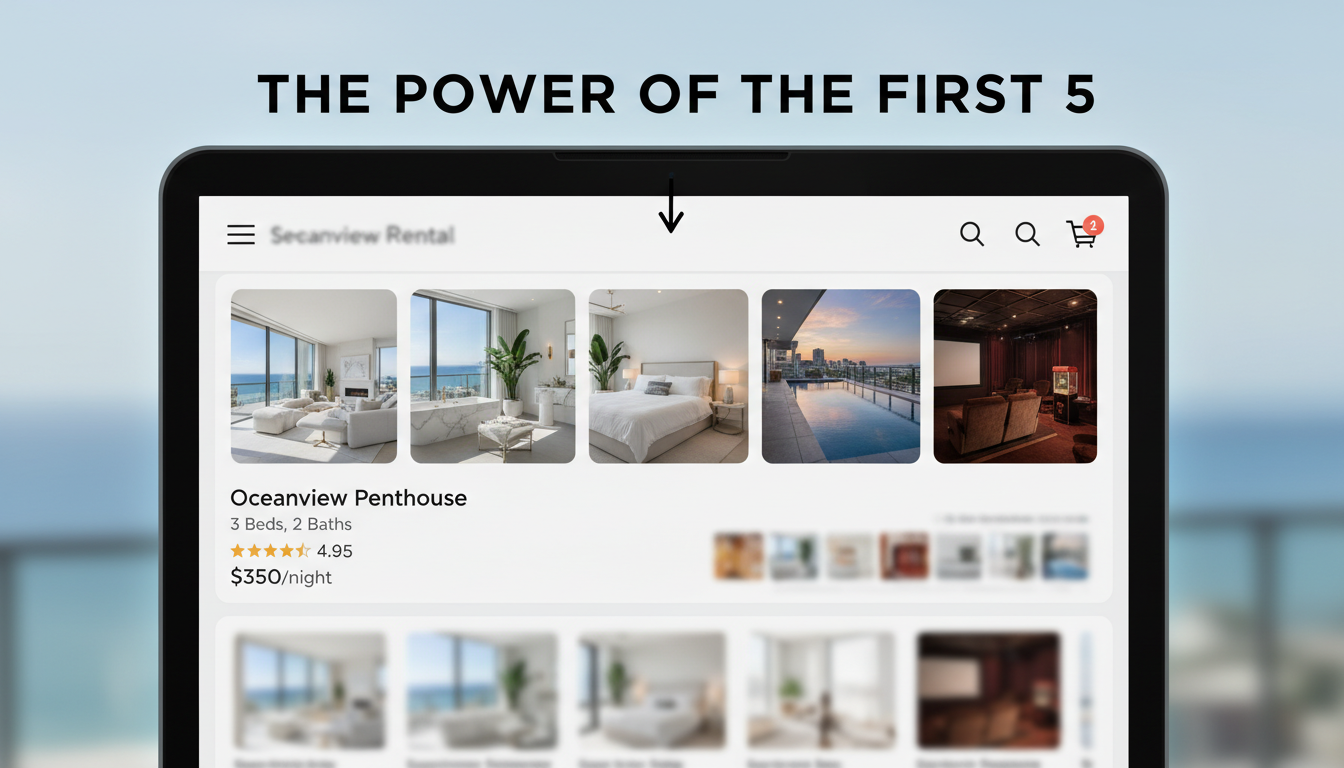
In the context of short-term rentals, guests “shop with their eyes” before they ever read a word of the description. Approximately 80% of potential guests decide whether to engage further with a listing based solely on the first five photos displayed in the search results. This makes the sequencing and quality of these five images the most vital component of a property’s Click-Through Rate (CTR) optimization strategy.
The first photo, the “Hero Shot,” must serve as the definitive hook. It should be bright, well-lit, and showcase the property’s most unique selling point—whether that is a stunning view, a high-end designer living room, or a private swimming pool. Photos 2 and 3 should follow with the primary living spaces, such as the master bedroom and the main seating area, emphasizing comfort and cleanliness. Photos 4 and 5 are reserved for key amenities or unique features, such as a spa-like bathroom, a professional-grade kitchen, or a dedicated workspace for digital nomads.
Shot-Scale Presentation and Consumer Psychology
Research into Airbnb cover photos has identified an interaction effect between the “shot-scale” of a photo and the “regulatory focus” of the consumer. Travelers often approach a search with one of two psychological frameworks: “promotion focus” or “prevention focus”. Promotion-focused guests are seeking pleasure, excitement, and unique experiences; for this group, panoramic or wide-angle cover photos significantly increase click-through and booking intentions because they allow for better “visioning” of the stay.
Prevention-focused guests, however, are primarily concerned with safety, security, and the avoidance of disappointment. For these travelers, close-range photos that clearly show the condition of the space and its cleanliness are more effective. A winning strategy involves using a wide-angle, panoramic “Hero Shot” to capture the promotion-focused market, while utilizing clear, detailed captions and subsequent photos to reassure the prevention-focused segment.
Technical and Aesthetic Standards for 2025
Beyond composition, the algorithm applies technical quality filters to visual assets. Images must be high-resolution (minimum $1024 times 683$ px, though higher is preferred) and shot in a landscape $3:2$ aspect ratio. The platform’s AI is increasingly adept at detecting “unnatural” imagery; over-processed photos with heavy filters, sepia tones, or distorted wide-angle perspectives are penalized as potential accuracy risks.
- Natural Lighting: Shooting during the “golden hour” or when natural light floods the space is paramount, as the algorithm associates bright, natural light with higher quality.
- Decluttering and Depersonalization: Removing personal items like family photos or toothbrushes is essential for allowing guests to envision themselves in the space.
- Seasonal Rotation: Updating photos to reflect the current season (e.g., swapping a photo of a snowy backyard for a summer garden) signals to the algorithm that the host is active and the listing is current.
- Accessibility Documentation: For listings with accessibility features, specific photos of step-free entries, wide doorways, and grab bars are required for verification by specialized Airbnb agents.
Linguistic Engineering: Keyword Strategy and Narrative Conversion
Strategic Keyword Research and Intent Mapping
Keywords in 2025 are no longer just about matching strings; they are about satisfying guest intent. Modern travelers use “plain language” searches such as “pet-friendly Airbnb with fenced yard” or “romantic cabin with hot tub”. To capture this traffic, hosts must conduct multi-layered keyword research.
Title Optimization: The 32-50 Character Window
The listing title is the most valuable piece of text for SEO. While some re-edit interfaces allow for up to 50 characters, the first 32 characters are the most critical, as they are guaranteed to display across all devices without truncation. Effective titles follow a “Formulaic Brilliance” approach: [Unique Feature] + + + [Location/Proximity].
For example, “Modern Loft with Skyline View – 5min to Metro” is significantly more effective than “Nice 2-Bedroom Apartment”. The use of emotive adjectives like “sun-drenched,” “serene,” or “luxurious” can increase the emotional resonance with potential guests, provided they are supported by visual evidence in the BiListing model.
Description Architecture: Skimmability and Narrative Flow
Research confirms that the majority of guests skim descriptions rather than reading them in full. Consequently, descriptions must be structured for rapid consumption. The use of HTML-like formatting, specifically the <b> tag for bolding, allows hosts to create section headings that guide the eye. Descriptions should avoid dense blocks of text, instead utilizing bullet points and short, 2-3 sentence paragraphs.
The narrative should transition from “What” to “Why.” Instead of simply listing a “fully equipped kitchen,” an optimized description might read: “The chef-inspired kitchen features granite countertops and high-end stainless appliances, perfect for preparing a local meal after a day of exploring”. This storytelling approach not only aids in conversion but also provides the algorithm with a richer set of semantic signals to match with guest preferences.
The Mechanics of Profitability: Booking.com’s Ranking Logic
The Expected Profit Formula
In contrast to Airbnb’s community-driven narrative, Booking.com’s algorithm is fundamentally a machine learning-powered system designed to maximize platform profit. The ranking position of a property is heavily influenced by its “Expected Profit”.
$$Expected Profit = (Reservations times Average Selling Price times Commission %) - Acquisition Costs$$
This formula indicates that visibility on Booking.com is a meritocracy of performance and financial contribution. Properties that generate more revenue for the platform—either through high booking volumes, competitive pricing, or by opting into higher commission tiers—are structurally prioritized in search results. The algorithm also considers “Market Demand”; during periods of high local demand, the platform will elevate properties that have the best combination of availability and competitive pricing.
The 2025 Review Score Update: Recency Weighting
One of the most significant shifts on Booking.com in 2025 is the implementation of a “recency-weighted” review scoring system. The platform has recognized that a property’s performance three years ago is not an accurate reflection of its current state. Under the new system, reviews from the most recent 12 months carry the heaviest weight, with a specific focus on the last 90 days.
| Review Age | Weighting Category | Impact on Ranking |
|---|---|---|
| 0 – 3 Months | Critical / Highest | The “Current Report Card”; immediate impact on visibility. |
| 3 – 12 Months | Strong / Heavy | Reflects current consistency and service standards. |
| 12 – 24 Months | Moderate | Provides historical context; impact begins to diminish. |
| 24 – 36 Months | Minimal / Lightest | Outdated information; minimally affects current standing. |
This update represents both a risk and an opportunity. For properties with a strong historical rating that have recently declined in quality, the fall in search rankings will be rapid. For newer properties or those that have recently undergone renovations, this system allows for a “faster recovery,” where a few months of exceptional service can quickly elevate a previously mediocre score.
The Property Page Score and Conversion Efficiency
Booking.com provides hosts with a “Property Page Score,” a metric that evaluates the completeness and quality of the listing content. This score is based on 20+ elements, including:
- Photo Count and Quality: A minimum of 10 high-resolution photos is required, but higher counts (25+) are often correlated with better conversion.
- Room Dimension Accuracy: Detailed room sizes and layouts.
- Facility and Amenity Granularity: Checking every possible box from “free WiFi” to “private entrance”.
Maintaining a 100% Property Page Score can lead to an estimated 18% increase in bookings. Furthermore, the platform tracks a “Reply Score,” which measures the responsiveness of the host to guest inquiries. A high Reply Score (answering within 24 hours, though under 1 hour is ideal) builds trust and is used as a filter by some guests, directly impacting the “Booking Rate”—the percentage of viewers who ultimately make a reservation.
Operational SEO: House Rules, FAQs, and Conflict Mitigation
Structured Clarity as a Quality Signal
House rules and FAQs are often relegated to the bottom of the listing, yet they serve as critical tools for both guest screening and algorithmic quality assessment. On Airbnb, the clarity of house rules is directly linked to the “Acceptance Rate” and “Cancellation Rate”. When rules are ambiguous, it leads to “booking rejections” or “guest-initiated cancellations,” both of which are major negative signals for the search algorithm.
Strategic house rules for 2025 should include:
- Noise Ordinances: Specifying quiet hours (e.g., 10 PM – 7 AM) to prevent neighbor disputes and associated “support needs”.
- Smoking and Vaping: Clearly defining non-smoking zones and potential cleaning fees for violations.
- Pet Policies: Being explicit about types, sizes, and additional fees, which allows the listing to appear in specific “Pet-Friendly” filters.
- Amenity Limitations: Clearly stating the policy for non-essential amenities like hot tubs or WiFi (e.g., “WiFi is a courtesy and not guaranteed for work use”) to manage expectations and prevent negative reviews.
The SEO Value of Guest Q&A
Booking.com’s “Guest Q&A” feature is a powerful tool for capturing long-tail search traffic. When potential guests ask questions like “Is there a grocery store nearby?” or “How far is the beach?”, the host’s public answers become part of the listing’s searchable index. By answering these questions promptly and professionally, hosts not only build trust but also feed the algorithm with high-value, location-specific keywords that might not be in the main description.
Mitigating the “Predicted Support Need” Score
Airbnb’s 2025 algorithm uses LLMs to scan reviews and host-guest communication for “sentiment analysis”. If the algorithm detects a high frequency of keywords like “broken,” “dirty,” “misleading,” or “unresponsive,” it increases the property’s “Support Need Prediction” score. A high score here can suppress a listing’s visibility regardless of its other SEO efforts. Therefore, using the FAQ and House Rules sections to proactively address common friction points is a primary defensive SEO strategy.
Niche Specialization: Accessibility and Categorical Optimization
The Growing Importance of Accessibility Filters
Accessibility has become a major differentiator in the 2025 market. Airbnb has introduced 21 specific accessibility filters, allowing guests to search for features such as “roll-in showers,” “toilet grab bars,” and “step-free bedroom access”. These filters represent an “underserved market,” and listings that verify these features through photographic evidence often find themselves at the top of niche searches with virtually no competition.
| High-Impact Accessibility Upgrades | Estimated Cost (USD) | Algorithmic ROI |
|---|---|---|
| Lever Handle Installation | $15 – $30 per door | High: Simple verification, high guest impact. |
| Portable Threshold Ramps | $100 – $300 | High: Enables step-free entry verification. |
| Grab Bar Installation | $50 – $150 | Moderate: Foundational for accessibility filters. |
| Zero-Threshold Shower | $2,500 – $4,000 | Very High: Commands premium rates in a supply-constrained niche. |
Verification is the key to this strategy. Airbnb’s “Accessibility Review” is a standardized process where specialized agents manually review host-submitted photos of doorways, bathrooms, and entrances against strict criteria (e.g., measuring tapes in photos to prove 32-inch clearances). Hosts who successfully complete this review gain a significant advantage in the “Adapted” category and enhanced search filters.
Categorical Alignment and the “Guest Favorite” Badge
Airbnb Categories (e.g., “Amazing Pools,” “Chef’s Kitchens,” “Ski-in/Ski-out”) are determined by the algorithm’s analysis of photos and descriptions. To qualify for these high-visibility categories, hosts must use “category-specific” keywords and visual cues.
For the “Amazing Pool” category, the algorithm looks for high-resolution images labeled with terms like “infinity pool,” “heated,” or “chlorine-free”. The “Guest Favorite” badge is another critical visibility driver. Awarded to the top 1%, 5%, or 10% of properties based on consistent quality and reliability, this badge acts as a powerful psychological trust signal for guests and is used as a filter in many searches. Achieving this requires a near-perfect review score (typically 4.9+) and a low cancellation rate.
Comparative Strategic Paradigms: Platforms as Cultural Entities
Airbnb: The Design and Emotional Ecosystem
The Airbnb algorithm in 2025 is optimized for “storytelling and design“. It rewards properties that feel personal, local, and unique. This is reflected in its “Personalized Search Conversation” AI, which allows guests to use natural language like “Find me a cozy cabin near Lisbon for under $400”. Success on Airbnb requires a focus on “Brand Soul“—the emotional connection between the host’s narrative and the guest’s aspirations.
Booking.com: The Scalable and Standardized Engine
Booking.com is an engine of “scale and transaction“. Its algorithm favors standardized excellence, predictable service, and instant availability. The “Genius” loyalty program and “Preferred Partner” status are central to this ecosystem; they offer properties special tagging and ranking boosts (up to 45% increase in bookings) in exchange for discounts or higher commissions. Optimization here is more clinical, focusing on “Conversion-to-Impression” ratios and “Average Daily Rate” (ADR) competitiveness.
| Platform Philosophy | Core Ranking Driver | Optimal Host Strategy |
|---|---|---|
| Airbnb | Predicted Satisfaction & Story | High-design, emotive photos, personal interaction. |
| Booking.com | Expected Profit & Efficiency | Dynamic pricing, instant book, program participation. |
The Strategic Path to Ranking Dominance in 2025
The 2025 short-term rental market is an arena of algorithmic sophistication. Achieving and maintaining high search visibility is no longer a matter of intuition, but of systematic optimization across multiple vectors. The synthesis of behavioral data, multimodal AI, and performance-based ranking dictates a clear set of imperatives for the professional host:
- Audit Visual Assets via BiListing: Ensure that photos are not only high-quality but semantically aligned with every claim in the description. The algorithm’s ability to detect discrepancies is a primary risk to visibility.
- Master the Review Recency Cycle: On Booking.com, prioritize the guest experience of the next 90 days over the prestige of the past three years. The “Weighted Recency” system ensures that your latest performance is your only performance.
- Incorporate Operational SEO: Treat House Rules and FAQs as tools for “Predicted Support Need” mitigation. Proactively addressing guest friction points is a high-impact, low-cost way to protect your ranking from algorithmic penalties.
- Capitalize on Niche Filters: The 21 new accessibility filters on Airbnb offer a “blue ocean” strategy. Verification of even minor features like lever handles can unlock access to highly loyal, underserved guest segments.
- Implement a Hybrid Platform Strategy: Apply the transactional precision of Booking.com (availability management, program participation) to the brand-led storytelling of Airbnb. This balanced approach ensures high occupancy across different traveler demographics.
By understanding the underlying mechanisms of these search engines—from the “Expected Profit” formula to the multimodal embeddings of BiListing—hosts can transition from reactive listing maintenance to proactive, strategic market leadership. The future of STR success lies in the ability to satisfy the machine’s thirst for data and the guest’s desire for a seamless, high-quality experience.
