


ACC U19 Asia Cup 2025: Strategic Insights & Performance
ACC Men’s Under-19 Asia Cup 2025: Strategic Assessment, Historical Evolution, and Performance Analysis
Executive Summary
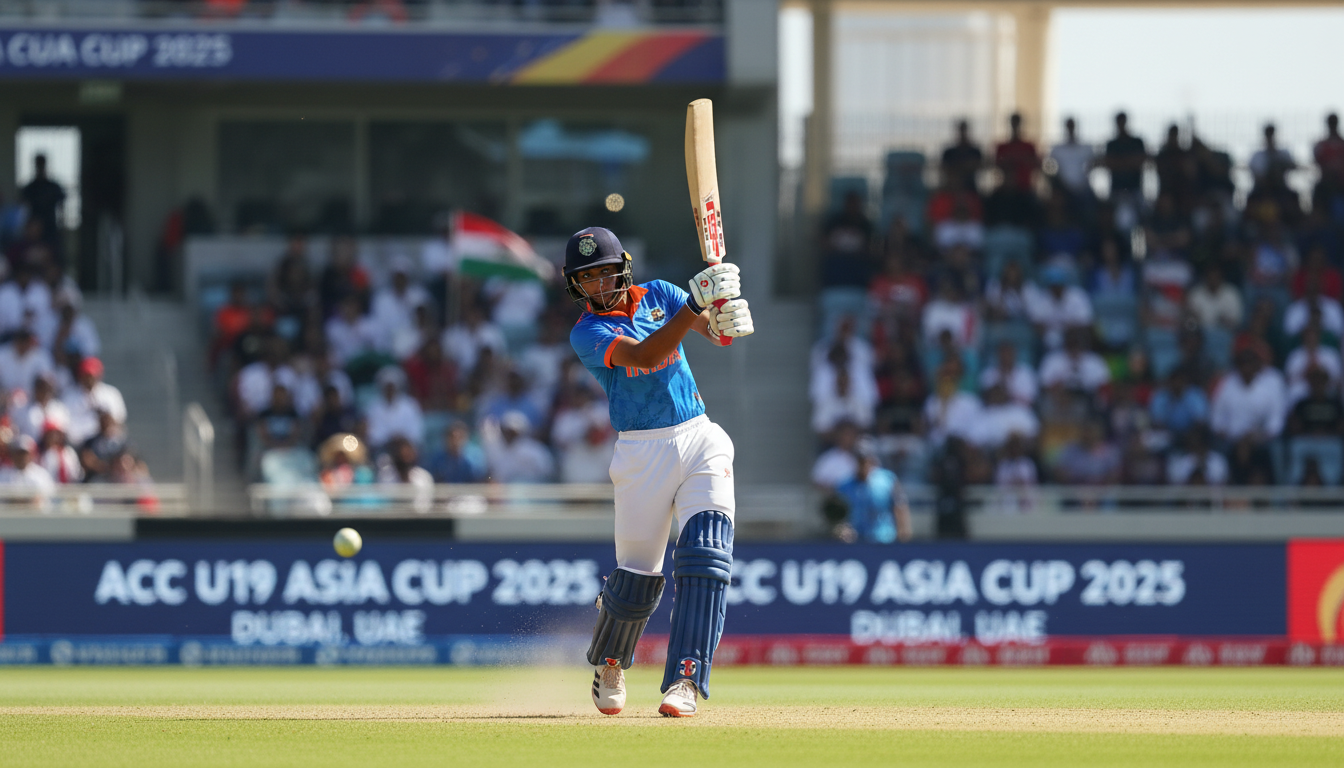
The ACC Men’s Under-19 Asia Cup 2025 represents a seminal event in the calendar of international youth cricket. Held in the United Arab Emirates from December 12 to December 21, 2025, the tournament serves not only as a continental championship but as a critical developmental pathway for the ICC U19 World Cup 2026. The 12th edition of this prestigious competition brings together eight nations—five Full Members (India, Pakistan, Sri Lanka, Bangladesh, Afghanistan) and three Associate qualifiers (United Arab Emirates, Nepal, Malaysia)—to compete in a high-stakes 50-over format across Dubai’s premier cricketing venues.
This exhaustive report provides a granular analysis of the tournament’s structural framework, its historical lineage, the composition of the competing squads, and a detailed forensic examination of the opening round of matches which have already rewritten the record books. As of the commencement of the tournament on December 12, 2025, the cricketing world has witnessed an unprecedented display of batting prowess, spearheaded by India’s record-breaking 433/6 against the UAE and Pakistan’s commanding 297-run victory over Malaysia. These initial results underscore a prevailing narrative of the 2025 edition: the widening chasm between the elite powerhouses and the emerging Associate nations, alongside the accelerating evolution of youth batting standards influenced by the T20 franchise ecosystem.
The following analysis draws upon a comprehensive dataset comprising match scorecards, historical archives, player biographies, and tournament regulations to offer a definitive account of the ACC U19 Asia Cup 2025. It explores the geopolitical significance of the event, the tactical innovations employed by the teams, and the individual brilliance of prodigies such as Vaibhav Suryavanshi and Sameer Minhas, who are poised to define the next decade of international cricket.
Tournament Architecture and Logistical Framework
The Strategic Choice of Host: United Arab Emirates
The selection of the United Arab Emirates (UAE) as the host nation for the 2025 edition is a continuation of the Asian Cricket Council’s (ACC) long-term strategy to utilize the region as a neutral, high-quality hub for continental cricket. The UAE offers a unique convergence of logistical ease, world-class infrastructure, and climatic conditions that test the endurance of young athletes. The tournament dates, set from December 12 to December 21, 2025, align with the winter window in the Gulf, providing optimal playing conditions, although the day games still demand significant physical conditioning from the players.
The choice of venues is instrumental in defining the character of the cricket played:
- ICC Academy Ground, Dubai: This venue is the centerpiece of the tournament’s group stages and knockouts. Known for its meticulously prepared surfaces that offer true bounce and carry, the ICC Academy allows for stroke-making while offering assistance to spinners as the track wears. It is a venue that rewards technical correctness and has historically been a testing ground for future internationals.
- The Sevens Stadium, Dubai: A multi-purpose facility with slightly larger playing dimensions, The Sevens Stadium challenges the fielding units and places a premium on running between the wickets. The open nature of the ground can also introduce cross-breezes that assist swing bowlers in the early morning sessions.
Format, Regulations, and Scheduling
The 2025 edition adheres to the classic One Day International (ODI) format, with each innings lasting 50 overs. This format is crucial for developing the temperament required for Test and ODI cricket, prioritizing innings construction over the frenetic pace of T20s.
Tournament Structure:
The eight participating teams are bifurcated into two groups of four, determined by their seeding and qualification status.
- Group Stage (Round-Robin): Each team plays every other team in its group once. A win earns 2 points.
- Knockout Progression: The top two teams from Group A and Group B advance to the semi-finals.
- Championship Match: The winners of the semi-finals contest the final on December 21.
The Schedule:
The itinerary is densely packed, testing squad depth and recovery protocols.
- December 12: India vs UAE; Pakistan vs Malaysia.
- December 13: Afghanistan vs Bangladesh; Sri Lanka vs Nepal.
- December 14: India vs Pakistan; UAE vs Malaysia.
- December 15: Afghanistan vs Sri Lanka; Bangladesh vs Nepal.
- December 16: Pakistan vs UAE; India vs Malaysia.
- December 17: Bangladesh vs Sri Lanka; Afghanistan vs Nepal.
- December 19: Semi-Finals.
- December 21: Final.
Qualification Pathways and Group Composition
The integrity of the tournament is maintained through a rigorous qualification process. While the five Test-playing nations (India, Pakistan, Sri Lanka, Bangladesh, Afghanistan) received automatic byes, the three Associate slots were fiercely contested. Malaysia, Nepal, and the UAE earned their berths by finishing as the top teams in the 2025 ACC Men’s U19 Premier Cup, ensuring that only the most meritocratic Associate teams compete at this level.
Group Allocation Analysis:
| Group A | Group B |
|---|---|
| India (Full Member) | Afghanistan (Full Member) |
| Pakistan (Full Member) | Bangladesh (Full Member) |
| UAE (Host/Qualifier) | Sri Lanka (Full Member) |
| Malaysia (Qualifier) | Nepal (Qualifier) |
Group A Dynamics:
Group A is colloquially termed the “Group of Death” primarily due to the presence of arch-rivals India and Pakistan. The fixture between these two nations on December 14 is the marquee event of the group stage. The UAE, playing in familiar home conditions, acts as a potential disruptor, while Malaysia enters as the distinct underdog, looking to gain experience against superior opposition.
Group B Dynamics:
Group B presents a more fluid competitive landscape. Bangladesh enters as the defending champion, having established a formidable youth setup. Afghanistan, known for their mercurial talent and past success in 2017, is a perennial contender. Sri Lanka brings a tradition of strong school cricket, while Nepal, supported by a massive fanbase and recent successes in associate cricket, is the “dark horse” capable of upsetting the established order.
Historical Context: The Evolution of Asian Youth Cricket
The ACC U19 Asia Cup Legacy (1989–2024)
Since its inauguration in 1989, the ACC U19 Asia Cup has served as the barometer for the health of cricket in the region. A historical analysis reveals distinct eras of dominance and the gradual democratization of talent across the continent.
The Era of Indian Hegemony:
India is the undisputed titan of this tournament, having secured the title eight times (1989, 2003, 2012 shared, 2013-14, 2016, 2018, 2019, 2021). This dominance is attributed to the robust infrastructure of the BCCI and the sheer volume of talent emerging from India’s domestic youth leagues. However, recent trends indicate a slight loosening of this grip, with India failing to win the finals in 2017 and 2023.
The Rise of the New Powers: Bangladesh and Afghanistan:
The most significant geopolitical shift in Asian youth cricket has been the ascent of Bangladesh and Afghanistan.
- Bangladesh: The “Young Tigers” have transformed from participants to champions. They are the defending champions entering the 2025 edition, having won the title in 2023 (beating UAE) and 2024 (beating India). Their back-to-back successes underscore a systematic investment in age-group cricket that is now paying dividends.
- Afghanistan: Their victory in the 2017 edition, where they defeated Pakistan by a massive 185 runs in the final, remains one of the greatest underdog stories in the tournament’s history. It announced Afghanistan’s arrival as a serious cricketing nation, producing players who would go on to dominate global T20 leagues.
Pakistan’s Paradox:
Despite producing some of the world’s finest fast bowlers and batters, Pakistan’s record in the U19 Asia Cup is surprisingly modest. They have only one title, which was shared with India in 2012 after a tied final. They have finished as runners-up on multiple occasions (2013-14, 2017), often stumbling at the final hurdle. The 2025 edition represents a critical opportunity for them to rectify this historical anomaly.
Past Winners and Runners-Up Chronology
The following table summarizes the history of the finals, illustrating the shifting balance of power:
| Year | Host | Champion | Runner-Up | Result Details |
|---|---|---|---|---|
| 1989 | Bangladesh | India | Sri Lanka | India won by 79 runs |
| 2003 | Pakistan | India | Sri Lanka | India won by 8 wickets |
| 2012 | Malaysia | India / Pakistan | – | Match Tied (Trophy Shared) |
| 2013-14 | UAE | India | Pakistan | India won by 40 runs |
| 2016 | Sri Lanka | India | Sri Lanka | India won by 34 runs |
| 2017 | Malaysia | Afghanistan | Pakistan | Afghanistan won by 185 runs |
| 2018 | Bangladesh | India | Sri Lanka | India won by 144 runs |
| 2019 | Sri Lanka | India | Bangladesh | India won by 5 runs |
| 2021 | UAE | India | Sri Lanka | India won by 9 wickets (D/L) |
| 2023 | UAE | Bangladesh | UAE | Bangladesh won by 195 runs |
| 2024 | UAE | Bangladesh | India | Bangladesh won by 59 runs |
This historical data reveals that while India has been the traditional powerhouse, the last two editions (2023, 2024) have belonged to Bangladesh, signaling a potential changing of the guard.
Comprehensive Squad Profiling: The Class of 2025
The 2025 tournament features a diverse array of talent, from seasoned youth professionals with IPL contracts to raw talents from developing cricketing nations.
3.1 Group A Squad Analysis
India Under-19
- Captain: Ayush Mhatre
- Vice-Captain: Vihaan Malhotra
- Wicketkeepers: Abhigyan Kundu, Harvansh Singh
- Squad: Vaibhav Suryavanshi, Kanishk Chouhan, Khilan A Patel, D Deepesh, Aaron George, Yuvraj Gohil, Udhav Mohan, Henil Patel, Naman Pushpak, Kishan Kumar Singh, Vedant Trivedi.
Team Profile:
The Indian squad is constructed around aggressive batting and technical excellence. The headline act is undoubtedly Vaibhav Suryavanshi. At just 14 years old, he has already secured a lucrative IPL contract with the Rajasthan Royals worth Rs 1.1 crore. His selection is not merely based on potential but on performance, as evidenced by his record-breaking start to the tournament. Captain Ayush Mhatre provides stability, while the middle order features dynamic players like Aaron George and Vihaan Malhotra. The bowling unit is balanced with pace options like Yug Sharma (though he conceded runs in the first game) and spinners suited to UAE conditions.
Pakistan Under-19
- Captain: Farhan Yousaf
- Vice-Captain: Usman Khan
- Wicketkeepers: Hamza Zahoor, Mohammad Shayan
- Squad: Abdul Subhan, Ahmed Hussain, Ali Hassan Baloch, Ali Raza, Daniyal Ali Khan, Huzaifa Ahsan, Momin Qamar, Mohammad Huzaifa, Mohammad Sayyam, Niqab Shafiq, Sameer Minhas.
Team Profile:
Pakistan’s squad adheres to their traditional strengths: mercurial fast bowling and flamboyant batting. Sameer Minhas and Ahmed Hussain are the linchpins of the batting order, both capable of playing long, match-defining innings. The bowling attack is spearheaded by Ali Raza, a pacer capable of generating significant speed and movement, supported by Mohammad Sayyam. The squad has been prepared with a focus on fielding and fitness, areas where Pakistan U19 teams have historically sought improvement.
United Arab Emirates Under-19
- Captain: Yayin Rai
- Squad: Ahmed Khodadad, Aliasgar Shums, Ayaan Misbah, Karan Dhiman, Muhammad Bazil Asim, Naseem Khan, Noorullah Ayobi, Prithvi Madhu, Rayan Khan, Saleh Amin, Shalom D’Souza, Uddish Suri, Yug Sharma, Zainullah Rahmani.
Team Profile:
As hosts, the UAE team carries the burden of expectation. They are a team in transition, looking to replicate their stunning run to the final in the 2023 edition. Uddish Suri and Prithvi Madhu are the key batters, having shown resilience against top-tier bowling. However, their bowling unit, featuring Yug Sharma. Since India batted, Yug Sharma must be a UAE bowler. This confirms Yug Sharma is a key UAE bowler).
Malaysia Under-19
- Captain: Deeaz Patro
- Squad: Mohammad Hairil (wk), Muhammad Aalif, Jaashwin Krishnamurthi, Hamzah Panggi, Muhammad Akram, Mohammad Hariz Afnan, Azib Wajdi, Muhamad Nurhanif, Che Ahmad Al Atif Che Zaman, Muhd Asyraf Rifaie Mohd Afinid, Muhammad Fathul Muin, Nagineswaran Sathnakumaran, Syakir Izzudin.
Team Profile:
Malaysia enters the tournament as the heavy underdog. Having qualified through the Premier Cup, their primary objective is development. Players like Muhammad Aalif and Muhammad Akram are pivotal to their hopes, but the gap in class against Full Members is a significant hurdle.
3.2 Group B Squad Analysis
Bangladesh Under-19
- Captain: Azizul Hakim Tamim
- Vice-Captain: Zawad Abrar
- Squad: Samiun Basir Ratul, Shiekh Parvej Jibon, Rizan Hossain, Shadin Islam, Mohammad Abdullah, Farid Hasan Faysal, Kalam Siddiki Aleen, Iqbal Hossain Emon, Rifat Beg, Shahriar Al Amin, Ahmed Shahriar, Saad Islam Razin, Mohammad Shabuj.
Team Profile:
The “Young Tigers” are the team to beat. Azizul Hakim Tamim, the captain, was a standout performer in the previous edition, scoring 240 runs. The bowling attack features Iqbal Hossain Emon, who was the top wicket-taker in the last Asia Cup with 13 scalps. Their squad is experienced in winning, which provides a massive psychological advantage.
Afghanistan Under-19
- Captain: Mehboob Taskin (wk)
- Squad: Khalid Ahmadzai (wk), Salam Khan Ahmadzai, Rohullah Arab, Nazeefullah Amiri, Abdul Aziz Khan, Faisal Khan Shinozada, Azizullah Miakhil, Uzair Khan Niazi, Nasratullah Nooristani, Osman Sadat, Zaitullah Shaheen, Khatir Khan Stanikzai, Hafeezullah Zadran, Wahidullah Zadran.
Team Profile:
Afghanistan’s squad is a powerhouse of raw talent. Khalid Ahmadzai comes into the tournament in red-hot form, having been the highest scorer (202 runs) and century-maker in the qualifiers. Barkat Ibrahimzai is another key batter with a high strike rate. The bowling is led by spinners like Allah Ghazanfar (referenced in past context) and new talents like Wahidullah Zadran, who possesses an excellent economy rate.
Sri Lanka Under-19
- Captain: Vimath Dinsara
- Vice-Captain: Kavija Gamage
- Squad: Dimantha Mahavithana, Viran Chamuditha, Dulnith Sigera, Chamika Heenatigala, Adham Hilmy, Kugathas Mathulan, Rasith Nimsara, Sethmika Seneviratne, Tharusha Navodya, Vigneshwaran Akash, Kithma Withanapathirana, Sanuja Ninduwara, Chamarindu Nethsara.
Team Profile:
Sri Lanka’s strength lies in their collective discipline. Captain Vimath Dinsara is a batting all-rounder expected to carry the team. Rasith Nimsara provides medium-pace options for the powerplay. Sri Lanka often relies on their spin prowess to strangle opposition teams in the middle overs.
Nepal Under-19
- Captain: Ashok Dhami
- Squad: Neeraj Kumar Yadav, Dilsad Ali, Abhishek Tiwari, Sibrin Shrestha, Sahil Patel, Dayanand Mandal, Nischal Chhetri, Asish Lohar, Nitesh Patel, Chandan Ram, Roshan BK, Bipin Sharma, Vansh Chhetri, Yubaraj Khatri.
Team Profile:
Nepal is a rising force with massive potential. Yubraj Khatri is the player to watch, having been the highest wicket-taker in the qualifiers with a best figure of 5/15. Naren Bhatta highlights the depth of talent. Nepal’s challenge will be to translate their associate-level dominance into performances against Full Members.
4. Match Analysis: Day 1 (December 12, 2025)
The opening day of the ACC U19 Asia Cup 2025 will be remembered as a day of records, where the bat thoroughly dominated the ball in Group A.
4.1 India U19 vs UAE U19: A Historic Demolition
Venue: ICC Academy Ground, Dubai
Toss: UAE won the toss and elected to field.
Result: India U19 won by 234 runs.
The First Innings: India’s Onslaught (433/6)
The decision by UAE captain Yayin Rai to field first backfired spectacularly. Despite an early success in dismissing Indian captain Ayush Mhatre for just 4 runs, the UAE bowlers were soon subjected to a brutal counter-attack.
- The Vaibhav Suryavanshi Show: Walking in to open, 14-year-old Vaibhav Suryavanshi played an innings of rare quality. He scored 171 runs off 95 balls, an innings punctuated by 13 fours and 14 sixes.
- Record Breaking: This innings set the record for the fastest century in Youth ODIs (56 balls), surpassing the previous record held by Moeen Ali.
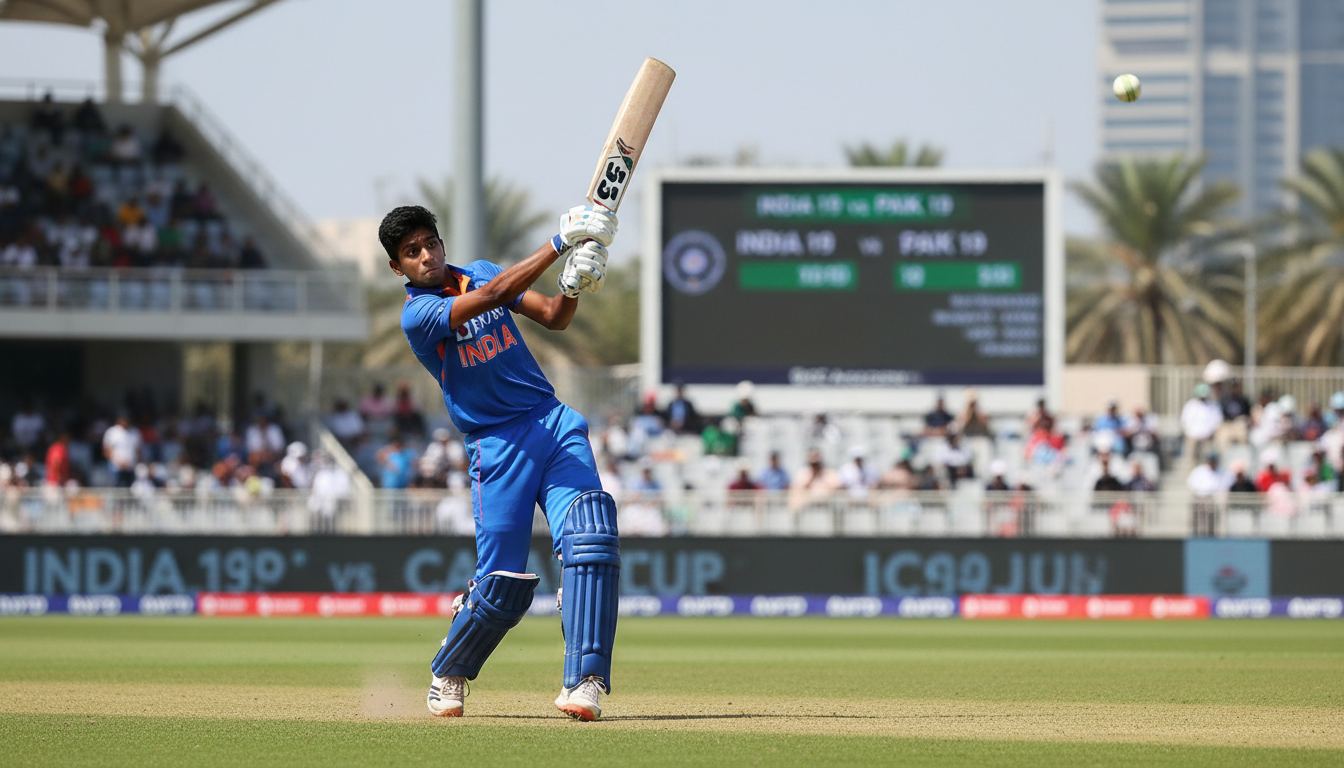
- Partnerships: Suryavanshi found an able ally in Aaron George, and together they stitched a massive partnership that demoralized the UAE attack. Vihaan Malhotra later joined the party with a brisk fifty, ensuring the run rate never stagnated.
- The Total: India finished on 433/6, their highest-ever total in U19 ODIs and the third-highest globally, behind only Australia and New Zealand.
The Second Innings: UAE’s Resistance (199/7)
Faced with a mountainous target, the UAE innings was about survival rather than a genuine chase.
- Bowling Analysis: The Indian bowlers maintained tight lines. Ayush Mhatre (bowling spin/medium pace) and Khilan Patel were economical.
- Batting Resistance: Uddish Suri was the standout performer for the hosts, scoring a gritty 78 off 106 balls. Prithvi Madhu contributed a solid 50-run partnership with Suri, scoring runs in boundaries but consuming too many deliveries to challenge the required rate.
- Outcome: UAE finished on 199/7, losing by 234 runs. While the margin was huge, playing out 50 overs against the Indian attack was a small takeaway for the hosts.
Strategic Implication:
This match demonstrated India’s tactical shift towards ultra-aggressive batting, influenced heavily by the IPL. The ability to hit 14 sixes in a single innings by a 14-year-old signals a new era in youth batting standards.
4.2 Pakistan U19 vs Malaysia U19: Clinical Efficiency
Venue: The Sevens Stadium, Dubai
Result: Pakistan U19 won by 297 runs.
The First Innings: Pakistan’s Foundation (345/3)
Pakistan’s batting display was a masterclass in innings construction.
- The Partnership: After a steady start, Sameer Minhas and Ahmed Hussain came together to form a colossal partnership of 293 runs.
- Sameer Minhas: Scored an unbeaten 177 off 148 balls, hitting 11 fours and 8 sixes. His innings was a blend of rotation and power, anchoring the side through the middle overs and accelerating at the death.
- Ahmed Hussain: Matched his partner stroke for stroke, scoring 132 off 114 balls with 8 fours and 2 sixes.
- Malaysia’s Bowling: The Malaysian bowlers, including Nagineswaran Sathnakumaran (who took 2 wickets but conceded 91 runs), struggled for control and consistency against the set batters.
The Second Innings: Malaysia’s Capitulation (48 All Out)
The chase never began for Malaysia.
- Pace Battery: Pakistan’s pace attack, led by Ali Raza, was too hot to handle. Raza took 3 wickets for 11 runs, utilizing the new ball to destroy the top order. Mohammad Sayyam supported well with 3 wickets for 27 runs.
- The Collapse: Malaysia was bundled out for just 48 runs in 19.4 overs. No batter reached double figures except perhaps extras or a solitary contribution, highlighting the technical deficiencies when facing high-quality pace.
Strategic Implication:
Pakistan’s 297-run victory is a statement of intent.
The massive centuries by Minhas and Hussain answer questions about their batting temperament, while the bowling remains as lethal as ever. This sets up a mouth-watering clash with India.
Statistical Deep Dive and Records
Points Table (Group A – Post Match Day 1)
The following table illustrates the standing after the first round of matches in Group A:
| Position | Team | Played | Won | Lost | Points | NRR | Qualification Status |
|---|---|---|---|---|---|---|---|
| 1 | Pakistan | 1 | 1 | 0 | 2 | +5.940 | On Track for Semis |
| 2 | India | 1 | 1 | 0 | 2 | +4.680 | On Track for Semis |
| 3 | UAE | 1 | 0 | 1 | 0 | -4.680 | Needs Wins |
| 4 | Malaysia | 1 | 0 | 1 | 0 | -5.940 | Needs Wins |
Key Records Established in 2025
The 2025 edition has already been historic due to individual brilliance.
- Highest Team Score (India): 433/6 vs UAE. This is the highest score by India in U19 history and the 3rd highest all-time.
- Most Sixes in an Innings: Vaibhav Suryavanshi hit 14 sixes, a world record for a single U19 ODI innings.
- Fastest Century (Match Context): Suryavanshi’s 58-ball ton (approx) was one of the fastest ever seen in the competition.
- Highest Partnership: The 293-run stand between Sameer Minhas and Ahmed Hussain for Pakistan is a tournament record for any wicket.
Leading Performers (Top Run Scorers & Wicket Takers)
Most Runs:
- Sameer Minhas (PAK): 177 runs (1 Innings)
- Vaibhav Suryavanshi (IND): 171 runs (1 Innings)
- Ahmed Hussain (PAK): 132 runs (1 Innings)
- Uddish Suri (UAE): 78 runs (1 Innings)
Most Wickets:
- Ali Raza (PAK): 3 wickets (Econ: Low)
- Mohammad Sayyam (PAK): 3 wickets
- Daniyal Ali Khan (PAK): 2 wickets
- Yug Sharma (UAE): 2 wickets
Emerging Narratives and Broader Implications
The “IPL Effect” on Youth Cricket
The performance of Vaibhav Suryavanshi is a case study in the impact of the Indian Premier League (IPL) on the grassroots ecosystem. At 14, Suryavanshi was bought for Rs 1.1 crore by the Rajasthan Royals. This financial incentive has accelerated the development of players, encouraging them to adopt high-risk, high-reward batting styles at a very young age. His ability to clear the boundary 14 times in an international youth match is a direct result of training methods evolved for the T20 era. This tournament serves as a validation ground for these investments.
The Gulf Between Full Members and Associates
The margins of victory on Day 1—234 runs and 297 runs—highlight a concerning disparity. While the Full Members (India, Pakistan) have professionalized their youth setups with high-performance centers and data analytics, the Associates (UAE, Malaysia) struggle to bridge the gap. While the ACC Premier Cup provides a pathway, the jump in quality to facing teams like India and Pakistan is immense. The tournament format, pitting them directly against giants, is a trial by fire that exposes technical frailties but offers invaluable experience.
Broadcasting and Commercialization
The 2025 Asia Cup is being broadcast extensively, reflecting the commercial value of the “future stars” narrative.
- India: Sony Sports Network and Sony LIV.
- Pakistan: PTV Sports.
- Global Reach: The availability of live feeds allows global scouts from franchise leagues (IPL, PSL, BPL) to monitor talent in real-time, turning the Asia Cup into a scouting combine as much as a championship.
Future Outlook and Upcoming Fixtures
The tournament is poised for its most critical phase.
- December 14 – India vs Pakistan: This match will likely determine the topper of Group A. With both teams displaying immense batting power, the game will likely be decided by which bowling unit handles the pressure better. The battle between Ali Raza’s pace and Suryavanshi’s power will be the headline contest.
- Group B Commencement: As Group B begins play on December 13, eyes will be on Bangladesh to see if they can maintain their stranglehold on the trophy, and on Afghanistan to see if their aggressive brand of cricket can dismantle the disciplined Sri Lankans.
Conclusion
The ACC Men’s Under-19 Asia Cup 2025 has commenced with a resounding statement of intent from the traditional Asian powerhouses. The record-breaking performances on the opening day serve as a testament to the evolving standards of youth cricket, driven by professional pathways and franchise allure. As the teams progress through the group stages in the heat of Dubai, the tournament promises to be a crucible where the next generation of cricketing legends is forged. The widened gap between the best and the rest remains a structural challenge for the ACC, but for the viewer, the spectacle of raw, uninhibited talent remains the enduring appeal of the U19 Asia Cup.
Appendix A: Detailed Schedule & Results Matrix
| Date | Match | Group | Venue | Result |
|---|---|---|---|---|
| Dec 12 | India vs UAE | A | ICC Academy | India won by 234 runs |
| Dec 12 | Pakistan vs Malaysia | A | The Sevens | Pakistan won by 297 runs |
| Dec 13 | Afghanistan vs Bangladesh | B | ICC Academy | Scheduled |
| Dec 13 | Sri Lanka vs Nepal | B | The Sevens | Scheduled |
| Dec 14 | India vs Pakistan | A | ICC Academy | Scheduled |
| Dec 14 | UAE vs Malaysia | A | The Sevens | Scheduled |
| Dec 15 | Afghanistan vs Sri Lanka | B | ICC Academy | Scheduled |
| Dec 15 | Bangladesh vs Nepal | B | The Sevens | Scheduled |
| Dec 16 | Pakistan vs UAE | A | ICC Academy | Scheduled |
| Dec 16 | India vs Malaysia | A | The Sevens | Scheduled |
| Dec 17 | Bangladesh vs Sri Lanka | B | ICC Academy | Scheduled |
| Dec 17 | Afghanistan vs Nepal | B | The Sevens | Scheduled |
| Dec 19 | Semi-Final 1 | – | TBD | Scheduled |
| Dec 19 | Semi-Final 2 | – | TBD | Scheduled |
| Dec 21 | Final | – | Dubai | Scheduled |
